

The Narrow Path 06/04/2026


Enjoy this program with Steve Gregg from The Narrow Path Radio.
Steve Gregg: Good afternoon and welcome to the Narrow Path radio broadcast. My name is Steve Gregg and we're live for an hour each weekday afternoon, taking your calls if you have questions about the Bible or the Christian faith. That's what we're here to talk about. If you want to call in, you can call in and ask any question you wish. That doesn't mean I know all the answers, by the way, but we can certainly discuss it and probably at more than a shallow level, which is nice sometimes.
You can call me if you have a disagreement also with the host, that is me, if you've heard me say something you don't care for, you don't believe is correct. You're always welcome to call and tell us why. The number to call is 844-484-5737. I'm looking at two open lines on our switchboard, which is an opportunity for you right now to call in: 844-484-5737. And a few announcements, not much.
Tonight I'm speaking. I've been announcing earlier in the week that I'm speaking at a church in Pede, Oregon. And I'm actually sitting in that church in Pede, Oregon right now in their office doing the show. But this is not where I'm speaking. They are the ones who invited me, but it's going to be at a meeting in a home and that's technically in Monmouth, but pretty close to Pede. Anyway, if you are in that area and want to join us, you go to our website, thenarrowpath.com, and look under announcements. You'll find how to contact the homeowner and find out how to get there.
Now, the same is true of all the places I'll be speaking in the next two weeks, I'd say. I'm going to be speaking in the Seattle area for like eight days. I'll be beginning this Sunday. I'm going to be speaking in Spokane after that. I'm going to be speaking in Idaho a couple of places. Not all of those have been nailed down yet, but that's more than a week from now, closer to two weeks from now. But the things that we have established and set up are at our website, thenarrowpath.com. And if you live in Seattle or Spokane or Idaho, feel free to look at the website and see where those meetings are going to be and you can join us. All right, now we're going to go to the phones and talk to Sean in Santa Cruz, California, where I lived for many years myself. Hi Sean, welcome.
Sean: Hey Steve, good to talk to you. I had a question about the end of Revelation and in regards to the timing of when it's supposed to take place. I wasn't sure if it was contingent on where society stands or his creation stands in regards to the amount of good or evil that exists in the world. Or in other words, does there need to be a certain amount of good and evil in order for him to return and does it determine when God is ready or does God decide to move certain chess pieces for things to unfold?
Steve Gregg: Well, are you saying is there a set time that's set in stone and that's when Jesus is going to come back or is that contingent on the condition of the world? Is that what you're asking?
Sean: Yeah, that's the question.
Steve Gregg: Okay. Well, it's interesting because Peter in 2 Peter chapter 3 says that we should be hastening the coming of the day of God. No place else in the Bible uses that kind of language for it, but it sounds like Peter's saying that things we can do and changes that can be made that are on us to do may bring about the second coming sooner than it otherwise would be. So it sounds like there is some kind of final state of affairs that God is waiting for and that we have a role to play in bringing it about.
Now, when it comes to the state of the world, I don't really know of anything in the Bible that tells us anything about the state of the world or how the world has to be when Jesus comes back. Some people take what Jesus said about the days of Noah, they say as it was in the days of Noah, so will it be in the days of the coming of the Son of Man. But actually, he's not actually describing the way the world would be.
He's saying that just like it was in the days of Noah, people will be living their lives, eating and drinking, getting married, buying and selling things as if nothing is going to happen, and it'll catch them totally by surprise just like it took the people by surprise the flood did. So will the coming of Christ, which means not that the world has to be in a certain state, but that just as most people don't expect Jesus to come right now and they're going about their business normally as if he's not coming, well, it'll be like that the day he does come, too. So it's simply talking about the obliviousness of the world at the moment that he's going to come.
Some people think, well, the days of Noah were days of great corruption. The Old Testament says the earth was filled with violence and the thoughts of and intents of men's hearts was only evil continually, and that is true. The Bible does say that in Genesis. But Jesus did not say that those are the ways in which the days before his coming will resemble the days of Noah. I mean, there's many things that could be said about the days of Noah. No doubt since Noah lived 900 years there’s probably a lot of things happened.
Jesus could, if this is what he wanted to say, Jesus could have said it'll be like the days of Noah. People were committing adultery, they were murdering each other, they were raping, they were cheating each other, they were robbing and, you know, because those things are no doubt true. Those things were happening in the days of Noah. But Jesus didn't mention those.
He said it'll be like the days of Noah when people were eating and drinking, which is by the way a very innocent thing to do, getting married, which is also an innocent thing to do, buying and selling, which is for the most part an innocent thing to do. In other words, all the things that Jesus mentioned people will be doing are innocent things. He's not describing the moral condition being like the days of Noah. He could have, and it would have been easy enough to do so.
In fact, also in Luke 17, he also spoke it'll be like the days of Lot and when he left Sodom. And again, it's saying the same thing: they were eating and drinking, doing normal stuff and then the fire came down. He didn't say they were, you know, committing homosexual acts and things like that, which we know they were.
In other words, when Jesus likens his coming to the destruction of Sodom or like the coming of the flood in Noah's day, he's not saying that society will resemble the societies that were judged there, though they might. He's not saying they won't, he's not saying they will. He's saying nothing about that. He's simply saying those societies when they came under judgment were oblivious. They had no idea that judgment was going to hit them that day and they just went on with their normal business. So that doesn't really tell us anything about the geopolitical things going on or the moral condition of the world. It just tells us Jesus will come as he put it at a time when you're not expecting him.
So, but why doesn't Jesus come back now? If there's something he's waiting for, what is it? Well, I don't think he's given us any information about what he's expecting the world to be like, but he has given us information about what he expects the church to be like. And if you want to look at, you know, indicators that maybe the coming of the Lord is near or not, you might be looking at the church, because that's the project that God's been working on.
It's because of the church and its mission not yet being completed that he hasn't pulled us out, I believe. I mean, it's just we've got a project and it's not done yet. Now, what is that project? Well, one thing Jesus said in Matthew 28:19, "Go and make disciples of all nations, baptizing them in the name of the Father, the Son, Holy Spirit, and teaching them to observe everything I've commanded you." So the church has a commission to disciple the nations. All people of all nations need to hear the gospel and they need to be discipled, and that includes not just baptizing them, which gets them into the church, it means teaching them to observe everything Jesus said, which is kind of a long-term thing. It's an educational process.
And so that's something that Jesus commissioned us to do. And Jesus said in Matthew 24:14 that this gospel of the kingdom must be preached in all the world as a witness to all nations, and then the end will come. So obviously universal preaching of the gospel to all nations apparently has to happen first. We also have to see conditions in the church a certain way.
Paul said in Ephesians 4 verses 11 through 13, he said he gave some apostles, some prophets, some evangelists, some pastors and teachers for the equipping of the saints for the work of the ministry, for the building up of the body of Christ, until we all come in the unity of the faith and of the knowledge of the Son of God unto a mature man. That is the church collectively has to become a mature entity. And it hasn't. And he says that'll be marked by unity of the faith and unity of the knowledge of the Son of God. So the maturing of the church has to do with its unity.
And it says that this is going to go on until the church has reached that stage. Revelation itself, which is where you started, has this statement in Revelation 19, only obviously a couple of chapters before the very end of the book. And it says in 19:6 and following, it says, "I heard as it were the voice of a great multitude, as the sound of many waters and the sound of mighty thunderings, saying: 'Alleluia! For the Lord God Omnipotent reigns! Let us be glad and rejoice and give him glory, for the marriage of the Lamb has come, and his wife has made herself ready.'"
And it says, "And to her was," that is the bride, "was given to be arrayed in fine linen, clean and bright, for the fine linen is the righteous acts of the saints." So the bride, the church, is ordained in the righteous behavior of the individual Christians. And when Jesus returns to take his bride, in my opinion, the bride's going to have made herself ready. Jesus or Paul said in Ephesians 5 that the Christ gave himself for the church that he might present her to himself a spotless bride, you know, a perfect bride without spot or wrinkle.
So obviously the condition of the church has an awful lot to do with what God's waiting for. And the holiness of the church, the unity of the church, as well as the mission of the church, which is evangelizing and discipling the world. So, you know, I don't know really what the world will look like, but I have a feeling that the church is going to look a lot different than it does now when Jesus comes back. That is at least what he's been waiting for for the past 2,000 years. It doesn't seem that he's got any reason to have to interrupt that. You know, some people say, well, we're getting impatient here. Yeah, but God doesn't get impatient. He's waiting. He can wait. He's waited 2,000 years. He could wait another 10,000 if he has to. But we should be the ones doing what has to be done to make sure that those preconditions are met, that the church grows holier and humbler and more unified. So that would be my, those are the things I think the Bible actually tells us about this.
Our next caller is Tom from Portland, Oregon. Tom, welcome to the Narrow Path. Thanks for calling.
Tom: Hi Steve, it's good to hear your voice. I have a pretty simple question.
Steve Gregg: Is this my friend Tom?
Tom: Yes, this is your friend Tom.
Steve Gregg: Hey, great to hear from you, man.
Tom: Yeah, yeah, my wife prompted me to call and she's got a detailed question she wants a detailed answer from you. And it's basically in Luke 10:8, when the disciples were sent out, Jesus said, "In whatsoever city they receive you, eat what is set before you." And so since you're going to come and visit us, she wants to know what we should set before you for lunch and dinner.
Steve Gregg: Well, how about no slugs or beetles?
Tom: Okay, we won't eat those.
Steve Gregg: I'll eat most things. Yeah, I mean, yeah, you're right, I'm going to be at your house tomorrow. I'm not picky. I mean, not much to say about that. What would you eat if I wasn't there? That's what I will eat.
Tom: Okay, that makes it pretty easy then. And also I would just like to say that I'm really enjoying your books and I'm more than halfway through all of them and having become a Christian at age 17, I've been a Christian for 55 years and I'm shocked at how many wrong things I was believing about Christianity that were preached in the churches and in popular Christian books and you've set me straight on a lot of things and I'm really thankful for it and I would just like to tell everybody that they ought to get your book. And when we listen to your programs oftentimes on the second listening I get more than I got on the first time. So you're a real treasure to me.
Steve Gregg: I appreciate that. Appreciate that. Well, thanks, bro. I'm looking forward to seeing you.
Tom: Okay. Bye-bye.
Steve Gregg: All right. Bye-bye. That doesn't happen very often on the air but just so I just so little background. Tom was a good friend of mine back in in my early in my late teens and early twenties in the Jesus movement. And I haven't seen him since then. I actually haven't seen him for probably 50 years. And we just got back in touch, that's the wonders of Facebook. And so I get to see him. He lives in Portland now. I get to see him and hang out with him. He was in the music ministry with me somewhat. We played music together.
So it's great, good to hear from you. Although we'll talk about some things that are maybe more of general interest. We'll talk to Terry who's also calling from Portland. And by the way, we still have some lines open. 844-484-5737 is the number. 844-484-5737. Terry, welcome to the Narrow Path. Thanks for calling.
Terry: Hi Steve. I really appreciate your ministry. I've got kind of a weird question. Do you know what exactly was the, if I say this right, Urim and Thummim was for the priest during Moses' day?
Steve Gregg: Well, nobody knows exactly what they were, but they are apparently stones of some kind. The high priest wore a little bag on his chest, which they called the breastplate. Part of his equipage. And in the breastplate there it was really kind of a cloth bag with 12 gemstones on the front of it decorating it. Inside, there were two stones that were called the Urim and the Thummim.
Now, the Urim and the Thummim Hebrew in the Hebrew, I think they mean something like the lights and the excellencies. I know one of them means lights and I think the other one means something like excellencies, but that doesn't tell us anything about them. What's interesting is 'im' at the end of the letter I-M makes it plural. So although there's apparently two stones, each of them is spoken of as if that one stone is plural. One is the Urim, which is a plural word and one is the Thummim, which is a plural word. So it's just weird. It's very mysterious.
Now, we do know that the Urim and the Thummim were used probably exclusively for getting guidance from God. Now, it wasn't the only way they got guidance from God. Obviously prophets, you know, were sent from God to give kings guidance and so forth. Dreams and visions were different ways God did that. His law gave guidance, obviously. Even wisdom of the ancients like Solomon and so forth were different ways that God gave guidance.
But there were certain times when, you know, they I guess those things weren't enough and they used the Urim and the Thummim. But in what way they gave guidance is not really known. There's theories. Some feel they were supernatural stones that because of the way the name "lights and excellencies" perhaps they were luminous. Maybe they lit up a certain way to to give a yes or no answer to a question.
On the other hand, some people think they might have been just like a black stone and a white stone, ordinary stones, and you draw them out of a bag like like drawing straws, you know, or picking something out of a jar or something to to determine what you're going to do. It's almost like flipping a coin. And the idea if you drew out the white one, maybe that meant yes and the black one meant no. No one really knows. This is something scholars have no more information about than we laymen have.
We know what the meaning in the Hebrew is of the words, but they don't tell us those meanings don't tell us how they were used. We know they were used for discerning the will of God in certain situations. But how they functioned to do that was I guess that was for Israel to know and they did know. But it was seemingly not for us to know because it was never explained for us. So there's still even after we say everything there is to say about them, we still have many unanswered questions and there's much mystery inshrouding them. So I'm sorry I can't do better than that. Yeah?
Terry: One quick question is how did they use when they said they would cast lots to get an answer? What was that all about? Do you know?
Steve Gregg: Casting lots, yeah, casting lots I don't know exactly what it looked like, but it's like tossing dice or drawing straws. It's it if it was done as a game, it'd be what we call a game of chance. But it wasn't used as a game, it was used to decide things. Just like, I mean, some decisions are made among people that way or have been in the past, drawing straws whoever gets the short straw is the one who has to go, you know, take the dog for the walk, you know, and the others don't have to.
I don't know what it looked like. Casting lots sounds like they're throwing something down. So it could be like, you know, we throw dice, you know, or throw flip a coin. We don't really know again what that may have looked like. There's lots of things you can do to get the same effect. And that is basically to let the decision be made ostensibly by chance.
Whereas there's the understanding, however, that it's not strictly just chance because God in the cases where they used this means, God was believed to be the one who was providing the result rather than just chance. And in Proverbs chapter 16 verse 33, it says, "The lot is cast into the lap, but its every decision is from the Lord." Now that's Solomon talking. You cast lots but the decision that it makes is from the Lord. So he's seen, he's seen divine providence behind it and God's guidance behind it.
Now, I want to say that that doesn't mean that every time you toss the dice, God is determined to bring up, you know, the that he's bringing about the end what what it does. This is more in cases where people are, you know, making some important decisions which God is given the right to make, but they don't know what his decision is except this way.
So for example, when Israel came into the land of Canaan under Joshua's leadership, the land had to be divided up 12 ways. And, you know, the land was apportioned, but in deciding which of the 12 tribes got which piece of land, they they cast lots. Now, you know, whatever whatever result resulted was the result of the casting of lots.
And we might say, well, that means that God was directing it to make sure that Judah had the land the territory in the bottom part and other tribes had the northern territories and so forth. And maybe he did. Maybe maybe their actual geographical place was important to God. Or maybe it was just a way of saying everyone's going to agree that however this lands, we're going to go with it and it doesn't really matter in the grand scheme of things who gets what land, but this will just prevent disputes. The casting of lots would end disputes.
Likewise, when the apostles were replacing Judas in Acts chapter 1, they came up with two candidates that were both excellent, both qualified, and really wouldn't make much difference which one it was. But, you know, they left it up to God or, you know, an unbeliever say they left it to chance. But they had the understanding that God would resolve the matter and they accepted the they all agreed to accept the result.
So casting lots might be very similar to how they used the Urim and the Thummim. We just we don't know very much about the Urim and the Thummim. And, you know, it could be that it was just like drawing out a stone and one means yes, one means no. Or it could be that there was something supernatural involved in these stones, which I don't know what it would be.
But I know that, you know, when Saul wanted to get guidance from God and God had abandoned him, it says that God wasn't answering him by dreams or by prophets or by Urim and Thummim. Now, that's interesting because if the Urim and Thummim was just a matter of drawing out of a bag a white or a black rock or something, how could it be that God wouldn't how could God prevent someone from drawing something out of a bag and taking that result? So it's possible that the Jews knew there was some supernatural thing that accompanied the use of the Urim and Thummim that wasn't happening for Saul.
But these things are not explained thoroughly. But I think I think that covers everything we're told about it. Leaving us with the option of imagining how it would work out and not ever being sure that we're right, or just not caring how it worked out and recognizing that God had given them a means by which he made his will known in the Urim and Thummim and we may never know exactly how that was practiced until we until we see Jesus and then we won't care. Anyway, I appreciate your call, Terry, and hope that helps. Probably doesn't help as much as you'd like since I didn't have the answer.
All right, we've got some more callers, but we also have immediately coming up a break. So I think probably rather than talk for a few seconds to a caller and put them on hold, I'll just talk through the break. And while I'm doing so, we have another half hour coming up after the break and we still have some lines open on our switchboard if you want to call and be on the second half hour. You're listening to the Narrow Path radio broadcast. The number to call is 844-484-5737.
And the Narrow Path has been on the air for 29 years since 1997, daily. We took one one year off at one point but apart from that, it's been a solid 29 years and we pay thousands and thousands, hundreds of thousands of dollars to the radio stations, in fact over a million dollars a year to the radio stations that carry this. But we don't sell anything and we don't have we don't have any mailing list or we don't solicit money other than for me to say at the end of the program every day, we're listener-supported.
That's really all all we do on the radio. We say we're listener-supported and we leave it to God to get the results that are necessary. Thankfully he does. If you'd like to help us stay on the air, you can write to The Narrow Path, PO Box 1730, Temecula, California, 92593. That's The Narrow Path, PO Box 1730, Temecula, California, 92593. Or you can just go to the website. Now the website thenarrowpath.com is just loaded to bursting under the weight of all the resources we have there for you. So if you download them, you'll take some of the weight off of it I guess. Feel free to go there. There's thousands of things and all of them are free for download, mostly lectures, other things too. That's thenarrowpath.com and you can also donate there if you want to. Now I'm going to take a 30-second break and we'll be back, we'll have another half hour of taking your calls. Stay tuned.
Welcome back to the Narrow Path radio broadcast. My name is Steve Gregg and we're live for another half hour. Our lines are full now, so I won't give out the phone number, but if we have lines open up, I will definitely give you the number so you can reach us here. Our next caller in line is Patrick in Spokane, Washington. Hi Patrick, thanks for calling.
Patrick: Hi Steve, thank you for taking my call. First-time caller and a little nervous, but hopefully I'll get my question out here. So the book of Revelations, your explanation of that book and Amillennialism, I don't know how to say that word very well, but it's just so open my eyes because Revelation so confused me for such a long time and the way you explain it's so beautiful. So I had a question here and not too complicated, but Revelations appears to me to be kind of a standalone book. I mean, at least the way I've read it, it doesn't seem to reach out to other parts of the Bible to pull it in. That being well, you can correct me on that, but Revelations 22:18 says, "I warn everyone who hears the words of the prophecy this scroll. If anyone adds anything to them, God will add to them to that person the plagues described in this scroll. And if anybody takes words away from this scroll of the prophecy, God will take away from them that person any share in the tree of life." And so when the pre-rapture folks, when they talk about taking the 70th week of Daniel and bring it into Revelations, it seems to me they're bringing in they're adding to Revelations or if they have some sort of theology where it takes a some part of Revelations out, it seems like it is hitting the warning that God has clearly stated in Revelations 22:18 that you shouldn't do. So it was just something.
Steve Gregg: Well, that depends on of course how you add or you don't subtract from the book. One way that this has been understood and probably, I think probably the correct way, is that this is a warning to those who handle the book and who would copy it in the future, that they be careful not to omit any part of it or add to it. In other words, to copy it faithfully. For me, let for you or me or some other person to read the book of Revelation and say, "You know, I think this is saying the same thing that Daniel's saying over here. I think this is the same saying the same thing the Olivet discourse is saying about this subject." That is, of course, drawing in information from other parts of the Bible. But I don't think that's what we're forbidden to do.
In fact, the book of Revelation actually alludes to and quotes lines from many hundreds of Old Testament passages and and they're supposed to be recognized. I think we're probably supposed to realize that much of this is explained or or in some way hinted at in some of these other passages. So I don't think I don't think that he's saying when you read the book and when you're trying to understand the book, don't, you know, don't consult anything else or you're adding to the book. I mean, the book has to be read by itself without any other context.
That I don't think that's true. I think that's probably the opposite of what he had in mind. I think he really intended for us to realize that the book is summarizing much of the things that are said elsewhere in the Bible and it's our ability to recognize those connections that that make the book of Revelation make sense to us in any way. At least that's how I see it.
My pastor when I was growing up said oh you need to take everything in in Revelation literally. And if you didn't take it literally, you were adding to the book or subtracting from the book. And so in other words, my pastor felt sort of like what you were saying that adding or subtracting the book has something to do with the way that you interpret or understand it.
However, if we're not allowed to, you know, try to understand it, well, it's a shame the book doesn't tell us how it's so, you know, how it's supposed to be understood. We recognize the book as a piece of apocalyptic literature of which we have many other samples and so did the original readers knew apocalyptic literature very well. And therefore there's things you apply to the reading of it that you would apply to apocalyptic books, just like when you read the Psalms, you apply a standard of interpretation that's relative to poetry as opposed to historical narrative, for example.
There's different ways that books are written. And if you know the genre of the book, well I should say if you don't know the genre of the book, you're going to not really know how to approach it. So I think that people can be forgiven for making mistakes in understanding the book or misunderstanding the book. And I don't think that's what's being condemned.
I don't think he's saying if you don't get this right, well you're not going to have any part in the tree of life and you're going to have all these plagues come upon you. I don't even see how adding to the words of this book or subtracting from the words of the book would be understood in terms of interpretation. It has to do with making the book longer or shorter. Not it's not directly speaking about how you interpret it. Obviously interpreting it correctly is important if you're going to get anything out of it.
But certainly a person could misunderstand the book of Revelation still be a good Christian, still be saved. There's no I don't think there's any penalties attached to misunderstanding something that was said. It's really about probably the fact that all books, including the book of Revelation, have come down through the ages by people copying it. There were scribes and copyists who made copies so that we that's why we have copies of it today is because someone did that.
And the that warning at the end of the book probably was intended to warn anyone involved in the reproduction of the book not to innovate, not to leave out parts they didn't like or add parts they thought should be in there. And that's what I think it means. Of course, I obviously as I've pointed out some people think it means something else. I appreciate your call and asking about that Patrick, God bless you.
All right, let's talk to Aaron from Worcester, Massachusetts. Hi Aaron, welcome.
Aaron: Hey, thanks for having me. So recently there was supposed to be a concert coming up in New Hampshire, Ipswich. Hillfest I believe it's called, they've been doing about 10 years. And I got invited to do private security. And my question I guess was that one of my friends who is a Christian as well, he said that Jesus talked about putting down your cloak and buying a sword if you didn't have one, you know, or sell your cloak to buy a sword and taking it in the literal aspect. They said is my question is is it Christian-like to carry a firearm if somebody's going to be shooting people or doing something terrible? Is it biblical to defend against these people?
Steve Gregg: Well, yeah, I know what you mean because the only reason people would wonder that is because Jesus said things about turning the other cheek and loving your enemy and things like that. Certainly if you just read through the Bible from beginning to end, you'd you'd never get the impression that it's wrong to defend the innocent or even to fight to save your life. I mean, this happened Israel was instructed to be involved in wars like that. There there was police action in Israel as a nation.
And and, you know, if God somehow decided that that's not the right thing to do, you know, that's we'd expect him to say something about it very clearly. And some people think he has, because they say, well, he said love your enemy and do good to those who persecute you and, you know, bless those who curse you. But of course that's talking more about your your personal relations with people who aren't nice to you. It doesn't tell us whether you should defend the innocent or not. It's talking about how people treat you, and that's a very different issue than whether enforcement of justice is a a legitimate activity for Christians to be involved in.
When Jesus said turn the other cheek, again it was very similar. Someone strikes you on the cheek, and he's not talking about, you know, assaulting you with the mind to kill you, he's talking about slapping you across the face as an insult to to get a rise out of you and you you just give him the other cheek. He said let them slap the other one too.
We know he's talking about slapping with the back of the hand because he said if a man strikes you on the right cheek. And with few exceptions, people were assumed to be right-handed. So for a right-handed man is facing you, if he's going to strike you on the right cheek, he's going to have to do it either with his left hand or he's going to do it with the back of his right hand.
And so the fact that, you know, he talks about someone striking you with the right hand, he specifically says that, it suggests it's the back of his hand as he's facing you. So this is not really even talking about, you know, just lay down and die if someone wants to kill you. It's just saying if a man insults you and strikes you like like that, well, let him do it to the other cheek too, it's not going to kill you.
There's nothing in these statements of Jesus that address the issue of defending innocent people or enforcing justice. Now obviously, if we give ourselves permission to enforce justice, there's always the danger that we'll misinterpret justice. I mean, obviously if we say well it's not a sin to go to war if it's if it's in defense of a helpless person against a horrible aggressor, but you know war is complicated. You know we don't always really know what's really going on there. We get the propaganda that the news media gives us and we don't really know much I mean think about Israel and Hamas. You know, if depending on who you read, Israel is, you know, just wiping out the people of Hamas in a genocide, or on the other side you hear that's not happening.
And so, you know, we hear propaganda it's hard to know. Going to war is a complicated thing. And I would have a I would not look forward to being in the position of making decisions about war. But when it comes to policing or guarding, if you're being a security agent, it's it's not so complicated, I would think. I mean there might be complicated situations but in general it means you see someone who's about to hurt someone and you do what you can to stop them. And that to me that's helping people. That's that's loving your neighbor as yourself. So I wouldn't see that as something contrary to what what Christ has taught us.
Aaron: Yeah and then did doesn't God say I guess the question was is vengeance is mine right?
Steve Gregg: Right and again I believe this is talking about situations where, you know, someone is getting a rise out trying to get a rise at you in they're doing something wrong to you and and you want to get vengeance. Well no don't get vengeance.
Vengeance is not the same thing as self-preservation. Vengeance means someone did something to you so you're going to do something back to them of the same kind to get vengeance on them. That's not that's not really what law enforcement is. I mean maybe law enforcement officers do that sometimes, maybe some criminal, you know, killed a cop and so cops gang up on him find him and kill him. That'd be vengeance. I don't think that's right to do that way.
But to enforce the law is not vengeance. I mean that's frankly law enforcement is there primarily as the means by which God helps you not have to carry out vengeance. Paul said in Romans 13 that the authorities that be are appointed by God to be agents of his vengeance on evildoers. So you don't have to avenge yourself, God has the state there to do that to avenge wrong. And it's it's God's agent for that.
So but can a Christian be one of those? I would say so. Again the Bible tells me not to avenge myself. It doesn't tell me that if somebody is doing something to my neighbor that's unjust or or you know dangerous to them and my neighbor's innocent, it doesn't say I can't take his side and do what I can to protect him. So yeah it's a different situation than what God's talking about when he says don't avenge yourself. I appreciate your call.
Let's talk to Sam in Boise, Idaho. Hi Sam, welcome.
Sam: Hey Steve, thanks for taking my call. I really like your show.
Steve Gregg: Sure.
Sam: Just a probably an easy question for you but an important one nonetheless. Let's see if you consider yourself to be a Christian and if you believe that Jesus is the Son of God and he came down here and he died and he rose from the dead, but you deny the atoning power of the cross. Is that I mean is your salvation in jeopardy if basically you think that's just a violent lie?
Steve Gregg: Well, I don't know any Christians who deny the atoning value of the cross, although I do know Christians have held four or five different views of how the atonement works. Are you asking this question because you're aware of somebody who's doing that, or you're doing that?
Sam: Well I've got a couple friends that that do that and so I'm I'm assuming that that they're rejecting the penal substitution theory of the atonement. Is that correct?
Terry: That's that's correct.
Steve Gregg: Yeah, they're probably probably holding the Christus Victor view instead.
Sam: Well I think from what I understand is they think salvation comes from um maybe it's universal to them.
Steve Gregg: Well, yeah, I don't I'm not sure. There are Christian universalists, that is Christians who believe that Christ's death will save everyone eventually. That's not denying the atonement, that's extending one's opinion of it to to include all people. And there are some scriptures that have given people reason to believe that that's how it works.
There's other theories too. I'll say this, when I first I was raised in in a evangelical church and with the penal substitution theory of the atonement, which means that we were guilty, Jesus took our sin on him like a animal sacrifice did and died in our place. He substituted for us for the penalty of our sins. And to me I just figured that's the only theory out there of the atonement. For me it was, and when I got to be an adult and met other Christians, I met people who had different views of the atonement.
Now they all all the people I knew believed in the atonement, that is they all believed that Jesus' death was an atoning act of some kind, but they had different theories of what it was to accomplish and how it accomplished it. I mean there's what they call the ransom theory, there's the penal substitution theory, there's the Christus Victor theory, which is gaining in popularity now but was also one of the earliest theories held by the church. There's the moral influence theory, there's the public justice theory.
Now all of these explain the way that Jesus' death solved the problem you know that God was trying to solve about sin. They all have different ways of explaining how it did so. And what usually happens is somebody takes one of those views and says all the others are wrong. Now the reason there are so many is because all of them have some scripture that could support them.
I mean it's hard to deny the ransom view when Jesus said he came to give his life a ransom for many. It's hard to deny penal substitution when if if that's what animal sacrifices were doing, taking the penalty for the sinner, which is the way it's usually understood, well the Bible speaks of Jesus as a sacrifice for our sins. So sounds right. It says who took his took our sins on his own body on the tree that we being dead to sin should live unto righteousness, or all we like sheep have gone astray, we've turned everyone to his own way, the Lord laid on him the iniquity of us all.
That sounds kind of like penal substitution. But there's there's other views too. Christus Victor view teaches that that Jesus through the cross got the victory over the powers of darkness. Now frankly all those things are true. The Bible says all those things. And the other views have in you know merit also. And so, you know, in other words it's hard to say exactly which of these views best describes, if any does best describe the way the atonement works.
But all of them believe in the atonement. That is all of them believe that Jesus' death was necessary and that it accomplished something that for our salvation for our sins. Now I don't know anything in the Bible that says you have to believe one or another of those theories. I myself feel that all the theories tell a a part of it. It's like a diamond with many facets, you look at a different angle and it's got a slightly different color or something.
But something that's a very complex thing can be described with many different metaphors. And so I think the Bible uses many of them. And so I think I think it's a mistake for someone to take one of these theories of the atonement and say this is it, the others are all wrong. Well why can't they all be seen a truth in it?
I've held this view for many years I just described, that all of them have truth in them. And C.S. Lewis I found in in the Mere Christianity, he said the same kind of thing. He said that he didn't he said he knew of several views of the atonement but he didn't he didn't think any of them by themselves had to be he didn't think we have to understand it.
Now you might not agree with him, but the Bible doesn't say we have to understand it. Being a Christian doesn't mean we have a certain understanding of how the death of Christ was effectual for our salvation. We believe it was. And as long as God understands it, that's good enough for me. C.S. Lewis said people were eating food and being nourished by it a long time before they ever knew how it worked. They didn't have vitamin theory and so forth, nutritional theories back in the ancient times, but they were eating their food and benefiting from it anyway.
He said we can benefit from Christ's atonement without fully understanding it. You know, and I think I think there's a problem because, you know, certain doctrines have been held to be essential doctrines in certain denominations, and then when you get kind of off the farm a little bit and meet some other Christians from other denominations, you find out they have another way of looking at it. And then you can either be shocked and say they don't believe in the atonement, or you can say oh there's they see something about it I'm not seeing and I'm seeing something they're not seeing. That's fine.
But I don't know you ask you to have to have a certain view of the atonement to be saved. I don't think so. Though of course if there is just one view, it'd be nice to know what it is. But as long as God knows what it is, that's all that's necessary. The atonement settles matters between us and God. God was in Christ reconciling the world to himself. Thankfully God understands how that worked. If we do or don't, that's not what makes us Christians. What makes us Christians is our devotion to Christ and our commitment to being his disciples and following him. And you'll remember his disciples in the Bible often were very confused about some of the things he said, but they were still his disciples.
So, you know, knowing esoteric theology is fun and and maybe profitable in some measure, but it's not what being a Christian is. Being a Christian is being a follower of Christ. So yeah I wouldn't be too concerned about them. Now if they're saying you know Jesus wasn't necessary and his death wasn't necessary for salvation, then then you've got a problem because they're denying every form of the Christian doctrine of of the atonement. And I don't think that's safe. I think that's very bad. Dan from Ware, Massachusetts, welcome.
Dan: Hello Steve. How are we doing?
Steve Gregg: Good, thanks. Go ahead.
Dan: Yes, I have one question but about a one-minute background to the question I'll give you if that.
Steve Gregg: Well we don't have many minutes. Go ahead.
Dan: Okay. Searching for a church most of my life for a large part of my adult life. I'm about 64 years old. I went to a church through my brother and other associates. I joined because it was a biblically-based church and that's what I was looking for having been raised a Catholic. I wanted true doctrine from that. But as going along I noticed they've appointed my wife a deacon. And I know in 1 Timothy 3, I think 8 through 11, 8 through 12, it describes deacons as being men. So I was just you know question about it. It's not that I have any problem with my wife being a deacon. Not at all. In fact I'm proud of it, but it's just the fact that maybe it's a little thing, but it's not scriptural. And I kind of asked somebody one of the elders the pastor in the church. I never really got the answer that I wanted that accurately anyway. I didn't think but what is your take on that?
Steve Gregg: Well, if you were asking me about elders, I would have to say well the Bible clearly says that elders are to be men. Deacons are also men, but 'diakonos' the Greek word that we anglicize it to be deacons, it's simply the ordinary Greek word for a servant. 'Diakonos' means a servant. And the masculine is used in describing the deacons in 1 Timothy chapter 3.
But the feminine I think exists too in the in the Greek. I believe that Romans 16:1, which talks about Phoebe, I think it I'd have to check it up, I think it uses a feminine form of the word 'diakonos', of the word deacon. Which means that, you know, a man or woman can be a servant. Now the deacons were not an authoritative position in the early church. They were servants. The elders were the ones who led the church.
The deacons were the ones who served. Probably they were the ones who made sure that the widows and orphans were taken care of and that, you know, the physical tasks that needed to be done were done. And some of those tasks could be done by women. And since it's not a leadership role in the church, I don't see why women should be thought to be excluded from it.
Now the elders are different because elders are supposed to be husbands of one wife. Now deacons are too, but there's such a thing as a deaconess, a feminine deacon. So I I wouldn't myself I wouldn't raise objection after female deaconesses in a church. Servants can be male or female. But the ones who are kind of the teachers and the leaders of the church were supposed to be men. So that'd be my take on it from what I can tell.
Dan: Yeah and I think that sounds the answer I did get was when they went over to Romans but and I know. Hey I'm sorry I need to take another call if I can. We don't have much time. I need to take another call. Matthew from Washington State, welcome.
Matthew: Hi Steve. I'm a first-time caller. Thanks for taking my call. Appreciate it.
Steve Gregg: We don't have much time, so give me your question if you could. Thank you.
Matthew: Hi my question is primarily your take on 2nd Thessalonians chapter 2 verse 9. How would you handle an interpretation which says that this verse demonstrates Satan would have practically a certain level of omnipotence or all power in the end times?
Steve Gregg: Well it doesn't say that Satan will have all power. It does say the man of sin will operate through the power of Satan and do signs and lying wonders. So it would affirm that Satan does have supernatural power. But not all power. God has all power. He's omnipotent. To say that Satan has powers that humans don't is not a problem spiritually speaking. I mean scripturally there's nothing to forbid that Satan is supernatural and has supernatural powers. Even demon-possessed people have supernatural power. They can break chains and so forth sometimes in the Bible.
So there is the supernatural and there's you know not just God's side, there's the Satan's side of the supernatural. And you know Satan's side can do things that we can't do. They might impress people. They're not very impressive compared to all the things God can do, but the man of sin will be operating in the power of Satan to do the kinds of things that impress people and deceive them. That's what Paul's saying I think. I'm sorry to cut it off. I need to go. You're listening to the Narrow Path. Our website is thenarrowpath.com. Thanks for joining us.
Featured Offer
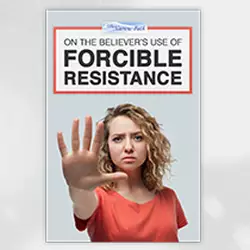
Question from a pastor: In light of Christ’s command to “turn the other cheek” and to “not resist the evil man”, is it inappropriate for believers to contemplate or exercise physical force in defense of our families against criminal aggressors? Over the course of more than three decades, I have weighed the biblical testimony concerning this topic and related questions and cannot claim even now to have the final and definitive answer for every situation. Individual commands of Scripture teach us how these principles are expressed in various life decisions, but in the absence of specific commands we must proceed upon principle, and the commands that do exist should be interpreted in the light of such principles. Download the eBook to read more!

Featured Offer
Question from a pastor: In light of Christ’s command to “turn the other cheek” and to “not resist the evil man”, is it inappropriate for believers to contemplate or exercise physical force in defense of our families against criminal aggressors? Over the course of more than three decades, I have weighed the biblical testimony concerning this topic and related questions and cannot claim even now to have the final and definitive answer for every situation. Individual commands of Scripture teach us how these principles are expressed in various life decisions, but in the absence of specific commands we must proceed upon principle, and the commands that do exist should be interpreted in the light of such principles. Download the eBook to read more!
About The Narrow Path
The Narrow Path is Steve's teaching ministry primarily to Christians. In part, it is a one-hour, call-in radio show. Christians call in with questions about what the Bible says on many topics and how certain passages can or cannot be interpreted. Occasionally, an atheist or agnostic or one of another faith calls in to inquire or raise objections. Steve takes all calls, including objections to what he has presented. It is an open forum with polite, respectful discussions. The object is for the host and the audience to learn together.
The ministry also has a website, a Bible-discussion forum, a Call-of-the-Week video, a YouTube channel, and a Facebook page. These contain Steve's verse-be-verse teachings through the entire Bible, topical lectures and articles, friendly debates with folks of other opinions, and much more. Please explore these hundreds of resources. They are all valuable, but they are all FREE. We have nothing to sell. "Freely you have received, freely give."
Steve is also available to teach and answer questions at church and home meetings. He has taught on every continent. If you would like to have him speak in your area, just organize a group, a place, and propose a date, or several, and e-mail Steve@TheNarrowPath.com.
The Narrow Path exists through the gifts of donors who appreciate these resources. We have no corporate sponsors and run no commercials on the radio or ads on the website. If you are blessed by these resources, we ask that you first pray for us, then tell your family and friends, then consider donating to help us stay "on the air". God faithfully provides through listeners.
About Steve Gregg
When asked a question about a passage, Steve usually lists its several interpretations, gives the reasoning behind each, cross-examines each, and then tells his own conclusions and reasons. He tries to teach how to read and reason about the Bible, not what to think. Education, not indoctrination.
Steve has learned on his own. He did not attend a seminary or Bible college, but he was awarded a Ph.D. for his work by Trinity College of the Bible and Theological Seminary in Evansville, Indiana. He is the author of two books:
(1) All You Want to Know about Hell: Three Christian Views of God's Final Solution to the Problem of Sin
(2) Revelation: Four Views, Revised & Updated
Contact The Narrow Path with Steve Gregg
Steve@TheNarrowPath.com
The Narrow Path
P.O. Box 1730
Temecula, CA 92593
844-484-5737 2-3 PM Pacific Time