

The Narrow Path 04/08/2026


Enjoy this program with Steve Gregg from The Narrow Path Radio.
Steve Gregg: Good afternoon and welcome to The Narrow Path radio broadcast. My name is Steve Gregg and we're live, as is generally the case on weekdays at this time. We have a live broadcast an hour a day, commercial-free, for you to call in and ask questions if you have questions about the Bible or the Christian faith, or to call in to disagree with the host on virtually anything you may wish to disagree with the host about.
I'm looking at a few open lines right now. Sometimes that's not the case, but it is now. If you want to call right now, this is a great time to get through. The number is 844-484-5737. That's 844-484-5737. There's really nothing to detain us from going to the phones right now, except to remind you that there are a few lines open right now. This is a good time to call if you hope to get through this hour.
We're going to talk first of all to Tim calling from Santa Ana, California. Tim, welcome to The Narrow Path. Thanks for calling.
Tim: Thanks for taking my call, Steve, and congratulations on the success of your program.
Steve Gregg: Thank you.
Tim: I'm going to challenge you today on your non-committal on the correct view of hell. I don't believe that it is really rocket science and I think that your non-committal after writing two books on hell—I don't think that there's probably anybody in the body of Christ that knows more about hell than yourself. I don't think that the right view is so difficult to see and what the Bible is actually teaching.
Steve Gregg: What do you believe the right view is?
Tim: Conditional immortality, annihilation. It's the only view that's not massively flawed exegetically and philosophically.
Steve Gregg: Conditional immortality definitely has a strong exegetical case. Have you read either of my books? Of course, I only wrote one book. The second one has a new name, but it's an updated version of the old book. Don't ever buy my old book. Buy the new one if you're going to buy a book of mine. Have you read them?
Tim: I have your book and it was a good read for me at the time because I was stuck in one of the wrong views that really did me much damage. It undermined my ability to share the gospel. When you hold to—I did hold to eternal conscious torment for 25 years.
Steve Gregg: I did for longer than that. I doubt it now, certainly doubt it.
Tim: I'm free of it and knowing the truth about hell has been incredibly liberating and healing to my spiritual life.
Steve Gregg: Are you aware of what the third view of hell is?
Tim: I am and I think that it is massively flawed exegetically and philosophically.
Steve Gregg: I'm going to say that I agree with you about the traditional view and I agree that the second view, the one you hold, has a very strong exegetical case. I believe the third view also has a strong exegetical case, which is the reason I'm non-committal on it. In this call, I'd particularly like to hear what you disagree with me on, namely, what are the flaws in the third view?
Tim: There are certain plain and clear statements in scripture that make the universalist position impossible to be true. It's just obviously excluded. My first one would be that the scriptures say, "Don't be deceived, the unrighteous will not inherit the kingdom of God." If that's true, and it is true, then it's impossible for the universalist position to be true.
Steve Gregg: A person can be a very wicked person up until the day they die and convert, and then they would inherit the kingdom of God, right? But what if they repent after their death?
Tim: I understand that to be impossible because the scriptures say that the unrighteous will not inherit the kingdom of God. If you die in your sins and in your unbelief...
Steve Gregg: Here's my problem, Tim. What if I'm an unrighteous man right now, but before I die, I repent? Am I then also an unrighteous man and will not inherit the kingdom of God? Or is it only while I'm unrighteous that I disqualify? What if I grew up and became even an old man as an unrighteous man and then turned to Christ and became a true follower of Christ or a true believer? Would the fact that I am an unrighteous man now be a guarantee that I won't ever inherit the kingdom of God? Or does it just mean I won't inherit the kingdom of God until I repent or unless I repent?
Tim: I don't think that there's any good reason to believe that repentance will be granted after death. I believe that the only people who will inherit the kingdom of God are blood-bought sinners. Although deathbed conversions are possible—we have the thief on the cross—this is a tenuous place to be.
Steve Gregg: Of course. I never recommend people becoming deathbed converts. I'm curious because you said blood-bought sinners will be saved. Are you a Calvinist?
Tim: No. I think Calvinism is probably the most dangerous theology to hold as a Christian.
Steve Gregg: I agree with you about this too, so we agree about a lot of things. Are you saying there are some people that Jesus didn't die for and are not blood-bought?
Tim: Jesus died for everyone, but in order to guarantee your salvation, you must repent and believe the gospel and confess that Jesus Christ is Lord.
Steve Gregg: Jesus died for everybody. Not everybody repents in this lifetime. In fact, not everybody repents until maybe a year prior to their death. A person could repent even later than that possibly. Deathbed conversions are tenuous because everyone wants to pretend to repent on their deathbed, whether they are sincere or not.
There are people who get saved, they hear the gospel, they love the Lord, they get saved late in life, and they die shortly after that. They are blood-bought, but the reason they can be saved is not because they believe but because they are blood-bought, because Jesus bought them. Of course, a person who rejects Christ's gift cannot be saved even if he bought them. He'll let them walk away. At what point does he decide he won't let them repent? You're saying at death, right?
Tim: Death is the finish line and if you're not saved before the finish line, then you are going to be destroyed.
Steve Gregg: I'm curious. How do you know that it is?
Tim: There's this verse that I just gave you, "Don't be deceived that the unrighteous will not inherit the kingdom of God." That's a clear statement.
Steve Gregg: I'm going to have to stop you there. We can't go back to that one because I already refuted it. Paul said the unrighteous will not inherit the kingdom of God. We both agree. A person who repents is no longer unrighteous. That's why we believe people can be saved. Everybody's unrighteous until they repent.
You're saying the last opportunity to repent is prior to death. I'm saying I don't know that you're wrong. It may be. I certainly have nothing in the Bible to tell me that you're right. How can you be sure that an unrighteous person could not repent after death and then be in the same condition you or I are in who have repented beforehand? Does God change? If God's not willing that any should perish but that all should come to repentance, is there something that changes in his intentions when a person dies? He no longer cares whether they perish or not? He no longer wants them to come to repentance? Is that your position?
Tim: It's my position that if you die unsaved in this life, you remain unsaved.
Steve Gregg: I'm looking for scripture. How do you know that God, who doesn't want anyone to perish and wants all people to repent, has set as an arbitrary deadline human death? Human death happens to some people quite young and others quite old, but God just says whenever that happens to you, I no longer want you to repent, I no longer care if you perish or not. You're saying that God's attitude changes, something in God's heart changes when someone dies.
Tim: No, I don't think that God can change his character. God is the maximally perfect being. God can never change his character.
Steve Gregg: Then he wants them saved even after they die. He has to love them even after they die and want them saved because he can't change his character. His character is love.
Tim: I understand. I would like to respond this way. The Bible says that we are saved by faith and through faith. If a person dies and they then see Jesus, they're no longer saved by faith. God requires faith to be saved. They're seeing Jesus.
Steve Gregg: The apostles didn't believe in Jesus' resurrection until they saw him. Did they not have faith then? Jesus said to Thomas, "You believe because you have seen. Blessed are those who, having not seen, still believe." Jesus doesn't say if you've seen me, you can't believe. He said you actually believe because you have seen me. This was Thomas, an apostle. It was true of all the apostles because all the apostles heard Sunday morning from the women that Jesus rose from the dead and they didn't believe them until Jesus appeared to them. When they saw him, that's when they believed. You can't really say that if you don't believe until you see, then you don't believe at all.
Tim: I believe you're making a category error there in that the disciples were alive at that point and then they saw Jesus. A person who dies in their sins and unbelief is required to repent and believe, otherwise you remain lost.
I have other objections to the universalist position. If everyone is going to be saved, which is what the universalist position holds, why did Jesus say that it would be better had Judas Iscariot not ever been born? If he was going to end up being saved and worshipping God in truth and in spirit for the rest of eternity, how could Jesus make such an erroneous statement?
Steve Gregg: I actually mentioned that in my book when I'm talking about the objections to the universal reconciliation view. I mention there are a few scriptures, that's one of them, that are problematic for it. Every one of the views has a few scriptures that are problematic for it. If you say how can this be, what did Jesus mean? I can't answer you. That's one reason I don't know which view is true because all the views have problems with them.
All of them have scriptures in their favor and all of them have a few points at least, if not many, that are problematic for them. This is why you're saying I shouldn't be so non-committal. I'm not going to commit myself to any position that I don't have a rock-solid scriptural case for. You said that I probably know about as much about hell as anybody. Probably I don't, but I do know a lot about it having studied it for my book. I've read at least eight to 10 or 12 books defending each of the positions before I wrote my own book on it. It's not like I'm an expert, but I certainly am not ignorant. I know what the arguments are and I know what the problems are.
My non-committal position is based on my honesty. You used to believe in the traditional eternal conscious torment and you were very relieved to learn there's another option, and that is conditional immortality, which some people would call annihilation. That is a relief to know there's another credible option. In fact, I would agree with you that the scriptural support for that view is stronger than the support for the eternal conscious torment view. It is, I can see how it's a relief and it's wonderful.
I also know of a third view that also has a ton of scripture in its favor. To my mind, we can't just write off because there's one or two verses that are problematic for it because there are one or two verses that are problematic for each of the positions. Until I have a position that there are no objections possible to scripturally, I'm going to just say I'll leave it for God to know. I can't be sure if there's—I can go eeny, meeny, miny, moe. I like this one the best.
If there's—I'm not going to change my mind to believe something I want to believe. If I wanted to believe that, I would have been a universalist from my childhood because I'd love everyone to be saved just like God would. God wants to be a universalist. The Bible says that. What you're saying is that something won't let him. All it would take for God to be a universalist and to realize that—I'm not saying he is, I'm just saying your arguments are not making this point very well in my opinion.
All it would take for God to save everybody, it seems to me, everyone that Jesus died for—and I believe Jesus died for everyone—is to continue dealing with them not only for their lifetime but longer if necessary and bringing them to repentance. Your objection to universalism is that you say people can't be saved unless they believe in Christ. I think a universalist who's an evangelical would say correct, no one can be saved without believing in Christ.
In this life, let's say a man lives to be 100 years old. He might get saved when he's four years old, he might get saved when he's 20 years old, he might get saved when he's 70 years old, might even get saved when he's 99 years old. If he lives on after death in some form, which some people would doubt is true, but let's just say since we don't know otherwise biblically, then maybe he could repent afterward too.
The question is, if God would save him at the moment before death because what, God loves him how much, enough to die for him? That's a lot. That's a lot of love. Then the moment the guy dies, and let's just say he didn't choose to die—it wasn't his choice to die—but suddenly the God who would have died for him and did die for him and loved him until the point of death just says I changed my mind. I could give you more options, but why bother? I gave you enough, that's enough. That is saying that God does change, his love does change afterward. You either have to say he didn't really want to save them up until the point of death and therefore he doesn't want to after death either, or you have to say that God—something in God changed when the man died. I can't think—if my children died, I have some children who aren't in the faith and I've had children who in the past were not on good terms with me. They are now, but there was never a time when I as a loving father would not have wished to give my children as many chances as possible even if they died alienated from me if I were in God's position. I'd keep giving them more chances because a father doesn't give up on his children.
All I'm saying is there's a good scriptural case to make for conditional immortality and there's a good scriptural case to make for the universal reconciliation. There's a slight case to be made for the traditional view, but I don't think there's much scripture on its side and it doesn't really reflect the character of God. That's why I'm non-committal. I'm not saying you're wrong, I'm just saying this is why I'm not as convinced as you are that we can just nail it down to one of those views since I have studied all the views very well and I'm apprised of the scriptural strength of each one.
Also, I don't know of any harm in remaining undecided. This is something I'd be curious about too. If I don't have enough biblical evidence to choose between the options, what am I suffering by not choosing? Should I make a choice without enough evidence?
Tim: Yes, I think it's—you may not be—am I back on, Steve? Did you put me on hold?
Steve Gregg: I was for a moment so I could speak, yes. You'd appreciate what?
Tim: Well, I wasn't interrupting. You're interrupting me a lot, but I wasn't interrupting.
Steve Gregg: I'm going to interrupt you right now too. When you call my program, I give you a chance to make your point. I even ask you questions and give you a chance to answer the questions. I don't give you the whole show. You've been on the show for 20 minutes now and nobody else has been, though my lines are full. Don't tell me how quickly I have to get through this call or how long I have to give you to talk. I try to be very generous with those who call to disagree with me and you're the first caller today. I've given you 20 minutes out of an hour show when there's half a dozen more people waiting.
Don't scold me that I cut you off when you're interrupting me and that I interrupt you. This is how conversations go if you're going to get into something deep. This is why I wrote a whole book because it takes more than 15 minutes of conversation to settle the question. If you're going to call and complain that it takes more than that and that I shouldn't answer you adequately and that if I cut you off because you won't stop and give me a chance, then I'm somehow doing the wrong thing. Anyone who thinks that I shouldn't run the program according to my instincts, they can have their own program and they can run it according to theirs. I need to get some other calls and everything you've said, I've answered in my book, which you say you have. If you didn't have my book or if I hadn't written it, I would then see more reason to go over all these points, but I think that you could read that book again and see some things again that apparently you haven't processed completely. Thanks for your call.
Holly in Pine Grove, California, welcome to The Narrow Path. Thanks for calling.
Holly: Hi, good morning, Steve. I'm a first-time caller and very new, as in two or three days of listening to your videos. I have two questions. One is in Deuteronomy where it says that the life of the blood resides in the soul and I know that that scripture is talking about sacrifices. My question is donating blood. I have high red blood cell counts and my doctor wants me to go donate blood to lower that so that my blood will be healthier. I know that it's talking about sacrifices. I'm just wondering how that might relate to humans.
Steve Gregg: The statement reads a little differently than you remembered it. It's Leviticus 17:11. Leviticus 17:11 says, "For the life of the flesh is in the blood," and he says, "I have given you the blood on the altar," but essentially your question doesn't change. The life of an organism—the animal in this case that's being sacrificed, but I think it'd be true probably in human organisms too, since God sees sanctity in the blood of humans and says anyone who sheds man's blood, by man his blood shall be shed. I don't think you're off. I think you're right that the blood is seen as the avenue or the conveyance or the essence even of life in the biological organism.
Now, by the way, the word soul is not found in there, so it doesn't say the soul is in the blood. It's just talking about biological life. And of course, animal life, which we have no reason to believe that animals have souls like we do anyway. All it's saying is that biologically, the animals'—and I would say humans' too, no doubt—we could say their biological life inheres in the bloodstream and the blood. So you're saying what about donating blood?
Holly: Like not a part of my life or soul or whatever is—its force, life force is not going to be depleted as I donate blood to supposedly help rejuvenate the blood that I do already have.
Steve Gregg: No. In fact, if you get a bad wound and lose a fair amount of blood, you haven't lost any of your spiritual life.
Holly: Thank you. The second question was on cremation. I want to be cremated, however, I've heard lots of different pastors say that you're defiling the temple of the Holy Spirit and in my opinion is—because I don't know enough scripture, but—ashes to ashes, dust to dust. Do you have any thoughts on that scripturally?
Steve Gregg: Your body—a human body is not by nature the temple of the Holy Spirit. A person becomes a part of the temple of God by becoming inhabited by the Holy Spirit. That's why our bodies are said to be a temple of the Holy Spirit, it's because he has come to live within us. He wasn't in us when we were born. This happens when you're born again. This happens when you become a Christian, you receive the Holy Spirit, the Bible says, and then you are incorporated into that body which collectively is seen as God's temple where the Holy Spirit resides.
When you die—it says in James, "The body without the spirit is dead." That's the last verse of James chapter two. "As the body without the spirit is dead, so faith without works is dead also." A dead body doesn't have the spirit in it. That's, I assume, the human spirit. Paul said in Philippians one that he's in a fairly miserable situation in a third-world jail and he could wish to depart and be with the Lord, which is far better. In other words, he believes that when he dies, his spirit, I'm sure he means, would go to be with the Lord, but his body would be without the spirit and be dead by definition.
Paul said in Second Corinthians five that as long as we are alive in the flesh or present in the flesh, we are absent from the Lord, but he said we're willing to be absent from the body and present with the Lord, which is speaking of dying and going to be with the Lord. It seems to me that when a body dies, neither the human spirit that lived in it nor the Holy Spirit that lived in it is there anymore. I don't see how there's any sense in which that body would be called the temple of the Holy Spirit.
There are some people who think that cremation's a bad thing because they think it'll somehow inhibit or compromise God's ability to raise our bodies on the last day because the Bible teaches there will be a resurrection on the last day. But that doesn't make much sense either since almost all bodies—as you pointed out, you quoted ashes to ashes, dust to dust—actually the way God said it in chapter three of Genesis is to Adam. He said, "Dust you are and to dust you'll return." Now that happens to everybody whether they're cremated or not. I don't really know how the decomposition of a body into dust or ashes in any way would inhibit God resurrecting that body from the dead, and it's a good thing too because every body that's dead for very long before Jesus comes back will be in fact in that condition. He'll have to raise dust into bodies again, just like he created the first man out of dust in Genesis chapter two.
Holly: All right, thank you so much. And then my husband's sitting here and he is desperately wanting to know near-death experiences as a Christian.
Steve Gregg: I can say about near-death experiences, we know nothing from the Bible about them. Lots of the research on near-death experiences has been done by people who aren't Christians, don't have a Christian worldview, and others have been done by Christians. Sometimes the results are seen as different, sometimes they're pretty much the same. All I can say is I don't know the nature of these near-death experiences. I'm not really sure even the researchers can be sure about it, so I'm going to be non-committal on that. I know some people don't want me to be non-committal, but you've got to be when you don't know what you're talking about, and that's one thing that if I made a commitment on it, I would not know what I was talking about.
You're listening to The Narrow Path. Our website's thenarrowpath.com. We have another half hour coming. Don't go away. I'll be gone for 30 seconds and be back.
Welcome back to The Narrow Path radio broadcast. My name is Steve Gregg and we're live for another half hour taking your calls. Right now our lines are full, so I won't give out the number because you can't get through at the moment. If we need to, we'll give out the number again and otherwise, just sit back, relax, listen, and call tomorrow if you have a question because we should be on the air then as we have been every weekday for the past 29 years.
Let's talk to Peter from Orlando—says Orlando, California. I would have thought it was Florida. Hi, Peter, welcome.
Peter: Hi, Steve. First-time caller. I appreciate what you do. I apologize for that first caller. He was very combative.
Steve Gregg: I think he found me annoying because I cut him off sometimes when I wanted to speak also. Go ahead.
Peter: I'm curious what your stance is on infidelity in marriage. I know that a lot of Christians think that Jesus endorses divorce after infidelity and I just am curious how you square that with the entirety of every other example in the Bible where someone's thrown at the feet of Jesus for infidelity and he says, "He without sin throw the first stone," or when he says, "This sums up all the laws and all the prophets, treat each other the way you want to be treated." If divorce was endorsed by Jesus, then Jesus also defines divorce or infidelity as even looking at another person lustfully. I'm just curious what your stance is.
Steve Gregg: It's a nuanced question. Obviously, infidelity begins in the heart and often manifests itself in physical adultery. Jesus makes it very clear that when infidelity exists in the heart, it's not okay. He doesn't say that when it's there alone that that's grounds for divorce. In fact, he said, "If you look at a woman to lust after her, you've committed adultery in the heart." But then when he talked about grounds for divorce, he said, "Any man who divorces his wife except for the cause of fornication."
Fornication, as far as I know, is always a physical act. Adultery in the heart is something going on in the heart by definition. Fornication, as far as I know, is never known in scripture other than as a sexual act and virtually any kind of sexual act that's outside of marriage could be called fornication. In the Book of Jude, homosexuality is called fornication. It says that the Sodomites were guilty of fornication, going after strange flesh, it says. A man living incestuously with his father's wife in First Corinthians 5:1 is referred to as committing fornication. In the Old Testament when Israel is committing, as it were, virtual adultery, worshipping other gods instead of God, which God regards to be an adulterous cheating on him, that is referred to as fornication there too.
In other words, fornication is just a general word for bad sexual misconduct which violates God's standards. If a woman or a man, I think, is committing fornication—that would be with somebody other than a spouse in their marriage—this is what Jesus, I think, is referring to.
You raised a couple of interesting points. The woman taken in adultery, Jesus said, "Let him that is without sin be the first to throw a stone at her." If we lived in a society where adulterers were stoned to death, I would think that'd be very applicable. If your wife has committed adultery, even if you haven't, even if you're without sin, I would suggest don't throw stones at her. I don't know anyone that does that in this society. Muslim societies do that, but I don't think in the free world that ever happens. To acknowledge that somebody has broken the covenant and is no longer in the covenant relationship that they entered at marriage is not the same thing as killing them, although frankly, I mean, it can be very hurtful if they're innocent and you're—but they may wish they were dead, but frankly, people usually get over it and it's not like murdering somebody.
More than that, the story about the woman taken in adultery in John chapter eight—it's not actually in the original or oldest manuscripts of John and there's some question as to where it belongs and some people might even think it's not an authentic story. I think it is, but so I'll go with that. But yeah, I won't throw stones at anybody even if I'm—even if I were sinless, I wouldn't throw stones at people. I'm not interested in killing people. That's what he's talking about.
Now, as far as do unto others what you'd want done unto you, this doesn't mean that criminal behavior should never be penalized because criminals would rather not be penalized. A criminal would rather not go to jail, would rather not have to pay the fine, would rather not face the electric chair. Criminals invariably are going to be people who'd like something different than the criminal penalties that they have earned.
When Jesus said what you would that men should do to you, do that to them also, he's not talking about criminal justice systems. He's not talking about laws. He's talking about behavior toward people that you encounter. If they're hungry, feed them because you'd want to be fed if you were hungry. If they're naked, clothe them because you'd certainly want that. It doesn't mean that if you've murdered somebody, you know you wouldn't want to be hanged for it, but—and so you shouldn't hang a murderer. That's more like a criminal justice issue.
Adultery in a marriage is also a criminal justice issue. It's a breach of contract. There are victims when a woman or a man commits adultery. They victimize their wife, they in many respects in many cases are victimizing their children. They may be victimizing the person they're having adultery with or and maybe the spouse and children of that person. This is not just a private sin, this is a public sin, this is a public betrayal, this is a violation of another person. That makes it a criminal act. Therefore, when we have criminal acts, love your neighbor as you love yourself does not mean that you ignore criminal acts and that you do not punish them. That's what God ordained governments for. And the government that granted a marriage to somebody would also, if there were proper grounds, could righteously withdraw that. It's a breach of contract. There's lots of contracts besides marriage and the government enforces contracts or is supposed to. This is the ideal government. Our government isn't ideal, but let's face it, ideally.
When Jesus said what you would have someone do to you, do that to them too, well, this isn't the case, but if I had a wife who was faithful but she wanted me to divorce her so she would be free from me, that doesn't mean I should do it. There are things that people might want that are not the right thing to do. What I think we should say is that we need to look at every human being as somebody with the same human rights and dignity that we have. And as we would not want our human rights or dignity violated by another, we should not for another person.
On the other hand, if I go into my neighbor's house and steal his television set, you might say well no one should prosecute me because actually those people wouldn't want to be prosecuted if they did that. Well, that's not necessarily true. A Christian wants justice. God wants justice. And if I commit a crime and somebody else is victimized, if I've got a decent heart, I want that to be rectified. That's why there's a thing in the Bible called restitution. A thief when he is truly repentant is to demonstrate it by giving back with interest the thing he stole. He might like to keep it, but let's face it, justice is a higher priority. Actually, justice and love cannot be separated because if you're going to do unto others what you want done unto you, you certainly want others to be just toward you and therefore if you've violated somebody else, you would want them or you'd at least accept the just penalty for what you did.
The Bible says that the just penalty for violating the covenant of marriage, which is done when somebody commits adultery against their spouse, the just penalty for that is that their spouse is free from the covenant. You want to be free of it, then your spouse gets to be. It's a kind of justice.
On the other hand, you're suggesting that Jesus of course advocates being merciful. I totally agree. I believe that while it would be a just thing for a man or woman to divorce their spouse who is unfaithful, it would be a very godly thing if they also wanted to be reconciled, wanted to forgive, wanted to show mercy and so forth.
Of course, when marriages are in bad repair and when there's that kind of violation and so forth, there's always a lot of nuances. There's the question of what's best for the children—generally speaking for the couple to stay together. Even if there has been adultery, it's generally better for the children to have their parents stay together. On the other hand, there might be a situation where somebody has not only committed adultery but they're also beating the children and beating the wife and they're drunkards and violent and dangerous, in which case concern for the children's safety might result in taking the option of divorce, not because of the beatings, because of the adultery.
The question of whether you say I'm going to try to force us back together again because I'm merciful, well, you've got to be merciful to more people than just that person. You've got to be merciful to everyone involved. So there's nuances. I'm not going to say when a person ought or ought not to get divorced. I will say this, I was married when I was 19 years old. I had a child by the time I was 20 and by the time I was 21 my wife had had two affairs. My child was one year old and I—and she was not behaving in any sense like a wife and I thought well I have grounds for divorce here, but I wouldn't do it. That was my choice. I could have gotten a divorce, but I don't believe in divorce. I believe that if there's any possibility of not getting a divorce and almost always there is such a possibility, that you should keep your wedding vows. To me, my integrity, my honesty, the fact that I made promises is far more important to me than whether I have a happy marriage or not, or whether I'm happy. Happiness is something that we are not entitled to necessarily. It's always great to have it as a perk in life. But the Bible doesn't promise us a happy life or happy marriage. It does promise us that God will be pleased and reward ultimately those who are faithful and who keep their promises and who are, you know, living out the things that Jesus said to live out. And staying with a difficult partner, even an unfaithful partner, if it can—I would suggest to ask God to give you the grace to forgive. It's a very hard thing, I know. It's a very hard thing to forgive an unfaithful spouse. I've done it more than once. Not with my present marriage thankfully. I've got the most wonderful wife in the world for the past 15 years, but I just have had some other situations. So I know the temptation to divorce and I certainly have thought through and studied the teachings of Jesus on this, but it's more nuanced than just say well do unto others what you want done unto you, so if you committed adultery you'd want someone to forgive you, so forgive them. That's a good first line of response, I think. I really believe that's a good first line of response. However, dealing with that kind of a complex issue, I think there's often nuances and you have to decide, okay, is forgiving them and just pretending like it didn't happen, is that really going to make things better? If it would, then that's what I should do. If it's going to have other ramifications and consequences for other people and so forth, maybe I need to rethink what God would have me do in the situation. Need to pray about it, ask God for grace, but I am of the opinion that there are times certainly when actual divorce can be justified. I'm not one to recommend it certainly, but if someone does it, there are people that I cannot condemn for getting a divorce because they had the grounds Jesus talked about. Thanks for your call.
Let's talk to Mark in West Hartford, Connecticut. Mark, welcome.
Mark: Hello Steve. I've just finished reading through the NIV Archeological Study Bible and before that I read the MacArthur New American Standard Study Bible and way before that, because I'm a Catholic, actually the first Bible I read through was the Jerusalem Bible.
Steve Gregg: The Jerusalem Bible, yeah. I've read it.
Mark: Which is—what is this—part of it is—
Steve Gregg: Exactly, yeah. Let me clarify that. You might know this or you might not, but the ESV is a translation of the Bible, so is the NASB, so is the NIV and the King James Version, the New King James and the Jerusalem Bible and the Douay-Rheims. These are all different translations of the Bible. In the case of the New Jerusalem Bible, they have study notes at the bottom of the page and so also study notes are sometimes some publishers join study notes to each of these other translations.
The translations—ESV, NIV, NASB, KJV, NKJV and so forth and many others—they exist simply as stand-alone Bible texts which you can read and you can read as many as you want. They're all going to teach pretty much the same thing. They'll just say it in different words because different translators are trying to make it more accessible to readers or whatever than others have done, but they really all teach the same thing. There's not really a contradiction between any of these translations. But the notes in them are what makes them a study Bible. You can buy an NIV Bible, ESV Bible, New King James Bible or whatever, but you can also buy NIV what you had—something like a Archeological Study Bible or something like that.
That's going to have special notes put in there by Christian archaeologists to explain what they have found to confirm certain things in there. But there's also what they call apologetic study Bibles where someone has put notes in there bringing out the arguments in favor of the things that Christians believe that are found in the Bible. The MacArthur Study Bible or many others are going to basically go through the whole Bible and give the—in this case John MacArthur's views on every passage.
Now John MacArthur's views on those passages will not be the same as the views of the Catholics, nor of all Protestants, because there are Protestants who would differ on some things with him. So what when you get a study Bible, there's two things to decide: what translation do I want and then whose notes, if any, do I want in it? I myself have—I'm looking at my shelf—I have an NIV Study Bible, ESV Study Bible, New Living Translation Study Bible, New King James Study Bible, the Apologetic Study Bible with the—I forget—I think that's got the—I won't worry about it—but I've got a lot of study Bibles. I don't pull them off my shelf very often. I would pull them off the shelf when I'm looking for something you go to a commentary for. That is, I have all those versions on my shelf without any study notes too on another shelf. When I go to the Bible, I don't go to a study Bible very often. I want to read the Bible itself. Now it's true some translations of it I prefer over others.
I prefer a word-for-word translation. The New American Standard Bible is going to be pretty much a word-for-word translation. I think among Catholic Bibles, probably the Douay-Rheims is going to be the most word-for-word. I'm not positive if they have a better one than that or not. The King James is, the ESV pretty much is. But there's other translations, and the New Jerusalem Bible is one of them and the NIV is also one of them and there are others, the New Living Translation, that are not word-for-word translations. They are paraphrases. I know I read the New Jerusalem Bible when I was like in my teens. It's one of the first books—first time I read through many of the books of the Bible, I was reading the New Jerusalem translation. I thought it was very readable, very good to read, but it was somewhat paraphrastic. So is the NIV.
Now, I didn't care for the notes in the New Jerusalem Bible, not because they were Catholic, because many of them weren't specifically Catholic, but because they were somewhat liberal. They suggested that Moses was not the author of the first five books, for example, as Christians have always believed they were and the Jews have always believed they were. The modern liberal scholarship rejects that and so the New Jerusalem Bible, as I recall, took what they call the documentary hypothesis as a given. But most of the Protestant study Bibles are going to be very similar to each other and they're going to be pretty conservative generally speaking. Study Bibles that are the ESV, the NIV, the New American Standard...
Mark: How about what you would recommend for the version and then I can go from the version to the study.
Steve Gregg: Sure. I have good feelings about the NASB, which you already have. It's not the one I use most of the time, but it's a pretty much of a word-for-word version. I find it not as smooth reading as some others, but that's partly due to its being very literal. I use the New King James probably more often than any other. The one I teach from is usually that, but I will consult others as well. I've got them all on my shelf and I consult them. But yeah, the New King James I have found to be pretty much word-for-word in its approach and I like it.
I don't use a study Bible generally, but like I say, have them on my shelf if I want to consult them like I would a commentary. But yeah, I'll tell you what. One—because I use the New King James more often, there is a New King James study Bible or actually the Nelson Study Bible—Thomas Nelson is the publisher of the New King James. The Nelson Study Bible, I found to be pretty good. I mean, again, I don't trust any study Bible completely because you're right, the opinions in the notes are the opinions of the scholars who wrote the notes, not—and sometimes they're right and sometimes I think maybe not. But they're usually pretty good.
Mark: Okay, I have one more quick question. By the way, when I was finishing up the NIV, I had just started using your verse-by-verse teaching and I would parallel it as I read through the end of it. So I'm looking forward to the next reading through the Bible starting with your studies at the very beginning, at Genesis and that approach. But there is such a helpful—it's like a study Bible in itself when you do that.
Steve Gregg: It's like a commentary, audio commentary verse-by-verse. Yeah. Well, I would say if you're going to—if you want to follow along most smoothly with my lectures on it, those lectures I was using the New King James. And I'm not going to say New King James is the best or the only good version, but it's on the short list of the best ones, I think.
Mark: Okay, my other quick question has to do with when Christ was on the cross and he told John to take care of Mary. Mary having other sons as we knew from James and I believe it was Jude, why wouldn't they take care of her or why wouldn't she be in their care already in a sense?
Steve Gregg: I think by default she would have been in their care. But we're told in John chapter seven that the brothers of Jesus didn't believe in him. Now Mary did, but his brothers didn't until after he rose from the dead. So I mean it could have just waited a few days. But after he rose from the dead, Jesus appeared to his brother James and in Acts chapter one, while the 120 are waiting in the upper room for the Spirit to come, it says that the mother and brothers of Jesus were there too and apparently the Spirit fell on them. So it would appear that his brothers did become believers and that really shortly after his death and resurrection.
The only answer I can give you is that because his brothers were not believers at that point when he died, that he might have felt it'd be better for her to be with a strong believer taking care of her. But that may not be the whole answer. I do not know the whole answer, but that's what I've always assumed. Joseph almost certainly was dead before Jesus began his ministry because right from the beginning, we find Mary and his brothers kind of traveling around with him before he started his public ministry. In John chapter two, we find Mary and the brothers kind of traveling with Jesus from town to town, but no Joseph, you know. So almost certainly and then of course, since Jesus committed his mother to the care of John, it's clear that Joseph was no longer there to take care of her or else that'd be superfluous.
I appreciate your call. I'm almost out of time. I want to take another call. Thanks for joining us. Ron in Indianapolis, Indiana, welcome.
Ron: Hi Steve. God bless what you do. Steve, in relation to the caller, your first caller, is there a scripture that says after the death judgment?
Steve Gregg: Yes. That's Hebrews 9:27. It says it's appointed unto man once to die and after this the judgment. Many people have thought, and it's possible that that caller thought though he didn't bring that scripture up, but many people think that that rules out the idea of post-mortem repentance. Post-mortem repentance, of course, is a feature of the view called universal reconciliation. Those who believe in universal reconciliation believe that when people have died, if they have not come to Christ, that Christ still wants them. He still wants them to come to him. God still wants them not to perish but to come to repentance and so God continues to allow them to in hell.
I mean once they've gone to hell, the idea is we know they go to hell. What happens there is very seldom spoken of in the Bible and not very clearly. So there's three views of hell. One is that once they go to hell, which is the lake of fire, they're tormented forever and ever and never expire. Another view is that they're punished proportionate to their guilt and then they do expire and they don't exist anymore. And the third view is God will just keep working on them in hell until they actually come to genuine repentance because he's not willing that any should perish but that all should come to repentance and there's nothing to stop him from continuing to reach out to them.
But some people say, but the Bible says it's appointed a man once to die, but after this the judgment. And they somehow think that this says something about the availability or non-availability of the opportunity to repent after death. No, when you die, the next thing to look forward to is the judgment. We read about the judgment at the end of Revelation 20 and we're told at the end of that, some go into the new Jerusalem for eternity and some go into the lake of fire. Okay, that's we agree with that. These people after the judgment go into the lake of fire. The question is what happens to them there? Do they ever repent? Do they burn out? What is that? And so the judgment simply means that they stand judgment. We're not told what the sentence is, we're not told what evidence is brought against them, we're not told anything about that. We're just said we're going to have to answer to God after we die and then he'll decide what's right. And some think what's right in God's sight is to keep working on them.
I'm out of time. Our website's thenarrowpath.com. Thanks for joining us.
Featured Offer
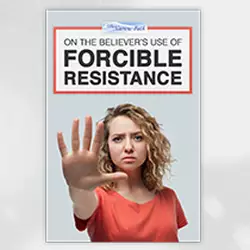
Question from a pastor: In light of Christ’s command to “turn the other cheek” and to “not resist the evil man”, is it inappropriate for believers to contemplate or exercise physical force in defense of our families against criminal aggressors? Over the course of more than three decades, I have weighed the biblical testimony concerning this topic and related questions and cannot claim even now to have the final and definitive answer for every situation. Individual commands of Scripture teach us how these principles are expressed in various life decisions, but in the absence of specific commands we must proceed upon principle, and the commands that do exist should be interpreted in the light of such principles. Download the eBook to read more!

Featured Offer
Question from a pastor: In light of Christ’s command to “turn the other cheek” and to “not resist the evil man”, is it inappropriate for believers to contemplate or exercise physical force in defense of our families against criminal aggressors? Over the course of more than three decades, I have weighed the biblical testimony concerning this topic and related questions and cannot claim even now to have the final and definitive answer for every situation. Individual commands of Scripture teach us how these principles are expressed in various life decisions, but in the absence of specific commands we must proceed upon principle, and the commands that do exist should be interpreted in the light of such principles. Download the eBook to read more!
About The Narrow Path
The Narrow Path is Steve's teaching ministry primarily to Christians. In part, it is a one-hour, call-in radio show. Christians call in with questions about what the Bible says on many topics and how certain passages can or cannot be interpreted. Occasionally, an atheist or agnostic or one of another faith calls in to inquire or raise objections. Steve takes all calls, including objections to what he has presented. It is an open forum with polite, respectful discussions. The object is for the host and the audience to learn together.
The ministry also has a website, a Bible-discussion forum, a Call-of-the-Week video, a YouTube channel, and a Facebook page. These contain Steve's verse-be-verse teachings through the entire Bible, topical lectures and articles, friendly debates with folks of other opinions, and much more. Please explore these hundreds of resources. They are all valuable, but they are all FREE. We have nothing to sell. "Freely you have received, freely give."
Steve is also available to teach and answer questions at church and home meetings. He has taught on every continent. If you would like to have him speak in your area, just organize a group, a place, and propose a date, or several, and e-mail Steve@TheNarrowPath.com.
The Narrow Path exists through the gifts of donors who appreciate these resources. We have no corporate sponsors and run no commercials on the radio or ads on the website. If you are blessed by these resources, we ask that you first pray for us, then tell your family and friends, then consider donating to help us stay "on the air". God faithfully provides through listeners.
About Steve Gregg
When asked a question about a passage, Steve usually lists its several interpretations, gives the reasoning behind each, cross-examines each, and then tells his own conclusions and reasons. He tries to teach how to read and reason about the Bible, not what to think. Education, not indoctrination.
Steve has learned on his own. He did not attend a seminary or Bible college, but he was awarded a Ph.D. for his work by Trinity College of the Bible and Theological Seminary in Evansville, Indiana. He is the author of two books:
(1) All You Want to Know about Hell: Three Christian Views of God's Final Solution to the Problem of Sin
(2) Revelation: Four Views, Revised & Updated
Contact The Narrow Path with Steve Gregg
Steve@TheNarrowPath.com
The Narrow Path
P.O. Box 1730
Temecula, CA 92593
844-484-5737 2-3 PM Pacific Time