
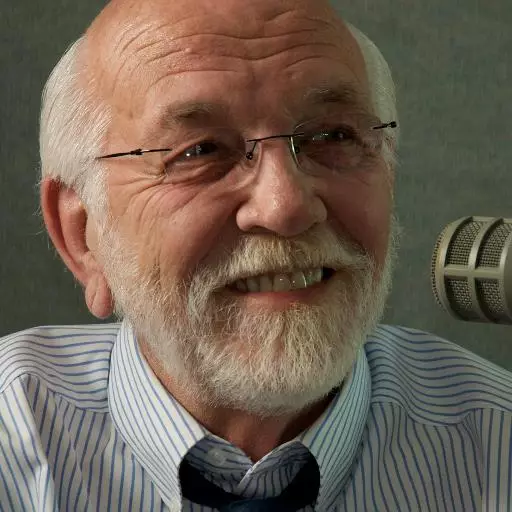
Jonathan Feldstein | Connecting Christians And Jews | Steve Brown, Etc.


How can we build bridges between Christians and Jews? This week, Steve and the gang chat with Jonathan Feldstein, a man who's been doing that very thing for years.
The post Jonathan Feldstein | Connecting Christians And Jews | Steve Brown, Etc. appeared first on Key Life.
Announcer: How can we build bridges between Christians and Jews, and should we? Let's talk about it with Jonathan Feldstein on Steve Brown, Etc.
He's an old white guy, an author, broadcaster, and seminary professor who's sick of religion. And he's brought friends. Please welcome Steve Brown, Etc.
Steve Brown: Hey, we're so glad you're here. You always have a seat at our table. And if you were wondering, I'm Steve, the aforementioned old white guy. Matthew Porter is our executive producer. He's here. Matthew, are you still trying to learn Spanish this year?
Matthew Porter: Sí.
Steve Brown: And what grade did you get in high school Spanish?
Matthew Porter: C-minus. To say C was just too on the nose.
Steve Brown: I got two Ds and wanted to get it off my record because everything else was higher than that. I took it over and failed it.
Kathy Wyatt: I got an F. That year I got straight As and an F. And the Spanish teacher said to me, "Why can't you do this in my class?" And I said, "Because you don't like me."
Steve Brown: You were even crusty in those days.
Matthew Porter: She didn't. She didn't like me at all. If you had learned to say that in Spanish, you probably would have gotten a B.
Steve Brown: I should have thought of that way back then. Our producer Jeremy's in the blue glass booth. Jeremy lived for a while in Miami. He actually knows a little Spanish.
Jeremy: Sí, gracias Esteban. Y bienvenidos a Steve Brown, Etc.
Steve Brown: Oh, he just said that was a funny joke. Were you cursing?
Jeremy: No, I said, "Thank you, Steve, and welcome to Steve Brown, Etc."
Steve Brown: I'm impressed. Our one-man IT department John Myers is in the tech bunker. John recently produced this show for us by himself, so thanks for that. And Jeremy, you need to be careful.
And Dr. George Bingham is the president of Key Life. In honor of Valentine's Day, he wrote a poem for us.
George Bingham: Roses are red, violets are blue, and a tax-deduction donation to Key Life reflects very well on you.
Steve Brown: I'm impressed. And Jeremy should say that in Spanish just in case. And Kathy Wyatt is the soft feminine side of the program. And if it looks like Kathy isn't smiling, it's just that she's still frozen from our cold weather in Florida this week.
Kathy Wyatt: Could I just ask a quick question about the Spanish emphasis today? When we've got Jonathan with us, shouldn't we have been trying to do something in Hebrew?
Jonathan Feldstein: My Spanish is a little bit better than my Yiddish, let's say.
Steve Brown: We're not going to touch Hebrew. And speaking of our guest, Jonathan Feldstein is one of my favorite people in the world. He's the founder and president of Genesis 123 Foundation.
He was born and educated in the US, and that explains a lot of his weirdness. He then immigrated to Israel in 2004, and that explains his wisdom. Throughout his life and career, Jonathan has built relations with Christians, serving as a bridge between Jews and Christians and helping connect Christians to Israel in meaningful ways.
He's kind of our guy with Jews, and he explains us, and we're hard to explain sometimes. And he does a pretty good job. I have friends now who used not to speak to me until they met Jonathan, and Jonathan said, "This is hard, but let me explain Steve to you."
Jonathan is in Jerusalem. That's my favorite city when I'm not there. I forget who said that, but that's a good statement. And if you've been there, you understand. Tell us some of the things that you're doing. They're unbelievably good.
How are things in Israel now? Is the peace holding at all? Do you feel safer? And I want to hear about your sons and what's going on there. So talk to us about what's going on.
Jonathan Feldstein: Thank you. First of all, it's always a pleasure. Really, you're my favorite old white guy. And it's good to be here with you. There's not peace in Israel. There never was peace, not from May of 1948 and not from decades before that.
What we're in the midst of is this ceasefire, but there's not a lot of active combat that's taking place there. But everyone that I know is really on edge. And by the time people are hearing this, maybe something will have happened. But we're waiting for the irony of if the United States is going to attack Iran, and there's good reason to do so.
And then if Iran as a result decides to attack Israel because that's logical. So we're all waiting, and we're leaving lights on in our bomb shelters at night. Every modern home in Israel has a safe room that's part of the building plan. And so we're leaving lights on. We have a two-story apartment, so we leave the lights on by the stairs so we don't fall down going down to the safe room.
I'm very pleased that my oldest son, who's now seen tours out of Israel's borders in Gaza, Lebanon, and most recently Syria, is home now. He's okay, but he's been through a lot in the last two years. My son-in-law the same, my oldest son-in-law, I have two.
My youngest son is doing his compulsory military service, and like I think many young Israelis his age, his generation, I feel like the heroism in them is just bubbling to the surface because they can't do enough. The sense of commitment and volunteerism.
But the paradox to all of that is if you don't listen to Jonathan Feldstein telling you this, and if you're not following the news and you put away your phone, you can go anywhere in Israel today. Go to a cafe, go to a restaurant, go to a movie, go to the beach. It's probably warmer on our beaches than it is on your beaches at the moment.
And you won't know that there's a war going on because we still have hundreds of thousands of soldiers in Gaza, along the Gaza border, a few that are still in Lebanon and Syria holding certain strategic areas, and a lot along the border with them. That's kind of the overview. We're just waiting for a shoe to drop, and that's a very uneasy feeling not knowing if and when.
Steve Brown: Are you hopeful?
Jonathan Feldstein: It's strange. I'm hopeful and I'm grateful. I'm hopeful that the US strikes Iran. I don't think that the justification should only be based on how many tens of thousands of Iranians the Islamic Republic is slaughtering in the streets. But I think that's a good start, a good foundation.
I'm hoping that happens because I'm hoping that whatever will come out of it as a result, we will be closer to world peace at the end of it than at least since before the Second World War, if not more. Because the truth is radical Islam in all its permeations and all of the massive number of tentacles that it exhibits around the world, I think there's a case to be made is more dangerous than Nazism and imperial Japan.
Steve Brown: I kind of agree. And I think Iran is funding all of that, is behind it, and is sending soldiers to make it happen. And I think when you kill the head like that—and I hope Trump doesn't back off. I don't think he will. I mean, he's demonstrated before that you shouldn't mess with him when he says he's going to do something.
Even if it's wrong, he's going to do it. And I think something's going to happen. And I hope that problem gets resolved. You know the great thing that's happened here is Venezuela, and Iran gets a lot of their oil from there. And so when the faucet is turned off, maybe they won't have gasoline to do the evil that they do. But you're hopeful, and I'm hopeful in the same way you are.
Listen, when we come back, we're going to talk to Jonathan about the Genesis 123 Foundation. You're going to be blown away when you see what Jonathan is involved in. And you're going to go out if you're a Christian and search for some Jewish friends. And if you're Jewish, you're going to go out and search for some Christian friends.
Because when they hate them, they hate us too. Both sides can say that. And it's a good thing to keep in mind when we're having this discussion with Jonathan Feldstein. He's the founder and president and a good man. If you go away, you'll get the hives.
Announcer: Welcome to the Vault, your home for classic sermons from Steve from the 90s, the 80s, even all the way back to the early 70s. The Vault is a one-of-a-kind online experience where you can explore more than three decades of grace-filled messages. Get the details and check out a free audio sample at keylife.org/vault. That's keylife.org/VAULT.
Hi, this is Steve Brown. In case you didn't know, one of the main reasons Key Life exists is to remind believers that God isn't mad at his children. Why am I telling you this? Because our weekly email Key Life Connection takes the best of the videos and articles and puts them right in your inbox. We'd love for you to try it. It's free. Go to keylife.org/subscribe.
Steve Brown: Hey, thanks for spending this hour with us. We're talking to Jonathan Feldstein. Jonathan, as I said before, but you never listen to me, serves as the founder and president of Genesis 123 Foundation. That's a non-profit created to build bridges between Jews and Christians with Israel in ways that are new, unique, and meaningful.
Jonathan, just quickly off the air, we were discussing you're getting ready to do a Zoom interview with four candidates for Senate in North Carolina. I think that's cool. Are you going to say nice things to them or what?
Jonathan Feldstein: I'm going to keep it very straight and no zingers. But I have a friend, full disclosure, his name is Thomas Johnson. I was catching up with him recently and he said he's running for Senate in North Carolina. I'm like, "Okay, that's great." And he wanted to know what his stance should be on Israel. And I said, "I'm not going to tell you what your stance should be. You should tell me what you think."
And then in the course of this conversation, I said, "Well, hey, I run this podcast called Inspiration from Zion. Maybe I should do a town hall with you and all the other conservative candidates." And he loved the idea, and I reached out to the candidates. We have about half of them joining me. It'll be posted on the Genesis 123 Foundation YouTube channel and Inspiration from Zion podcast in a couple of weeks.
So we are hosting a town hall about Israel with four or five of the Republican candidates for Senate from North Carolina. And why that's important, of course Israel's important and it should be, but North Carolina is a seat that's vacating. So it's wide open. There's seven or eight people running on the conservative side and seven or eight people running on the other side.
It's a wide-open field. And so it's one of the most watched races in 2026 across the country. So it'll be a fascinating conversation, and I'm going to probe them. None of them have seen my questions. And we're going to get into what their views on Israel are.
Steve Brown: Good. I like Jonathan because he's a conservative. I would love him if he were a liberal; it would just be harder.
Matthew Porter: Jonathan, just kind of continuing in the vein of politics, I'm just curious what your take is on how Trump is maintaining the US's relationship with Israel and very recently any what's your take on that and how he's handling those relations?
Jonathan Feldstein: So when I lived in Atlanta, I learned how to do the two-step. And sometimes I feel like we're going one step forward and two steps back or vice versa. Look, I think overall, President Trump's instincts vis-a-vis Israel, his support is strong and his instincts are good.
Having said that, I'm not embarrassed to say it, recently I think he's been doing some things that if I were in his seat, I wouldn't do. And I'm speaking specifically, he talks a lot about peace. Peace has not broken out in the Middle East. It's not true. It's a nice aspiration, but you don't get that aspiration by declaring it.
The other side is he's created a Board of Peace. But as I've just written, in fact, for one of the questions that I'm going to speak to the North Carolina candidates about, 10 or 20% of the members of the Board of Peace, the countries, are countries that are either radical Islamist that are at serious conflict with Israel or are moderate Islamist countries that just don't recognize Israel's right to exist.
And I don't know how you include people like that in a Board of Peace if your objective is to make peace with the Jewish state. So I'm hesitant. I don't like Qatar. I don't like Turkey. I'm not so thrilled about Pakistan. Egypt and Jordan have been a little tenuous in terms of their relationship with Israel, even though they're at peace with us. I always know that it's possible with President Trump that he has something up his sleeve that none of us can imagine. And I'm praying that it's there and that you and I will have this conversation again, and I'll gladly say, "Nope, I was wrong."
Jeremy: Jonathan, from our side of the Atlantic, it seems like there are some pretty significant divisions in terms of how we support Israel and in particular related to Israel's self-defense and response to the attack from Gaza and so forth. Are there similar divisions in that vein in terms of a strong position versus a more moderate position among Israelis related to response to Gaza and so forth? Do you see those divisions there?
Jonathan Feldstein: Well, not only do you see the divisions, but we're in an election year. Our parliamentary democracy, we have a very different voting system, but we are in an election year. If the current coalition government makes it to the end of its term this fall, then that'll be one of the first in the history of the state of Israel that we actually make it because parliamentary coalitions don't typically last.
One of the reasons it might not last is that even the parties that are members of the coalition now need to use early 2026 to differentiate themselves from one another so that they can all capture votes from one another and come out of the election, whether it's in the spring or whether it's in the fall, at a higher place with more seats in the parliament. And so we are seeing it.
It's a little bit easier now to be more divisive in public because, thank God, all of the hostages as of the last week of January were finally brought home. The last one in a body bag, but everyone's back, and many of us thought that that would never happen. So now we're going to see political divisiveness on steroids here. And I hope that it doesn't break down into civil problems as well. It's one thing to disagree politically; it's another thing when that trickles down into society.
Jeremy: And that would be specifically related to Israel's involvement in Gaza?
Jonathan Feldstein: The war itself, the conduct of the war, who's responsible for the war, who has a better idea, who has better relationships with foreign governments, and how we would move forward in theory making peace.
Steve Brown: They say that if you get three Presbyterians together, there'll be seven different views. That's true of Jews too in Israel. Man, if somebody had a rocket pointed at me, I'd learn to get along with everybody on my side of the fence, and I would do it quickly. But then that's just me. Probably I'd run as fast as I could in the other direction.
We're talking with Jonathan Feldstein, and we're going to talk to him some more about some plans for the future. And it's going to amaze you, and you can be a part of it. So don't go anywhere. Like Jesus, we're going to come back.
Announcer: Hi, this is Steve Brown, and I'm excited to tell you about a new offer from Key Life called Living with Steve. Let me tell you the way it works. I travel with you wherever you go. If you need an entertaining conversation or even a sermon, there I am. That's the good news. The bad news is that it costs a million bucks. But wait, there's good news. You can get everything I've just described with the Key Life app. And for a limited time, it's not a million dollars, it's free. Try it now at keylife.org/app.
Steve Brown: Hey, thanks for hanging out with us. By the way, if you haven't yet subscribed to the weekly Key Life email, you're missing some really good stuff. And even if you don't think it's good stuff, it's free, so you can't complain. So while you're thinking about—no, wait until the program's over and then go to keylife.org/subscribe. And once you do that, you will rise up and call me blessed for having told you about it.
Jonathan, I love that your whole work is in creating greater understanding between Christians and Jews. Just a broad question really, what's one thing that you wish more Christians knew about Judaism?
Jonathan Feldstein: It's a great question. First of all, I have three answers, and they're quick. First of all, let's remember that Jesus was Jewish. Jesus's Bible was the Hebrew Scriptures. He was born a few miles from where I'm sitting, and he lived an observant Jewish life like I do. He didn't have elevators in his building, so he didn't worry about how to use the elevator on Shabbat, but he would be very familiar in my community.
The other thing that I think Christians need to always know and remember is that God's covenant with Abraham through Isaac and Jacob—and it's important, we always have to say through Isaac and Jacob—is a covenant that's eternal, that's unbreakable. It hasn't been replaced; it hasn't been revoked. God didn't change his mind.
And I love what Steve says because I believe it, that we're on the same side. And that's one of the reasons we have Root and Branch because the metaphor of you Christians being grafted into the covenant, but we're the root. And that's important.
And the other thing I wish Christians knew more—and we're doing some programs on my podcast Inspiration from Zion to talk about more traditional Judaism—is specifically observing the biblical festivals. Because it's easy for a Christian, and it's not wrong for a Christian, to read the biblical festivals—and we're coming up on celebrating Purim, the story in the book of Esther—and to read them through a Christian prism, and that makes sense.
But I think to understand and build relations, Christians should better understand the whats and whys and hows we do it. When we talk about Passover, we're talking about our liberation from slavery 3,500 years ago and everything that that meant and still means to us today.
Steve Brown: And that's our family. Jonathan, we've talked about it some before, but just review again if you would, what inspired you to immigrate to Israel and then also begin the Genesis 123 organization?
Jonathan Feldstein: Okay, so I wanted to live here since I was a teenager. My father was born here in 1937. So he was referred to as a Palestinian. He was an original Palestinian before the name was hijacked by another ethnic group the year I was born. Because when he was born here, the only people referred to as Palestinians were the Jewish population.
When I came here, I felt at home. When I came here for the first time, I felt like this is the place I wanted to live. And strangely, and I was a teenager, I had never dated anybody, but I wanted to raise my children here because I wanted to be in the front line or, some people say, the starting five. And I wanted to raise my kids here where we're making Jewish history, not living on the sidelines.
And when I met my wife, 1991, the day the Gulf War ended in 1991—so that's coming on 35 years, a long time—we both had that same aspiration. And it took—God is funny—we had a plan. There's a Yiddish phrase that's translated "man plans and God laughs." So our plan was deferred by a bunch of years, but we made it in 2004. We imported our five oldest kids, and our youngest was born here, and he's the one who's now doing his compulsory service. And it's a blessing. And now we have five grandsons who are born here.
And as far as Genesis 123, so back in the late '80s, I was working at the Israeli consulate in Atlanta and went into a church for the very first time speaking on behalf of the state of Israel. And God showed me something remarkable which I had never thought about and I never would have understood: Christians loving, supporting, celebrating, praying for the state of Israel and the Jewish people. And that's not something that Jews grow up hearing about. Not at all. The opposite, if anything.
So I realized that God was really giving me a very firm tap on the shoulders, calling me to do something. It took me years later—that was in the late '80s—to be here in the land before I could actualize that. And then after a career where I was very successful building transactional relations, meaning fundraising for other organizations, when I passed 50, I didn't want my integrity to be what kept me up at night. I didn't want all my relationships to be about how much I could monetize them, but I wanted to build true relationships, not transactional ones. And that's when I started the Genesis 123 Foundation in order to do that, in order to leave a legacy that's more than swiping a credit card.
Steve Brown: Are you seeing with Christians when they hear your message for the first time reacting very positively because of God's spirit in them?
Jonathan Feldstein: I hope they would be reacting to God's spirit in me first of all. But yes, absolutely. There's a wonderful, refreshing thing for Christians to see—especially people who know that from the beginning of the church which excised Judaism from the early church and in the terrible period that Jews were being slaughtered in the name of the church, in the name of Jesus.
So Christians who see someone like me come into their church and speak and embrace them because they're embracing me are refreshed, are grateful, are blessed by that. And by the way, that's my job too. We're supposed to be a blessing to the families of the world.
Steve Brown: Jonathan, we're out of time. I hate this. We've got to either do a doubleheader or we're going to get a longer show. And for certain guests, we're going to use the longer one, and you'd be at the top of the list.
Listen, we do rise up and call you blessed. What you're doing is God's work, and you're making a difference, and we're so glad for you. I pray for you every day of my life. And Jonathan, if it gets really bad, let me know and I'll stop.
Go to genesis123.co and you'll discover some really good stuff. Jonathan, thanks for being with us. I hope we can do it again soon.
Jonathan Feldstein: Thank you. God bless you, my friends.
Steve Brown: Well, we're going to come back for a little bit and tell you who we're going to do it unto next week. But this has been hard work, so we've got to rest before we do that. So listen to the commercials and don't go anywhere.
Announcer: Hey, thanks for listening to Steve Brown, Etc. and if you're enjoying the show, would you help us let others know about it? You can share a link, click subscribe on our YouTube channel, or drop us a review on your favorite podcast platform. Thanks so much.
What if you could start your day by hanging out in God's word and with some of the most significant theologians, authors, and pastors ever? That's the idea behind the one-year devotional, *God With Us*. Find it now at keylife.org/store.
This is Pete Alwinson, and if you're a guy, I want to show you how to recover and reclaim an intimate growing relationship with your heavenly Father. Check out *Like Father, Like Son: How Knowing God as Father Changes Men*, available now at keylife.org/store.
Believer, I want you to remember that where sin abounds, grace does much more abound. And you will run out of sin before God runs out of grace. Grace, the real good news of the gospel. Find it now on keylife.org/store.
Matthew Porter: What a great hour with Jonathan. I love that guy, and I love what he's doing. You say, "Steve, where did you get this thing for Israel?" Do you know when I started seeing this? When I was a teenager, and that was back in the days of Columbus, just after he came to America.
I had a dance band I did through college, and the manager of my band was Jewish. And so he set up a lot of gigs at Jewish events, and we played those.
Steve Brown: And I had heard, because there's a lot of it around, a lot of anti-Semitic jokes and anti-Semitism in a lot of different places. And then I got to these Jewish events and absolutely loved them. And all of those jokes became offensive.
And that was the beginning of my thinking, "They're lying about the Jews." And I began to check on it. And later on, when I was a pastor, I began to preach on it and became a part of an organization, one of the founding members, called Forgive Us Israel. And we Christians have done some really bad stuff. Now that doesn't make Jewish people wonderful; they did some bad stuff too. We're all sinners in need of grace and mercy.
But Christians formally persecuted Jews in horrible ways. And I went to Israel to do some research on a book about that particular subject. I never had to publish it; somebody else wrote it, and I was kind of glad. But I learned a whole lot.
And a part of that is that when we speak of Jesus to Jewish friends, before you do that, ask forgiveness for what's been done in the name of Jesus. And you may not even know what that is, but they'll know, and you'll be surprised at the reaction. Good hour. Hey, who's going to be with us next week?
Matthew Porter: Next week is going to be a great week. Matthew's going to be hosting for us, and we are going to have Stephen McWhirter, who I've never even heard of, which is fine because I don't know a lot of people out there. But his book is titled *Radically Restored: How Jesus Heals Our Brokenness*.
And he has a horrific story. And he is a musician, and he is the person, once I found this out, I was like, "Okay, it's all over now." He wrote the song "Come Jesus Come." And if you haven't heard CeCe Winans sing "Come Jesus Come," you have not gone to heaven. You don't want to miss next week. Everybody but me will be here. And I'll be watching just in case. Between now and then, don't do anything we wouldn't, and that gives you a wide, wide range.
Featured Offer

Are you feeling guilty? Maybe it’s what you said to your husband or wife last night...what you did years ago…the places where you’re struggling right now. What do you do with your guilt? Ignore it or bury it? Or is there another way, one that can handle guilt for good? Guilt can lead us back to Christ to find true and lasting forgiveness. His death paid the debt for all our sins. He loves us that much.

Featured Offer
Are you feeling guilty? Maybe it’s what you said to your husband or wife last night...what you did years ago…the places where you’re struggling right now. What do you do with your guilt? Ignore it or bury it? Or is there another way, one that can handle guilt for good? Guilt can lead us back to Christ to find true and lasting forgiveness. His death paid the debt for all our sins. He loves us that much.
About Steve Brown, Etc.
Key Life exists to communicate that the deepest message of the ministry of Jesus and the Bible is the radical grace of God to sinners and sufferers.
Because life is hard for everyone, grace is for all of us. And grace means that because of what Jesus has done, when you run to him, God’s not mad at you.
All of the radio shows, sermons, books, and videos we produce work together toward one mission: to get you and those you love Home with radical freedom, infectious joy and surprising faithfulness to Christ as your crowning achievement.
Learn more: http://www.keylife.org
About Steve Brown
At Key Life, Steve serves as Bible teacher on the radio program Key Life and the host of the talk show Steve Brown, Etc. Prior to Key Life, Steve served as a pastor for more than thirty years and continues speaking extensively.
Steve has also authored numerous books, including How to Talk So People Will Listen, Three Free Sins, Hidden Agendas and his latest release, Talk the Walk: How to Be Right Without Being Insufferable (now available as an audiobook).
Contact Steve Brown, Etc. with Steve Brown
steve@keylife.org
https://www.keylife.org
P.O. Box 5000
Maitland, FL 32794
In Canada, send requests to:
Key Life Canada
P.O. Box 28060
Waterloo, Ontario N2L 6J8