

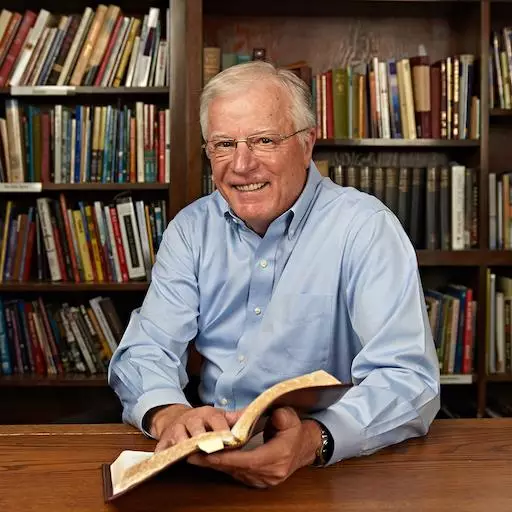
The Sin We Rationalize – Part 1 of 2
“Sin” is a word that has been dropped from modern vocabulary. Even some Christians prefer to think of “sins” as shortcomings or sicknesses. In this message from Ephesians 2, Pastor Lutzer exposes two deadly lies we believe about sin. Sin is so serious God sent his Son to pay the ultimate penalty that ultimate justice demands.
Dave McAllister: Let us run with endurance the race that is set before us, looking to Jesus, the founder and perfecter of our faith. When you read the Bible, you find that God is not tolerant of something called sin. Sin means missing the mark God has set for our behavior. Sin is so serious that God sent his only Son to die as a sacrifice to pay the penalty ultimate justice demands. From the Moody Church in Chicago, this is Running to Win with Dr. Erwin Lutzer, whose clear teaching helps us make it across the finish line.
Pastor Lutzer, in days gone by, sin was seen as wrong. It seems now that sin is something we manage. Tell us about the sin we rationalize.
Dr. Erwin W. Lutzer: Dave, I think you put it so beautifully and so accurately. Nowadays, we manage our sin. What a way to describe the reality of the human heart. Now, here is a quote. I don’t know who said it, but I know it is true. The human mind is able to rationalize anything that the human heart wants to do. And so it is we manage our sin instead of turning from it.
Well, this is the second to last day we are making a special resource available for you. It is entitled Be Joyful. It is a book by Dr. Warren Wiersbe. It is actually a very readable commentary on the book of Philippians. We think it will help you in your Christian journey. Here is what you can do. You can go to rtwoffer.com, rtwoffer.com, or call us at 1-888-218-9337. Now, at the end of this message, I’m going to be giving you that contact info again because we don’t want you to forget or to neglect what we think will be a tremendous help in your spiritual journey. But for now, let us listen.
While perhaps you have noticed that the word sin has basically dropped from our vocabulary. Oh, I know, eating chocolate is still sin, but lying isn’t. Many years ago, a psychiatrist wrote a book entitled Whatever Happened to Sin? And I read it many years ago, and it is just as relevant today, perhaps more relevant than it was when it was written some time ago. Whatever Happened to Sin?
Let me tell you today that your view of sin, if you have a wrong view of sin—let me put it that way—if you have a wrong view of sin, you will be wrong about everything in the world that really matters. Your understanding of sin determines who you are as a person and your understanding of God’s grace. The doctrine of sin, the sin we rationalize.
Think of what happens if you have a naive view of sin, like Karl Marx, for example, who believed in a utopia. That people, if given a chance, are going to live together, be happy to work for the state, and to be really content with the equality of all people. What naivete. And he almost ruined the world proving how foolish that was.
And if you have a wrong view of sin, you will think to yourself, "You know, my sins aren’t really that big a deal. God is something like I am, except a little bigger and a little higher, and I can maybe get him to accept me. And if he doesn’t accept me," a woman said on a plane to a friend of mine who was witnessing to her, "if he doesn’t accept me, then I’m going to tell him to lighten up."
In other words, my sins aren’t that great. Furthermore, I can manage them. I can live with the consequences. They are within my control. If you don’t understand sin, you might be rationalizing it that way. If you don’t understand sin, you might not get the help that God is able to give you.
Today, nobody has sins and addictions. Addictions have become sicknesses. And the reason for that is because we want people to come for help. Nobody should be embarrassed because of a sickness, but we are embarrassed because of our sins. So we call sins sicknesses.
The problem with that is God has not promised to heal all of our sicknesses, but he has promised to deliver us from our sins if we meet the conditions. So you see, if you have a wrong diagnosis, you might end up with the wrong cure of what is really needed.
Well, there was a time when the word sin was a strong word. And when somebody said sin, we knew what they meant. Not today. Nobody sins; everybody makes unwise choices. I was reminded of that and somewhat amused by this. I was walking three blocks from here, walking to the church from the loop for the purpose of exercise along Clark Street.
And I was met by a whole host of little school children, all dressed in uniforms, looked very, very beautiful. And they were maybe, what shall I say, seven or eight years old. And one of the kids, bless him, he was walking with one foot on the sidewalk and the other foot on the street. And the teacher said to him, "Now, Matt, you’re making an unwise safety decision." All right.
I’m not saying that Matt was sinning, but I do know this: that when I was that old in school, our teachers would have spoken to us much more plainly, much more plainly than making an unwise safety decision. And so there are people today who use language to tone down what they’ve done. Someone who has bilked retirees from all of their money, he hasn’t really sinned or committed a crime; it was just a lapse in judgment. Jay Leno calls it "no-fault syntax." Nobody’s guilty of anything anymore.
Now the Bible has a different picture of us as human beings, and it is not a pretty picture. Some of you are going to sit through this message and say, "Wow, all of this on a Sunday morning? We came to be happy, happy, happy." Well, the happiness is going to come because you cannot really understand who we are and what grace is unless you understand sin. And today we are going to look at it and, as I mentioned, it is not very beautiful.
Somebody asked what is the difference between a psychiatrist and a coal miner? And the answer is that the psychiatrist goes down deeper, stays down longer, and comes up dirtier. That’s what it’s like to look into the human heart. And today we are going to begin only a little bit of that picture, not everything because the Bible says we can’t comprehend everything, but we are going to take a look at it and the text is Ephesians chapter 2.
Ephesians chapter 2 is a very familiar passage to us. It begins by saying, "And you were dead." Now, if I can just find it. I thought I had it here, but evidently I didn’t. But I know that it’s in the New Testament. I know where it is. Ephesians chapter 2: "And you were dead in your trespasses and sins." I’m going to stop there.
The Bible is talking about us before we received Christ, before Jesus connected us to God. We were dead in trespasses and sins. Not physically dead. Look at Adam. After he and his wife sinned, they woke up and the sky was blue, and the grass was green, and later on they discovered that the weeds were powerful, and he went along and lived and they bore children and everything. Spiritually dead.
Now God made provision to connect them back then, knowing that Jesus would eventually come, but left to themselves, dead in trespasses and sins. That’s who you are without Jesus Christ. Now think about it. Obviously, you may be listening to this message. You may enjoy opera. You’ve got your friends. You may be attending university. You’re going to school. But if you don’t know Christ and have never trusted him, you are dead in trespasses and sins. Now for a few moments, let’s think of deadness. Let’s think of a corpse.
One of the things that we learn is that dead is dead. There’s not degrees of deadness; there’s only degrees of decay. We go down to skid row and we meet a derelict there who’s wandering along, hasn’t showered for two weeks, is asking people for money for another drink. And we can see him there, and the decay is quite evident.
And then we look at someone else who is involved in social work and raising funds for the poor, but they don’t know Christ as Savior either. Both are dead, but both are not equal in the decay. That’s the only difference. But both are dead in trespasses and sins, cut off from God.
Dead is dead, and also the dead person has no spiritual appetite. Now, they may be interested in God, but they’ll always want to come to God in their own way and in accordance with their own convictions and for their own benefit. But they aren’t necessarily interested in a life of holiness. They do not thirst after righteousness.
They want to use God and to try to find the God that is within them. And I say to you with a smile on your face, look very carefully and see if you can find that God within. And they will not submit to the God without, to the holy God, because they have no spiritual appetite.
Another characteristic is they can’t raise themselves. You can’t go to a funeral home and say to the corpse, "Now, if you would just wiggle your finger, God would do the rest." But at least let’s show some interest in coming alive. A corpse can’t do that.
I know that it seems as if I tell this story every year at Moody Church, and I suppose I’ll continue to tell it every year because it certainly fits here. When I teach preaching at Trinity International University, I always take the students on a beautiful fall day to a cemetery and we gather around a tombstone, and this is the passage that I read. That we are dead in trespasses and sins.
When you preach the gospel to the unsaved, you’re talking to the dead. So I say to the students, "This is a good place for you to practice preaching to the dead." I say, "Find a tombstone and preach and tell them that the day of resurrection is here." The color drains from their faces.
So then I say, "If you won’t, I will." And I go over to a tombstone. Let’s suppose it’s Jonathan, dead, died 1912. I shout, "Jonathan, stand up! It’s the day of resurrection!" And then I always wait for resurrection. Fortunately, none has ever happened, you understand.
I say to the students, "How do you think that made me feel?" And they always say, "Pretty stupid." Yeah, sure did. And then I say, "That’s how stupid you are every time you preach the gospel, except for verse 4 in this passage: But God, being rich in mercy, for his great love wherewith he loved us, even when we were dead in sins, raised us up." Praise God.
I tell the students that when you preach the gospel, you’re expecting the dead to rise, the blind to see, and the deaf to hear. How many of those miracles can you do? And then I go over to the book of Ezekiel where Ezekiel was asked to preach to dry bones, and with a smile on my face, I say, "Every pastor can relate to that, preaching to dry bones."
What a silly thing to do, preach to dry bones. But while he is preaching, flesh comes on the bones. While he is preaching, life is breathed into those bones, and those bones live by God’s sovereign power. And that’s why we witness, and that’s why we preach, and that’s why we proclaim, because God is able to raise the dead.
And after 15 minutes of this exposition, we get on our knees in the cemetery, and we dedicate ourselves to unrelenting, hopeless dependence upon God in the proclamation of the gospel, because we’re preaching to the dead. Not the grateful dead, but the walking dead. And there is a difference. The whole world is a cemetery, spiritually speaking.
So Paul says we’re dead in our trespasses and sins, and in verse 2, he goes on to say, in effect, that we’re deceived. He says, "In which you once walked, following the course of this world, following the prince of the power of the air, the spirit that now is at work in the sons of disobedience, among whom we all once lived in the passions of our flesh, carrying out the desires of the body and the mind." Just that far. I’ll leave the last phrase for a moment.
You’ll notice that Paul says we’re basically deceived. It says that we are following the God of this world. That’s Satan. Now you and I very probably have never met Satan directly. Just like in World War II, soldiers, for the most part, never had any direct contact with Hitler.
But you see, Satan has all of his associates, and they’re called demons. And apparently there are tens of thousands of demons, and so we are up against his army. And we are deceived because we are following his way, and what is his primary characteristic? It is lies—lies, lies, lies, lies, lies, lies, lies. And we believe them, and we think we’re doing ourselves a favor.
The first lie that we believe is that we can manage our own affairs, that we can be king of our own lives, and we don’t need God to interfere with our morality and with our sin. We’ll handle it, thank you very, very much. Well, that’s what the devil said, and look what happened to him. Banished from God forever, he will be. So we tend to believe those lies.
We then say that we can manage our sin on our own. We can manage it, we can live with the consequences. Like one man said to me, "I’ll get what I want today, and I’ll deal with the devil tomorrow." And so we believe the lies. We also believe that we are rationally driven.
You’ll notice the Bible says we aren’t. We fulfill the desires of the flesh and of the mind. Parenthesis: we, as human beings, saved or unsaved, are basically desire-driven. When we receive Christ as Savior, he gives us different desires, but we aren’t the rational creatures we pretend we are.
Here’s what we do. We do what our heart wants to do. In the immortal words of Woody Allen, "The heart wants what it wants." So we do what the heart wants to do, and then we recruit the mind to justify it so that we can live with ourselves. And we’ve got it all worked out, and we tell ourselves these lies that we just love. We love the lies that we tell ourselves.
And then we begin to live our lives in two compartments. We discover that a lie works. Of course, lies work. That little boy in Sunday school had a point. "A lie is an abomination unto the Lord, but a very present help in time of trouble," he said. We discover that lies get us out of difficult situations.
So what happens to human nature as it progresses along is that a person may end up living in two worlds. In World A, he’s a Sunday school teacher, he’s a deacon, he’s well-respected in the community because to him the opinion of others is absolutely essential. It’s not necessary for him to be good; it’s very essential to appear good. That’s World A.
World B, he may be beating his wife, he may be mistreating his children, he may be a child molester, and World A and World B are never allowed to come together. In fact, there’s a wall between them that is soundproof so that he can live with himself. Like one man told me, "There was a part in my mind where no one, not even God, was allowed to enter." And the whole life is built on deception and on lies.
And when sin is exposed, we as humans have a tendency first of all to deny it, secondly to minimize it, thirdly to compare it with someone else who is worse than we are, and so we go on our way, managing through life thinking we’re doing the best that we can. And there’s no area in which we are more gladly and willingly deceived than in the area of sexuality because it touches so deeply as to who we are as people. So it is there that deceptions happen.
Examples are legion at this point, but I’m thinking of two lesbians, both brought up in Christian families, living together and saying, "There’s nothing that we are more sure of than this, that God approves of what we’re doing because our relationship is so beautiful." Now let’s think about that for a moment. No one can argue with them as to whether or not it’s a beautiful relationship. I’m sure that it is, if they say that it is, we have to accept that.
But that was Eve’s argument in the garden. She said the fruit of the tree is beautiful; it’s the fruit of the tree to make one wise. She saw its beauty. But we look at the scriptures and we discover that not everything that is beautiful is right and holy.
Relationships, adulterous relationships: "Well, now I have found love. Who can, who can object to love?" Not all loving relationships are holy and beautiful. It is in this area that we deceive ourselves most readily, and we tell ourselves lies, and we believe those lies, and we convince ourselves of those lies, and we are determined to live with those lies until the undertaker takes us to the cemetery. We are people who are deceived and gladly deceived, but deceived nonetheless, and Satan has misled us.
So first of all, we find in the text that we are dead, we are deceived, and then we are depraved. What an awful word to use in a church in an era of time when everybody wants to hear happy, happy, happy sermons. We’re depraved. You’ll notice the text Paul says, "By nature, we’re the children of wrath like the rest of mankind."
By nature. It’s not just the choices we make, but by nature, a baby is born as a child of wrath under condemnation, not innocent. A baby is not born innocent. You say, "Well, I don’t like the idea that we’re under Adam’s sin." Well, there are instances in which you could be born into a family that is in debt.
And I’m sorry, but you inherit that debt and you have to manage that debt. And the Bible would teach that because of Adam, we are all constituted sinners and we’re all born under condemnation. That sweet little baby is not innocent.
Dave McAllister: And you know, my friend, all that you have to do is to wait until that sweet little baby is two years old, and then you will know for sure that children are not innocent. Well, of course, it is a different subject, but I want to emphasize the fact that I do believe that babies and children go to heaven thanks to Jesus, but at the same time we have to know that sin is something deeply rooted in the human heart. And the only way in which we can confront it and do so adequately is through repentance and faith.
Well, this is the second to last day we’re making a resource available for you entitled Be Joyful. It’s a book by Dr. Warren Wiersbe. And the reason that we think this resource will help you so tremendously in the Christian life is, first of all, it is very readable. And you and I know right well we can read the scripture and we can miss so much simply by reading it and not meditating on it and absorbing it into our minds.
This book will help you to do just that. Very quickly, I hope that you have a pen or pencil handy. What I want you to do is to go to rtwoffer.com. That’s rtwoffer.com or pick up the phone and call us at 1-888-218-9337. Now, because this is the second to last day, I’m going to be giving you that contact info again, but I want to thank you from the bottom of my heart for your generous support of this ministry. You’ve heard me say it before, but because of people just like you, Running To Win goes around the world.
Well, once again, that contact info: go to rtwoffer.com or call us at 1-888-218-9337. Remember the name of the resource, Be Joyful. It is a very readable commentary on the book of Philippians by Dr. Warren Wiersbe. And we’re so thankful once again for you joining hands with us as together we run toward the finish line.
You can write to us at Running To Win, 1635 North LaSalle Boulevard, Chicago, Illinois, 60614. There’s a sickness inherent in the human race. Full prisons testify to the reality of sin. Prisons are full of people born in sin, born with a propensity to do wrong. But as Paul says, we’re all by nature the children of wrath.
In our study of key doctrines, we’re coming to grips with the sin we rationalize. Next time on Running To Win, Erwin Lutzer will finish this study. Running To Win is all about helping you understand God’s roadmap for your race of life. Thanks for listening. For Pastor Erwin Lutzer, this is Dave McAllister. Running To Win is sponsored by the Moody Church.
Featured Offer
In spite of his dire situation as a prisoner in a Roman jail, Paul's letter to the church at Philippi overflows with joy. Discover Paul’s secret to finding joy in Christ as Dr. Warren Wiersbe leads you on a verse-by-verse tour through the book of Philippians. Learn how your joy can also be complete in Christ. Click below to receive this book for a gift of any amount or call Moody Church Media at 1.888.218.9337.
Past Episodes
- Changed By The Word
- Children of an Awesome God
- Chiseled By The Master's Hand
- Christ Among Other Gods
- Christ Before Bethlehem
- Christ, God's Gift at Christmas
- Christians In Conflict
- Come and See Jesus
- Cries from the Cross
- Crowning Christ Lord
- Seven Convincing Miracles
- Seven Reasons You Can Trust The Bible
- Seven Secret Snares
- Sharing Secrets With God
- Slandering Jesus
- Suffering Wrong
- Ten Lies About God
- Thanksgiving
- The Battle for America’s Youth
- The Church in Babylon
- The Darwin Delusion
- The Flurry Of Wings
- The High Cost Of Lost Opportunities
- The Invisible War
- The Invisible World
- The King Is Coming
- The Legacy of a Converted Man
- The Man Who Cradled God In His Arms
- The Manger And The Sword
- The Power of a Clear Conscience
- The Triumph of the Gospel
- The Triumph Of Unanswered Prayer
- Till Death Do Us Part
- What Do These Stones Mean?
- What is God Up To
- What Jesus Thinks Of His Church
- What We Believe
- What Would Jesus Do?
- When a Nation Forgets God Interview
- When God Is First
- When God Shows Himself
- When the Spirit Has His Way
- When You've Been Wronged
- Who Are You To Judge?
- Why Good People Do Bad Things
- Why The Cross Can Do What Politics Can't

Video from Dr. Erwin W. Lutzer
Featured Offer
In spite of his dire situation as a prisoner in a Roman jail, Paul's letter to the church at Philippi overflows with joy. Discover Paul’s secret to finding joy in Christ as Dr. Warren Wiersbe leads you on a verse-by-verse tour through the book of Philippians. Learn how your joy can also be complete in Christ. Click below to receive this book for a gift of any amount or call Moody Church Media at 1.888.218.9337.
About Running To Win
Running the race of life is hard. But with the Bible front and center and a heart to encourage, Pastor Erwin Lutzer presents clear Bible teaching, helping you make it across the finish line. Since 2011, this 25-minute program has provided a Godward focus and features listeners’ questions.
About Dr. Erwin W. Lutzer
Dr. Erwin W. Lutzer is Pastor Emeritus of The Moody Church where he served as the Senior Pastor for 36 years (1980-2016). He earned a B.Th. from Winnipeg Bible College, a Th.M. from Dallas Theological Seminary, a M.A. in Philosophy from Loyola University, and an honorary LL.D. from the Simon Greenleaf School of Law (Now Trinity Law School).
A clear expositor of the Bible, he is the featured speaker on two radio programs: Running to Win—a daily Bible-teaching broadcast and Songs in the Night—an evening program that’s been airing since 1943. Running To Win broadcasts on a thousand outlets in the U.S. and across more than fifty countries in seven languages. His speaking engagements include Bible conferences and seminars, both domestically and internationally, including Russia, the Republic of Belarus, Germany, Scotland, Guatemala, and Japan. He has led tours to Israel and to the cities of the Protestant Reformation in Europe.
Pastor Lutzer is also a prolific author of over seventy books, including the bestselling We Will Not Be Silenced, One Minute After You Die, and the Gold Medallion Award winner, Hitler’s Cross. Pastor Lutzer and Rebecca live in the Chicago area and have three grown children and eight grandchildren. Connect with Pastor Lutzer on X (@ErwinLutzer) or moodymedia.org.
Contact Running To Win with Dr. Erwin W. Lutzer
media@moodychurch.org
http://moodymedia.org/
Moody Church Media
1635 North LaSalle
Chicago, IL 60614
1.800.215.5001
Monday – Friday
8:00am – 5:00pm CST
Fax Number
1.312.642.4904