

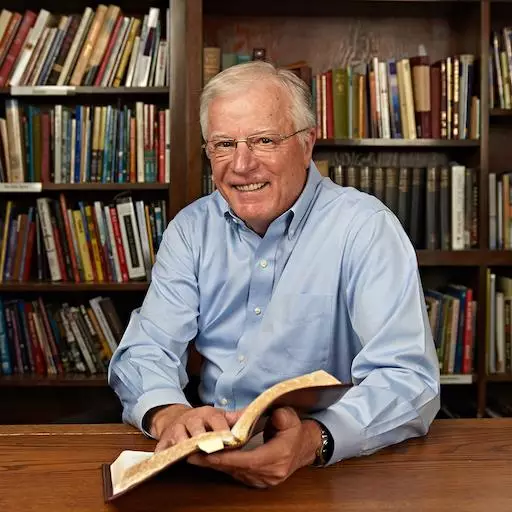
In Prison For Christ – Part 2 of 2


We all carry wrongs from our past that need to be made right. Onesimus was a runaway slave whose return raises a hard question: “Does the Bible condone slavery?” In this message, Pastor Lutzer shows how the Gospel reconciles, transforms, and saves. Why is it good news that Christ comes to dwell only in sinners?
Dave McAllister: Let us run with endurance the race that is set before us. Looking to Jesus, the founder and per fector of our faith. In Roman times, slaves were over half the population. Paul wrote about one slave while in prison, a man named Onesimus. Today, the lessons we can take home from Paul's admonition to the owner of Onesimus, a man named Philemon. From the Moody Church in Chicago, this is Running to Win with Dr. Erwin Lutzer, whose clear teaching helps us make it across the finish line. Pastor Lutzer, we're learning about the legacy of a converted man.
Paul wrote to a man named Philemon about one of his slaves. Bring us up to date so far.
Dr. Erwin W. Lutzer: Dave, I absolutely love this. You know why? Because evidently Onesimus had stolen something from Philemon. And when Paul wrote the letter, he said this, if he has wronged you or owes you ought, put that on my account. Paul says, I'm willing to pay whatever he stole or whatever you are owed. What a wonderful example of the gospel of Jesus Christ. But here at Running to Win, we want to emphasize that this week is the last week we're making available for you a book entitled Failure the Backdoor to Success. I wrote the book because of course as a pastor, I heard many stories of failure.
And yet I also saw many stories of grace out of pain, out of difficulty because God is there for us. And for a gift of any amount, we're making it available for you. Here's what you do. You go to rtwoffer.com. That's rtwoffer.com or pick up the phone and call us at 1888 218 9337. Now even as we contemplate the gospel of Jesus Christ as the word is preached, let us keep in mind that all of us are recipients of God's indescribable grace. But here's the apostle Paul pleading for a runaway slave. Well, I've walked you through the text, but what does this have to do with us and what are the seminal lessons that are transforming that we should remember?
First of all, this is a marvelous illustration, a marvelous illustration of the power of the gospel. When Paul says, you know, he was useless to you, but he's become useful. He's living up to his name. What he has accentuated is the fact that somebody who really was disobedient and evidently a thief has been changed by the power of the gospel. So he lives differently and you can depend upon him now, Philemon. And that's what God wants us to do. You know, in the Bible, God is constantly saying to us, live up to your name. If you say that you are a Christ follower, then follow Christ and live accordingly.
There are some people, and maybe some are listening to me right now, it would be better if nobody knew that you were a Christian because you're not living up to the name of Christ. You remember what God said, what Jesus said to Peter, he said, you are called Simon. This is in John chapter 1. You are called Simon, but you shall be called Peter. You're going to be called a rock. When God saves you, he renames you and gives you a whole new sense of identity as to who you are. That's what God does to those whom he saves.
You know, there is a story that comes to us from the days of Alexander the Great. Evidently, there was one soldier in the army that was really a coward and backed out of a difficult situation. And that soldier's name was Alexander. So this meant that Alexander the Great was enraged. And as the story goes, he went up to the soldier and he shook him and he said, either change your character or change your name. If you're going to be called Alexander, then you have to be a warrior with bravery. You have to live up to the Alexander name.
My dear friend today, God tells us, you are a Christian, live up to that name because you have a huge inheritance. And so this is what we see now. It's remarkable that the apostle Paul sent this young man back. Normally, slaves don't want to go back. Of course, in some situations, they would have been beaten. And I'm sure that in that kind of a situation, Paul would not have sent him back. You're not supposed to go back where there is abuse and so forth. But in many contexts, what this text teaches us is the need for reconciliation, the need for simply not avoiding your past, but going back to the past and making sure that you have done everything within your own power to make your past right.
Now you can't do everything, but there are some things that you can do. Years ago, I told you about a great revival that took place in Canada in the early 1970s. And one of the reasons that the world found out about it is the number of people who are going back and making things right. For example, the Canadian Revenue Service, which is something like our IRS, uh they were receiving all kinds of of money unsolicited from people who had cheated on their income tax. When God works mightily, there's reconciliation. People were going back to stores and saying, years ago, I stole this.
Now in some instances, they couldn't make restitution. For example, I think of a woman who years ago wrote an essay for which she was awarded some money. Well, you know, who knows where the people are who had the context? She couldn't make it right. So this was called conscience money. When the offering baskets were passed, people would actually put in money because it was conscience money and they were seeking reconciliation to the very best of their ability. God wants you to do that. When we come to God in prayer and we are totally honest, there are things that we need to confess and reconciliations that need to be made.
And if not, they will always pop up and they will hinder our relationship with God. And I just heard recently someone said that a marriage can withstand anything. It can withstand even adultery. And there can be reconciliation. But one thing it cannot stand and that is deceit. As long as there is this, what is hidden and there's no attempt at honest reconciliation, that marriage simply cannot move forward. And in a different context, the apostle Paul said regarding young Onesimus, Onesimus, you go back to your owner. But when you do, I'm really going back with you.
I'm sending my heart. I'll stand in for you. And that's your responsibility and mine as well to be the agents of reconciliation. I remember many years ago, there was a woman who who lied at work. And the way she did it is she punched in hours that were fraudulent. She didn't work the hours that she indicated she had. And she came to me as a pastor and said, you know, would you go with me back to this place, back to this organization, back to this company? And would you put in a good word for me?
And I did. And I urged the staff to give her another chance. And she worked there many years. And as far as I know, she never fell into that sin again. So the gospel, you see, with all of its power desires transformation of heart. It's a gospel with power that brings about reconciliation. So there's the personal power of the gospel. But let me speak also about the social power of the gospel, the social power of the gospel. Let's take out a moment and just speak about slavery. You may not know this, but the Bible is often attacked on this basis.
Oh, it's just an ancient book. It condones slavery and because it condones slavery, you know, we can't trust it. It is socially repressive. That's the narrative that's out there. Now let's talk about that. Did you know that there were 60 million slaves in the Roman Empire? 60 million slaves. And that meant that every third person was a slave. One third of the population during this time was slaves. So what what were the options? Should Paul have said now, you know, leave, leave your masters? Uh to do what may I ask? Here you'd have all of these people unemployed that have no place to stay.
And so this was a much bigger issue than you and I realize that it really was. So on the one hand, you know, there'd be no place. The other thing is if Christianity if Christianity were seen as a religion whose primary message was the disruption of the culture by having all of these slaves leave their masters, the message of the gospel would have really been lost. There would have been a lot of confusion as to what Christianity really stands for. So this is the way in which the New Testament deals with the issue of slavery.
What it deals with is that the gospel itself is so transforming that slavery therefore by nature and by definition is unacceptable. That's why in the church, in the New Testament church, what you will find is over and over again, we have references to the fact that slaves are to be treated just as well with just as much honor as anyone else in the church, anyone who is rich, anyone who had status. Slaves were to be treated in the very same way. I can quote many verses, but one that comes to mind is 1 Corinthians chapter 12 verse 13, for by one spirit are we all baptized into one body, whether we be Jew or Greek, whether we be slaves or free, and are all made to drink in one spirit.
So the Bible would indicate that Christian charity and Christian the Christian gospel is powerful enough to so change the human heart that people realize that slavery is really unacceptable. And that's why when England became Christianized, despite its decadence during that period of time, Wilberforce was mightily used of the Lord to prick the conscience of a nation so that slavery would be abolished. You say, but what about the civil rights movement in the United States? Where was the church at that time? Well, there's no doubt that the church was AWOL during that period of time. But isn't it interesting that if you read the sermons of Martin Luther King, what was he doing?
What was he appealing to? He was always appealing to the Christian scriptures and the higher calling of all believers. And because of that, we recognize that the kind of racism and the kinds of horrors of American slavery in a Christian context are evil and completely unacceptable. And the seeds of that lie here within the pages of the New Testament. Yes, you can clap if you want, by the way. The apostle Paul is is putting slaves in an entirely different category. Receive him no longer as a slave. Well, yes, a slave, but a brother. Receive him as you would me.
You put me in the guest room, you put him in the guest room because the relationship has now changed. So there's the personal power of the gospel in the transformation of lives. There's the social transformation of the gospel. But there is also the price that must be paid for the gospel. I think that we have here in this passage a marvelous example of the gospel of Jesus Christ. Here you have the apostle Paul saying two things regarding Onesimus. First of all, Philemon, I want you to receive him as you would receive me. And that's our inheritance as believers.
When you die as a Christian, you will be welcomed into heaven as if you were Jesus because you are found in him. God says, I'll receive you as I will receive my son. Not only that, but the Bible indicates that when Jesus died on the cross, he paid our debt. That is to say, Jesus is the one who on his credit card paid what we owed God. 2 Corinthians chapter 5 verse 21. He, that is God, made him who knew no sin, Jesus, to be made sin for us that we might be made the righteousness of God in him.
Jesus got what he didn't deserve, namely our sin, and we get what we don't deserve, namely his righteousness. So I can imagine as it were that Jesus stands before the Father and says, Father, these have sinned and they owe you plenty. But you've charged that to my account. Receive them as you would receive me. Put them into the guest rooms of heaven because that's where I belong and that 's where they belong too because you have welcomed them as if they were me. Martin Luther was a flawed man, but he saw this very clearly. He saw what it was like to strive against the righteousness of Christ and seek somehow our acceptance before God on our own.
And one day, he wrote a letter to a man by the name of George Spalin. There's also a George Spalatin to whom he wrote, but this is Spalin, l e i n at the end. And I want to read it to you. This is a letter of counsel to a man who was overwhelmed by his own sin and trying to somehow rectify it by his own righteousness. Luther said this. Now I should like to know whether your soul, tired of its own righteousness, is learning to be revived by and to trust in the righteousness of Christ.
Are you weary, by the way, of trying to live the Christian life and always failing and trying harder next time? Is your soul revived by the righteousness of Christ? For in our age, the temptation to presumption besets many, especially those who try with all their might to be just and good without knowing the righteousness of God, which is freely given to us in Jesus Christ. They try to do good of themselves in order that they might stand before God clothed in their own virtues and merits. But this is impossible. While you were here, that is when Luther and his friend were together, you were the one who held this opinion or this error, I should say.
And so was I and I'm still fighting it. Therefore, dear brother, learn Christ and him crucified. Learn to pray to him and despairing of yourself, say, thou, Lord Jesus, art my righteousness. I am thy sin. I love that. What is my contribution to salvation? I present my sin. That's my contribution. Thou hast taken upon thyself what is mine, namely my sin. Thou hast given to me what is thine, namely thy righteousness. Thou hast taken upon thyself what thou wast what thou wast not and hast given to me what I was not. Then Luther goes on to say, beware of aspiring to such purity that you will not wish to be looked upon as a sinner or to be one.
In other words, beware of working so hard that you think of yourself no longer as a sinner. That's really dangerous and wrong. For Christ dwells only in sinners. Remember I told you how I met a very self-righteous woman on a plane one day, an elderly woman who and she was so full of self-righteousness. And I don't normally speak this way to people, but sometimes you need strong medicine. I said to her, would you consider yourself to be ungodly? She said, oh, no, I'm not ungodly. I said, I feel so sorry for you because the Bible says that Jesus died for the ungodly.
So he didn't die for you. I mean, you know, you're in trouble. Luther says, beware of the kind of righteousness where you no longer think that you're a sinner. Christ dwells only in sinners. Isn't that good news? Christ only dies only in sinners. Meditate on this love of his and you will see sweet consolation. Why was it necessary for him to die if we can obtain good conscience by our works and afflictions? You will find peace in him and only then when you despair of yourself and your own works. Besides, you will learn from him that just as he has received you, he has made your sins his own.
Your sins no longer belong to you if you're a believer. They belong to Christ. And he has made your righteousness his. What beauty there is in the gospel of Jesus Christ. If they owe thee and they do, charge that to mine account. Father, I will repay. And on the cross, he did. Have you trusted Christ as your savior? Are you still striving or as a Christian, you're striving with moralism, always trying to do the right thing? There's a place for that and we're thankful that you try to do the right thing, but doing the right thing does not attain the righteousness of God.
You attain that through faith in a savior who paid it all. Let's pray together. Father, we want to thank you today for the power of this short letter, 25 verses. Thank you for the heart of the apostle Paul. Thank you that history records that Onesimus apparently later became a bishop in Ephesus. As you lifted a slave out of his situation, a sinful slave and honored him. Show us, Lord, your grace. Help us to be reconciled in those areas where reconciliation is possible and thus prove that we belong to you. We love you. And before I close this prayer, if you've never received Christ as savior, you can do that right now.
Believe on him, accept his righteousness as yours. And you will be saved. Amen.
Dr. Erwin W. Lutzer: My friend, I'm speaking to somebody today who needs the message you have just heard. You need to come to faith in Jesus Christ and realize that he pays for us what we owe God but cannot pay. Come to Christ as savior. But you know, even believers often times fail. That's why we're making available for you. And I might emphasize that this is the last week that we are doing this. We're making available for you a book I've written entitled Failure the Backdoor to Success. In this book, I tell many stories of failure, how God reworked the situation, so to speak, and how even in failure, we see God's grace.
We see God's help and we have direction for our lives. For a gift of any amount, it can be yours. Here's what you do. You go to rtwoffer.com. That's rtwoffer.com or pick up the phone and call us at 1888 218 9337. From my heart to yours, thank you so much for supporting this ministry, for joining hands with us as we run toward the finish line. Right now, go to rtwoffer.com.
Dave McAllister: You can write to us at Running to Win, 1635 North LaSalle Boulevard, Chicago, Illinois 60614. Running to Win is all about helping you find God's road map for your race of life. In the early church, dying for Christ went hand in hand with being his witness. Paul the apostle went to his death in Rome, sealing that witness with his blood. Next time, a final look at his legacy. Thanks for listening. For Pastor Erwin Lutzer, this is Dave McAllister. Running to Win is sponsored by the Moody Church.
Featured Offer

This book is uniquely personal and encouraging. It will make you feel free to try and unafraid to fail, knowing that God is the one at work in you, and that He's not finished yet. Click below to receive this book for a gift of any amount or call us at 1.888.218.9337.
Past Episodes
- Changed By The Word
- Children of an Awesome God
- Chiseled By The Master's Hand
- Christ Among Other Gods
- Christ Before Bethlehem
- Christ, God's Gift at Christmas
- Christians In Conflict
- Come and See Jesus
- Cries from the Cross
- Crowning Christ Lord
- Seven Convincing Miracles
- Seven Reasons You Can Trust The Bible
- Seven Secret Snares
- Sharing Secrets With God
- Slandering Jesus
- Suffering Wrong
- Ten Lies About God
- Thanksgiving
- The Battle for America’s Youth
- The Church in Babylon
- The Darwin Delusion
- The Flurry Of Wings
- The High Cost Of Lost Opportunities
- The Invisible War
- The Invisible World
- The King Is Coming
- The Legacy of a Converted Man
- The Man Who Cradled God In His Arms
- The Manger And The Sword
- The Power of a Clear Conscience
- The Triumph of the Gospel
- The Triumph Of Unanswered Prayer
- Till Death Do Us Part
- What Do These Stones Mean?
- What is God Up To
- What Jesus Thinks Of His Church
- What We Believe
- What Would Jesus Do?
- When a Nation Forgets God Interview
- When God Is First
- When God Shows Himself
- When the Spirit Has His Way
- When You've Been Wronged
- Who Are You To Judge?
- Why Good People Do Bad Things
- Why The Cross Can Do What Politics Can't

Video from Dr. Erwin W. Lutzer
Featured Offer
This book is uniquely personal and encouraging. It will make you feel free to try and unafraid to fail, knowing that God is the one at work in you, and that He's not finished yet. Click below to receive this book for a gift of any amount or call us at 1.888.218.9337.
About Running To Win
Running the race of life is hard. But with the Bible front and center and a heart to encourage, Pastor Erwin Lutzer presents clear Bible teaching, helping you make it across the finish line. Since 2011, this 25-minute program has provided a Godward focus and features listeners’ questions.
About Dr. Erwin W. Lutzer
Dr. Erwin W. Lutzer is Pastor Emeritus of The Moody Church where he served as the Senior Pastor for 36 years (1980-2016). He earned a B.Th. from Winnipeg Bible College, a Th.M. from Dallas Theological Seminary, a M.A. in Philosophy from Loyola University, and an honorary LL.D. from the Simon Greenleaf School of Law (Now Trinity Law School).
A clear expositor of the Bible, he is the featured speaker on two radio programs: Running to Win—a daily Bible-teaching broadcast and Songs in the Night—an evening program that’s been airing since 1943. Running To Win broadcasts on a thousand outlets in the U.S. and across more than fifty countries in seven languages. His speaking engagements include Bible conferences and seminars, both domestically and internationally, including Russia, the Republic of Belarus, Germany, Scotland, Guatemala, and Japan. He has led tours to Israel and to the cities of the Protestant Reformation in Europe.
Pastor Lutzer is also a prolific author of over seventy books, including the bestselling We Will Not Be Silenced, One Minute After You Die, and the Gold Medallion Award winner, Hitler’s Cross. Pastor Lutzer and Rebecca live in the Chicago area and have three grown children and eight grandchildren. Connect with Pastor Lutzer on X (@ErwinLutzer) or moodymedia.org.
Contact Running To Win with Dr. Erwin W. Lutzer
media@moodychurch.org
http://moodymedia.org/
Moody Church Media
1635 North LaSalle
Chicago, IL 60614
1.800.215.5001
Monday – Friday
8:00am – 5:00pm CST
Fax Number
1.312.642.4904