

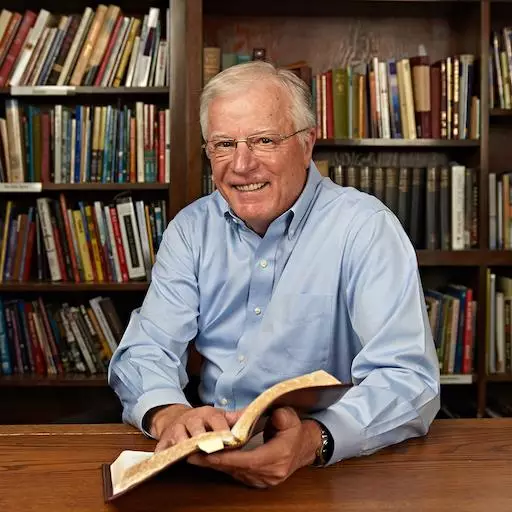
Dying with Christ – Part 2 of 2


Most of us fear death, and we long for peace when our time finally comes. Torn between life and heaven, Paul left a legacy of faithfulness to Christ all the way to the end. In this message from Philippians 1, Pastor Lutzer reveals how God gives dying grace right on time. What brings a Christian to the point of saying, “Live or die, I’m a winner”?
Dave McAllister: Let us run with endurance the race that is set before us. Looking to Jesus, the founder and perfecter of our faith. What kind of legacy will you and I leave behind? The apostle Paul left a legacy of faithfulness to Christ to the very end when he died as a martyr in Rome. Today, some final thoughts about death and how Christians should face it. Stay with us. From the Moody Church in Chicago, this is Running to Win with Dr. Erwin Lutzer, whose clear teaching helps us make it across the finish line. Pastor Lutzer, today you conclude your series on the legacy of a converted man.
What's the main takeaway you want to leave with us?
Dr. Erwin W. Lutzer: Well, you know, Dave, if I were writing the biography of the apostle Paul, I would call it from murderer to martyr. If you recall, he was a man who was killing Christians. He was helping to imprison them. And then he meets Jesus on the way to Damascus and of course his life is totally transformed. He becomes a great defender of the gospel, writes many books that we read today as part of God's word and then dies as a martyr. What a legacy. But what a transformation. And you know, I've written a book entitled Failure the Backdoor to Success and today is the last day we're making this resource available for you.
And in it, I emphasize how sometimes failures can lead to God's grace, to God's forgiveness and actually help us in our journey. Now, we don't condone failure, but God takes those failures and makes something of them. For a gift of any amount, we're making it available for you. And because this is the last day, I'm giving you this contact info. Go to rtw offer.com. That's rtw offer.com or pick up the phone and call us at 1888 218 9337. You'll be encouraged by hearing stories of failure and yet God's grace, God's forgiveness and even God's unexpected blessings help us on our spiritual journey.
But for now, let us go to the pulpit of Moody Church. But the Christian not only believes in the value of Christ, the Christian believes also in the sovereignty of Christ. Notice that the apostle Paul says this in verse 22. If I am to live in the flesh, that means faithful labor for me. Yet what I shall choose, I cannot tell. I am hard pressed between the two. My desire is to depart and be with Christ that is far better, but to remain in the flesh is more necessary for your account. Paul says, look, I prefer to die and be with Jesus.
But I'm going to be alive as long as God wants me to be with you and to minister to you. So we see the sovereignty of the Lord Jesus Christ in the timing of our death. Of course, there's also a confluence. We play a part in the length of our life. Some people cut their life short. But the Christian walking in obedience, walking with God dies under the good hand and the timing of God. And there is no group of demons or men who can put us to death. If God thinks there's still work for us to do because our times are in God's hands.
But it's not just that we trust the timing of the Lord Jesus. We also trust in the means of death. As you know, there are many, many different ways to die. There's heart disease, there's cancer, there's accidents. One time I was in a funeral home and just walked through. And so all of these people, their ages, sometimes young, sometimes old. And if you ask the question, why do some people live so long and others not? We cannot answer those questions. But we believe that God is good and the Christian dies within God's good hand and providence.
I don't think anyone exemplified this better than James Montgomery Boice, a pastor of Tenth Presbyterian Church in Philadelphia for many years, a man that I met occasionally in conferences and so forth at the age of 62. Now, if you think 62 is old, you've not lived very long actually. At the age of 62, he has terminal cancer. He's wheeled onto the platform of his church and he speaks to them and I don't have his speech right here. But I remember his general content. He says, people ask me whether or not they should pray for my healing.
He said, that's fine, go ahead and do it. But he said, I haven't seen too many miracles in my ministry of God delivering people from terminal cancer. He said, I've always taught that my faith was in God's hands and if God didn't want me to have cancer, I wouldn't have it. But my time is coming. So he said, pray that God will give me grace, pray for the doctors. But he said, for years I taught the sovereignty of God and now I accept it. Wow. James Montgomery Boice also wrote music. He wrote hymns. Let me read one for you.
What can separate my soul from the God who made me whole? Wrote my name on heaven's scroll, nothing. Hallelujah. Victors we are ordained to be by the God who set us free. What can therefore conquer me? Nothing. Hallelujah. We face death for God each day. What can pluck us from his way? Let God's people ever say nothing. Hallelujah. We die not only by the means of death, but God's timing. One day, a woman said to me, my husband was murdered and it had happened years ago, but she was still distraught. This was an act of the devil, she said.
And I responded and I said, of course that may be an act of the devil, but remember Jesus was murdered too and that was an act of the devil and he died according to God's timetable. What about all the murders through the centuries? What about that 10-year-old boy that I read about who was who was dragged and killed because he was a believer in Jesus? Who kills him? Well, demonically controlled people to be sure. But he dies within God's providence and within God's will. I want to say now a word about God's comfort in death.
Corrie ten Boom, a woman that some of us know who has gone on to glory because of the books that she wrote about the concentration camps in Germany that she survived. She said on one occasion she asked her father, father, I'm afraid of death. She was about six or seven years old. She said that to him. He said, Corrie, when you and I go to Amsterdam on the train, when do I give you the ticket? And she says, well, Daddy, you give me the ticket just before we board. He said, you don't need the ticket before you board.
You need the ticket when you board. And he said, there is such a thing as dying grace, but God doesn't give it to us until it's time to die. But at the moment we need it, it is there. Some of us remember Nate Nyman who was a member of this church. He and his wife Margaret used to attend here and he died five or six years ago. And Rebecca and I visited him in Michigan. There's only about 45 days from the time when he was diagnosed until the time he died. But but he looked at this so maturely.
I'll never forget it. He said, I am glad it happened this way. I would rather have it this way than a heart attack because now I have the opportunity to help my wife to make provisions for my family to get things ready. But then he said, it's not how many years we have, but how we use them that matters. It's not the number of candles on the cake, but how it tastes. I think that's a lot of wisdom right there. Some of us have many candles on our cake and I want to taste it. He said, if I could get out of this, I would.
But then it would have to happen again. You know, you'd have to face death again. I'm sorry, there's just no no easy way out of this. He said that it is as if we are at a wall and we can't see over it. I would not totally agree with that. We as Christians, we don't see through the wall clearly. But we do see. We see through a glass darkly. And this is what the Bible says, that Jesus came to destroy him who has the power of death, that is the devil, and to deliver those who through fear of death were all their lifetime subject to bondage.
Maybe your fear of death is subjecting you to bondage. Jesus came to deliver us from that fear. You know, as westerners, we don't think that persecution is going to come to us and if we're relatively healthy, we just go on our way. Let's remember when we read about Christians being marginalized and killed and dismembered and shot and beheaded. Let us remember that God is there granting them grace. Of course, we should do all that we possibly can to help them. But at the end of the day, it is God who even there gives comfort to his people.
I want to conclude by just reminding us of how some people died. We think for example of Jesus who was killed unjustly. But what does he say? Father, forgive them for they know not what they do. And then what are his final words on the cross? Father, into thy hands I commit my spirit. All is well with me despite the pain, despite the injustice, I'm in your hands. Wow. And throughout history, many martyrs have followed Jesus in this. Remember Stephen, one of the first Christian martyrs being stoned outside of Jerusalem. He looks up and what does he see?
He sees Jesus standing on the right hand of God the Father ready to welcome him home. And then he also prays for the forgiveness of his enemies and basically says, into thy hands I commit my spirit. I think for example I'm going to include here Anne Boleyn. Anne Boleyn, you know, was the second wife of Henry VIII. What an interesting guy he was. He had six wives. Three or so of them were beheaded by him. He was not entirely a nice husband. He married Anne Boleyn and she would not bear him a son, but she did have a daughter who turned out to be Elizabeth I.
Great impact on England. Henry accused her of adultery. Not sure if that's right. Maybe it was, maybe it wasn't, but the real reason was because she had become a believer. She had never met Tyndale who translated the Bible into English, but she had a copy of his New Testament. And when we were in the British Library in London, we were shown a New Testament of Tyndale's. There's only about one or two left. Some people would even argue that that at one time belonged to Anne Boleyn and supposedly, not sure if it can be proven, she took the New Testament to the chopping block with her.
But I'm reciting here and paraphrasing the prayer that she prayed before Henry had her beheaded. It went something like this. Lord Jesus, I commit my soul to you. You shed your precious blood on the cross on my behalf. And she died and I believe arrived in heaven right after the event. Wow, what a way to go, you know. I don't know how I'd act if I knew I was going to be hacked to bits. I do know that sometimes the chopping block didn't work too well and it took a while. Could be painful. But just know that on the other side of the curtain Jesus is there.
Actually, that's not accurate. Jesus is on this side of the curtain and then he walks us through to the other side and we see him in a new way. Then I think of Bonhoeffer. You remember he turned against Hitler and became part of the resistance movement and he was hung in Flossenburg. But what impresses me is this, that the morning of his hanging and that wouldn't be a nice way to die, would it? The morning of his hanging the biographers say that he was stripped. He was taken to the gallows and he was allowed to pray.
And he prayed these words. He said, oh God, this is the end. But for me, it is the beginning of life. And with that he walked to the gallows and was hung. A doctor who saw him said that he had never seen anyone die with such tranquility, such a sense of confidence in Jesus Christ. This is the end. But for me, the beginning of life. And then of course I want to end with the apostle Paul. So he goes along living a bit longer, visits many churches. Of course, as you know, he wrote 12 or so books of the New Testament.
And it's time for him to die. And in Second Timothy chapter four, he says this. He says, the time has come for me to be offered. The time of my departure has come. I've kept the faith. I've finished my course. Henceforth there is laid up for me a crown of righteousness which the Lord, the righteous judge, shall give me on that day and not to me only, but until him also who love his appearing. And with that he is beheaded by Nero, reminding us that death does not end all. Not only that, but decisions and victories won in this world may be very different in the life to come.
Eternity, I guess is what I'm trying to say. Eternity reverses the decisions and the events of time. Jesus told a story about a rich man who was had all kinds of jewelry and fine clothes and fine food. And he would sit there every day and he would enjoy life. And there was a beggar by the name of Lazarus, not to be confused with the other Lazarus who was raised from the dead. And Lazarus would come and with the dogs he would lick some of the crumbs from the rich man's table. Both died. Lazarus ends up in Abraham's bosom close to Abraham.
The rich man ends up in Hades in torment. Things are not what they appear to be. And at the end of the day, what we need is Jesus so that we can say for me to live is Christ to die is gain. I'm sure throughout the many years I've been here at the Moody Church, I've used this illustration, but I shall use it again. Think of how different the apostle Paul was from Julius Caesar. When Caesar in his play spoke about death, Hamlet, I should say, Hamlet speaking about death in that grand soliloquy. Remember Hamlet said to be or not to be, that is the question.
And then he goes on to talk about the possibility of suicide. But he said, oh, in that sleep of death, what dreams may come when we have shuffled off this mortal coil? Wow, life is miserable. I want to end it. But after I end it, it could be a lot worse than it is now. You see what he was saying, what Hamlet was saying, liver die, I'm a loser. The apostle Paul is saying, liver die and I'm a winner. For me to live is Christ and to die is gain. What a difference Jesus makes. When we were on the cruise one morning as we are going through the Dardanelles.
Now, the Dardanelles are a very small, narrow neck of land, one of the most important waterways in all of Europe. All kinds of battles happen there. And we're on our way to Istanbul and going through them takes a couple of hours. I noticed that there was a ship that was coming and it was coming to our ship. It was much smaller. And then it was a long side of our ship and somewhere on our ship there was a door and somebody exited the door onto the ship. So I wondered what in the world and left.
I wondered what in the world this was about. So the captain of our ship told us this. He said, the Dardanelles have so many danger points because of the currents that it is a requirement that before we go through them we have a different captain who knows the area very well. He comes on and he helps guide us. And once we're through that area he goes his way. And I thought, you know, that's the way life is. Waters with currents, rocks along the way, winds that blow us from one end of the shore to the other.
When we come to the important issue of going through the valley of the shadow of death, we need a guide. And what we need is a guide who knows the way, who's been there and who says, follow me and I can take you safely to the other side. Well, you know who that guide is. There's only one. It's not Muhammad, not Krishna, it's not Baha'u'llah. There's only one guide who's been there, done that and waits for us on the other side, Jesus. If you don't know him personally, you know of him, you recite the creeds, you grew up baptized, whatever, but you don't know him personally.
Would you receive him as your savior? Thank him for dying for you and that you receive his death and you receive the gift of eternal life given to all who believe. That's the good news of the gospel. That's the good news that Europe desperately needs and the good news that America is forgetting and turning against. But here we are to witness to the power of Christ. For me to live is Christ, to die is gain. You believe on him. You may be listening by way of internet, by way of radio right here in the sanctuary of Moody Church.
You trust Christ as your savior. He's the only one who can guide us safely to the other side. This is Pastor Lutzer. I want to speak specifically to those of you who are listening, who feel that you have fallen too far. You have failed too miserably for you to have hope. Corrie ten Boom, who was a prisoner in one of Hitler's concentration camps, says this. There is no pit so deep, but that God is deeper still. And that's why I wrote the book entitled Failure the Backdoor to Success. No matter how far we have fallen, God is there for us to catch us, yes, but also to help us on our spiritual journey.
Today is the last day we're making this resource available for you. I believe that it will be of help. You'll want to read it and then pass it along to someone else. Well, I hope that you have a pen or pencil handy because this is what you need to be in touch with us. Go to rtw offer.com. That's rtw offer.com or pick up the phone and call us at 1888 218 9337. We here at Running to Win like to emphasize that God is a redeeming God and he even redeems us in the midst of our greatest need.
Once again, that contact info rtw offer.com or call us at 1888 218 9337. Today is the last day that you have this opportunity to receive from us special gift Failure the Backdoor to Success.
Dave McAllister: You can write to us at Running to Win 1635 North LaSalle Boulevard, Chicago, Illinois 60614. Running to Win is all about helping you find God's road map for your race of life.
Dr. Erwin W. Lutzer: Ever wonder what it will be like on the day Jesus returns? Next time, a look into the future as we consider seven signs of Christ's return. Plan to join us. Thanks for listening. For Pastor Erwin Lutzer, this is Dave McAllister. Running to Win is sponsored by the Moody Church.
Featured Offer

This book is uniquely personal and encouraging. It will make you feel free to try and unafraid to fail, knowing that God is the one at work in you, and that He's not finished yet. Click below to receive this book for a gift of any amount or call us at 1.888.218.9337.
Past Episodes
- Changed By The Word
- Children of an Awesome God
- Chiseled By The Master's Hand
- Christ Among Other Gods
- Christ Before Bethlehem
- Christ, God's Gift at Christmas
- Christians In Conflict
- Come and See Jesus
- Cries from the Cross
- Crowning Christ Lord
- Seven Convincing Miracles
- Seven Reasons You Can Trust The Bible
- Seven Secret Snares
- Sharing Secrets With God
- Slandering Jesus
- Suffering Wrong
- Ten Lies About God
- Thanksgiving
- The Battle for America’s Youth
- The Church in Babylon
- The Darwin Delusion
- The Flurry Of Wings
- The High Cost Of Lost Opportunities
- The Invisible War
- The Invisible World
- The King Is Coming
- The Legacy of a Converted Man
- The Man Who Cradled God In His Arms
- The Manger And The Sword
- The Power of a Clear Conscience
- The Triumph of the Gospel
- The Triumph Of Unanswered Prayer
- Till Death Do Us Part
- What Do These Stones Mean?
- What is God Up To
- What Jesus Thinks Of His Church
- What We Believe
- What Would Jesus Do?
- When a Nation Forgets God Interview
- When God Is First
- When God Shows Himself
- When the Spirit Has His Way
- When You've Been Wronged
- Who Are You To Judge?
- Why Good People Do Bad Things
- Why The Cross Can Do What Politics Can't

Video from Dr. Erwin W. Lutzer
Featured Offer
This book is uniquely personal and encouraging. It will make you feel free to try and unafraid to fail, knowing that God is the one at work in you, and that He's not finished yet. Click below to receive this book for a gift of any amount or call us at 1.888.218.9337.
About Running To Win
Running the race of life is hard. But with the Bible front and center and a heart to encourage, Pastor Erwin Lutzer presents clear Bible teaching, helping you make it across the finish line. Since 2011, this 25-minute program has provided a Godward focus and features listeners’ questions.
About Dr. Erwin W. Lutzer
Dr. Erwin W. Lutzer is Pastor Emeritus of The Moody Church where he served as the Senior Pastor for 36 years (1980-2016). He earned a B.Th. from Winnipeg Bible College, a Th.M. from Dallas Theological Seminary, a M.A. in Philosophy from Loyola University, and an honorary LL.D. from the Simon Greenleaf School of Law (Now Trinity Law School).
A clear expositor of the Bible, he is the featured speaker on two radio programs: Running to Win—a daily Bible-teaching broadcast and Songs in the Night—an evening program that’s been airing since 1943. Running To Win broadcasts on a thousand outlets in the U.S. and across more than fifty countries in seven languages. His speaking engagements include Bible conferences and seminars, both domestically and internationally, including Russia, the Republic of Belarus, Germany, Scotland, Guatemala, and Japan. He has led tours to Israel and to the cities of the Protestant Reformation in Europe.
Pastor Lutzer is also a prolific author of over seventy books, including the bestselling We Will Not Be Silenced, One Minute After You Die, and the Gold Medallion Award winner, Hitler’s Cross. Pastor Lutzer and Rebecca live in the Chicago area and have three grown children and eight grandchildren. Connect with Pastor Lutzer on X (@ErwinLutzer) or moodymedia.org.
Contact Running To Win with Dr. Erwin W. Lutzer
media@moodychurch.org
http://moodymedia.org/
Moody Church Media
1635 North LaSalle
Chicago, IL 60614
1.800.215.5001
Monday – Friday
8:00am – 5:00pm CST
Fax Number
1.312.642.4904