

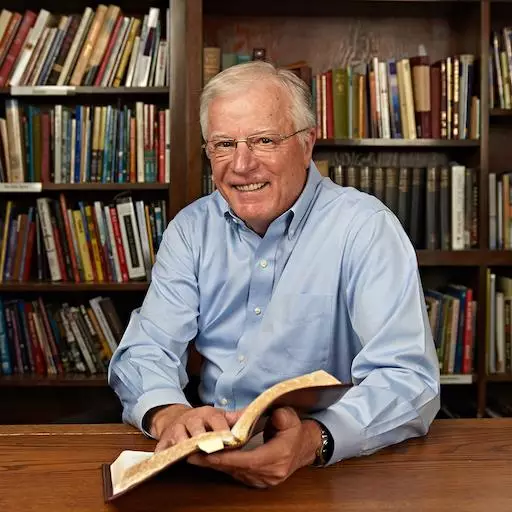
Europe Reunited – Part 1 of 2


Many of us want to know what the future holds for our world. Nebuchadnezzar dreamed of a statue that mapped the rise and fall of empires. In this message, Pastor Lutzer shows why a revived Rome signals Christ’s return. Charlemagne and Hitler tried to unite Europe, but who will finally succeed?
Dave McCallister: Let us run with endurance the race that is set before us. Looking to Jesus, the founder and proclaimer of our faith. If you're new to Bible prophecy, get set for a major dose on today's program. We'll find modern-day Europe in a king's dream. Turn to Daniel chapter 2 and sit back for a whirlwind tour of the future. Today, why a reunited Europe is another sign of Christ's return. From the Moody Church in Chicago, this is running to win with Dr. Irwin Lutzer, whose clear teaching helps us make it across the finish line. Irwin Lutzer is in a series on seven signs of Christ's return.
Pastor, today's news points to the very event you'll talk about today. Sign number two, Europe reunited.
Dr. Erwin W. Lutzer: You know, Dave, when it comes to prophecy, oftentimes we may get the details wrong. It's not because God's promises are not absolute. They will come to pass, but we need to be very careful about our interpretation. That being said, the main lines of prophecy are abundantly clear. We know that Jesus Christ is going to return. We also look around and we can see many signs that his return may be near. I'm holding in my hands a book entitled When Jesus Returns. The general editor is Jan Markell, whom I met many years ago at a prophecy conference in Minneapolis.
She assembled a group of various authors writing about different aspects of prophecy. For example, in the book, I have an article entitled One Minute After You Die. For a gift of any amount, we're making this book available for you. And I'm excited about it because I think it's going to shed a lot of light, not just about the future, but how to live today in light of the future. For a gift of any amount, we're making it available for you. And at the end of this message, I'm going to be giving you some contact info.
For now, let us listen. Back in 1989, Time magazine said, The wall crumbles overnight. Berliners embrace in disbelieving joy and a stunned world ponders the consequences. Many of us shall never forget the Berliners dancing on the Berlin wall. And you can't pick up your paper today without understanding that Europe seems to be coming together in some very interesting ways. What connection could there possibly be between a revived Europe and the return of Jesus Christ? Well, that's the topic that we have before us today. As you know, this is a series of messages titled Seven Signs of Christ's Return.
Last time, we talked about the return of Israel. Today, we speak about the unification of Europe. Now, you say, well, where is that found in the scriptures? Well, what I want you to do is to take your Bibles and turn to the second chapter of the book of Daniel. Daniel chapter 2, a king, a pagan king at that time, though he was later converted, a pagan king had a dream. And he did not know how to interpret the dream. It says in chapter 2 verse 1, In the second year of his reign, Nebuchadnezzar had dreams.
His mind was troubled and he could not sleep. So, the king summoned the magicians and the enchanters and the sorcerers and the astrologers to tell him what he had dreamed. When they came in and stood before the king, he said to them, I have had a dream that troubles me and I want to know what it means. And all of his advisors standing around said, Okay, king, tell us your dream and we'll interpret it for you. And king Nebuchadnezzar said, No way, Jose. Now, he said it in Aramaic, but that's what he said. No way, Jose.
I know you guys. I tell you my dream and you give me the interpretation. You're making this stuff up. But I do have an agreement to make with you. If you tell me what I dreamed, then I'll believe your interpretation. And if you don't and cannot tell me what I dreamed, then you will be cut in pieces. It's called pressure. And And they say, Verse 10, there is not a man on earth who can do what the king asks. No king, however great and mighty, has ever asked such a thing of any magician, enchanter, or astrologer.
What the king has asked is too difficult. No one can reveal it to the king except the gods, and they do not live among men. They're off on vacation. What are we going to do? By the way, when you're walking in the streets of Chicago and you see those signs that say palm reading or astrologer or horoscope read, that some of you missed that. What you should do is to say a prayer and keep on walking. Because one of two things are true. Number one, either they're making this stuff up. And if they're too good at it and they're too specific and they know too much about you, you know that their source of information comes from the dark side of the spirit world.
Well, you say, how do you know that? Because the Bible is very clear. We're to stay away from such things. God calls it a personal affront. He calls it an abomination to try to seek wisdom that way and knowledge. And if they have hidden knowledge about you that could not have been received by ordinary means, clearly it's coming to them from the spirit world. And there are spirits who know a whole lot about you, by the way. So, maybe there's a connection there. But one way to call their bluff, and I don't suggest you do it because you're not supposed to go there.
But one way to call their bluff would be to say, You know, I had a dream and I've come for the interpretation. And you can just imagine them saying, Oh, sure, tell us the dream and we 'll interpret it. And then you say, You know, you're making that stuff up. You tell me what I dreamt and then I 'll believe you. That's what the king did here. And all of them said, We are en route to the gallows. This is not working very well. And then Daniel steps in, who had a responsibility of being the cupbearer.
He was next to the king, had a responsibility. Information comes to him and he says, I think I can help. By the way, have you ever thought of the unique providence of God in bringing Daniel to that position? And I want you to know today that you are providentially where you are in offices, in business places, in banks, and factories. God has put you there and sometimes it is there for a specific reason at a need in time when they need you. They need you. And you know God and you walk with God and your resources and abilities suddenly become very very important.
That's what happened here. So, Daniel prays a wonderful prayer in verse 20. He says, Praise to the name of God forever and ever. Wisdom and power are his. He changes times and seasons. He sets up kings and deposes them. He gives wisdom to the wise and knowledge to the discerning. He reveals deep and hidden things. He knows what lies in darkness and light dwells with him. I thank and praise you, oh God of my fathers. You have given me wisdom and power. You have made known to me what we asked of you. You have made known to us the dream of the king.
The astrologers didn't know, but God knows. By the way, did you know that God knows what you're dreaming? And he not only knows the good dreams, he knows the nightmares. He knows the struggles that you have in the depths of your soul. Perhaps even because of occult invasion and occult harassment in your own experience, God knows all those things. He knows the texts as what is done in darkness because the darkness and the light are the same to him. So, Daniel goes to the king, and I'm making a long story short here, and he says, I want to tell you two things.
I want to tell you what you dreamed and I ll tell you the interpretation. And the king said, If you can do that, uh you know, you're in. You're in. I ll believe you. Verse 31, he says, You looked, oh king, and there before you stood a large statue, an enormous, dazzling statue, awesome in appearance. The head of the statue was made of pure gold. Its chest and arms of silver, its belly and thighs of bronze, its legs of iron, its feet partly of iron and partly of baked clay. While you were watching, a rock was cut out, but not with human hands.
It struck the statue on its feet of iron and clay and smashed them. Then the iron, the clay, the bronze, the silver, and the gold were broken to pieces at the same time and became like chaff on the threshing floor in the summer. The wind swept them away without leaving a trace, but the rock that struck the statue became a huge mountain and filled the whole earth. And if you have not done a lot of Bible study or if you're a new Christian or you've had no orientation to the scriptures at all, you say, What in the world does that mean?
And if you say that, you're not alone because that's exactly what Nebuchadnezzar was saying. He said, I had the dreams. I saw this metallic man, a huge statue, and I saw the different kinds of metal, but what could it possibly refer to? Dreams, by the way, are very interesting. They come to us sometimes from outside the situation. You know, when you go to bed at night and you're thinking about something, oftentimes you dream about it. And my mind has such creativity. Sometimes I'm overwhelmed by what I dream. But none of my dreams have ever come to pass.
But this one did. Now, Daniel says, I'm going to give you the interpretation. So, hang on. Hang on. Don't be discouraged if there was was too much symbolism, if you don't know what all of this metal is about. Verse 36, This was the dream and now we will interpret it to the king. You, oh king, are the king of kings. The God of heaven has given you dominion and power and might and glory in your hands. He has placed mankind and the beast of the field and the birds of the air. Wherever they live, he has made you ruler over them all.
You are that head of gold. Wow. So, the head of gold is none other than Nebuchadnezzar, the Babylonian Empire. Then he says, And after you, there will be another kingdom, an inferior kingdom to yours. That is the breast and arms of silver known as the Medo-Persian Empire. Do you see the accuracy of scripture? God says after Babylon, there's going to be an empire that's going to have two arms. And the reason it will have two is because it is Medo-Persia and its metal is inferior to gold. It is silver, but nonetheless, it is going to be in existence.
And then after that, it will pass off the scene. And he says, a third ruler, middle of verse 39, one with bronze will rule over the whole earth. And that, of course, refers to Greece. We think of Alexander the Great who conquered the then known world and extended the Grecian Empire as far as India. He did encompass the whole earth. That's the next empire to rise. And then our interest is focused on the fourth empire because this is the key to where we're going. And after you, he says another kingdom will arise. But verse 40, finally there will be a fourth kingdom strong as iron, for iron breaks and smashes everything.
And as iron breaks things to pieces, so it will crush and break all the others. Just as you saw that the feet and toes were partly of baked clay and partly of iron, so this will be a divided kingdom, yet it will have some of the strength of iron in it. Even as you saw iron mixed with clay. As the toes were partly iron and partly clay, so this kingdom will be partly strong and partly brittle. And just as you saw the iron mixed with baked clay, so the people will be a mixture and will not remain united anymore than iron mixes with clay.
In the time of those kings, key verse here now, everybody awake. In the time of those kings, the God of heaven will set up a kingdom that will never be destroyed nor left to another people. It will crush all those kingdoms and bring them to the end, but it itself will endure forever. You know what Daniel's saying? He's saying, king, you had a vision that really began from when you're ruling all the way to the end of time till the return of Jesus Christ. The stone that is cut out of the mountain is Jesus. And Jesus comes.
When does he come? When it says verse 44, at the time of those kings, when there is a ten-nation confederacy roughly united, it is at that time that Christ comes. Now, everyone that I know and have read agrees that when it talks about the legs of iron, that is the Roman Empire that followed the Grecian Empire. It is the Roman Empire. And And yet Rome is no longer in existence today as the Roman Empire and And what do we have? We have, however, an extension an extension of those legs in toes that are mixed with iron and clay.
And it's during those days that Christ comes. There's really no way to interpret this except to say that that there's a gap of time here, that the Roman Empire has to be revived. The legs of iron perhaps took place in ancient Rome during the centuries that Rome ruled. But there is still a future time when that empire is going to have ten toes, ten kings because that's the time that Christ is going to come back and establish his kingdom. Now, you know what about the Roman Empire? You know that it existed for centuries and according to Edward Gibbon, who wrote The Rise and Fall of the Roman Empire, he says that there is some disagreement as to when Rome fell because it really disintegrated from within.
And so historians dated variously, but the Roman Empire has kind of what shall we say, fallen apart. Now, it's been fragmented, but interestingly, during this ten-toe stage, the book of Revelation has something to say about this too. You know, it would take too long to show all the parallels and how they fit in. So, I'm just going to read a verse to you because what this verse is going to show is that these ten kings are going to get together not by force, but voluntarily. It's going to be a voluntary federation of ten states. This is what it says.
And now the imagery is not ten toes, but it's ten horns. The ten horns that you saw are ten kings who have not yet received a kingdom, but who for one hour will receive that means a brief period of time, will receive authority as kings along with the beast. They have one purpose and it is to give their power and authority to the beast. They give the power and the authority to the beast. And the Bible says they make war against the lamb. Notice that these ten toes, by the way, as we shall see in the next message when we talk about the rise of Antichrist, this is where he's going to come from is among those ten-nation confederacy.
But you'll notice it says they give their power to the beast. It isn't forced upon them. And because they are iron mixed with clay, you'll notice it says in Daniel they are they are united and yet they're not really united. They're maintaining some kind of identity. But it's during those days the Lord will come. Now, let me just simply remind you the fact that historically people have always tried to revive the old Roman Empire. We go back to the days of Charlemagne, Charles the Great. He was in St. Peter's Basilica, you remember, on Christmas Day in the year 800 and the Pope surreptitiously.
You know, I don't use that word often, but I love it. I'm going to say it again. The Pope surreptitiously came and put the crown on his head and said, I need you. And Charles the Great became the beginning of what is sometimes called the Holy Roman Empire, which Voltaire says was neither Roman nor holy nor was it an empire. But he became he became the civil head. He He tried to unify Europe and the Holy Roman Empire never really unified Europe. They were all independent states. But there was a rough kind of unification. And how long did that last?
Nearly a thousand years until the time of Napoleon in 1806. So, you have the year 800 to 1800. That is a thousand years. The Holy Roman Empire had this rough fragmented existence. Now, after Napoleon, of course, it broke apart and you have the end of the first Reich. That's the German word for kingdom. When I was growing up, we used to always say the Lord's Prayer in German, dein Reich komme. Your kingdom come. That's the first Reich. Years go by and the 1871 Kaiser Wilhelm is crowned in the hall of mirrors in France despite the French.
Bismarck had Kaiser Wilhelm the first crowned there in France. And why is he called Kaiser, the German word Caesar? He is Caesar Wilhelm. The intention was to revive the Roman Empire and to finally unify Europe. If it takes war, let it be war, but let us unite Europe together in one. Well, you know, of course, that failed after Germany lost World War I, 1918. And then there was another man who arose. And this other man was Adolf Hitler. And Hitler began what was known as the third Reich. The third Reich. The third attempt now, major attempt since ancient Rome collapsed, to unify all of Europe.
And he always said that he was beginning a Reich that would last a thousand years. He knew that Charlemagne had not really accomplished it because the empire was too loosely federated, but he thought he could begin something that would last for a thousand years. It lasted 12 years and six months. Now, today, do we begin to see this voluntary association of states in Europe coming together not with war, not with war yet, but but with a federation, a a sense of voluntary, the scripture says, giving their authority. Some people have thought it would be the European common market.
We don't know. There's always some danger in trying to read the present trends into what we are seeing. But let me give you some ideas as to how I think Europe will look under the unification that is described here in the book of Daniel. First of all, we can expect some kind of geographic unity. The rough outline of the old Roman Empire. It doesn't have to be the exact boundaries because those boundaries even changed. But But roughly speaking, and that included parts of North Africa, even some of England, Southern Europe, and all of those countries that were roughly the Roman Empire, we can expect them to be to be unified at least in a general sense as the nations give their authority and their power.
Secondly, we can also expect economic unity. Economic unity. Back in 1988, the economist said, low a central bank for Europe. And it predicted the day when Europe would have a single European currency, a single European currency. Oh, wouldn't you know that on January the 4th, 1999, some 12 years or so later, what do we have? We have the Euro. And And you have the Euro bringing Europe together in that economic powerhouse that will be important for its survival. And what you find is now trade happens more easily, tourism is easier. It's going to be because all that you need to do is to change your money once.
And then you can go from France and Germany and the different countries which now belong to this federated union.
Dave McCallister: Well, this is Pastor Lutzer. What excites me most about prophecy is the reminder that God ultimately controls all events. And no matter how turbulent the times are for us today, let us remember that if we are in the hands of God, all is secure. And God actually is the author of history and that's why he could predict so many events that someday will take place. I'm holding in my hands a book entitled When Jesus Returns. It's actually a collection of authors who have written various aspects about prophecy. For example, here are some of the chapters hidden in plain view, The New World Order in Bible Prophecy.
Another chapter, The Primacy of Jesus Christ in the Book of Revelation. Another chapter, Perilous Times When America abandons its role of global leadership. Our blessed hope, the rapture of the church and so forth. It was written to motivate us to recognize that no matter how hard life is now, someday eternity will be upon us. And the way in which we live for Christ now, well, that will be our legacy for all eternity. For a gift of any amount, we're making it available for you. Sure hope that you have a pen or pencil handy because here's the contact info.
Go to rtwoffer.com. That's rtwoffer.com. Of course, rtwoffer is all one word. rtwoffer.com or pick up the phone and call us at 1 888 218 9337. Let me give you that again. rtwoffer.com or call us at 1 888 218 9337. You can write to us at Running to Win, 1635 North LaSalle Boulevard, Chicago, Illinois 60614. Irwin Lutzer with part one of Europe Reunited, the second sign in a series on seven signs of Christ's return. Next time, we review the dream again and explore why we're seeing it come to pass in Europe in our day. Thanks for listening.
For Pastor Irwin Lutzer, this is Dave McCallister. Running to Win is sponsored by the Moody Church.
Featured Offer

This guide to the last days will stoke your trust in God’s glorious plans for the future. You will be empowered to live with boldness and readiness like never before. Click below to receive this book for a gift of any amount or call us at 1.888.218.9337.
Past Episodes
- Changed By The Word
- Children of an Awesome God
- Chiseled By The Master's Hand
- Christ Among Other Gods
- Christ Before Bethlehem
- Christ, God's Gift at Christmas
- Christians In Conflict
- Come and See Jesus
- Cries from the Cross
- Crowning Christ Lord
- Seven Convincing Miracles
- Seven Reasons You Can Trust The Bible
- Seven Secret Snares
- Sharing Secrets With God
- Slandering Jesus
- Suffering Wrong
- Ten Lies About God
- Thanksgiving
- The Battle for America’s Youth
- The Church in Babylon
- The Darwin Delusion
- The Flurry Of Wings
- The High Cost Of Lost Opportunities
- The Invisible War
- The Invisible World
- The King Is Coming
- The Legacy of a Converted Man
- The Man Who Cradled God In His Arms
- The Manger And The Sword
- The Power of a Clear Conscience
- The Triumph of the Gospel
- The Triumph Of Unanswered Prayer
- Till Death Do Us Part
- What Do These Stones Mean?
- What is God Up To
- What Jesus Thinks Of His Church
- What We Believe
- What Would Jesus Do?
- When a Nation Forgets God Interview
- When God Is First
- When God Shows Himself
- When the Spirit Has His Way
- When You've Been Wronged
- Who Are You To Judge?
- Why Good People Do Bad Things
- Why The Cross Can Do What Politics Can't

Video from Dr. Erwin W. Lutzer
Featured Offer
This guide to the last days will stoke your trust in God’s glorious plans for the future. You will be empowered to live with boldness and readiness like never before. Click below to receive this book for a gift of any amount or call us at 1.888.218.9337.
About Running To Win
Running the race of life is hard. But with the Bible front and center and a heart to encourage, Pastor Erwin Lutzer presents clear Bible teaching, helping you make it across the finish line. Since 2011, this 25-minute program has provided a Godward focus and features listeners’ questions.
About Dr. Erwin W. Lutzer
Dr. Erwin W. Lutzer is Pastor Emeritus of The Moody Church where he served as the Senior Pastor for 36 years (1980-2016). He earned a B.Th. from Winnipeg Bible College, a Th.M. from Dallas Theological Seminary, a M.A. in Philosophy from Loyola University, and an honorary LL.D. from the Simon Greenleaf School of Law (Now Trinity Law School).
A clear expositor of the Bible, he is the featured speaker on two radio programs: Running to Win—a daily Bible-teaching broadcast and Songs in the Night—an evening program that’s been airing since 1943. Running To Win broadcasts on a thousand outlets in the U.S. and across more than fifty countries in seven languages. His speaking engagements include Bible conferences and seminars, both domestically and internationally, including Russia, the Republic of Belarus, Germany, Scotland, Guatemala, and Japan. He has led tours to Israel and to the cities of the Protestant Reformation in Europe.
Pastor Lutzer is also a prolific author of over seventy books, including the bestselling We Will Not Be Silenced, One Minute After You Die, and the Gold Medallion Award winner, Hitler’s Cross. Pastor Lutzer and Rebecca live in the Chicago area and have three grown children and eight grandchildren. Connect with Pastor Lutzer on X (@ErwinLutzer) or moodymedia.org.
Contact Running To Win with Dr. Erwin W. Lutzer
media@moodychurch.org
http://moodymedia.org/
Moody Church Media
1635 North LaSalle
Chicago, IL 60614
1.800.215.5001
Monday – Friday
8:00am – 5:00pm CST
Fax Number
1.312.642.4904