

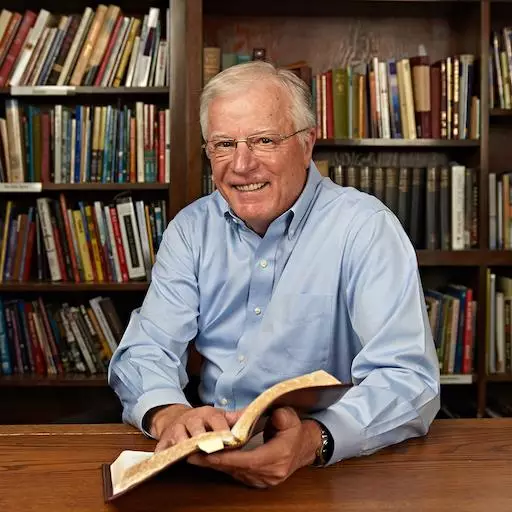
Compassion In Outreach – Part 1 of 2
RTWL20260501
Dave McAllister: Let us run with endurance the race that is set before us, looking to Jesus, the founder and perfecter of our faith. Early in the ministry of Jesus, he became known as a healer. Large crowds followed him, hoping to be cured of their many ailments.
His heart was moved. He saw them as sheep without a shepherd. How do we as believers view the great needs around us? Today we begin a brief series on practicing the compassion of Christ. From the Moody Church in Chicago, this is Running to Win with Dr. Erwin Lutzer, whose clear teaching helps us make it across the finish line.
Erwin W. Lutzer: You know, Dave, just stop to think about this. What if Jesus had been selfish? What if Jesus had come into this world and decided that it's all going to be about him and not about others? Well, you and I would not be redeemed.
And he really is our model. He's the one that we should follow. That's why it is so important for us as Christians to be generous, generous toward others, both of our time, of our money, of our influence. What we should do is think in terms not of ourselves but as Jesus said to take up our cross and to follow him daily. And that means for Christians a spirit of helpfulness and generosity.
I'm so glad for the many people who indeed do work together with us here at Running to Win. I'm talking about the staff, of course, of this ministry, but equally important are all those of you who are listening. We depend upon your prayers. We depend upon your gifts. And it's because of you that this ministry can continue to expand.
Would you consider becoming what we call an endurance partner? That's someone who stands with us regularly with their prayers and their gifts. Here's what you do, and I'm going to be giving you this contact info again at the end of this message. You can go to rtwoffer.com or you can call us at 1-888-218-9337. Through your generosity and prayers, this ministry continues to go around the world.
Let me begin today with a question: How big is your world? You know, there are some people whose world is only as big as they are. We call them narcissists. We're all narcissists to some degree, but the true narcissist says to himself or herself, "The only thing that really matters is how I look and how I feel. Everything else revolves around them." They have very little compassion for others, and if you would be a sociopath actually, you would only see others as an opportunity to do them harm and not to do them good. Is your world bigger than that? I hope so.
Now there are some people whose world includes their families at least, so they have a much bigger world, but they're only concerned about their own families. That's all that really matters. I've met people like that and they never extend hospitality and care to those beyond their little group. And some of them maybe have lots of resources, but they don't see any place where there is a need that they can help.
And then of course you have those who have a larger family, a larger world, and that is the world of their church. How we thank God for that and the hundreds and hundreds of people here at the Moody Church who are involved in various ministries. We need you and we value you. But if that's all that there is to your world, your world needs to be expanded. My world needs to be expanded. As I've been preparing this message, I need to say that it applies to me as much as it does to anyone else who's listening. My own world needs to get bigger because I work in a Christian environment.
I've been here many, many years at the Moody Church and I've not yet heard a swear word. Now, maybe there have been some close calls on occasion. But many of you live with that all the time. You live in a different world and in a sense I admire you and envy you because you have an opportunity to expand your larger world and we'll be explaining what that's all about as all of us expand our world.
Ninth chapter, the ninth chapter of the book of Matthew where Jesus is doing ministry. And now we come to a very familiar passage, Matthew chapter 9, and I'm going to begin at verse 35. "And Jesus went throughout all the cities and villages, teaching in their synagogues and proclaiming the gospel of the kingdom and healing every disease and every affliction. When he saw the crowds, he had compassion for them because they were harassed and helpless like sheep without a shepherd. And he said to his disciples, 'The harvest is plentiful but the laborers are few. Therefore pray earnestly to the Lord of the harvest to send out laborers into his harvest.'" Just that far for now.
Could we pray together and ask the Lord to use this passage to change our lives and to enlarge our world? Father, we come to you as basically selfish people. Today we pray that we might have the blinders taken off. Help us to see like we've never seen before. Grant us, O God, your compassion for a world that is helpless and broken down. Do that in mercy, we pray in Jesus' name. Amen.
What I'd like to do today is to give you four steps that are necessary for us to expand our world. Four steps that are necessary for us to expand our world and we take all of those steps directly from the life and the ministry and the example of Jesus.
Number one, what we need to do is to see with our eyes. To see with our eyes. I read it there in verse 36: "And when he saw the crowds, and when he saw the multitude." You see, what we are determines what we see. For example, if you're into gardening, you will notice gardens throughout the neighborhood or wherever you go. If you travel abroad, all that you'll be looking for, or one of the things is, to see the gardens because what you are in your heart determines what your eyes see.
I love to tell the story—a true story—about a farmer from Iowa who came here to this lovely sanctuary here at the Moody Church, this large sanctuary. I feel sorry for those of you who are listening by radio or other means and you've never had an opportunity to see this lovely sanctuary at Moody Church, but he came in and said, "Boy, you could put a lot of hay in here." And you could. What we are determines what we see.
Do you remember that little poem? You probably learned it in school, at least I did. I hope I can quote it correctly. "Pussycat, pussycat, where have you been? I've been to London to see the queen. Pussycat, pussycat, what saw you there? I saw a mouse sitting under her chair." I can imagine that when pussycat came home and she gathered all of her human friends together to show them her slides of her trip to London—she lived during a time when there were no video cameras, she only had slides—they might have asked her, "Pussycat, what was the queen wearing?" "I've no idea." "You didn't see her crown?" "Had no idea." "What were the pictures on the wall?" "Never saw a single picture." "What did you see?" "I saw a mouse sitting under her chair." Because she had a pussycat heart.
Jesus explained this one time in that great parable of the Good Samaritan. The priest saw the man who was wounded and robbed and walked by on the other side. The Levite, what did he see? He saw the same thing. And they went back to Jerusalem and they said, "We saw somebody who was in great need. We saw somebody who had bad luck. We saw somebody who should have taken more precautions." Maybe they went to the Sanhedrin and said, "You know what we need? We need a social program so that we have guards all the way from Jerusalem to Jericho because it's a dangerous piece of road." But the problem is they did not see somebody whom they could help.
And you and I can see poverty in this city. We can leave the beautiful sanctuary of the Moody Church and walk out onto LaSalle Street and Wells Street and all over and we do not see people to help. Jesus saw the multitude and he saw them because he was looking for human need. What we are determines what we see.
In fact, in John chapter 4, Jesus is on the well talking to a Samaritan woman. And you remember he's sitting there. The disciples have gone away to buy some meat, to buy some food, and they come back and they're troubled. They're troubled because a Jewish man did not speak to a woman, particularly an immoral woman, and a Samaritan woman at that, without other people being around. And that's all that they saw. And Jesus said to them, "The harvest is plentiful, the laborers are few," essentially the very same text that we read here, "and the fields are white unto harvest." Jesus saw there somebody who wasn't just an immoral woman, a Samaritan woman, but he saw a woman who needed the hope of eternal life. And that's why he sat there on the well. He saw differently than everyone else. We ought to be praying that God will give us new eyes to see the way in which God sees.
First step, we have to see with our eyes. Secondly, we have to feel with our hearts. We have to feel with our hearts. You notice the text says, we're still in verse 36, he saw the multitude, it says, and he felt compassion for them. His heart was tenderized to the needs around him. He felt that compassion because he saw them as sheep without a shepherd. The text says that they were harassed and helpless. He saw them like helpless sheep.
You know that the imagery that is used here probably refers to sheep who sometimes are cast down. A cast-down sheep is a sheep that's walking along and perhaps lies down for a rest and then decides to turn over onto its back and cannot on its own get up. As a matter of fact, soon the oxygen is cut off, circulation stops, and sheep can die that way. And so what the shepherd does is he comes and he massages the sheep to get the circulation going again, and after the circulation helps the sheep stand up and then steadies the sheep so that it can begin to walk on its own. What a vivid picture of the world in which we live. Could we just for a moment look beyond ourselves to the world? What kind of a world is it?
A friend of mine has pointed out that, first of all, it is a crowded world. Seven billion people live on this planet. If I remember correctly when I was in grade school we were told that there were two and a half billion people on the planet. Now there are nearly seven billion. You get to a country like India with its near billion and China with a billion and you begin to look at the population explosion around the world. It is a crowded planet.
It is an urbanized world. The flight is to the big cities. I looked it up and discovered that Mexico City is probably the biggest city in the world if you consider the metropolitan area: 21 million people. It's hard to get our minds around it, but it is an urbanized world.
It is a suffering world. And it's suffering because of natural disasters, even as we suffer here in America with natural disasters, with floods and tornadoes and tsunamis and what have you. And yet the world continues to suffer for other reasons because of poverty. 20,000 children die every day because of malnutrition. I can say the words, but I have to tell you I can't get my mind around it. And if you aren't there to see it somehow, out of sight, out of mind. We have no idea, but could we just for a moment try to enter into the pain of parents and children who are starving on this planet? It is a suffering world.
And then it's a suffering world because of divorce and the break-up of the family. You know, if we could look into the high-rises here, even within this area, we might be surprised at the kind of abuse that is taking place in some quarters. It is indeed a suffering world.
It is a persecuted world. Especially because of the rise of militant Islam, what you have in many of the countries of the Middle East is great persecution today. I've pointed out in the past that about 400 Christians a day die and are martyred for their faith simply because they believe in Jesus in North Korea and throughout the Middle East. Do we understand what that means? Would we be able to endure that kind of suffering? It is a suffering world. It is a persecuted world.
But above all, it is a lost world. People don't know that they were created for the glory of God. People don't know how to connect with the Almighty. People don't know how to manage their own guilt and their own failure because they don't know the Father and his mercy. They don't know how to get through to God. They pray but have no assurance that they have been heard. And then think of this—this is hard for me to say but I'll say it—to think that after they die, the eternity that they are going to endure is even worse than the life that they have had here on earth. It is a lost world. Can we be touched by the feelings of that pain, that lostness, and that alienation from God?
Now, of course, it's fine to talk about the world that is distant, but what about our world? What about your neighbors, your friends, where God has planted you? Let us keep in mind that we must have compassion, we must feel with our heart. Jesus saw the crowd, the Bible says, and was filled with compassion.
Third, we must go with our feet. We must go with our feet. Now Jesus changes the figure of speech. Your Bibles are open there to verse 37. He said to his disciples, "The harvest is plentiful, the laborers are few. Therefore pray earnestly to the Lord of the harvest to send out laborers into his harvest field." Couple of comments. First of all, the harvest is God's. I don't think I've ever seen this as clearly as I did this week as I meditated on this passage. The Lord of the harvest to send forth laborers into his harvest.
Now I was brought up on a farm. I know something about harvest. I know that there is only a window of time when you can really reap, and if you miss that window you can never recoup it. You can't come back in a month because by then everything will have rotted. You can't come back and say, "Well, we'll do it next week or even particularly next month or next year." When it's gone, it's gone. Now I want you to see for a moment today the multitudes who are here today, they will be gone tomorrow. The harvest is plentiful, Jesus says. And then what he says is that we should pray that the Lord of the harvest will send forth laborers.
It's been pointed out that that word "send out" laborers is actually "ekballō." In Greek, the word "ballō" means to throw, "ek" means to throw out. It's the word that is used frequently in the New Testament for the casting out of demons. When Jesus spoke the word, you know, the Bible says that the demons ekballō, he cast them out. Jesus is using the very same expression. And what he says is that we should pray to the Lord of the harvest.
When you and I pray, we can go behind enemy lines. We can go to any country of the world. We can stand with missionaries. We can go with other Christians because God is not limited by human borders and all the rest. But also, please keep in mind that we should not just be praying for the world out there. We should be praying for Moody Church that among us God will ekballō, send out many different laborers into his harvest fields. Chicago needs laborers like that, but so does the whole world. And we thank God for every one of our missionaries and your gifts to our missionary ministry help support that ministry. But I pray, I pray that God might from this congregation raise up many people who will still go because they sense the call of God and we sense upon their lives the call of God to touch the world. Jesus said pray, pray that the Lord of the harvest will send forth laborers into his harvest field.
But let us go into the neighborhoods. Let us go to the areas of Chicago that are in great need. Let us support ministries such as By The Hand Club For Kids, but also ministries in India such as another ministry as our own where we help support an orphanage and are trying to help build a brand new orphanage. What we need to do is to see the larger world. Jesus said pray that the Lord of the harvest would send forth laborers into his harvest field. He's saying that we have to go with our feet and we most assuredly do.
And then we must speak with our mouths. We must speak with our mouths. Now your Bibles are open because I'm going to go to chapter 10. Because chapter 10 is now an example and an extension of what Jesus just simply said. And it says, "And he called to him his twelve disciples and gave them authority over unclean spirits to cast them out and to heal every disease and affliction."
What you need to understand is that these 12 were called to do the very same thing that Jesus did. The very same. He gave them fully his authority to do these miracles. Now some authority is very weak. There's a story about a man—an officer who worked for the DEA, that is the Drug Enforcement Agency of the United States of America. And he went to a farmer in Kansas and said to him, "I'm here to inspect your fields to see whether or not you're growing marijuana." And the farmer said to him, "Hey, you can go anywhere you like on my fields except that field over there. Don't go to that field over there." The officer said, "Wait a minute." He whipped out his badge and said, "Do you see this? This gives me authority from the federal government of the United States of America. I have authority to go wherever I want to go. Thank you very much." Farmer said, "Oh, okay."
A few moments later, the farmer hears screams—blood-curdling screams—as he sees a bull come across the field toward the official. And the official is calling out, and the farmer goes to him: "Show him your badge! Show him your badge!" A badge issued by the federal government does not stop a raging bull, but the authority of Jesus given to disciples will stop demons in their tracks. Aren't you glad for that?
Well, my friend, even though we do not have the same authority as Jesus Christ, we do have authority. And based on what he has done, we have the ability to take our stand against evil, to live beyond the world. We have the ability also through our prayers to pray deliverance prayers for those who are bound by Satan. And we as believers should look like Jesus in our compassion, in our willingness to help others, and always looking beyond ourselves to ask this question: How do I please God? I hope that that's true of you. We thank God that Jesus Christ's authority is also delegated to some extent to his followers and we ought to be like him in his selflessness.
I'm holding in my hands a letter that we received from an Arabic-speaking listener in the Sudan. If you asked me, Pastor Lutzer, what is it that thrills your soul? Well, many things do, but one thing most assuredly blesses me and that's when we hear about people who are listening in other countries, all throughout the Arabic-speaking world, for example. This person says, "This message has helped me realize that God hasn't forgotten me. I needed that reminder today."
Now I mention that because this testimony actually is your testimony. It's because of people just like you helping us. Would you investigate what we call becoming an endurance partner? Look into it. Here's the info. You go to rtwoffer.com, click on the endurance partner button. Now I'm going to be mentioning that again in just a few seconds because I want you to do that. Consider and pray about the possibility of becoming a partner with us in sharing the good news of the gospel around the world. Or you can call us at 1-888-218-9337. Once again, write this down. Go to rtwoffer.com, of course rtwoffer is all one word. Go to rtwoffer.com, click on the endurance partner button and learn how you can be a member of the Running to Win family.
Dave McAllister: You can write to us at Running to Win, 1635 North LaSalle Boulevard, Chicago, Illinois, 60614. It's easy to be overwhelmed by human need. It seems the more we try to help, the more need there is. Next time on Running to Win, more thoughts about the compassion Jesus had and our obligation to reflect that compassion where we live. For Pastor Erwin Lutzer, this is Dave McAllister. Running to Win is sponsored by the Moody Church.
Featured Offer
This short but powerful work delivers on its significant promise. Pastor Lutzer explores a wide array of Scriptural teachings and siphons them into clear, cohesive truths. It is straight gospel—applicable to the skeptic, newly saved, and long-time believer alike. Click below to receive this book for a gift of any amount or call Moody Church Media at 1.888.218.9337.
Past Episodes
- Changed By The Word
- Children of an Awesome God
- Chiseled By The Master's Hand
- Christ Among Other Gods
- Christ Before Bethlehem
- Christ, God's Gift at Christmas
- Christians In Conflict
- Come and See Jesus
- Cries from the Cross
- Crowning Christ Lord
- Seven Convincing Miracles
- Seven Reasons You Can Trust The Bible
- Seven Secret Snares
- Sharing Secrets With God
- Slandering Jesus
- Suffering Wrong
- Ten Lies About God
- Thanksgiving
- The Battle for America’s Youth
- The Church in Babylon
- The Darwin Delusion
- The Flurry Of Wings
- The High Cost Of Lost Opportunities
- The Invisible War
- The Invisible World
- The King Is Coming
- The Legacy of a Converted Man
- The Man Who Cradled God In His Arms
- The Manger And The Sword
- The Power of a Clear Conscience
- The Triumph of the Gospel
- The Triumph Of Unanswered Prayer
- Till Death Do Us Part
- What Do These Stones Mean?
- What is God Up To
- What Jesus Thinks Of His Church
- What We Believe
- What Would Jesus Do?
- When a Nation Forgets God Interview
- When God Is First
- When God Shows Himself
- When the Spirit Has His Way
- When You've Been Wronged
- Who Are You To Judge?
- Why Good People Do Bad Things
- Why The Cross Can Do What Politics Can't

Video from Dr. Erwin W. Lutzer
Featured Offer
This short but powerful work delivers on its significant promise. Pastor Lutzer explores a wide array of Scriptural teachings and siphons them into clear, cohesive truths. It is straight gospel—applicable to the skeptic, newly saved, and long-time believer alike. Click below to receive this book for a gift of any amount or call Moody Church Media at 1.888.218.9337.
About Running To Win
Running the race of life is hard. But with the Bible front and center and a heart to encourage, Pastor Erwin Lutzer presents clear Bible teaching, helping you make it across the finish line. Since 2011, this 25-minute program has provided a Godward focus and features listeners’ questions.
About Dr. Erwin W. Lutzer
Dr. Erwin W. Lutzer is Pastor Emeritus of The Moody Church where he served as the Senior Pastor for 36 years (1980-2016). He earned a B.Th. from Winnipeg Bible College, a Th.M. from Dallas Theological Seminary, a M.A. in Philosophy from Loyola University, and an honorary LL.D. from the Simon Greenleaf School of Law (Now Trinity Law School).
A clear expositor of the Bible, he is the featured speaker on two radio programs: Running to Win—a daily Bible-teaching broadcast and Songs in the Night—an evening program that’s been airing since 1943. Running To Win broadcasts on a thousand outlets in the U.S. and across more than fifty countries in seven languages. His speaking engagements include Bible conferences and seminars, both domestically and internationally, including Russia, the Republic of Belarus, Germany, Scotland, Guatemala, and Japan. He has led tours to Israel and to the cities of the Protestant Reformation in Europe.
Pastor Lutzer is also a prolific author of over seventy books, including the bestselling We Will Not Be Silenced, One Minute After You Die, and the Gold Medallion Award winner, Hitler’s Cross. Pastor Lutzer and Rebecca live in the Chicago area and have three grown children and eight grandchildren. Connect with Pastor Lutzer on X (@ErwinLutzer) or moodymedia.org.
Contact Running To Win with Dr. Erwin W. Lutzer
media@moodychurch.org
http://moodymedia.org/
Moody Church Media
1635 North LaSalle
Chicago, IL 60614
1.800.215.5001
Monday – Friday
8:00am – 5:00pm CST
Fax Number
1.312.642.4904