

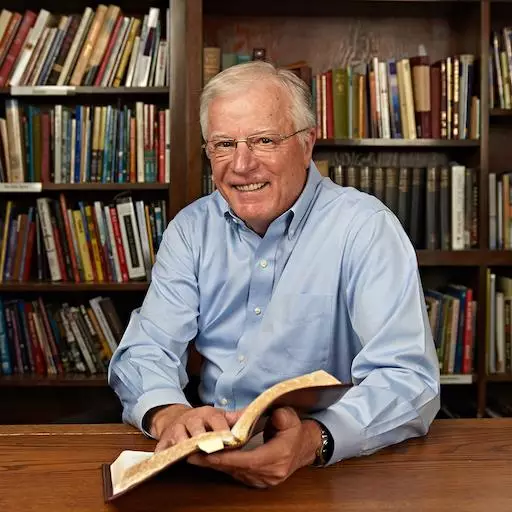
Temple Rebuilt In Jerusalem – Part 1 of 2


Few places on earth are as fought over as the Temple Mount. It fills the pages of history, from Abraham to Solomon to the Dome of the Rock. In this message, Pastor Lutzer tours Israel’s first two temples and the third temple predicted to be built. What is God’s purpose for revealing Himself on the Temple Mount?
Dave McAllister: Let us run with endurance the race that is set before us. Looking to Jesus, the founder and proclaimer of our faith. In ancient Israel, sacrifices were made every day at the temple in Jerusalem. The Bible says that one day those sacrifices will resume. That means a temple must be rebuilt in Jerusalem on the most sacred ground on earth, and that won't be easy. From the Moody Church in Chicago, this is Running to Win with Dr. Erwin Lutzer, whose clear teaching helps us make it across the finish line. Erwin Lutzer is in a series on seven signs of Christ's return.
Today we turn to sign number five, the temple rebuilt in Jerusalem. Pastor, you and I have stood together on the Temple Mount trying to envision this future day.
Dr. Erwin W. Lutzer: Yes, Dave. I remember that so vividly, and of course, all that we can do is try to imagine it because there are some really difficult roadblocks to get there. I'm thinking, for example, of the Dome of the Rock, those 20 acres, namely the Temple Mount, are indeed, as you have said, Dave, the most sacred ground on earth. And everything is going to be localized there. And even as we think about the future and prophecy, of course, Jerusalem, well, as all of us know, it's really the focal point. We're making available for you a book entitled When Jesus Returns.
This book is not a road map that necessarily shows us all of the sequence of events in the future, but rather discusses various aspects of prophecy. What Jan Markell has done, and she is the general editor, what she has done is gather together prophecy experts, those who have studied and thought about what we're going to be experiencing in the future, and she has brought them together in one volume. Once again, the title of the book When Jesus Returns. Here's what you can do. Go to rtwoffer.com and then after the message that we are going to be listening to right now, I'll be giving you more comments and that contact info again.
Let's take a little tour today. Doesn't cost you anything now that the offering plates have been passed. It's going to be free from here on. We're standing on the Mount of Olives. As you stand on the Mount of Olives, if you were to look to the left within the city walls, you would see the Al Aqsa Mosque. It's that silver domed building. But if you looked to the right, in fact, practically in front of you, you would see the dome of the Rock, that golden domed building. Now, can you imagine that that building has been standing there for 1,300 years?
It's amazing how well they knew how to build even way back then. But let's go into the Dome of the Rock. Let's go through and let's take our shoes off as we have to. And those of us who have been tourists there, we have complied, of course, to go into the Dome of the Rock, and let's walk around. There isn't that much to see. There's a railing, and behind the railing there is a rock, an outcropping of rock. I'm going to estimate that it's about 150 feet in diameter, and the circumference would be 3.14 multiplied by that, as many of you know from your early days in geometry.
And and we're just simply walking around it, and there are a couple of other things that I won't describe, a little hair actually in a little glass case that supposedly belongs to Muhammad and a number of other artifacts. But why is this little piece of real estate, these few thousand square feet so important? Why is it the most sacred site in all the world, the most fought over? And why is it that it elicits the deepest emotions? Well, Genesis chapter 22, one day God said to Abraham, he said, Abraham, I want you to sacrifice your son, and I want you to take him onto Moriah and there offer him for a sacrifice.
Abraham gets up early in the morning, and he goes according to the command of God, and he gets to Mount Moriah, and he is willing to sacrifice Isaac on the altar and actually prepares to and God interrupts him and says, no, you don't have to do that. Now I know that you really love me. God was saying, Abraham, could it be that Isaac has so warmed his way into your heart that he means more to you than I do? That was a test, and Abraham proved that the answer was no. He said, God means more than my son.
Now we wouldn't know where Mount Moriah really was. I mean, where is Mount Moriah except that in the Bible in 2 Chronicles chapter 3 verse 1, it says that Solomon built the temple on Mount Moriah, the very spot that David had purchased from Araunah the Jebusite who had used it as a threshing floor, and David bought that site, and that's where the temple was built. So when you go into the Dome of the Rock, scholars disagree as to whether or not that rock actually is the place where the burnt altar stood or whether it was where the Holy of Holies stood, or some people even suggested that actually the Holy of Holies and the temple was about 200 feet north of that area, whatever.
That's the significance of the spot. Now why all this in a series on prophecy? Well, as you know, we're doing a series entitled Seven Signs of Christ's Return, and some of us actually believe that a temple is going to be built there before the Lord Jesus Christ comes in glory. Now before that time, there's going to be the rapture of the church, and as we're going to see at the end of this message, it could well be that that temple might be quite quickly built under certain political circumstances, though of course, right now it seems so unlikely and even impossible.
But I want you to stay with me because what we're going to do is to tour the first two temples and then talk about the possibility of a third and how that might fulfill biblical prophecy. That's the agenda. But first of all, I want to begin with Solomon's temple, the first temple. The date is about 950 years before the time of Jesus Christ. David wants to build the temple, but God says, no, you've been a man of bloodshed. He said, Solomon is going to build the temple. So Solomon does. So let 's take a tour of Solomon's temple.
It was about 10 feet high on a platform. Now we're actually talking about the inner shrines, the Holy of Holies and the Holy Place. And what we have to do is go up 10 stairs, so we take our time going up those 10 stairs. And we notice that on either side of us there are bronze pillars, something like 40 feet in the air. This is indeed an amazing amazing spectacle. We come into the porch and then we walk into what is known as the Holy Place. Once in the Holy Place, we notice that in addition to the gorgeous gorgeous various jewels and stones that Solomon had there, there is a table of showbread that has to be changed regularly.
There is also the menorah, the seven-branch candlestick. And then we look ahead of ourselves, and there, wouldn't you know it, there is an altar of incense. And the incense was continually burned upon that altar, and the reason was because the stench of the sacrifices which were being offered to God outside were so continuous and it smelled so awful that that masked the smell. We'd like to continue on because there's a curtain before us, and we wonder whether or not we can go behind that curtain, but the answer is no because behind those double curtains is really the Holy of Holies.
That's the place where the high priest could go only one day a year. So we're forbidden to go into that room which would be about 35 feet by 35 feet in terms of its area. So we turn around and we go back out, and we're going back the stairs again, and this time we notice that there is the brazen altar where sacrifices are continually offered. Off to the right there is a basin that holds about 15,000 gallons of water. And that basin was used for the purification of the priests and so forth. An amazing spectacle that Solomon built.
Well, we can't be there physically, but at least let's read about the dedication. The dedication is found in 1 Kings chapter 8. 1 Kings chapter 8, and you may turn to that in the Scriptures. And let me simply say that people say, well, isn't this just like the pagans? They used to build altars and temples to their gods, too. Two very big differences. Number one, there is no representation of God in the tabernacle or in the temple. The ark was not a representation of God. The ark is where God was going to come in the Holy Place there, but the ark does not represent God because God had said very clearly in the Ten Commandments, thou shalt not make unto thee any any image or any likeness of God.
So that is not that is different from the pagan temples. Another difference is this, that the pagans were there to help their God. They were supposed to bring their God food and water and so forth. You do have to wonder what kind of a God there would be that needed to be fed, but nevertheless, the pagans believe that in this case the purpose of the tabernacle and then the temple, which is what we're talking about, the purpose of the temple was really that God might do something for his people. It is there that he is going to meet with them.
It is there that he is going to bless them. So it's a different conception. But you'll notice it says in 1 Kings chapter 8 verse 8, there was nothing in the ark except the two tablets of stone which Moses put there at Horeb where the Lord made a covenant with the sons of Israel when they came out of the land of Egypt. And it came about when the priests came from the Holy Place. Now they are bringing actually the ark. The ark had been somewhere else, and now the building was finished, and somebody had to carry the ark, and there were certain restrictions as to how it might be carried.
And they bring it in. They came from the Holy Place that the cloud filled the house of the Lord so that the priests could not stand to minister because of the cloud, for the glory of the Lord filled the house of the Lord. What an experience that was. This cloud of glory, God was saying, this is indeed where I'm going to dwell. Now God of course dwells everywhere. Solomon says this in his prayer. You'll notice in verse 27 he says, but will God indeed dwell upon the earth? Behold, the heaven and the highest heaven cannot contain thee.
How much less this house which I have built. Of course God can't be all put into that building, into that temple. But God says, I'm going to manifest myself there even though the heavens and the heavens cannot possibly contain me. But this will be the meeting point between God and man. By the way, another characteristic of this temple is it was to be a house of prayer. You'll notice that Solomon said in verse 28, yet have regard to the prayer of thy servant and to his supplication. Oh Lord my God, to listen to the cry and to the prayer of thy servants and what they pray before thee today.
Verse 41 also concerning the foreigner who is not of thy people Israel, when he comes from a far country for thy name's sake, for they will hear of thy great name and thy great mighty hand and thine outstretched arm. When he comes and prays toward this house, hear thou in heaven thy dwelling place and do according to all for which the foreigner calls to thee in order that all the people of the earth may know thy name to fear thee as do thy people Israel, and that they may know that this house which I have built is called by thy name.
What an amazing prayer. And this is why Jesus is going to say later in the second temple, my temple is supposed to be a house of prayer, and you have made it a den of thieves. We sometimes think, well, you know, God gave the oracles to the Jews. What about the non-Jews? Well, notice God is inviting everybody to his temple and saying, come and pray there. Now the splendor of Solomon's temple was so great that people came from the then known world simply to see it. It was awesome. What happened to that temple? Well, first of all, let me say that it served Israel for nearly 400 years.
That's a long time. We think of the United States of America, 200 years. Within time it will be 250 300 years 400 years. What an old country. 400 years this temple served the people. And then various kings ruled who were idolatrous, and God says, I'm going to destroy you. I'm going to take the temple from you. And so you have the king of Egypt coming and taking some of the treasures because some of the kings had to buy them off. You have the king of Assyria coming, and Ahaz stripped the silver and the gold from the temple in order to buy him off so that Israel might not be destroyed.
Then finally you get good king Hezekiah who does a very foolish thing. There's a delegation that comes from Babylon, and they say, you know, we just like to see the temple. We're just tourists. We have a tourist visa. He said, fine. He said, I want to show you the treasures that are left. And so he took them and he showed them the treasures. Actually they were casing the place so that they could come and get everything. And then under Nebuchadnezzar in 605 the city of Jerusalem was besieged, and more damage was done. And finally in 586 BC the Babylonians came and they destroyed that temple completely.
Totally destroyed it because you see, in those days if you destroyed the temple, you also destroyed the people's god. So the pagan Babylonians said to themselves, what we want to do is we want to do away with Israel's god. And in order to do that, we'll destroy Israel's temple. And that temple has no ruins that we know of today are in existence. We know where those ruins probably are, but nobody has any. You can't go to Jerusalem and see any of the ruins. Wouldn't it be wonderful if archaeologists could dig 30 or 40 feet beneath the Dome of the Rock and come to all of the things that pertain the ruins that were left of Solomon's temple.
Now that would be a real archaeological site. And you remember that a number of years ago there were some people who were digging in that area. You know, there's that controversial tunnel in Jerusalem that was opened a few years ago, and some of us had the privilege of walking through it a few months after the controversy. But there was a passageway there where someone actually was able to go under the dome of the rock, and he claims that he believes he actually saw the ark of the covenant, and it's buried there somewhere. Nobody's ever been able to find it for sure.
Not even Harrison Ford has been able to find it for sure. Some people think the ark of the covenant is buried somewhere else. It's buried in the hills or whatever. We are not sure. But imagine capturing that ark of the covenant. What happened when the temple was destroyed? Ezekiel tells us that the Shekhinah glory, the cloud that we just read about, left. It went where the eastern gate is today, and then after that it went through the Kidron Valley and then up to the Mount of Olives, and it disappeared. Ichabod, God says, the glory has departed.
It's all over. Wow, what a tragedy to think that we'll never see that building. Unless again, I always think that we're going to see videotapes in heaven, and maybe we'll get a chance to see it then. Now question is, does God say, hey, you know, you Jewish people, you know, you're always turning to idols and I had to judge you. I had to take the temple and have it destroyed, and that's the end. No, it's never the end for God. Here you have these people being taken into Babylon, and 70 years later a man by the name of Cyrus, because the Cyrus, the Medes and the Persians now conquer Babylon, he says to himself, you know what?
You Jews can go back and you can rebuild your temple. And he allows 50,000 of them to return. Now we're talking about the second temple. And the leader of the second temple, the man who organized it all was a man by the name of Zerubbabel. I was thinking of that name the other day and thinking that if you don't like your name, and some of us may not be very happy with our name, we could have been stuck with Zerubbabel. Now 1 and 2 Kings, you have your Bibles open, 1 and 2 Chronicles, Ezra. And we get to the book of Ezra and chapter 3, and here we have the story of the dedication of that temple.
You go home today, somebody says, what were you doing in church? You say, we attended the dedication of two temples. All right? Notice Ezra chapter 3, we pick it up in verse 10. The people it says now, when the builders had laid the foundation of the temple of the Lord, the priests stood in their apparel with trumpets and the Levites and the sons of Asaph with symbols to praise the Lord according to the directions of king David of Israel. And they sang praising and giving thanks to God saying, for he is good, for his loving kindness is upon Israel forever.
And all the people shouted with a great shout when they praised the Lord because the foundation of the house of the Lord was laid. Yet many of the priests and the Levites and the heads of fathers' households, the old man who had seen the first temple, they wept with a loud voice when the foundation of this house was laid before their eyes while many shouted aloud for joy. Another thing I want to see on videotape is verse 13, so that the people could not distinguish the sound of the shout of joy from the sound of the weeping of the people.
For the people shouted with a loud shout, and the sound was heard far away. What's going on here? We have to understand that the people were gone for 70 years, but some of these people who went to Babylon, they were teenagers. They were just kids. They live in Babylon for 70 years. They come back, but bless their hearts, they remembered what Solomon's temple looked like. They remembered the splendor. They remembered the stones, the glory. They remembered those brass pillars or those those pillars that go to the heavens. They they saw all that. And now Zerubbabel comes back, organizes some men, and they lay the foundation stone for this temple, and it was so pitifully small in comparison to the glory of the one they once remembered.
In fact, that's why Zechariah, you have to put this together. You remember he was a prophet who was prophesying during that period of time. He says, don't despise the day of small things. He was encouraging the people because the people were saying, you know, this temple is so small that it's it's just heartbreaking. And he says, don't despise that day because who knows what God is going to do in this temple? And another prophet, Haggai, who was prophesying during that time said, wait a moment. The glory of this house is going to be greater than the glory of the other one.
Boy, that was some encouragement. And how in the world was that prophecy ever fulfilled? Will you stay with me, and you'll understand how it was fulfilled? What happened to that temple? We're talking about 538 BC now. You understand. 538 Solomon's 950 BC. Now we're to 538 and Zerubbabel builds it. And Tychicus, it's it's used by the Jews for 200 years. And Tychicus Epiphanes, you've heard of him. Here he comes with the Greek Hellenization of the area because Greece comes to conquer the area, and Antiochus appoints someone to be a high priest who is a Greek and who is a blasphemer and against the wishes of the people.
Obviously a sow, a pig is actually sacrificed on the altar. And he puts up a statue within the Holy of Holies to a foreign god. He desecrates the place just like the prophet Daniel predicted would happen. The people of course were very very angry and upset, and they fought against the Greeks. And that's where you have the wars of the Maccabees. And then in 63 BC 63 Ptolemy comes, and he's a Roman now because you know, Greece is beginning to fade in its influence. Rome is beginning to come. And and as he marches into Jerusalem, he sees all of these Jews who are lying physically in front of the temple saying, we would rather be killed.
Do not go in here. Do not desecrate this place. Well, when he saw them protecting the temple that way, he said to himself, this must be because there's lots of treasures in the temple. So obviously he went in. And according to Josephus the historian, when he went into the Holy Place and then he went into the Holy of Holies, he noticed that there was just a barren rock. There was no ark because you see that ark that was lost during the time of Solomon's temple was never rebuilt. There was only one ark. And he was shocked at the fact that there was no representation of deity and really no treasures at least within the Holy of Holies.
And you know, my friend, there have been those who have searched for the ark. I have no knowledge as to where it might exist or if it still exists, but this much I know. You and I do not need that ark to get into God's presence. Thankfully Jesus is our ark, so to speak. He is our way to God. And we hear it running to win or deeply committed to him to share his message of love and forgiveness around the world. At the same time, all of us know that the world is also headed in a very wrong direction.
And often times we see the chaos around us, and we don't know how to respond. That's why we're making available for you a book entitled When Jesus Returns. What this book does is it takes various aspects and themes of prophecy, and some of the experts you will recognize, Jack Hibbs for example, and Graham Lots, and others. For a gift of any amount this book can be yours. And by the way, this is the last week we're making it available. Here's what you can do. Go to rtwoffer.com or call us at 1 888 218 9337. Let me give you that contact info again.
And remember this is the last week we're making it available. Go to rtwoffer.com or call us at 1 888 218 9337. My heart is so full of gratitude because of people just like you who support this ministry.
Dave McAllister: You can write to us at Running to Win 1635 North La Salle Boulevard, Chicago, Illinois 60614. Running to Win is all about helping you find God's road map for your race of life. That was Erwin Lutzer with part one of the Temple Rebuilt in Jerusalem, the fifth sign in his series Seven Signs of Christ's Return. Next time we sum up the history of temples past and look forward to the temple rebuilt. Thanks for listening. For Pastor Erwin Lutzer, this is Dave McAllister. Running to Win is sponsored by the Moody Church.
Featured Offer

This guide to the last days will stoke your trust in God’s glorious plans for the future. You will be empowered to live with boldness and readiness like never before. Click below to receive this book for a gift of any amount or call us at 1.888.218.9337.
Past Episodes
- Changed By The Word
- Children of an Awesome God
- Chiseled By The Master's Hand
- Christ Among Other Gods
- Christ Before Bethlehem
- Christ, God's Gift at Christmas
- Christians In Conflict
- Come and See Jesus
- Cries from the Cross
- Crowning Christ Lord
- Seven Convincing Miracles
- Seven Reasons You Can Trust The Bible
- Seven Secret Snares
- Sharing Secrets With God
- Slandering Jesus
- Suffering Wrong
- Ten Lies About God
- Thanksgiving
- The Battle for America’s Youth
- The Church in Babylon
- The Darwin Delusion
- The Flurry Of Wings
- The High Cost Of Lost Opportunities
- The Invisible War
- The Invisible World
- The King Is Coming
- The Legacy of a Converted Man
- The Man Who Cradled God In His Arms
- The Manger And The Sword
- The Power of a Clear Conscience
- The Triumph of the Gospel
- The Triumph Of Unanswered Prayer
- Till Death Do Us Part
- What Do These Stones Mean?
- What is God Up To
- What Jesus Thinks Of His Church
- What We Believe
- What Would Jesus Do?
- When a Nation Forgets God Interview
- When God Is First
- When God Shows Himself
- When the Spirit Has His Way
- When You've Been Wronged
- Who Are You To Judge?
- Why Good People Do Bad Things
- Why The Cross Can Do What Politics Can't

Video from Dr. Erwin W. Lutzer
Featured Offer
This guide to the last days will stoke your trust in God’s glorious plans for the future. You will be empowered to live with boldness and readiness like never before. Click below to receive this book for a gift of any amount or call us at 1.888.218.9337.
About Running To Win
Running the race of life is hard. But with the Bible front and center and a heart to encourage, Pastor Erwin Lutzer presents clear Bible teaching, helping you make it across the finish line. Since 2011, this 25-minute program has provided a Godward focus and features listeners’ questions.
About Dr. Erwin W. Lutzer
Dr. Erwin W. Lutzer is Pastor Emeritus of The Moody Church where he served as the Senior Pastor for 36 years (1980-2016). He earned a B.Th. from Winnipeg Bible College, a Th.M. from Dallas Theological Seminary, a M.A. in Philosophy from Loyola University, and an honorary LL.D. from the Simon Greenleaf School of Law (Now Trinity Law School).
A clear expositor of the Bible, he is the featured speaker on two radio programs: Running to Win—a daily Bible-teaching broadcast and Songs in the Night—an evening program that’s been airing since 1943. Running To Win broadcasts on a thousand outlets in the U.S. and across more than fifty countries in seven languages. His speaking engagements include Bible conferences and seminars, both domestically and internationally, including Russia, the Republic of Belarus, Germany, Scotland, Guatemala, and Japan. He has led tours to Israel and to the cities of the Protestant Reformation in Europe.
Pastor Lutzer is also a prolific author of over seventy books, including the bestselling We Will Not Be Silenced, One Minute After You Die, and the Gold Medallion Award winner, Hitler’s Cross. Pastor Lutzer and Rebecca live in the Chicago area and have three grown children and eight grandchildren. Connect with Pastor Lutzer on X (@ErwinLutzer) or moodymedia.org.
Contact Running To Win with Dr. Erwin W. Lutzer
media@moodychurch.org
http://moodymedia.org/
Moody Church Media
1635 North LaSalle
Chicago, IL 60614
1.800.215.5001
Monday – Friday
8:00am – 5:00pm CST
Fax Number
1.312.642.4904