

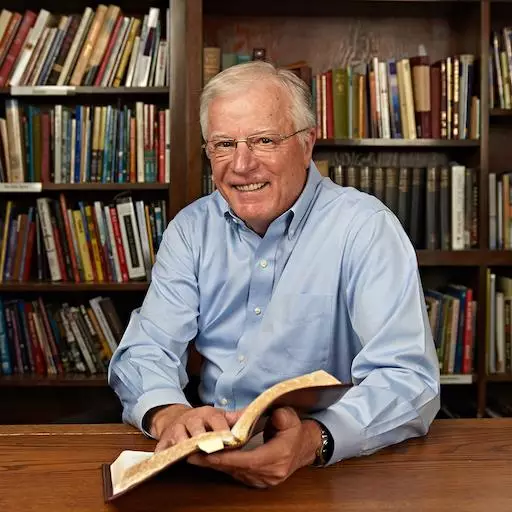
When The Shepherd Takes Our Hand – Part 1 of 2


Though we may feel unworthy of God’s blessing, He chooses to pour it out on us anyway. The Good Shepherd takes a personal interest in every single lamb. In this message from Psalm 23, Pastor Lutzer reflects on how God guides, protects, and comforts His people like sheep. Though we are incredibly needy, He takes responsibility for us.
Dave McAllister: Let us run with endurance the race that is set before us, looking to Jesus, the founder and perfecter of our faith. When God chose to communicate how he cares for his own, he gave the picture of a shepherd tending his flock. Shepherds do more than guide their sheep to food and water; they take a personal interest in every sheep. Today, we learn all about the Great Shepherd. From the Moody Church in Chicago, this is Running to Win with Dr. Erwin Lutzer, whose clear teaching helps us make it across the finish line.
Pastor Lutzer, it seems Psalm 23 is inexhaustible. There are so many lessons to learn here, we could spend a month or more.
Dr. Erwin Lutzer: And Dave, isn’t it wonderful to see the relationship between Psalm 23 and the 10th chapter of the book of John? It’s a hand-in-glove relationship. It has to do with the Shepherd and his sheep, and we are indeed blessed. Imagine this: belonging to the Good Shepherd. I want to thank the many of you who support the ministry of Running to Win. Possibly you’ve heard me say this before, but because of people just like you, we are in 50 different countries in seven different languages. Now, at the end of this message, I’m going to be giving you some contact info and also telling you a story about the impact of this ministry because of people just like you. For now, let us listen.
If people would just repeat Psalm 23 seven times every night before they go to bed, we very seldom, if ever, would have an emotional breakdown. Those are the words of Charles Allen, a Christian psychologist. If only we grasped hold of Psalm 23. As we come to this wonderful Psalm today, let us not be fooled simply because we are so familiar with it. It is deep in its riches, and let us not be hindered simply because some of us have never taken care of sheep. I had to do a little bit of studying this week to actually find out what shepherds go through so that I’d be better equipped to be able to interpret this Psalm. So, you shall receive some of those insights as we go through the message.
Jesus is known as the Good Shepherd. He said in John chapter 10, "I am the Good Shepherd, and I am known of mine. I know my sheep; they follow me. They recognize my voice." He is the Good Shepherd of Psalm 23. How does a shepherd get sheep? Well, unless he inherits them, he buys them. Jesus purchased us at high cost. And then what a shepherd does is he marks every sheep on his ear, putting his particular stamp on the ear of each of the sheep so that there’s no question about identification. Jesus marks us with the cross. He gives us the blessed Holy Spirit of God as a downpayment, as a recognition that we belong to him, and he follows us all the way home.
What we’re going to do this morning is to simply be blessed. Would you like to just open your soul today for God’s blessing? You say, "Well, I feel unworthy of God’s blessing." Believe me, you are unworthy of God’s blessing. So am I; we all are. But God has chosen to bless us. And today, we’re going to relax. I’m relaxed; I want you to be relaxed. Then, all that we’re going to do is to soak in Psalm 23 and leave rejoicing and leave changed forever. The way I intend to look at this Psalm is to list from it those responsibilities to which a shepherd commits himself when he has some sheep.
What are those responsibilities that a shepherd takes over when he has sheep? Now, I’m referring to those of you, of course, who are the sheep of Jesus. Some of you aren’t, and I’m going to give you an opportunity at the end of the message to become one of his sheep. But actually, it’s just now for those of us who know him, though I want all the rest of you to listen in. What does a shepherd commit himself to do when he takes over responsibility for the sheep? Well, are you ready to be blessed? All distraction set aside, every worry about tomorrow taken care of, every regret of yesterday under the blood so that we can be blessed.
Well, first of all, you’ll notice that he takes responsibility to provide for them. "The Lord is my shepherd, I shall not want. He makes me to lie down in green pastures; he leads me beside still waters." Sheep are very difficult to get to lie down. You cannot even cause them really to lie down unless they do so voluntarily. And they don’t do that unless all of their needs are met because they cannot rest as long as they are restless. Very quickly, I’m going to list five different needs that a shepherd needs to take care of if he expects his sheep are actually going to lie down.
First of all, they have to be free from anxiety. I understand that a rabbit running among some sheep can distract some of them, and a whole flock of sheep can become like a herd stampeding to nowhere, most of them not knowing why they’re running, but they run anyway. You know, when God created sheep, I believe that he created them for the express purpose so that he would have a good illustration of human nature. He said, "I want to create an animal that is as stubborn as human beings. I want to create an animal that is always tempted to go its own way. I want to create an animal that is essentially ignorant, though they think they know a lot more than they really do. I want to create an animal that is always going his own way." All we, like sheep, have gone astray; we’ve turned everyone to his own way. So, I’m going to create sheep because sheep are an awful lot like they are. In the Bible, sheep are not painted in a flattering way.
So first of all, they have to be free from anxiety. The shepherd has to interfere so that they can get some rest. Free from distraction, pests, all kinds of things that may distract a sheep so that they can no longer concentrate on the rest that it is intended to give them. They have to be free from conflict. In every animal society, there is what is known as dominance. One animal wants to be dominant over the others. If it’s among chickens, it’s called pecking order. If it’s among sheep, it’s called budding order.
And usually, there is one sheep, sometimes an old miserable ewe who wants to take over charge of the flock, walks around head cocked, eyes glaring, waiting for anyone to get some grass before she does, making sure that everyone is in line, taking care of everyone, and causing irritation throughout the whole herd. And the only way they can begin to rest is when the shepherd begins to interfere and give that flock some rest and some comfort from one or two that want to dominate the rest. And by the way, what ones are the most comfortable, the ones that lie down most easily? They are the ones who are further down in the budding order. They don’t have anything to prove, they’re not in competition, they’re not jealous of others who have the best pasture lands, and they are the most contented.
But notice what the text has to say. "The Lord is my shepherd, I shall not want." He takes care of all of my needs. "He makes me lie down in green pastures." Another need that must be met is, of course, food. And so, what the shepherd does is he will find a piece of land, maybe remove the rocks, try to sow some grass, try as best he can to water it to create the kind of pasture that the sheep will enjoy and benefit from, and he will do that, of course. And the sheep afterwards enjoy it, but they aren’t necessarily thankful. God gives us food; it’s the food of his word that is to be absorbed into our soul. We’re supposed to meditate in the law of God day and night, and then we find contentment. But many, many of God’s sheep don’t. They refuse the green grass and they go somewhere else. They fill their lives with television, and it’s something like a sheep trying to be comfortable and sustained by AstroTurf. It’s just not working.
And then, of course, he says, "He leads me beside still waters." Sheep do not like running waters because then they get their wool wet. So, what he likes to do is to take rocks and so forth and create a little dam, a little place where the water can run, a little pool that is quiet. And God says, "I take care of that myself. I feed you. I care about you, and I myself am the water from which you can drink." What is the responsibility of the shepherd? First of all, to provide for the sheep. He makes it available, but he can’t force them to do it. If they don’t want to, if they are interested in finding their own grass, their own polluted streams, all that the shepherd can do is work with them and the sheep begin to face the consequences.
Number one, the shepherd says, "I’m going to provide for them." Secondly, the shepherd says, "I’m going to guide them." You’ll notice in verse three: "He restores my soul; he leads me in paths of righteousness for his name's sake." He restores me. There are two different kinds of situations in which sheep need to be restored. One is when they have followed false paths. A sheep will go from one clump of grass to another to another to another, and pretty soon, you know it, they’re a quarter of a mile from the herd and they don’t know their way back. Sometimes also there are robbers and thieves that will actually create some false paths for the sheep, hoping that they will wander down those paths. And oftentimes there are windswept paths that look like sheep paths that sheep will follow. And so what the shepherd has to do is he has to go find one of those sheep and he needs to bring the sheep back into the herd or into the flock.
And what happens if a sheep is particularly rebellious? A sheep that is simply unwilling to learn that it’s a bad idea to get out of step with the rest of the flock. Well, what the shepherd will do, which seems very mean, is to actually break the leg of that sheep. And what he’s trying to do is to teach him a lesson. That’s why the Bible says in Psalm 119 verse 67, "Before I was afflicted, I went astray." And then he says in verse 71, "It was good for me that I was afflicted, now I have kept thy word." And what the shepherd will do is take that sheep and put him on his shoulders—plural, not just his shoulder, but shoulders—and will sling him over his neck so that the shepherd can really hold on to all four legs if he wishes to do so, so that the sheep is secure, and he’ll bring him back and he’ll work with him and he will teach him a lesson. It is a bad idea to go your own way and to choose your own grass and your own water. You can’t live alone if you’re a sheep, and you have to stay close to the shepherd. That’s one kind.
There are Christians who are going the wrong way, and the shepherd has to pull them back. We’ve all been there, haven’t we? There’s another kind of sheep that needs to be restored, and that is the ones who have to be turned right side up. Because what happens is some sheep will be resting in the sun and enjoying themselves, but they’ll be along on the side of a hill. And so what happens when the center of gravity begins to shift of their body, they get turned upside down and there they are just like a turtle. And they can’t get back up on their own. And they can paw all that they want, they can paw the air, but nothing happens. And they will be dead in a matter of hours if they’re in heat, in the heat of the sun. And if not, they can also die of starvation over a period of time. And what the shepherd needs to do is to get them right. These kind of sheep are cast down sheep. That’s what they are called.
And maybe that’s what David had in mind in Psalm 42 when he says, "Why are you cast down, oh my soul? Why are you turned, turned upside down? Why is it that you feel so helpless and all that you are doing is beating the air?" God is there to help you. God is there to right you and to set you up straight and get you back into the path. You’ll notice that he leads us, the Bible says, in paths of righteousness for his name's sake. We sometimes sing "He leadeth me, oh blessed thought," and it is a blessed thought to know that God is the one who does the leading and we do the following. And he doesn’t take us anyplace where he has never been. The shepherd always goes to pastures ahead of the sheep and checks things out. And there’s no trial that God will take you through but that Jesus has been there. Have you been rejected? He was despised and rejected of men. Have you been a victim of injustice? All of the injustices and the false accusations that were made against him, he endured. Will the time come for you and for me to die? Yes, and he has died as well. He’s gone on ahead; he’s prepared the way. And now he asks us as his sheep to follow in paths of righteousness for his name's sake. His reputation is at stake.
Third, he comforts the sheep. You’ll notice it says in verse four: "Even though I walk through the valley of the shadow of death, I will fear no evil, for you are with me. Your rod and your staff, they comfort me." Most people, when they read this, they think of a funeral, don’t they? Because this Psalm is oftentimes read at funerals and has comforted many of those who have survived. But actually, there is such a thing in Israel as the valley of the shadow of death. I’ve been in Israel four times, and only once did I see that valley. Most of the time, people don’t go to see that valley. It’s a little bit out of the way; the bus has to make some extra miles. But you see this deep valley. I’m told hyenas at night and vultures by day. Beating sun also during the day and cold at night. And you look at how steep it is. There’s no way that anyone would want to go in that valley. It’s known as the valley of the shadow of death, where many people have died. And so he says, "Even though you’re going to lead me through that valley," he says, "I know that your rod and your staff are going to be there and you are going to be with me."
Do you notice in the text how he actually changes now pronouns? In the first three verses, he talks about the Lord in the third person. "He leads me beside still waters. He restores my soul." In verse four, it says, "Even though I walk through the valley of the shadow of death, I will fear no evil, for you are with me." Now he’s into the second person. God walks with him through the experience. The shadow of a sword draws no blood. The shadow of a wolf does not bite. Donald Gray Barnhouse was coming back from the funeral of his wife, and he was trying to comfort his children. And as they were going along the highway, a truck came and passed them. And he noticed that the shadow passed the car and he said, "Children, were you hurt by the shadow?" And they said, "No, we weren’t hurt by the shadow. Now we would have been hurt by the truck, but not its shadow." In the very same way, he said, "Your mother has died, but she passed through the shadow of death and she was not hurt by it because the Good Shepherd was there with her on the other side to greet her as she made it to the other side."
Oftentimes what shepherds would do to help the sheep in the summertime as they had to go to higher grazing elevations, they would take them through that valley and then up the other side. But the sheep didn’t want to go. Too steep, too many rocks, too many dangers. So, what the shepherd would do is to choose a little lamb and he’d put that lamb on his shoulder and he himself would begin the journey. Well, obviously, as you might suspect, the mother of the little lamb would follow. And once the mother began to follow, one or two other sheep would follow. And once you got two or three others, you’d get all the rest, and pretty soon the whole flock would be going through the valley and doing their best, struggling up to the other side.
See, that’s what God does to us, doesn’t he? There are some of you who are listening to this who know what it’s like when God chooses a little lamb: the death of a child, a child that is born stillborn, or perhaps dies after a certain number of weeks or years or months. And your heart is just absolutely broken. And for the first time in your life, you begin to long for heaven, and you begin to say, "I want to follow my child all the way to glory. I want to follow that one who has followed the Good Shepherd." And the Good Shepherd takes us to the other side. "Yea, though I walk through the valley of the shadow of death, I will fear no evil, for you are with me." Your rod—the rod, of course, which is a defensive weapon. The rod is about four feet long; it’s like a club. Keeps the enemies away. The staff—the shepherd’s crook, to take that sheep that’s on its way off the path or that has fallen or that has experienced even a broken leg and the shepherd needs to bring him back. "Your rod and your staff, they comfort me." Yes, the shepherd’s crook sometimes hurts, but it’s good because it gets me back. David, who wrote this Psalm, remember, experienced the bitterness of sin, adultery, and murder. And he knows what it’s like for the restoring shepherd to come and to say, "David, you’re off the path. I have to pull you back into fellowship with myself so that I can continue to lead you, to lead you in paths of righteousness."
So, you’ll notice that he comforts the sheep. He defends the sheep. In verse five: "You prepare a table before me in the presence of mine enemies. You anoint my head with oil; my cup overflows." Imagine, the sheep is now on the other side of the valley. That’s where the green grass is; that’s where the table is prepared. And the shepherd has prepared it; he’s gone on ahead, he’s checked out the grass, he’s checked on the water to make sure that it isn’t polluted. It’s the best meal that the sheep can possibly ever have. And where does it happen? Right there in the presence of its enemies. If you can feel content in the presence of your enemies, you have won the battle with fear. If you can feel content exactly where God has planted you, with people who are against you, people who are lying about you, people who would like to destroy you, people who would like to see you fail—and right there you are content. That is the provision of God. And how does it work? You stay very, very close to the shepherd. The reason that the sheep can graze in the presence of enemies is because the sheep knows that the shepherd is close by and the shepherd is watching the sheep as he or she eats. The shepherd is there.
Well, my friend, my own heart is blessed as I hear those words that the shepherd is near. And indeed, we can graze, we can be content, no matter what is going on around us. We’re so thankful for that Good Shepherd. Perhaps you’ve heard me say this before, but the ministry of Running to Win is now in 50 different countries in seven different languages. And the reason I mention that is because of people just like you helping us. And what blesses me is when we hear from people in different parts of the world. Specifically, today, from the Arabic world. An Arabic-speaking listener said that they had accepted Jesus Christ as Savior earlier, but then they say, "Through your ministry and prayer, the more I search to know about Jesus, the more I love him." Now, that testimony actually is your testimony because of the many people who hold our hands as we continue to expand this ministry around the world. I mention this because I want to challenge you to become what we call an Endurance Partner. Those are people who stand with us regularly with their prayers and their gifts. Investigate it. Here’s what you do: you go to rtwoffer.com and click on the Endurance Partner button. Go to rtwoffer.com. Of course, rtwoffer is all one word. rtwoffer.com, click on the Endurance Partner button, or pick up the phone right now and call us at 1-888-218-9337. That’s 1-888-218-9337. Consider standing with us as we do all we can to reach as many people as we can with the good news of the gospel of Jesus Christ. I want to thank you in advance for your commitment to help us with this ministry.
Dave McAllister: You can write to us at Running to Win, 1635 North LaSalle Boulevard, Chicago, Illinois, 60614. Running to Win is all about helping you understand God’s roadmap for your race of life. Though named as king, David was pursued by a jealous King Saul for ten long years. Still, he could say of God, "You prepare a table before me in the presence of mine enemies." Can you face trials with that kind of confidence? Next time on Running to Win, more lessons from Psalm 23. Thanks for listening. For Pastor Erwin Lutzer, this is Dave McAllister. Running to Win is sponsored by the Moody Church.
Featured Offer

Author and trusted pastor Chuck Swindoll calls us to wake up and reject living in a legalistic, performance-oriented bondage. Find freedom for your soul and joy for your spirit when you discover the secret of living a grace-filled life. Let’s learn to live by grace! Click below to receive this book for a gift of any amount or call us at 1.800.215.5001.
Past Episodes
- Changed By The Word
- Children of an Awesome God
- Chiseled By The Master's Hand
- Christ Among Other Gods
- Christ Before Bethlehem
- Christ, God's Gift at Christmas
- Christians In Conflict
- Come and See Jesus
- Cries from the Cross
- Crowning Christ Lord
- Seven Convincing Miracles
- Seven Reasons You Can Trust The Bible
- Seven Secret Snares
- Sharing Secrets With God
- Slandering Jesus
- Suffering Wrong
- Ten Lies About God
- Thanksgiving
- The Battle for America’s Youth
- The Church in Babylon
- The Darwin Delusion
- The Flurry Of Wings
- The High Cost Of Lost Opportunities
- The Invisible War
- The Invisible World
- The King Is Coming
- The Legacy of a Converted Man
- The Man Who Cradled God In His Arms
- The Manger And The Sword
- The Power of a Clear Conscience
- The Triumph of the Gospel
- The Triumph Of Unanswered Prayer
- Till Death Do Us Part
- What Do These Stones Mean?
- What is God Up To
- What Jesus Thinks Of His Church
- What We Believe
- What Would Jesus Do?
- When a Nation Forgets God Interview
- When God Is First
- When God Shows Himself
- When the Spirit Has His Way
- When You've Been Wronged
- Who Are You To Judge?
- Why Good People Do Bad Things
- Why The Cross Can Do What Politics Can't

Video from Dr. Erwin W. Lutzer
Featured Offer
Author and trusted pastor Chuck Swindoll calls us to wake up and reject living in a legalistic, performance-oriented bondage. Find freedom for your soul and joy for your spirit when you discover the secret of living a grace-filled life. Let’s learn to live by grace! Click below to receive this book for a gift of any amount or call us at 1.800.215.5001.
About Running To Win
Running the race of life is hard. But with the Bible front and center and a heart to encourage, Pastor Erwin Lutzer presents clear Bible teaching, helping you make it across the finish line. Since 2011, this 25-minute program has provided a Godward focus and features listeners’ questions.
About Dr. Erwin W. Lutzer
Dr. Erwin W. Lutzer is Pastor Emeritus of The Moody Church where he served as the Senior Pastor for 36 years (1980-2016). He earned a B.Th. from Winnipeg Bible College, a Th.M. from Dallas Theological Seminary, a M.A. in Philosophy from Loyola University, and an honorary LL.D. from the Simon Greenleaf School of Law (Now Trinity Law School).
A clear expositor of the Bible, he is the featured speaker on two radio programs: Running to Win—a daily Bible-teaching broadcast and Songs in the Night—an evening program that’s been airing since 1943. Running To Win broadcasts on a thousand outlets in the U.S. and across more than fifty countries in seven languages. His speaking engagements include Bible conferences and seminars, both domestically and internationally, including Russia, the Republic of Belarus, Germany, Scotland, Guatemala, and Japan. He has led tours to Israel and to the cities of the Protestant Reformation in Europe.
Pastor Lutzer is also a prolific author of over seventy books, including the bestselling We Will Not Be Silenced, One Minute After You Die, and the Gold Medallion Award winner, Hitler’s Cross. Pastor Lutzer and Rebecca live in the Chicago area and have three grown children and eight grandchildren. Connect with Pastor Lutzer on X (@ErwinLutzer) or moodymedia.org.
Contact Running To Win with Dr. Erwin W. Lutzer
media@moodychurch.org
http://moodymedia.org/
Moody Church Media
1635 North LaSalle
Chicago, IL 60614
1.800.215.5001
Monday – Friday
8:00am – 5:00pm CST
Fax Number
1.312.642.4904