

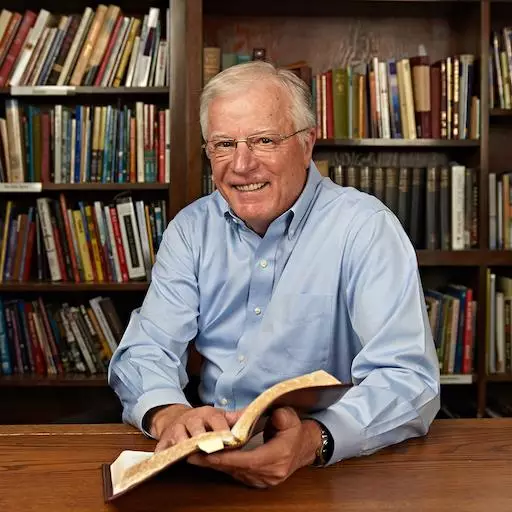
Trusting God When The Wells Are Dry – Part 2 of 2


When tough times come—and they are coming—God shakes us up to make sure we remember who our real provider is. He can sustain us through adversity. In this message, Pastor Lutzer provides three principles to hang onto when our crisis comes. Even through trials, God is working to develop our character.
Dave McAllister: Let us run with endurance the race that is set before us, looking to Jesus, the founder and proctor of our faith. When tough times come, and they're coming, God shakes us up to make sure we remember who our real provider is. He can sustain us through adversity when we accept the limitations that adversity brings. Today, some key principles to hang on to when your crisis comes. From the Moody Church in Chicago, this is Running to Win with Dr. Erwin Lutzer, whose clear teaching helps us make it across the finish line. Pastor Lutzer, is it wise to assume that adversity is inevitable?
In other words, will we, like Abraham, find ourselves trusting God when the wells are dry?
Dr. Erwin W. Lutzer: Dave, I think the answer is yes, as long as we understand that every person's dry well experience may be different, but at the end of the day, we all face trials, and then we all know that eventually we will face the ultimate trial of our own mortality and our death. But the good news is that if we've trusted Christ as our Savior, he helps us through all those experiences. I've written a book entitled Famines, Deserts, and Other Hard Places because I am convinced that God does not use people until he has disciplined them, until he has tested them.
And of course, he did that with Israel in the desert and a host of other saints. But let me remind you of this. Some of the sermon titles are trusting God when the wells are dry, empty cupboards, empty stomachs, the desert, the devil, and you. All that to say, for a gift of any amount, we're making this book available for you. Here's what you do. Go to rtwoffer.com. rtwoffer.com or call us at 1-888-218-9337. Now, I'm going to be giving you that contact info again at the end of this message. Let us be encouraged by God's word.
You say, well, Pastor Lutzer, what's the what's the bottom line here? How does this change our lives and my particular famine? You may be in a situation where your wells are dry, so to speak, and I speak not only economically, but in terms of relationships, in terms of hardship, in terms of crisis. How does it affect us? Let me give you some observations and then nail it to the wall for all of us. First of all, the God who saves us is the God who sustains us. The God who went with Abraham into the land would have been able to keep Abraham in the land.
No question about it. Now, as I already mentioned, it isn't wrong for us to move when we're in a famine in one part of the country and go to another. But for Abraham, this was unique. The problem was he believed in God's guidance into the land, but he couldn't trust God to sustain him in the land. There's a very interesting passage in the 26th chapter of Genesis. Genesis chapter 26 Isaac, the son of Abraham. It says chapter 26 verse 1, now there was a famine in the land besides the former famine that was in the days of Abraham.
And Isaac went to Gerar to Abimelech, the king of the Philistines. That's actually on the way to Egypt. And the Lord appeared to him and said, don't go down to Egypt. Dwell in the land of which I shall tell you. And then God reiterates his covenant with Isaac. And Isaac trusts God to keep him in the midst of the famine and to grant him the grace to stay there. And what follows in the rest of the chapter is quite unique and even surprising because we notice that Isaac, it says in verse 12, Isaac sowed in that land and reaped in the same year a hundredfold.
Wow, that's unique, isn't it? He was in the land of famine, but God says, I am going to provide for you in the midst of your famine. Not going to take the famine away, but I'm going to grant you grace and strength so that you can live in the midst of the famine. To those of you who are going through an actual economic famine, what this means is that we are where we are. We can't change our situation. Many of us perhaps can't who are going through that. We can't change where we go. We can't just pick up and move.
It's it's so complicated. Can God sustain you in the midst of that heartache, that famine? The answer is yes. Isaac reminds us of the fact that you should be willing to do anything. You should be willing to trust God not only for a harvest, but the rest of the chapter in 26 says that the Philistines filled the wells that Abraham had dug. And Isaac went, it says, and he redug Abraham's wells. And they had water. Look around. There may be some move you can make that you've not thought of. And one of the moves, since we're speaking economically, certainly is downsizing.
I know that there is some folks who said this, and this is an actual story, though not connected to Moody Church, about a real estate developer who is making so much money, Christian. And he said, you know, we just open our hands like this and God fills it. One success after another. And then when the downturn came in the real estate market and he was unable to meet his obligations, he suddenly learned something that God sustains us in the midst of famine, but we may live through the famine, but we can't live as we always lived.
He had to downsize. He had to sell off. He had to lose a lot of money. But that from God's standpoint is part of the teaching. He says, I will sustain you in the midst of the famine. It may be hard. It may be difficult, but don't give up hope. And the reason that we should not give up hope is because of the next observation I'd like us to make. And that is that God doesn't leave us even when we leave him. God doesn't leave us even when we leave him. Here's Abraham. And he is supposed to be sustained in the land.
And he panics, decides to do something foolish, go into Egypt. And next week, I'm going to tell you about some people. I have their letters in my file who in the midst of financial need have done very foolish things. In one or two instances, it is men who without their wife knowing it invested money in a get-rich-quick scheme that they found hoping to cash in on all of this money only to discover that their nest egg became a yolk. And it didn't work at all. Does God abandon us then? Because you see, there are two different kinds of famines.
There's the famine over which we have absolutely no control. That's the famine that Abraham had when he was in Egypt. You don't control those kinds of things. None of us controls the economy or the company in which we work. We can't control that, but the famine, I'm putting it in quotes, that Abraham experienced when he was in Egypt, that mess was self-created. And today, there is some of you who are in a self-created hard place. Somebody told you, don't marry that guy. And you thought that you knew better, but they were right, weren't they? Somebody said, no, no, your wife told you, don't invest money there.
I don't know why it is, but women have this fifth sense or sixth sense. They have more sense than we do anyway. And And they say no, and And you know better. But the point is this, that some messes are self-made. Does God say, well, Abraham, you know, when you left the promised land to go into Egypt, I stopped at the border because I'm not going to have anything to do with somebody who so disobeys me and uses deceit in order to get ahead and to save his neck. That God say that? No. God walks with us.
God is there with us. God accompanies Abraham into Egypt. God brings a plague on Pharaoh for Abraham's benefit. God restores Abraham even though his testimony is lost, and he discovers that you know what? This God who led me is also the God who forgives me. He's the God who restores me. And he's the God that I can worship again. I can build another altar. I can come back from my backslidings. Some of you, and you know who you are. You have been come so cynical in your walk with God. There is no longer really warm fellowship because you feel that God wasn't there for you.
And you say to yourself, I'm in a mess. I've made it, and God's not helping me in it. If you're a believer, God is with you there. He is for you. He's rooting for you. But he wants you to come back into fellowship. He wants you to say that I've strayed long enough. I've done my own thing long enough. I want to come back because it is better. It is better to have a dry well in Canaan than it is the lush pasture land of Egypt. It is better to have a dry well than a poisoned oasis.
And so the Lord says, return to me, believe me, and trust me. There's a final lesson, and it really is the bottom line of everything. Every famine we go through, every famine is in test of our trust. Now, of course, when I speak about famines in the next message, I'm going to talk about the need for us as a community to walk through famine. But for now, I'm talking about us as individuals. It is always always a test. We have to just stand back of this passage and think about it again. Would you never get tired about thinking about the scriptures and meditating on it?
Why did Abraham say, if we go down into Egypt, they may kill me? What do you mean they may kill me? Was there any chance in the world that Abraham could die in Egypt and be killed? Of course not. Why? What's because God just plainly told him, I'm giving you this land and I'm giving it to your descendants. He didn't have any descendants at that point. How could the promise of God possibly be fulfilled if the Egyptians had killed him? Even if Abraham had said, I'm going down to Egypt, he should have simply said, I'm going down.
We're going to tell the truth. My life is in God's hands. It's not in Pharaoh's hands. God gave me a promise that someday through my seed this land would be populated, and that's good enough for me. My life in God is secure. It's very interesting that in the book of Galatians chapter 3 verse 8, you know what the apostle Paul says? He says that when God said to Abraham, in thy seed the nations of the earth shall be blessed, he actually said that Abraham believed the gospel. He said the gospel was preached to Abraham. We look at the text and we say, boy, there's no gospel here, nothing about Jesus dying for our sins.
No, all that will eventually come to pass, but inherent within the promise that in thy seed all the nations of the earth would be blessed, within that promise there was entailed the coming of Jesus, the redeemer. Wow, you know what the bottom line was? Abraham experienced a crisis of faith. He could not trust God to continue, to lead there, yes. But beyond that, he couldn't grasp it. And he failed. Every famine is a test. Can we trust God no matter whether it's a famine we've created or one created for us? Can we trust him? That's always the issue.
Sometime ago when I landed at O'Hare field, the plane that I was on stopped at a gate that was very far from baggage claim. Shortly after I got off the plane, I found myself in step with a young mother. Wanted to describe her to you. She had a baby in one arm. She was pulling her suitcase with the other hand. And she had a little toddler, perhaps three, trying to keep up with her, going ahead and behind as little toddlers do. And I had a free hand. So I said to her, would Would you let me pull your suitcase?
I have only one briefcase. I'd be glad to. She said, no, no, no, no, she says she says I I can handle it. I said, I promise I will stay in step with you wherever you are going. Just let me pull it for you. No, no, no, I'll take care of it. Later on as I meditated on that, I realized that she was just obeying a little bit of common sense and wisdom. You just don't trust a man you've never met before. Fact is I could have taken that suitcase, and in 10 steps or less been in the crowd and disappear, and then what was she to do?
But I thought to myself how different that all would have ended if she had known me. If she'd been a member of Moody Church or an attender, if she knew me, and I'd have said, may I pull your suitcase for you? May I take it? And she probably would have said, well, sure, here's my suitcase. And by the way, here's the baby too. And then I thought about how Jesus walks with us in life, how we are carrying our suitcases and trying to manage and trying to manipulate and and trying to control and some of that all may not be wrong.
But at the end of the day, Jesus said, don't you see that I'm beside you? Why don't you let me carry your baggage? Instead of just praying all the time frazzled prayers that have no faith, oh God, help me. Help me. Help me. Help me. Nothing wrong with that. Peter prayed in desperation and said, help me. I perish. And it worked for him. But I think, and here of course I'm just using my imagination, I think that in heaven all of the angels are processing these prayers and taking a lot of them and just throwing them in the waste basket.
Because what they're saying is father, they keep asking you for help, but one thing they will not do, and that is trust. They will not take their sin and their failure and their concern and their deserts and their famines and just turn them over to me. Doesn't mean it's an immediate answer, but you are walking with somebody beside you whom if you knew his heart. And I know I desire to know his heart and wouldn't claim that I know his heart completely in any way. He'd say, let me carry it for you. I've not abandoned you.
I'm walking in your direction, and if you're going the wrong direction, I'll even lead you in the right direction. But today, could we tell Jesus that we give him our suitcase? May be a relational issue, may be a financial issue, could be a health issue. The Bible does say, cast all your burdens upon him because he cares for you. He really cares for you and knows the famine that you're going through, knows how it's going to end, and knows your part in it. Today at the Moody Church, we're going to have the privilege of singing in just a moment.
And when that happens, prayer partners are going to step out out of the aisles. I'm told we have about 27 different places in this sanctuary where you can find a prayer partner. Ask this prayer partner, and you don't even have to ask them because they are ready, to simply take your request in a single sentence and commit it to God and trust him to do it. Now, that's not the end of it. But I want you to do this morning, I would like you to do every day of your life as I try to do.
We always live in surrender, not just prayer, though thank God for prayer, but in submission to God. Because what we'd like to see here at the Moody Church is to see God answer so many prayers because they are prayers made in faith and commitment. Because he really does care for you. He really does. Let's pray. Father, we thank you today for the story of Abraham, and even in his failure we see ourselves. Now, restore your people, Lord. There are people going through times of very great famine. Some can't pay their bills. Other people are going through times of stress, questioning your will, not knowing where you want them.
Lord, every person, everyone, including the one on this platform, is all filled with questions, concerns, burdens. Today in faith, we give them to you. Help your people to connect, to be willing to share that we might see your glory in this place. And for those who've never trusted Christ the Savior, may they lay their burden down and receive you today in Jesus name. Amen. This is Pastor Lutzer, and I can't help but think that there are many of you who are praying right now, asking God to help you. But actually, I want to challenge you with something that is even deeper.
Instead of simply asking for his help, ask for his transforming power. Ask God to give you the grace to surrender to his will. Ask him for his forgiveness. God wants to do something deep in our lives, and of course, sometimes the only way he can do it is through trials. And so I have no doubt that there are many of you who have identified with Abraham. You've thought to yourself, God is not faithful to me in the desert, and you have gone and taken the wrong way. Would you come back? Would you repent? Would you end your backsliding?
Wherever you are at spiritually, talk to God about it. I've written a book entitled Famines, Deserts, and Other Hard Places. And as you've probably heard me say before, I wrote it to encourage believers to help them to understand God takes us through the trials. He does not abandon us. He takes us through trials, and we come out with greater faith on the other side. And of course, the ultimate trial of course is when we will die. But John Stott, great preacher in England, who is now with the Lord, said on one occasion that for the Christian death is trivial.
Why? It's an open door to glory. For a gift of any amount, we're making this book available for you. Here's what you do. Go to rtwoffer.com. That's rtwoffer.com or call us at 1-888-218-9337. Why don't you go to your computer right now? Type in rtwoffer. Of course, that's all one word. rtwoffer.com or call us at 1-888-218-9337. And if you are able, I hope that you'll take out the time to go to church this weekend to seek God with other believers because together we are stronger than we are when we simply stand on our own. Meanwhile, from my heart to yours, thank you so much for supporting this ministry because of people just like you.
The ministry of Running to Win goes around the world. Thanks in advance for helping us and for your love and prayers.
Dave McAllister: You can write to us at Running to Win 1635 North LaSalle Boulevard, Chicago, Illinois 60614. Running to Win is all about helping you find God's road map for your race of life. Sorrow comes to all of us, and it's through tears that we learn to depend on God for every breath, every bite of food, and every dollar. Next time, a story of famine and how God met a woman's needs. Thanks for listening. For Pastor Erwin Lutzer, this is Dave McAllister. Running to Win is sponsored by the Moody Church.
Featured Offer

This guide to the last days will stoke your trust in God’s glorious plans for the future. You will be empowered to live with boldness and readiness like never before. Click below to receive this book for a gift of any amount or call us at 1.888.218.9337.
Past Episodes
- Changed By The Word
- Children of an Awesome God
- Chiseled By The Master's Hand
- Christ Among Other Gods
- Christ Before Bethlehem
- Christ, God's Gift at Christmas
- Christians In Conflict
- Come and See Jesus
- Cries from the Cross
- Crowning Christ Lord
- Seven Convincing Miracles
- Seven Reasons You Can Trust The Bible
- Seven Secret Snares
- Sharing Secrets With God
- Slandering Jesus
- Suffering Wrong
- Ten Lies About God
- Thanksgiving
- The Battle for America’s Youth
- The Church in Babylon
- The Darwin Delusion
- The Flurry Of Wings
- The High Cost Of Lost Opportunities
- The Invisible War
- The Invisible World
- The King Is Coming
- The Legacy of a Converted Man
- The Man Who Cradled God In His Arms
- The Manger And The Sword
- The Power of a Clear Conscience
- The Triumph of the Gospel
- The Triumph Of Unanswered Prayer
- Till Death Do Us Part
- What Do These Stones Mean?
- What is God Up To
- What Jesus Thinks Of His Church
- What We Believe
- What Would Jesus Do?
- When a Nation Forgets God Interview
- When God Is First
- When God Shows Himself
- When the Spirit Has His Way
- When You've Been Wronged
- Who Are You To Judge?
- Why Good People Do Bad Things
- Why The Cross Can Do What Politics Can't

Video from Dr. Erwin W. Lutzer
Featured Offer
This guide to the last days will stoke your trust in God’s glorious plans for the future. You will be empowered to live with boldness and readiness like never before. Click below to receive this book for a gift of any amount or call us at 1.888.218.9337.
About Running To Win
Running the race of life is hard. But with the Bible front and center and a heart to encourage, Pastor Erwin Lutzer presents clear Bible teaching, helping you make it across the finish line. Since 2011, this 25-minute program has provided a Godward focus and features listeners’ questions.
About Dr. Erwin W. Lutzer
Dr. Erwin W. Lutzer is Pastor Emeritus of The Moody Church where he served as the Senior Pastor for 36 years (1980-2016). He earned a B.Th. from Winnipeg Bible College, a Th.M. from Dallas Theological Seminary, a M.A. in Philosophy from Loyola University, and an honorary LL.D. from the Simon Greenleaf School of Law (Now Trinity Law School).
A clear expositor of the Bible, he is the featured speaker on two radio programs: Running to Win—a daily Bible-teaching broadcast and Songs in the Night—an evening program that’s been airing since 1943. Running To Win broadcasts on a thousand outlets in the U.S. and across more than fifty countries in seven languages. His speaking engagements include Bible conferences and seminars, both domestically and internationally, including Russia, the Republic of Belarus, Germany, Scotland, Guatemala, and Japan. He has led tours to Israel and to the cities of the Protestant Reformation in Europe.
Pastor Lutzer is also a prolific author of over seventy books, including the bestselling We Will Not Be Silenced, One Minute After You Die, and the Gold Medallion Award winner, Hitler’s Cross. Pastor Lutzer and Rebecca live in the Chicago area and have three grown children and eight grandchildren. Connect with Pastor Lutzer on X (@ErwinLutzer) or moodymedia.org.
Contact Running To Win with Dr. Erwin W. Lutzer
media@moodychurch.org
http://moodymedia.org/
Moody Church Media
1635 North LaSalle
Chicago, IL 60614
1.800.215.5001
Monday – Friday
8:00am – 5:00pm CST
Fax Number
1.312.642.4904