

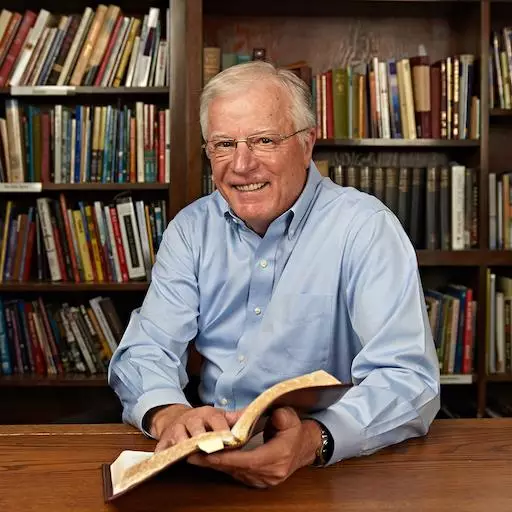
Thunder From Sinai – Part 1 of 2


God gave to Moses the Ten Commandments on Mount Sinai. More than just rules, God’s law reveals God’s nature—and exposes ours. Pastor Lutzer explores three transformative insights into why God gave us His law. What if we could see God’s holiness and our brokenness with absolute clarity?
Dave McAllister: Let us run with endurance the race that is set before us. Looking to Jesus, the founder and perfecter of our faith. The great moral code God gave to Moses contains principles governing our relationships with God and with each other. That code shows us who we are and more importantly who God is. Today we begin a series on the Ten Commandments. Stay with us. From the Moody Church in Chicago, this is running to win with Dr. Erwin Lutzer, whose clear teaching helps us make it across the finish line. Pastor Lutzer, as we begin, are the Ten Commandments still in effect for New Testament believers?
Dr. Erwin W. Lutzer: Dave, that's an incredibly important question. And you know, I could take a lot of time answering it. I encourage people to listen to this series of messages, but I want to say this. We're living at a time when people think that because the commandments are from the Old Testament that we should discard them. After all, aren't we under grace? Well, you and I know that Jesus emphasized that under grace the commandments even have a deeper meaning. I'm so glad today, friend, that you have joined us for this series of messages. I hope that you phone and invite your friends to join you as we discuss the Ten Commandments and especially as we talk about the holiness of God and how they reflect God and their relevance for today.
So you listen carefully and at the end of this broadcast I'm going to be giving you some contact info as to how this book that I've written, Why Holiness Matters, can be yours.
Dr. Erwin W. Lutzer: I decided to preach a series of messages on the Ten Commandments because the Ten Commandments are law. I can imagine there's someone saying, Oh my, spare me. Spare me. We don't need that. We're tired of being told the way we should live and and we're weary of it. Give us something that's a little bit more exciting and optimistic. Well, I want to tell you that the series, even though it will be an exposition of law, will at the same time also be an exposition of grace. And we'll see how grace and law work together and how God expects through grace us to be able to live up to the law because we're under a different principle.
But today we want to discuss in an introductory way before I get to any of the Ten Commandments, which we'll get to next time. We're going to discuss the question of why is it that the law was given? What was God up to on Mount Sinai? So turn in your Bibles to the 19th chapter of the book of Exodus. Exodus chapter 19, that dramatic, incredible passage where Mount Sinai is filled with smoke and fire and flashes of lightning and thunder and God is the one who is speaking to Moses. Exodus chapter 19. I'd like to suggest that there are three reasons why the law was given.
Three reasons. The first is to reveal the holiness of God. To reveal the holiness of God. I think that the most fundamental attribute of God is holiness. Holiness stands at the very center and the very core of the being of God in ways perhaps that his other attributes do not. There is only one attribute in all the Bible that is elevated to a third degree. It is the attribute of holiness. Holy, holy, holy Lord God Almighty. Now the word holy really means separate. It means that God is separate from his creation, separate from anything else, separate from us because he is different and he is a cut above us all.
A good word to introduce to you is the word transcendent. That means that God is beyond the limits. He transcends space. He transcends the universe. He is the God that goes beyond. That's God. Transcendent and holy. How is the holiness of God seen in this passage of scripture? I think it's seen first of all in the way in which God put distance between himself and the people at Mount Sinai. Remember in the 19th chapter earlier in this passage, God says that when he speaks on Mount Sinai, there is to be a boundary around the mountain.
No beast, no person is to touch that mountain and if they do, you cannot touch them, but you must kill them either with an arrow or with stones, but no person should touch the person or animal that touch the mountain. And what God is saying is that the physical distance, if you please, the physical distance between the people and the mountain is symbolic of the moral distance that exists between us and God. And so God in this way is saying that he is removed from the people and that they must keep their distance because if not, they will die.
No man can see God directly and live. And God made a special exception for Moses and for Aaron. He shielded them in some way from the full force of his holiness and power, but all the other people were told to stand back. I think there's another way that his holiness is seen and that is not only in the distance that the people kept from the mountain, but also in the fact that God spoke as being on top of the mountain. The Lord descended, the scripture says, from on top of the mountain or to the top of the mountain.
For example, verse 20, the Lord called Moses to the top of the mountain and Moses went up. Not only a horizontal distance between the people and God, but also a vertical distance between the people and God. So God says, I am holy, separate. I am different. I am removed. I transcend the limits. Now when you look at the Old Testament, you can see the holiness of God almost on every page. You know, you read these passages of scripture and later on we find that as you look at the text, you are astounded. There are passages in the Old Testament that offend the sensibilities of those of us who live in the 20th century and we're tempted to scream up and to say that's not fair.
God was harsh. In fact, there are some people who think that the God of the Old Testament is a different God than the God of the New Testament. David Hume, the great atheist, said that there was evolution in our conception of God and the Old Testament God was a meanie. He wiped people out without a trial. He did all sorts of things, but the New Testament God fortunately is loving and kind and wouldn't send anybody to hell. Let me assure you that the Old Testament God is the God of Jesus Christ and the Old Testament God is our God.
We read, for example, stories such as in Leviticus 10, Nadab and Abihu. The text says that they went in and they were the sons of Aaron. Aaron, head of the priesthood. And the scripture says that Nadab and Abihu went into the temple area and they offered a strange fire to the Lord. We don't know what that strange fire is or was. God consumed them just like that and Aaron was angry, the Bible says. God wiped out his sons. No trial, no opportunity to defend themselves and we might say, Well, these were just young men who were experimenting with the liturgy.
God says, you're dead. And they were. We find in the First Chronicles 17 a story of how the ark was being taken back to Jerusalem and there was a man by the name of Uzzah who was a Kohathite who had responsibility for the ark. And the scripture tells us that as it was moving along, it was in on a cart that was taken and pulled by two oxen. The oxen stumbled and Uzzah just instinctively went out and touched the ark to steady it and God smote him. And he was dead and David was angry with God.
We read it and we say it's not fair. They weren't given a trial. They didn't understand that the offense would be that great. But I want you to know today that these people did not die innocently because God had said to Aaron and to his sons that fire had to be offered in a certain way and his sons disobeyed and God had said to the Kohathites that when you carry the ark, don't ever touch it with human hands. It is to be enfolded in a curtain in such a way that no man should even see it, much less touch it after it becomes the property of the tabernacle.
And so they died guilty. Oh, it's true, we may say that they didn't understand the severity of what they were doing and and Uzzah meant well. He wanted to steady it, but God says, if I tell you don't touch something, it means don't touch. It would be better for it to fall to the ground that is less polluted than the hands of a polluted man. So when God says no, he meant no. When you read the Old Testament, you find I used to tell people that you can find at least a dozen crimes that people were to be stoned or executed for in the Old Testament.
I found out I was far too low. It's at least over 20, but let me give you some of them. For cursing your parents, for murder, for kidnapping, for idolatry, for child sacrifice, for magic or the occult, for unlawful divorce, for adultery, for homosexuality, for incest. All of these and more God says, when someone does this, kill him, stone him. You say, well, hasn't God changed his mind? If we were to apply that today, there wouldn't be one TV executive that would be alive. I mean, surely God has a different opinion about these things today.
My friend today, if you miss everything that I say, will you hear this with clarity that God has not changed his mind regarding one single aspect of these sins? Not one. He still feels just as deeply about every one of them. It is absolutely unthinkable that the sovereign God who says I change not would have in this era decided that these things weren't quite as bad as he made them out to be in the Old Testament. Unthinkable and blasphemous to think that God has a different opinion of these things today. Well, you say, well, people are getting by.
You see, today we as believers have the privilege of being shielded from the wrath of God because of Jesus Christ. But also in this era God has decided not to relegate the judgment to civil authorities as he did in the Old Testament during the time of the ocracy. And so what God says is is that his holiness, which is such a part of his justice, will be meted out for every one of these sins, but he will take care of it personally at death. Every one of these crimes is capital. All sin is capital punishment.
The soul that sins, it shall die and all of us will die because we are guilty and God says that so far as the unbelievers are concerned, he will judge them personally and take care of the retribution at death. It does not happen in this life, but his opinions are unchangeable and the same. And you know that when men and women die without Christ and they go to hell forever, the degree of that punishment is going to be based on how much they knew and how much they sinned in light of what they knew. And the judgment is going to be meted out with such exactness that an adulterer, for example, will wish that he committed adultery one less time than he did because if he had done so, his judgment would have been just a shade less severe.
And a liar will wish that he lied just one less time than he lied because if he had lied one less time, his judgment and retribution would have been just a shade less severe. And people who publish pornographic magazines will wish that they had published one less than they published because the judgment of God will be so exact and so right and so specifically tuned to the crime that they will wish that they had done less so that their judgment would have been a fraction under what they were experiencing. Because God is holy and has not changed his mind regarding a single sin.
He is not more tolerant today than he was in the Old Testament. So one of the things that God wants to say by the giving of this law and by having Sinai quake and having thunder and lightning, God is saying, I am transcendent. I am holy. And people are defiled. Stay away. Don't touch the mountain. If somebody touches it, don't touch him, but kill him from a distance, God says. And he's the Lord and he changes not. There's a second reason why the law was given and that is to reveal the sinfulness of man, to reveal the sinfulness of man.
Nothing is in more stark contrast than the sinfulness of man once you get a glimpse of the holiness of God. You read the rest of the Old Testament and you find that it's just filled with people doing nothing really but breaking the laws that God gave them. The total inability of man to meet God's high standard. I realize of course that man can meet the Ten Commandments, many of them at least minimally. He can do no murder. He can remember the Sabbath day to keep it holy. But in the New Testament as God begins to elevate that and to show that actually the standard of God has to do with the intense of the heart, you find then of course that once you understand the law, and that was true even in the Old Testament, particularly the last commandment about coveting, God was interested in the human heart.
Any honest person who understands himself knows that he cannot keep the law and the law was given to reveal sin that he might cry up to God for mercy. The total inability of man. This is the doctrine, by the way, in which the reformers broke with the Roman Catholic Church. You say, I thought it was justification by faith. Justification by faith and inability go together because you see, once you take the point of view that man cannot cooperate with God in his salvation, that man cannot add one single particle to the process of salvation, then of course salvation becomes a matter that is in God's hands.
And it is a gift of God, not of works, lest man should boast. The inability of man, but also the deception of man's heart. Look at this 19th chapter. In an introductory way God is speaking to Moses in the first few verses. And in verse eight it says, and all the people answered together and said, all that the Lord has spoken we will do. Unbelievable. And to think they meant it. They actually thought that whatever God tells us to do we can do. How deceived can you get? It was Martin Luther who said that man is not only blind, sick, and dead without God.
If he were blind, sick, and dead and that were the end of it, he might see his need and cast himself upon the mercy of God. But he is not only blind, sick, and dead, but it's far worse than that. He perceives himself to be able to see. He perceives himself as healthy and alive and that's what makes it so difficult for men and women to repent. They don't see themselves as God sees them. It's a remarkable story in the New Testament. The young ruler comes to Jesus and says, what shall I do that I may inherit eternal life?
Jesus plays the game with him. What shall you do? Okay, you want to do it by works? Fine. There is a second way of salvation. Just be perfect and you'll make it. Jesus said. He says, do the commandments. The young man says, these have I kept from my youth up. And Jesus said, oh, really? Tongue in cheek. Our Lord says, well, you know, one thing you lack, go sell everything that you have and give it to the poor and then come and follow me. Jesus knew that he was covetous, so he picked on the last commandment.
Oh, a remarkable story. Why is it remarkable? The two most perfect human beings in all the world are having a discussion. One is the spotless lamb of God and the other is a lamb with only one minor blemish. Isn't that remarkable? These have I kept from my youth up. You know what that man needed to do? He needed to get a glimpse of the holiness of God and if he had seen God, he would have fallen on his face and he'd repented in dust and ashes. The gall to say, these have I kept from my youth up.
What a shallow view of sin. Do you know what happens when people see God? They begin to see themselves and it's not a pretty picture. My dear friend, could I have a moment with you? Let me share a burden that I'm carrying in my heart. We're living at a time when we have pared God down to manageable proportions. We have domesticated him. If there's anything that the evangelical church desperately needs today, it is a fresh vision of the holiness, the grandeur, and the greatness of our God. And as I mentioned in the message, the minute we begin to see God, we see ourselves and we repent in dust and ashes.
That's why I believe so deeply that this series of messages and a book I've written entitled Why Holiness Matters is so critical in an age in which we are so careless about our relationship with God. Today, of course, we often times pride ourselves that we are not legalists, but at the same time, as a result of that, we are constantly compromising with the world. I sure hope that you have a pen or pencil handy because I want to give you some info as to how this book can be yours for a gift of any amount.
And thank you in advance for helping us as we continue to get the gospel of Jesus Christ to millions of people. But here's what you do. Go to rtwoffer.com. Perhaps I said that too quickly. RTW offer. RTW offer, of course, is all one word. rtwoffer.com or pick up the phone and call us at 1-888-218-9337. Remember the title of the series, Why Holiness Matters, and I've written a book on that topic. So thank you in advance for helping us. I hope that you'll receive your copy, read it, share it with your friends because as Tozer once said, our greatest need is always to see God afresh.
Dave McAllister: It's time now for another chance for you to ask Pastor Lutzer a question about the Bible or the Christian life. Peter listens to Running to Win and poses this question for you, Dr. Lutzer. Why is the Trinity important to our faith as true believers in Jesus Christ alone for our salvation?
Dr. Erwin W. Lutzer: Peter, very good question and many Christians don't understand this, so I'm so glad that you asked. The Trinity is important because it enables God to be a redeeming God. It enables God to say that the second person of the Trinity, Jesus Christ, comes to die for us so that in a sense we say, along with Charles Wesley, that thou, my God, shouldst die for me. So Jesus Christ makes the atonement and the Father accepts it. This means that God can be just and the justifier of those who believe in Jesus. It's because of the Trinity that God can both demand payment and supply what he demands.
Now we have to contrast this with Islam. Islam believes in one God only. Monotheism is very important to Islam, but the God of Islam has no sacrifice for sin that Allah, the God of Islam, accepts. He cannot accept any human sacrifice. He cannot accept any sacrifice that is made. Theoretically, the only sacrifice that he could receive is a divine sacrifice, but he can't do that because he is only one. I know that that's theologically a little difficult for us to get our minds around, but you've asked a very good question. Finally, let me say also that the Trinity is a model for how we should conduct ourselves in the church.
John 17 Jesus says, thou in me and I in thee that they may be one even as we are one. Unity and diversity is in the Trinity. Unity and diversity should be within the church. And we should get along with one another, the way in which the members of the Trinity get along with each other. Well, there's more that I could say, but perhaps that's enough for now. Thanks so much, Peter, for writing. God bless.
Dave McAllister: And thank you, Dr. Lutzer. If you'd like to hear your question answered, go to our website at rtwoffer.com and click on Ask Pastor Lutzer or call us at 1-888-218-9337. That's 1-888-218-9337. You can write to us at Running to Win 1635 North LaSalle Boulevard, Chicago, Illinois 60614. On Earth the law of gravity is immutable. God's moral law has the same force. The commandments he gave to Moses define his character and his expectations of our behavior. Next time on Running to Win, why God's moral law shows us who we really are. We'll resume right where we left off in Exodus chapter 19 as we relive a time of thunder from Sinai.
Thanks for listening. For Pastor Erwin Lutzer, this is Dave McAllister. Running to Win is sponsored by the Moody Church.
Featured Offer

This guide to the last days will stoke your trust in God’s glorious plans for the future. You will be empowered to live with boldness and readiness like never before. Click below to receive this book for a gift of any amount or call us at 1.888.218.9337.
Past Episodes
- Changed By The Word
- Children of an Awesome God
- Chiseled By The Master's Hand
- Christ Among Other Gods
- Christ Before Bethlehem
- Christ, God's Gift at Christmas
- Christians In Conflict
- Come and See Jesus
- Cries from the Cross
- Crowning Christ Lord
- Seven Convincing Miracles
- Seven Reasons You Can Trust The Bible
- Seven Secret Snares
- Sharing Secrets With God
- Slandering Jesus
- Suffering Wrong
- Ten Lies About God
- Thanksgiving
- The Battle for America’s Youth
- The Church in Babylon
- The Darwin Delusion
- The Flurry Of Wings
- The High Cost Of Lost Opportunities
- The Invisible War
- The Invisible World
- The King Is Coming
- The Legacy of a Converted Man
- The Man Who Cradled God In His Arms
- The Manger And The Sword
- The Power of a Clear Conscience
- The Triumph of the Gospel
- The Triumph Of Unanswered Prayer
- Till Death Do Us Part
- What Do These Stones Mean?
- What is God Up To
- What Jesus Thinks Of His Church
- What We Believe
- What Would Jesus Do?
- When a Nation Forgets God Interview
- When God Is First
- When God Shows Himself
- When the Spirit Has His Way
- When You've Been Wronged
- Who Are You To Judge?
- Why Good People Do Bad Things
- Why The Cross Can Do What Politics Can't

Video from Dr. Erwin W. Lutzer
Featured Offer
This guide to the last days will stoke your trust in God’s glorious plans for the future. You will be empowered to live with boldness and readiness like never before. Click below to receive this book for a gift of any amount or call us at 1.888.218.9337.
About Running To Win
Running the race of life is hard. But with the Bible front and center and a heart to encourage, Pastor Erwin Lutzer presents clear Bible teaching, helping you make it across the finish line. Since 2011, this 25-minute program has provided a Godward focus and features listeners’ questions.
About Dr. Erwin W. Lutzer
Dr. Erwin W. Lutzer is Pastor Emeritus of The Moody Church where he served as the Senior Pastor for 36 years (1980-2016). He earned a B.Th. from Winnipeg Bible College, a Th.M. from Dallas Theological Seminary, a M.A. in Philosophy from Loyola University, and an honorary LL.D. from the Simon Greenleaf School of Law (Now Trinity Law School).
A clear expositor of the Bible, he is the featured speaker on two radio programs: Running to Win—a daily Bible-teaching broadcast and Songs in the Night—an evening program that’s been airing since 1943. Running To Win broadcasts on a thousand outlets in the U.S. and across more than fifty countries in seven languages. His speaking engagements include Bible conferences and seminars, both domestically and internationally, including Russia, the Republic of Belarus, Germany, Scotland, Guatemala, and Japan. He has led tours to Israel and to the cities of the Protestant Reformation in Europe.
Pastor Lutzer is also a prolific author of over seventy books, including the bestselling We Will Not Be Silenced, One Minute After You Die, and the Gold Medallion Award winner, Hitler’s Cross. Pastor Lutzer and Rebecca live in the Chicago area and have three grown children and eight grandchildren. Connect with Pastor Lutzer on X (@ErwinLutzer) or moodymedia.org.
Contact Running To Win with Dr. Erwin W. Lutzer
media@moodychurch.org
http://moodymedia.org/
Moody Church Media
1635 North LaSalle
Chicago, IL 60614
1.800.215.5001
Monday – Friday
8:00am – 5:00pm CST
Fax Number
1.312.642.4904