

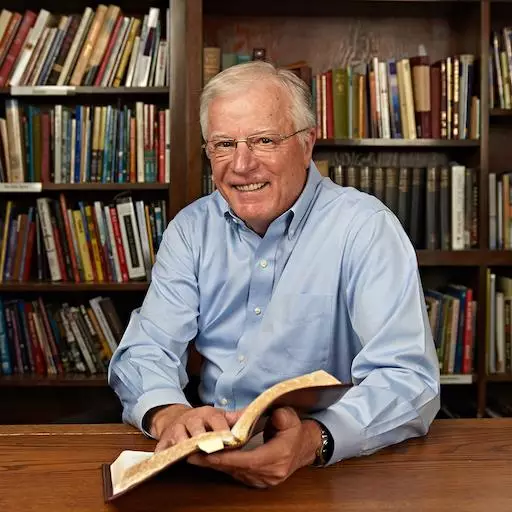
The Shepherd Guides His Sheep – Part 2 of 2


We can never wander too far for God to ever find us. The Good Shepherd always seeks us out because His heart is for the broken and to restore His glory. In this message, Pastor Lutzer provides three truths for needy, lost sheep. Discover why there is more grace in His heart than there is sin in your past.
Guest (Male): Let us run with endurance the race that is set before us, looking to Jesus, the founder and perfecter of our faith. Many people think they're in control of their lives. They work and plan for success, not realizing that the future offers them no guarantees. But believers running life's race have a guide pointing the way, a Good Shepherd who's been there, done that, and that's security for the days ahead. From the Moody Church in Chicago, this is Running to Win with Dr. Erwin Lutzer, whose clear teaching helps us make it across the finish line.
Pastor Lutzer, people who know they're lost are usually glad for a guiding hand to point the way. What about the many who have no idea they are lost?
Dr. Erwin W. Lutzer: Dave, you have touched on the most important issue in a person's life. Yes indeed, we are all surprised at the number of people who think that they are not lost because they are charting their own course. They're making up their own religion. They're believing what they want to believe, and all of us see ourselves much better than we are. In order to be saved, God actually shows us we're not nearly as good as we think we are because the standard is God himself, and not our neighbors, not our friends, and certainly not ourselves.
I'm holding in my hands a book entitled *The New Birth* by Peter Mead. The reason, my friend, you need that book is to clarify what the new birth really is so that you do indeed know how to become one of God's sheep and also to help you with the assurance that you do indeed belong to him. I'll tell you, the new birth is a tremendous miracle. It's not just going to church or giving money or singing the right song; it is a transformation of our hearts. If anyone be in Christ, he is a new creation. Here's how a copy can be yours. Go to rtwoffer.com or call us at 1-888-218-9337. Now, because this is the second to last day we're making this resource available, at the end of this message, I'll be giving you that contact info again. But remember the most important question you can possibly ask is: Are you born again?
Jesus is also likened unto a sheep in Isaiah 53, where it says he is led as a lamb to the slaughter, and as a sheep before his shearers is dumb, so he opened not his mouth. Jesus went through all that for us, and now he says, "Wherever I lead you, I want you to know that I've been there ahead of you." Notice what the text says: He restores us. He restores those who need to be turned around and those who need to be turned right side up. And then he leads us in righteous paths, in righteous paths.
Let me help us summarize what it is that I'm saying today by reminding you of three truths that grow out of this particular verse. First of all, that the needy sheep, the needy sheep has the particular interest of the Shepherd. The more needy you are, the more focused the Shepherd's eyes are on you. He comes in at the end of the day and he counts the sheep, and if there's one missing, what does Jesus say? He goes and he finds that missing sheep, not the 99 that are safely in the fold, but he finds the one that has wandered the farthest away.
If I speak today to someone who has been broken down because of moral involvement and moral sin, if I speak to someone today who has been isolated from families and friends because of despair and loneliness, if I speak to someone today who is cast down, let me invite you to hope in God because the Shepherd who knows your name is the one who is interested in you. Today, he says, be restored. You've been lost, but you can be found.
Secondly, I need to remind you that the reputation of the Shepherd—and this is important—the reputation of the Shepherd is just as important as the leading of the sheep. Notice what the Bible says there in the last part of verse three: "He leads me in righteous paths for his name's sake." Can you imagine a shepherd who purchases a flock of sheep and then will not take care of them? Shepherds are made a laughingstock; they are criticized if they have sheep that have not had proper care. And shepherds pay a great deal of time and energy to their reputation; it's important for them.
Listen, Jesus purchased us at high cost. He died for us. We have been redeemed and we have been bought by the Good Shepherd. The Good Shepherd lays down his life for the sheep, the Bible says. And so, do you think he's going to abandon us? Do you think that he will ever disown us? Will he ever say to himself, "I've purchased some sheep who are now not worth the trouble. They are stubborn. They wander. They do their own thing. They betray me. They don't act like my sheep." Do you think that will ever happen? No. He leads us in righteous paths for his name's sake. Christ's name is important, and his reputation is involved in our commitment or lack thereof. And so, I want you to remember that.
And finally, and most importantly, that the Shepherd always seeks the sheep. The Shepherd always seeks the sheep; sheep never go looking for the Shepherd. They never say to themselves, "You know, I'm lost. I'm going to try to find the Shepherd." Almost always, it is the other way around, and certainly that's true in relationship to our Good Shepherd, the Lord Jesus Christ. It is always the Shepherd who goes hunting for the sheep.
One day, Jesus was criticized for spending so much time with some of the sinners that were there in the city of Jerusalem and in Judea. And in order to justify spending time with harlots and tax gatherers, he said, "You know, there was a shepherd who had 99 sheep, but he left them in the fold and then he went out and he found the one sheep, and when he brought him back, he rejoiced." And here Jesus was saying that these people are like those who have wandered very far away. In fact, if we may stretch the analogy a bit, strictly speaking, they were not even his sheep yet.
But he said, "I went out and I found them." The Good Shepherd leaves the 99 with someone whom he trusts, and then he goes out in the wilderness and he seeks and he finds and he comes across this little lamb that is caught in the bushes, the little lamb that is lost, and he puts him on his arm and he brings him back to the fold. "Now," said Jesus, "that's what the Good Shepherd does. He does the seeking. We never do."
Now, oftentimes when you hear testimonies, you'll hear some people say this: "I found the Lord as my savior back in 1985." Now, we understand what they mean, but strictly speaking, that's not very good theology. It is the Shepherd who found you in 1985. You weren't looking for him; he came looking for you. No man can come except the spirit draw him. You say, "Oh yes, but I was seeking God." Yes, the reason that you were seeking God is because God was first seeking you. Left to ourselves, we as sheep will never turn to God. God comes hunting for us, and of course, he knows our address and he finds us.
Here at the Moody Church on Fridays, we have staff devotions with the pastoral staff and the office staff together. And since I led it this week, I told the staff that were present a story I had just skimmed a book this past week—I don't have time to read anymore, I can only skim—skimmed a book on the life of John Newton. Now, you have to get the picture: Here is someone who is brought up in a semi-Christian home, though with a very harsh father, and Newton becomes involved in the slave trade, goes to Africa, decides that he's going to jettison everything that he ever learned about Christianity, though he had learned some verses of scripture as a youth.
And while he's in Africa, he chooses to become a hardened sinner, an atheist he says. He had convinced himself that there was no God so that he could do whatever he wished. He had been warned about immorality, but now decided to commit immorality. His mouth, his swearing was so vile that even some of the hardened sinners and sailors with whom he worked did not want to work with him. But now he who knew so much sin—in fact, there was a time when he was in Africa when he kind of was willing to give a prize to someone who thought of some new way of sinning that he, John Newton, had not yet tried.
But he's on his way back now in the North Atlantic, and the date is March 10th, 1748. And they are in a ship that is called the *Greyhound*, and a huge storm comes up. And the waves begin to go over the ship. He and another man began to man the pumps; others of the sailors were trying to scoop up the water. Some of the cargo was already lost, and now the gale became absolutely vile. And every time the ship was in that hollow waiting for the next wave, they thought that the very next moment the ship would be dashed to pieces.
And Newton said something to the captain and then said, "If this will not do, may the Lord have mercy on us." And the minute those words came out of his mouth, he realized that he had in effect spoken a prayer. The storm became so vile that he and another man strapped themselves to the pump for fear that the water should bring them overboard. While he was thinking about the verses of scripture he had learned, this verse from Proverbs chapter one came to him. He said, "God is speaking: 'Because I have called and you have refused, I will also laugh at your calamity and mock when your fear cometh.'" He thought, "I can't turn to God now because is there grace even for me? God is mocking as the ship is being battered and destroyed."
Well, as the story goes, the storm eventually ended, and by the way, it took them nearly 28 days longer after they had run out of food in order to find land. But it was when the storm abated, he found a New Testament that was on the ship and he began to read. And he read through the Gospels and then the light dawned that Jesus Christ was indeed who he said he was, and Newton savingly believed. Well, no wonder he was qualified to sing and to write the most beloved hymn, one of the most beloved hymns we could ever possibly sing: "Amazing Grace, how sweet the sound that saved a wretch like me. I once was lost, but now am found, was blind, but now I see."
How does it go? "Through many dangers, toils, and snares, we have already come. When we'll be there ten thousand years, bright shining as the sun, we've no less days to sing his praise than when we've first begun." Let me ask you something: Who was searching for who? Was it the sheep that said, "I need a shepherd"? No, when the sun was shining and when the money was there and when there was health and strength, this sheep was not looking for a shepherd. But what the Shepherd did is take that sheep through a series of experiences, stripping him of his self-confidence and leading him back to the faith of his mother, who taught him those verses of scripture. The Shepherd was finding a lost sheep.
Now, there are two categories of lost sheep. There are those who are not really sheep at all, just like Newton on that boat, perhaps running from God, running from everything that you think and know you should be doing. Or maybe not running, but wandering and considering faith in Jesus Christ because the Shepherd is at work in your heart. But then there are those of you who know the Shepherd. You remember the love of his voice. You remember responding to his call. You remember the intimacy that you had with him years ago, and now possibly you need to be turned around. You've gone from one clump of grass to the other, and your trail leads nowhere. Or you need to be turned right side up.
The Shepherd says to you and to me today: Be restored. He restores my soul. He guides me in paths of righteousness for his name's sake. Be encouraged. The Shepherd loves his sheep and longs and longs for closeness and intimacy. And he's there speaking to you now. And if you will, let us pray.
And our Father, we do want to thank you that we have often sung: "Prone to wander, Lord, I feel it, prone to leave the God I love. Here's my heart, oh take and seal it, seal it for thy courts above." Father, for those who are listening who have wandered away from the flock and wandered away from you, make this a day of restoration. We pray that you will pick them up, clean them up, restore them, bring them back. I pray that each one who is listening will know that there is more grace in your heart than there is sin in their past. In Jesus' name, amen.
Guest (Male): My friend, we've been emphasizing in this series of messages that the most important thing that you can know is that you belong to God, that you are one of his sheep. Would you like to have a book that clarifies exactly what the new birth is, the miracle that God does in our hearts to bring us into his fold, so to speak? I'm holding in my hands this book, and this is the second to last day that we're making it available for you. It's entitled *The New Birth* by Peter Mead. Now, one of the things that you'll discover is that he uses illustrations to clarify what he is speaking about. It is a book indeed that you can read for yourself, you'll be edified by it, but then give it to a friend, someone who perhaps is not born again. Meanwhile, I do hope that you have a pen or pencil handy because I'm going to be giving you some contact info. We'd like you to have a copy for your own benefit and for those around you who need to understand more clearly what the gospel is. Very quickly, here's what you do: Go to rtwoffer.com. That's rtwoffer.com. Of course, rtwoffer is all one word. rtwoffer.com or call us at 1-888-218-9337. Ask for the book *The New Birth*. It's yours for a gift of any amount. Right now you can go to rtwoffer.com.
Dave McAllister: It's time now for you to ask Pastor Lutzer a question about the Bible or the Christian life. The damage done by divorce is heart-rending, but when it happens in full view of a local church, the pain is intensified. Nancy has written from Pennsylvania with this story:
"My husband was saved at age 20 and was a deacon, a Sunday school teacher, and a youth leader for over 30 years. Now he's left me for the church organist. He says that after he divorces me and marries her, he'll ask me and my adult children to forgive him. He says we have to forgive him and invite him back to our birthday gatherings and holiday celebrations with his new wife. As devastated as I am, I believe I can still think clearly enough to believe this is not a good plan. Does God really expect me to accept a clearly unrepentant adulterer as though nothing is wrong? For his mistress, this is her fifth affair with a married man. She also claims the grace and mercy of the Lord. 16 years ago, her husband cheated on her, so she feels completely justified. She divorced that husband, and despite my efforts to fight it, my husband will soon be rid of me by divorce. What should I do?"
Dr. Erwin W. Lutzer: Nancy, first of all, let me thank you so much for asking this question. And even as I have read it, I've been praying that God will give me wisdom to answer it. The answer is this, however: That your husband is taking forgiveness for granted. He is confusing, first of all, forgiveness with consequences. Does he really think that he can leave you, that he can commit this great sin, leave you, become involved with this other woman and marry her, and then think to himself, "I've done nothing that a little bit of forgiveness can't cure"?
There are built-in consequences. One day, a pastor friend phoned me, and he left his wife for another woman. And he said, "Well, even David got his Bathsheba." And I said, "Yes, David got his Bathsheba, but look at what he also got: The devastation of his own family, etc." It is very important for your children and other people who are watching this scenario to recognize the fact that a man cannot walk away from his wife, marry someone else, and then consider it to be just a small bump in the road. What does that say to your family, your children, the wider family of the church?
What the church really ought to do is to discipline him, is to have him recognize that he is committing a sin, and he has to be put outside the congregation in a legal sense. So what he is doing is he's confusing forgiveness with consequences—the consequences will still be there. He's also confusing forgiveness with genuine repentance. Obviously, neither he nor the woman he is marrying have any idea of what true repentance is, because they're repenting, so to speak, and asking for forgiveness before they commit a sin. That is presumption. It only intensifies really their sin.
So specifically, to give an answer to your question: No, I don't think that he should be invited back for your celebrations with your children and the like as if nothing has happened because, after all, he has asked your forgiveness. I think that after he is married, what you need to do is to write him a long letter, and you need to point out that you cannot pretend that what he has done is such a small thing that it can just be shoved under the rug.
Yes, it is true that God is available to forgive him if he genuinely repents. But restoring him to the family is another matter. I think that there should then be repentance in the presence of the church and in the presence of your family with real brokenness so that he acknowledges among all of those who are watching that he has sinned. Now, he's probably not going to be willing to do that because he's going to say, "Well, you know, I'm in love with this other lady." Fact is, I believe the time will come when God will turn her heart to someone else. They will begin to have problems, and probably not until then will he finally face his sin and see the extent of the iniquity that he has done.
So until that time happens, I think that you must respectfully avoid him. If he does show up to these celebrations, let him know that he is viewed as one who is under discipline because I see no genuine repentance, no acknowledgment of his sin. And all that I see is a terrible example for everyone else who is watching what is happening. I pray that you will receive some counseling that will enable you to make wise decisions in the midst of this very, very difficult situation. But sin can never be minimized. Forgiveness is wonderful, but that does not take a big sin and make it negligible. Thank you, and I pray that God shall indeed give you the wisdom about which I spoke.
Dave McAllister: Thank you, Dr. Lutzer, on behalf of all our listeners in similar situations as Nancy's. If you'd like to hear your question answered, go to our website at rtwoffer.com and click on Ask Pastor Lutzer or call us at 1-888-218-9337. That's 1-888-218-9337. You can write to us at Running To Win, 1635 North La Salle Boulevard, Chicago, Illinois, 60614.
Deep valleys—we've all been there, seeing obstacles on all sides and noting that little light reaches the bottom where we are. But believers running life's race have a Good Shepherd who knows all about valleys, and they know he will lead them safely, no matter what. Next time: How the Shepherd comforts his sheep. Plan to join us. Running to Win is all about helping you understand God's roadmap for your race of life. Thanks for listening. For Pastor Erwin Lutzer, this is Dave McAllister. Running To Win is sponsored by the Moody Church.
Featured Offer

This short but powerful work delivers on its significant promise. Pastor Lutzer explores a wide array of Scriptural teachings and siphons them into clear, cohesive truths. It is straight gospel—applicable to the skeptic, newly saved, and long-time believer alike. Click below to receive this book for a gift of any amount or call Moody Church Media at 1.888.218.9337.
Past Episodes
- Changed By The Word
- Children of an Awesome God
- Chiseled By The Master's Hand
- Christ Among Other Gods
- Christ Before Bethlehem
- Christ, God's Gift at Christmas
- Christians In Conflict
- Come and See Jesus
- Cries from the Cross
- Crowning Christ Lord
- Seven Convincing Miracles
- Seven Reasons You Can Trust The Bible
- Seven Secret Snares
- Sharing Secrets With God
- Slandering Jesus
- Suffering Wrong
- Ten Lies About God
- Thanksgiving
- The Battle for America’s Youth
- The Church in Babylon
- The Darwin Delusion
- The Flurry Of Wings
- The High Cost Of Lost Opportunities
- The Invisible War
- The Invisible World
- The King Is Coming
- The Legacy of a Converted Man
- The Man Who Cradled God In His Arms
- The Manger And The Sword
- The Power of a Clear Conscience
- The Triumph of the Gospel
- The Triumph Of Unanswered Prayer
- Till Death Do Us Part
- What Do These Stones Mean?
- What is God Up To
- What Jesus Thinks Of His Church
- What We Believe
- What Would Jesus Do?
- When a Nation Forgets God Interview
- When God Is First
- When God Shows Himself
- When the Spirit Has His Way
- When You've Been Wronged
- Who Are You To Judge?
- Why Good People Do Bad Things
- Why The Cross Can Do What Politics Can't

Video from Dr. Erwin W. Lutzer
Featured Offer
This short but powerful work delivers on its significant promise. Pastor Lutzer explores a wide array of Scriptural teachings and siphons them into clear, cohesive truths. It is straight gospel—applicable to the skeptic, newly saved, and long-time believer alike. Click below to receive this book for a gift of any amount or call Moody Church Media at 1.888.218.9337.
About Running To Win
Running the race of life is hard. But with the Bible front and center and a heart to encourage, Pastor Erwin Lutzer presents clear Bible teaching, helping you make it across the finish line. Since 2011, this 25-minute program has provided a Godward focus and features listeners’ questions.
About Dr. Erwin W. Lutzer
Dr. Erwin W. Lutzer is Pastor Emeritus of The Moody Church where he served as the Senior Pastor for 36 years (1980-2016). He earned a B.Th. from Winnipeg Bible College, a Th.M. from Dallas Theological Seminary, a M.A. in Philosophy from Loyola University, and an honorary LL.D. from the Simon Greenleaf School of Law (Now Trinity Law School).
A clear expositor of the Bible, he is the featured speaker on two radio programs: Running to Win—a daily Bible-teaching broadcast and Songs in the Night—an evening program that’s been airing since 1943. Running To Win broadcasts on a thousand outlets in the U.S. and across more than fifty countries in seven languages. His speaking engagements include Bible conferences and seminars, both domestically and internationally, including Russia, the Republic of Belarus, Germany, Scotland, Guatemala, and Japan. He has led tours to Israel and to the cities of the Protestant Reformation in Europe.
Pastor Lutzer is also a prolific author of over seventy books, including the bestselling We Will Not Be Silenced, One Minute After You Die, and the Gold Medallion Award winner, Hitler’s Cross. Pastor Lutzer and Rebecca live in the Chicago area and have three grown children and eight grandchildren. Connect with Pastor Lutzer on X (@ErwinLutzer) or moodymedia.org.
Contact Running To Win with Dr. Erwin W. Lutzer
media@moodychurch.org
http://moodymedia.org/
Moody Church Media
1635 North LaSalle
Chicago, IL 60614
1.800.215.5001
Monday – Friday
8:00am – 5:00pm CST
Fax Number
1.312.642.4904