

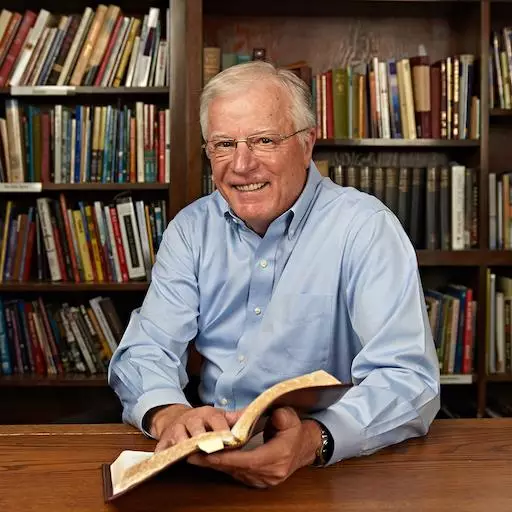
The Shepherd Guides His Sheep – Part 1 of 2


Trials and discouragement are inevitable, even for Christians. But we are not left alone—God is our Good Shepherd. In this message from Psalm 23, Pastor Lutzer explains how the Good Shepherd leads the wandering and restores the fallen. Let’s discover how His mercy reaches us in our deepest valley and brings us home.
Dave McAllister: From the Moody Church in Chicago, this is Running to Win with Dr. Erwin Lutzer, whose clear teaching helps us make it across the finish line. In his series on The Good Shepherd, Erwin Lutzer will now turn our attention to how the shepherd guides his sheep. Pastor Lutzer, if sheep are as dumb as they are, why would they accept guidance from a shepherd?
Dr. Erwin W. Lutzer: Well Dave, I think that you have already hinted at the answer. On their own, they never would. But it's the shepherd who gathers his sheep together, works with them, and saves them so that they become a part of his family, a part of his flock, to use that imagery. And then what he does is he guides them all the way home.
So it's really all about Jesus; it's not about us. But I want to ask everyone who is listening this question: Are you one of God's sheep? I hope that you will ponder that and don't think that you are just because you've gone to church or have been baptized.
I'm holding in my hands a book I want you to have. During this Holy Week is a wonderful time for you to contemplate your relationship with God. The title of the book is *The New Birth*. It's actually written by Peter Mead, who is a Bible teacher in England. He clarifies what the new birth is, but he also gives us some tests so that we can answer this question: Are we really born again?
Now, this is the last week we're making this resource available for you, so I'm going to be giving you some contact info. As a matter of fact, I'll give you that info right now. Go to rtwoffer.com. That's rtwoffer.com, or pick up the phone and call us at 1-888-218-9337. Now, at the end of this message, I'm going to be giving you that contact info again because we are dealing with the most crucial question that you could ever ask: Are you born again? And if so, what are the implications? And if not, what are those implications? For now, let us listen.
Guest (Male): If you have never felt hopeless, I would like to suggest that very probably the day will come when you will feel that way. Life has many blessings. It also has many trials. Sometimes they are equally proportioned; sometimes there is more of one than the other. Maybe it's the doctor telling you things about yourself that you thought could only be true of someone else, and you hear the tragic news that you have a terminal illness.
Perhaps it is also the disappointment of friends who have forsaken you or who have betrayed you. But difficulties come to all of us. It may be loneliness and despair, a sense of frustration because of poverty. I want you to know that as we go along in life and we encounter these obstacles, the Good Shepherd is there.
And if you were here last time, you know that we began a series of messages on Psalm 23, one of the most familiar passages in all the Bible, one that I hope that you have memorized. Today, we come to verses two and three, or is it three and four, where it says, "He restoreth my soul. He leadeth me in paths of righteousness for His name's sake."
As we've been studying, we've noticed that it is very important for us to understand sheep, because that's the metaphor, that's the analogy that is being used. And the better we understand them, the better we will understand ourselves. What does the text tell us that the Good Shepherd does for us? Well, first of all, we recognize that He restores us. And that word "restore" means to bring us back to our former position.
We use the word when we speak of the restoration of health or the restoration of someone who was in a particular level of work or vocation and then he's restored. We use it when someone is away from home. That's the way the word "restoration" is used. And you'll notice that in the text it says that He restoreth our soul. He restores me. He brings me back to other sheep and to the shepherd.
Now, as I studied this, I discovered that there are two different kinds of sheep that need restoration. First of all, there are those sheep who need to be turned around because they're going along a wrong path. Sheep are notorious for finding one clump of grass and then another clump of grass, and pretty soon they leave the rest of the flock behind and then they're way out in the wilderness somewhere and they can't find their way back.
Sometimes they follow paths that have been deliberately set up for them by thieves who would like to see them wander so that they could be captured. Sometimes also there are trails that are blown by the wind that look as if they are sheep paths, but they are not and they lead nowhere. The responsibility of the shepherd is to constantly be bringing them back, to restore them.
No little wonder the Bible likens us onto sheep. It says in Isaiah chapter 53, "All we like sheep have gone astray. We have turned everyone to his own way and the Lord has laid on Him the iniquity of us all." We live at a time when there is a great deal of emphasis on self-determination, when I do my own thing, I make my own decisions, and I ask the question, "What's in it for me?" and then I take it from there.
Dr. Erwin W. Lutzer: Well, it's the responsibility of the shepherd to keep bringing us back. He brings backsliders back into fellowship.
Guest (Male): I read this week that a man by the name of Robert Robinson wrote one of my favorite hymns. I have a lot of favorite hymns, but one is "Come Thou Fount of Every Blessing." Tune my heart to sing Thy praise. Streams of mercy, never ceasing, call for songs of loudest praise. Robert Robinson wrote that hymn and then himself backslid.
He lived a life of immorality, a life of rebellion, a life of doing his own thing. One day in his travels, he met a Christian woman to whom he was speaking, and she said to him, "I have been particularly blessed by a hymn." And she read those words to him. That was used by the Holy Spirit of God to reconcile him to his father because he had wandered far away from home—his heavenly Father.
Because he said to her, "I'm the one that wrote those words." But he says, "I have backslid so far, can I even come back to God?" And she reminded them of the words that he himself had written: "Streams of mercy, never ceasing, lead to songs of greatest praise." Yes, there was mercy even for him, even for him.
Dr. Erwin W. Lutzer: The shepherd often times even breaks the leg of a rebellious wandering sheep. You get a sheep that is constantly going his own way in the vicinity of wolves and other animals, and the shepherd will break the leg of that sheep. Then he will put a splint on it and carry the little lamb close to his heart.
And every time he comes to a stream, he has to help the lamb across. He has to help the lamb over rough terrain until the leg is healed. And there's a bonding process that develops between the sheep and the shepherd, and that little lamb will not wander again.
Guest (Male): I'm reminded of the words of David in Psalm 119, the longest chapter in the Bible. And what a psalm it is. But he says in verse 67, he makes this statement. He says, "Before I was afflicted, I went astray. But now I have kept Thy word." And then four verses later in verse 71, he says, "It is good for me that I have been afflicted because now I have kept Thy statutes."
I'm speaking to someone today who has experienced the affliction of God because you have wandered astray. And the price that you have paid for that wandering, the conviction of sin, the circumstances of life, all point to the loving hand of the Shepherd who says, "Come back home where you belong."
Now, not all of our afflictions are because of disobedience and wandering. We learned that when we studied the book of Job. Sometimes the shepherd allows our legs to be broken simply because He wants us to be even closer in His bosom. He wants to restore us. He wants to bring us as close to Himself as possible, because that's the only safe place to be.
What kind of sheep need to be restored? First of all, those who have wandered and need to be turned around. But there's another kind that needs restoration, and that is those who need to be turned right side up. They need to be turned right side up.
I discovered in my studies that sometimes there are sheep who lie down in a gully near a valley, and they may actually stretch out to relax in the sun. And then the center of gravity changes, and as a result, they end up on their backs and they begin to paw furiously, but of course going nowhere and only making their situation worse.
In hot weather, they can die in a matter of hours. In cold weather, they might live an entire week, but they go through this experience. Their blood circulation is affected, and only the shepherd can go, turn them back on their side, strengthen their legs so that they can be made upright again.
In fact, it's this terminology very probably that David had in mind when he said in Psalm 42, "Why art thou cast down, oh my soul? And why art thou disquieted within me? Hope thou in God." Those kind of sheep were called cast down sheep, on their backs going nowhere.
Nobody would have been more qualified to write about this than David himself, who had been a cast down sheep. Committed murder and adultery. Lives for nearly one year, he said his sin was ever before him. Everyone he talked to in his mind, he began to ask the question, "I wonder if they know." It was always there.
And then one day, the Prophet Nathan came to him and pointed out his sin to him. And even then, David simply could not see it because no one is as blind as those who have chosen to not see. But when Nathan used that analogy, David realized that he was the sinner.
And he said, "God be merciful to me, the sinner." Not exactly in those words, but that was the essence of it. And in Psalm 51, he pours out his heart to God and he says, "Restore to me the joy of Thy salvation." And God did it.
Consequences didn't change. Uriah was still dead. Bathsheba had still been sinfully violated. David had to live with those consequences, but his soul was restored to God. That's the kind of person who needs restoration: someone who has slipped and fallen.
Now, there are some people who have slipped and fallen, and then there are other people who have fallen because they have been pushed. In American history, in most recent history, we've gone through a great emphasis on victimization, and there's been such an emphasis on that that people have not been willing to take responsibility for their own responses.
And now I notice that there is a shift in the other direction. People are telling us that we should end the blame game. You remember that graffiti in Philadelphia that was scrawled on the wall that said, "Humpty Dumpty was pushed." Well, maybe Humpty Dumpty was pushed.
There is such a thing as people who are going through difficulty today simply because they have been the product of other people's anger. They have been victims. But I want you to know today that the Bible says in Psalm 147, verse 3, "He heals the brokenhearted and binds up their wounds." Bottom line: If you need restoration today, the Good Shepherd will restore you.
He restores you to Himself and He will restore you back to the sheep where you belong. And some of you know that you belong in this flock. God has a lot of different flocks. But wherever it is that you belong, God is in the business of restoration, of bringing people back.
So first of all, the text says in verse three, "He restoreth my soul." And then it says, "He leads me," or guides me, "in the paths of righteousness for His name's sake." Just that one verse actually is the focus of our attention today. He leads us in right paths.
Sheep are notorious creatures of habit. They'll take a path and they will use it so often it will become a rut. They will overgraze the pastures and the fields. They will wander. They know nothing about taking good care of pastureland. And it's the responsibility of the shepherd to lead them in good paths, in right paths.
As I was thinking about that this past week, it dawned on me that the Good Shepherd leads us in the best paths, not necessarily the easiest paths. Remember also that the Good Shepherd has to overcome the innate resistance and stubbornness of the sheep to be properly led. That is one of his greatest problems.
But once he does have our attention, he leads us in righteous paths for His name's sake. As somebody who has talked to people for years and tried to help them in their troubles, you sometimes say to them, "Did you ever consult the shepherd before you made that decision?" Sometimes the answer is, "No, because I already knew what the Good Shepherd would think of the decision I was going to make."
Sometimes it was just benign neglect. And then we get off from that one clump of grass to another clump of grass and we wander so far away, and then we wonder where the shepherd is. Well, when we're in his presence, he leads us, the text says, in right paths.
Now you think about this: How much do sheep know in relationship to how much a shepherd knows? Very little. And a human shepherd can only know the beginning of the life of the sheep, approximately the entire life of the sheep, and he knows where the best grazing land is and where the best watering holes are. And sometimes he has to lead them through the wilderness to get to those good paths.
But I want you to think for a moment about the Good Shepherd Christ. He not only sees your birth and your lineage and your vocation, your beginning and your end here on earth, He sees the entire spectrum of eternity. And that's why He is so qualified to lead us. He leads us with heavenly values. Not down the easiest path, but the path that is actually best for us. He leads us in right paths.
Also, let me say that he leads us in paths that have already been used. No shepherd ever says to the sheep, "Now I want you to investigate this grazing land and then later on tell me what you think of it." All of the grass to which a shepherd leads his sheep is grass that has already been tested.
The trail has already been blazed by others and certainly has been blazed by the shepherd. You'll notice what it says in John chapter 10: "When he putteth forth his own sheep, he goeth before them." You are never shoved; you are never pushed. You are always led. Always led. He is there first.
Rick Olsen is sitting right up here. He's been a missionary in Romania, and what an outstanding young man he is. And some of us had the privilege of visiting him when we were in Romania. Long before Rick left a few years ago, God was already in Romania as the Good Shepherd making preparation for his arrival.
God is the best travel agent because wherever he asks you to go, he's already been there and he's already making arrangements for your arrival. And whatever it is that God ever takes us through, the Shepherd goes through that first. Are you experiencing rejection, the friends that have betrayed you, and it has hurt so deeply?
Be encouraged: The Good Shepherd experienced that also. "My own familiar friend has lifted up his heel against me." Is it poverty that is causing the great distress? It is the Son of Man about whom it is said, "He has nowhere to lay his head." He had no place that he could call home. He knows the loneliness. He knows the despair. He knows the limitations of your trial. He understands it.
Is it death, and not just any death, not just a natural death, but a violent death, someone rising up against you and killing you mercilessly, thoughtlessly? That has happened to the Good Shepherd as well, because the Bible says that Jesus Christ, nailed to the cross by sinners, even though He had done nothing amiss.
Again, Jesus is also likened onto a sheep in Isaiah 53, where it says, "He is led as a lamb to the slaughter, and as a sheep before his shearers is dumb, so he opened not his mouth." Jesus went through all that for us. And now He says, "Wherever I lead you, I want you to know that I've been there ahead of you."
Notice what the text says. He restores us. He restores those who need to be turned around and those who need to be turned right side up. And then He leads us in righteous paths, in righteous paths. Let me help us summarize what it is that I'm saying today by reminding you of three truths that grow out of this particular verse.
First of all, that the needy sheep, the needy sheep, has the particular interest of the shepherd. The more needy you are, the more focused the shepherd's eyes are on you. He comes in at the end of the day and he counts the sheep. And if there's one missing, what does Jesus say? He goes and he finds that missing sheep. Not the ninety-nine that are safely in the fold, but he finds the one that has wandered the farthest away.
If I speak today to someone who has been broken down because of moral involvement and moral sin, if I speak today to someone who has been isolated from families and friends because of despair and loneliness, if I speak today to someone who is cast down, let me invite you to hope in God, because the Shepherd who knows your name is the one who is interested in you. Today He says, "Be restored." You've been lost, but you can be found.
Dr. Erwin W. Lutzer: And some of you, my friends, may be lost. You may not be one of God's sheep. And the most important decision that you can make—and that decision is made by the power of the Holy Spirit right now, who may be speaking to your heart—the most important decision is to repent and to believe in Christ and become one of His sheep.
I'm holding in my hands a book that we want you to have because we think it'll be a great resource as you run the race of life. It's entitled *The New Birth* by Peter Mead. And what this book does is it not only explains what the new birth is and the miracle that God performs in our hearts when we receive Him, but also gives us some tests to give us the assurance that we are indeed one of God's sheep.
Not only that, but it's a tremendous resource to give to a friend who may not know Christ as Savior or may think that they do because they go to church or have given some money. Well, it's not that. It's a miracle of God. We just don't need a life coach; we actually need a Savior.
And the Savior Jesus Christ, by means of the Holy Spirit, brings about the new birth. And that has huge implications. This is one of the last days we're making it available for you. I hope that you have a pen or pencil handy because I'd like to give you that contact info.
Go to rtwoffer.com. That's rtwoffer.com. Of course, rtwoffer is all one word. Rtwoffer.com, or pick up the phone and call us at 1-888-218-9337. Right now, go to your computer, go to rtwoffer.com and ask for the book *The New Birth*.
Dave McAllister: You can write to us at Running to Win, 1635 North LaSalle Boulevard, Chicago, Illinois, 60614. Many people think they're in control of their lives. They work and plan for success, not realizing that the future offers them no guarantees. But believers running life's race have a guide pointing the way—a Good Shepherd who's been there, done that. And that means real security. Next time, more about how our Shepherd guides us. Thanks for listening. For Pastor Erwin Lutzer, this is Dave McAllister. Running to Win is sponsored by The Moody Church.
Featured Offer

This short but powerful work delivers on its significant promise. Pastor Lutzer explores a wide array of Scriptural teachings and siphons them into clear, cohesive truths. It is straight gospel—applicable to the skeptic, newly saved, and long-time believer alike. Click below to receive this book for a gift of any amount or call Moody Church Media at 1.888.218.9337.
Past Episodes
- Changed By The Word
- Children of an Awesome God
- Chiseled By The Master's Hand
- Christ Among Other Gods
- Christ Before Bethlehem
- Christ, God's Gift at Christmas
- Christians In Conflict
- Come and See Jesus
- Cries from the Cross
- Crowning Christ Lord
- Seven Convincing Miracles
- Seven Reasons You Can Trust The Bible
- Seven Secret Snares
- Sharing Secrets With God
- Slandering Jesus
- Suffering Wrong
- Ten Lies About God
- Thanksgiving
- The Battle for America’s Youth
- The Church in Babylon
- The Darwin Delusion
- The Flurry Of Wings
- The High Cost Of Lost Opportunities
- The Invisible War
- The Invisible World
- The King Is Coming
- The Legacy of a Converted Man
- The Man Who Cradled God In His Arms
- The Manger And The Sword
- The Power of a Clear Conscience
- The Triumph of the Gospel
- The Triumph Of Unanswered Prayer
- Till Death Do Us Part
- What Do These Stones Mean?
- What is God Up To
- What Jesus Thinks Of His Church
- What We Believe
- What Would Jesus Do?
- When a Nation Forgets God Interview
- When God Is First
- When God Shows Himself
- When the Spirit Has His Way
- When You've Been Wronged
- Who Are You To Judge?
- Why Good People Do Bad Things
- Why The Cross Can Do What Politics Can't

Video from Dr. Erwin W. Lutzer
Featured Offer
This short but powerful work delivers on its significant promise. Pastor Lutzer explores a wide array of Scriptural teachings and siphons them into clear, cohesive truths. It is straight gospel—applicable to the skeptic, newly saved, and long-time believer alike. Click below to receive this book for a gift of any amount or call Moody Church Media at 1.888.218.9337.
About Running To Win
Running the race of life is hard. But with the Bible front and center and a heart to encourage, Pastor Erwin Lutzer presents clear Bible teaching, helping you make it across the finish line. Since 2011, this 25-minute program has provided a Godward focus and features listeners’ questions.
About Dr. Erwin W. Lutzer
Dr. Erwin W. Lutzer is Pastor Emeritus of The Moody Church where he served as the Senior Pastor for 36 years (1980-2016). He earned a B.Th. from Winnipeg Bible College, a Th.M. from Dallas Theological Seminary, a M.A. in Philosophy from Loyola University, and an honorary LL.D. from the Simon Greenleaf School of Law (Now Trinity Law School).
A clear expositor of the Bible, he is the featured speaker on two radio programs: Running to Win—a daily Bible-teaching broadcast and Songs in the Night—an evening program that’s been airing since 1943. Running To Win broadcasts on a thousand outlets in the U.S. and across more than fifty countries in seven languages. His speaking engagements include Bible conferences and seminars, both domestically and internationally, including Russia, the Republic of Belarus, Germany, Scotland, Guatemala, and Japan. He has led tours to Israel and to the cities of the Protestant Reformation in Europe.
Pastor Lutzer is also a prolific author of over seventy books, including the bestselling We Will Not Be Silenced, One Minute After You Die, and the Gold Medallion Award winner, Hitler’s Cross. Pastor Lutzer and Rebecca live in the Chicago area and have three grown children and eight grandchildren. Connect with Pastor Lutzer on X (@ErwinLutzer) or moodymedia.org.
Contact Running To Win with Dr. Erwin W. Lutzer
media@moodychurch.org
http://moodymedia.org/
Moody Church Media
1635 North LaSalle
Chicago, IL 60614
1.800.215.5001
Monday – Friday
8:00am – 5:00pm CST
Fax Number
1.312.642.4904