

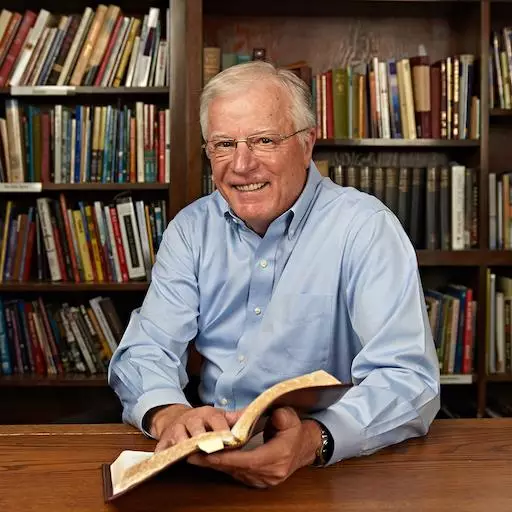
The Shepherd Cares For His Sheep – Part 2 of 2


Many of us wander through life—thirsty, restless, and prone to straying. But Jesus, our Good Shepherd, suffered and sacrificed Himself for us. In this message, Pastor Lutzer explains how Jesus claims us as His own. We can trust the risen Christ because He’s still caring for His people today.
Dave McAllister: Let us run with endurance, the race that is set before us, looking to Jesus, the founder and perfecter of our faith. When you take time to study sheep, you come back with one conclusion: sheep are really dumb. That’s why they need a shepherd. We who run life’s race, though, are a little better. Like sheep, we go the wrong way and drink at the right streams unless we are guided by the shepherd’s staff.
From the Moody Church in Chicago, this is Running to Win with Dr. Erwin Lutzer, whose clear teaching helps us make it across the finish line. Again, we’re in Psalm 23 for today’s message, The Shepherd Cares For His Sheep. Pastor Lutzer, when David wrote this psalm, who was he writing it to?
Erwin W. Lutzer: Dave, I’m going to answer that question in just a moment. But before I do, I want to pick up on a phrase that you used: Your rod and your staff, they comfort me. Now, of course, all of us know that the rod and the staff were used. They perhaps were very painful to the sheep because they were used in order to keep the sheep in line, bring them back to the right path, and keep them from eating poisonous plants.
Isn’t it wonderful that God takes an interest in us and is willing to indeed keep us on the right path and discipline us when we need it? Now, in answer to your question, Dave, I think that David had everyone in mind who would ever read the psalm. I think he wrote it for all of us.
How we all have been blessed as a result of this beautiful psalm, and I certainly hope that everyone who is listening knows it by memory. The Lord is my shepherd. Now, we here at Running to Win share the Gospel of Jesus Christ with as many people as possible, actually around the world. But we do it because of people just like you.
And at the end of this message, I want to read a testimony of someone who has been blessed as a result of this ministry, someone in another country. That blesses us so much because we know that the Gospel is needed around the world. So, I’m going to be giving you some contact info. But for now, let us listen, let us be blessed, and remember, it’s very important to say the Lord is my shepherd.
I think that Jesus comes into our lives and he works on stones of bitterness and he digs them out, and anxieties, the bushes, the concerns of life. And he’s constantly taking our hearts and pruning them, and then he sows his word within us with the intention of bringing us to the place of peace and contentment and satisfaction.
And then I want you to notice that also, of course, they have to be free of thirst. Free of anxiety, free of hunger, and also free of thirst. The Scripture says that he leads me beside quiet waters. Of course, if sheep don’t have water, like other animals, they become dehydrated, they become very sickly, and of course, they are very discontent.
And the responsibility of the shepherd is to find those places where sheep can drink and drink with contentment in the pure streams of water. Now, sometimes sheep don’t need too much water when there is a lot of dew on the ground and they go out early and that dew begins to water them. But all of them eventually need the quiet pools.
Sometimes a stream, even though it may contain good water, is frightening to the sheep because they come and the rushing water makes them afraid. They don’t want to bow down that they might be able to drink. So, it’s the responsibility of the shepherd to make sure that they have a quiet place to drink.
And he will actually take this pond and build a kind of dam. You know, when it says here, "he leads me beside still waters," we could translate it, "he leads me beside stilled waters." They have become quiet, and so the shepherd makes a special place for the sheep to drink.
But stubborn as they are, difficult to work with, even as they are going on their way to the fresh stream, they often stop at polluted streams along the way, drinking water that causes parasites within them that causes disease. And they simply will not follow the shepherd to where the real stream of water is.
You remember God’s word in the book of Jeremiah. He said, "My people have forsaken me, the fountain of living water, and they have hewn out for themselves cisterns, broken cisterns that can hold no water." David, you remember, says, "As the deer pants for the water brooks, so my soul pants for thee, O my God."
And yet you and I know what it’s like to drink from forbidden fountains, to drink from the polluted streams because we’re thirsty. Something has to satisfy us. "Come and quench this thirsting of my soul," we say to the Lord Jesus Christ, and he is the one who can do it.
But if we are not careful, like those stubborn sheep that constantly get sidetracked, we can find sources of satisfaction that are temporary, that will end up eventually being bitter. It is the Lord who is our shepherd, and it’s his responsibility to refresh us, and he can.
Now, we look at this text again and we ask ourselves the question: Who is the Lord? Well, that is the Lord Jesus Christ, the Good Shepherd. What does he do? He makes us content so that we can lie down by feeding us through the Word of God, through the Spirit of God, by making us content so that we receive the water by satisfying our inner being.
And what about the sheep themselves? Notice David said, "The Lord is my shepherd." My shepherd. There is ownership obviously that is involved. One of the first things that a shepherd does if he doesn’t have a flock of sheep is to purchase them. He purchases the sheep, they become his.
And you and I, of course, were purchased at very high cost, as you know. And then after they become his, though this may create some sadness in our sensitive hearts, those sheep have a knife mark on their ears. The ear is put on a block, and a knife is taken, and every single sheep has a different marking so that it can be identified should the flocks get confused or mixed up.
And it’s the responsibility of the shepherd to put his own mark on the sheep, and that creates a bonding, a bonding that is really with them for as long as the sheep lives. The Bible says that Jesus said, "If any man will come after me, let him deny himself, let him take up his cross, and let him follow me."
And the cross of Jesus Christ becomes the bonding. He, of course, was crucified on the cross. We accept that cross and that is our mark. And Paul even says, "I bear in my body the marks of Jesus Christ," and we become his forever.
How can we summarize these two verses so that we will remember them and apply them to our lives? I’d like to suggest that if the Lord is our shepherd, three things become very true. If the Lord is our shepherd, first of all, we really need nothing else. We really need nothing else.
Notice, "The Lord is my shepherd, I shall not want." That is to say that I have other needs, but my greatest need has been taken care of. Of course, we have needs for jobs and for friends and for homes and for cars and for our health that we might be able to live, but all of those are not ultimate needs. They are not the final thing that we need.
I don’t know if you read this past week about a man who was driving his truck off of a road. I believe it was out west in one of the states where there was an awful lot of snow, and he slipped off the road. He had eighteen miles to walk back to town, and he knew that he couldn’t walk the eighteen miles.
He hoped that someone would come and see him and rescue him, and so he lived in his truck. Now, he had lots of water because he had snow, but he did not have any food. And now in May, his body was found and he was dead. After about nine weeks, he starved.
But he made notes. He made notes regarding each day, and he wrote things like this, "My life is now in his hands." I read that and I said to myself, I wonder if that man was a believer in Christ. I hope that he was. I hope that he could say, "The Lord is my shepherd."
But now let us speak very frankly and candidly. In what sense can it be said that the Lord is our shepherd if we’re in that kind of a dilemma and we eventually starve and die? Is the shepherd really taking good care of his sheep or not? Isn’t that really the problem that you and I face every day?
We say this is beautiful poetry, but what about my struggles? What about the person who slips off into the ditch in his truck and lives there for nine weeks and dies? Does it make sense to say the Lord is my shepherd? I pondered that this week and concluded, yes. Yes, it does make sense because what the text is really saying and what Jesus says in John chapter 10 about the Good Shepherd making sure that he does not lose any of his sheep.
He says, "My Father who gave them to me is greater than all, and no man can pluck the sheep out of my hand." That if we are his sheep, then even though sometimes we will be stripped of our jobs and food and friends and we will die, still the Good Shepherd does not leave us as we approach death.
But he walks through the gate of death with us to the other side. If that man was a believer in Christ, today he’s in the presence of the Good Shepherd, and what he really needed ultimately is his forever. If the Lord is my shepherd, I may need a number of different things, but what I really need, I have.
Secondly, our chief duty really is to develop confidence in the Good Shepherd. That’s really what we need. The more we walk with the shepherd, the more the trust relationship develops. Those sheep out there in the Judean hillside with David, those sheep were not expected to have in their minds the map of Judea. They weren’t expected to do that.
Their main responsibility was to follow the shepherd. That was number one. Now, if they got off course, the shepherd went and found them, as we’ll find in another message. But their primary responsibility was to follow the shepherd. The closer to the shepherd, the further the wolves would stay away. They found that when they were close to him, they still had problems, but at least they were with someone who was qualified to solve them.
And I want you to know today that our greatest challenge is to be so confident of the shepherd’s leading that even when we make wrong decisions, even when we slip off our paths, even when we go our own way, we rush back to where it is safe.
Jesus said to the disciples, "Behold, I send you forth as sheep in the midst of wolves." And when you’re close to a wolf and you’re a sheep, what you really need to do is to stay as close as possible to the shepherd. Finally, obviously, our primary duty is to make sure that we are one of his sheep.
It was Martin Luther who said that the first responsibility that we have is to be able to use personal pronouns. Let’s look at the text one more time. The Lord is my shepherd. I shall not want. He makes me to lie down in green pastures. He leads me beside quiet waters. Me, I, mine.
Can you say that? Can you say that? The Lord is my shepherd. Now, listen carefully. Jesus Christ as the Good Shepherd died to purchase us. And whether you are purchased will be found out as to whether you have been saved, whether you believe in Christ.
Sometimes the word faith is used as an acrostic. F-A-I-T-H. Forsaking All, I Trust Him. And that is what must be done personally and does not come simply because you are raised as a Christian or because you are brought up in a good home. It comes through personal faith to be able to say, "The Lord is my shepherd." Let us pray.
Father, we want to just take in these moments and recognize that those of us who do know you as our shepherd, we want to give you all of our concerns, all of our wanderings, all of the distractions, the anxieties, the beasts that are out there, the pecking order.
All of the things that distract us so that we cannot relax in the presence of the shepherd. Remove those, Lord, because our desire is to know him. Our first duty is to know him. And for those who are listening today who have never believed on Christ, they’ve never trusted him personally, today may they reach out and say, "Lord Jesus, be my shepherd. Be my Savior. I trust you for forgiveness, for cleansing, for reconciliation with God, and at this moment, I believe in you." And if that’s what you are saying, even before I close this prayer, in this moment of quietness, you talk to God and you tell him. Thank you, Father, for hearing your sheep this morning. In Jesus' name, amen.
My friend, today I want to emphasize that you don’t become a Christian just because you go to church. You don’t become a Christian just because you are baptized or have done some good works. You become a Christian through repentance and faith. Admitting your own helplessness and cleaving to Christ as the only Savior, the only Good Shepherd.
If you asked me this question, what is it, Pastor Lutzer, that blesses you the most, I would say this: It’s hearing from other countries. People who are listening to the ministry of Running to Win. For example, I’m holding in my hands a letter from someone who has written to us from East Africa, and they speak about how Running to Win has molded their spiritual life.
The ministry has sustained their family. The person says, "We always listen to Running to Win programs. They uplift us spiritually and we are growing. Thank you so much." Now, how can we minister in East Africa? It’s because of people just like you.
Let me ask you a question. Would you consider becoming an endurance partner? I hope that you have a pen or pencil handy because I want to give you some info that will help you connect and find out what an endurance partner is. Here’s what you do: go to rtwoffer.com. When you’re there, you click on the endurance partner button, or you can call us at 1-888-218-9337.
Dave McAllister: It’s time once again for you to ask Pastor Lutzer a question about the Bible or the Christian life. Kathy contacted us and has some serious questions about observing the Lord’s Supper. Here’s what she wrote:
"1 Corinthians 11:23-32 talks about the Lord’s Supper. I am confused by verse 27: 'Therefore, whoever eats the bread or drinks the cup of the Lord in an unworthy manner will be guilty of sinning against the body and blood of the Lord.' What does an unworthy manner mean?"
Erwin W. Lutzer: Well, thank you so much for your question. And we need to understand that in the church in Corinth, there was a tremendous misuse of the Lord’s Supper. What happened was that the church came together, something like a potluck dinner, and after they came together, there were those who actually drank and they became drunk at the Lord’s table.
You see, what they did is they had their supper, and then the Lord’s table was a part of it. So, the Apostle Paul is writing to admonish them. And when he says that you should not eat or drink the cup of the Lord in an unworthy manner and then you’re guilty of sinning against the body and the blood of the Lord, it means that you are really desecrating what this is all about.
You are participating for the wrong purpose. You don’t understand its meaning. As a church, you are having factions, the Apostle Paul says, and your guilt is not merely against other members of the body of Jesus Christ, it is against Christ himself.
So, it does not say that we should not eat or drink if we are unworthy to eat or drink. On one level, all of us are unworthy. But if we’ve confessed our sins, if we are right with others in the church, we have a clear conscience before God, then we can participate. But we do so recognizing that this is a very special occasion because that represents the body of Jesus Christ. And I think that that’s what the Apostle Paul was referring to.
Dave McAllister: Thank you, Pastor. She goes on with a second question: "Verse 29 says, 'For anyone who eats and drinks without recognizing the body of the Lord eats and drinks judgment on himself.' What does it mean to eat and drink judgment on yourself?"
Erwin W. Lutzer: Well, you know, I think that when it says that he who eats or drinks without recognizing the body of the Lord eats or drinks judgment, eating or drinking without recognizing, I think in the original means discerning the Lord’s body. And that could mean either the body called the church, but more likely in context, it’s talking about the body of the Lord.
To not discern it means that you don’t understand the purpose of this feast. You’re not grasping the significance of what it is that you are doing. We are, after all, honoring the elements, the bread and the wine that represent the body and the blood of Jesus. We honor these elements because they represent something very special, namely the body and the blood of our Lord.
And to not discern that is to bring judgment to yourself. And what could that judgment do? The amazing thing is that Paul, there in 1 Corinthians chapter 11, said that because of this, some among you are sickly and others sleep. What he means is some among you have actually died because of your disobedience and your lack of respect for our Lord.
You know, in today’s society, we become so casual, we become so irreverent. We look around and we say, well, no one has been struck dead by the way in which they are acting. So, we simply go our own way. Well, what God is saying is that’s dangerous. You could have physical effects that would be brought on by God because you participated in an unworthy way, not understanding what you’re doing for all the wrong reasons.
And this, I think, is a tremendous admonition for all of us to be sure that our hearts are cleansed, we’re in fellowship with other people, and we know what we are doing when we receive the bread and the cup.
Dave McAllister: Some sobering thoughts about the Lord’s Supper from Dr. Erwin Lutzer. And thank you, Kathy, for that question. If you’d like to hear one of your questions answered, go to our website at rtwoffer.com and click on Ask Pastor Lutzer, or call us at 1-888-218-9337. That’s 1-888-218-9337.
You can write to us at Running to Win, 1635 North LaSalle Boulevard, Chicago, Illinois, 60614. When it comes to knowing where to go next, sheep are clueless. Unless a shepherd guides them, they wander away and never return. We as believers are not much better off. We need someone to point the way for us, just like a shepherd gently leads his flock. Next time, we learn from Psalm 23 how the shepherd guides his sheep. Running to Win is all about helping you understand God’s roadmap for your race of life. Thanks for listening. For Pastor Erwin Lutzer, this is Dave McAllister. Running to Win is sponsored by the Moody Church.
Featured Offer

This short but powerful work delivers on its significant promise. Pastor Lutzer explores a wide array of Scriptural teachings and siphons them into clear, cohesive truths. It is straight gospel—applicable to the skeptic, newly saved, and long-time believer alike. Click below to receive this book for a gift of any amount or call Moody Church Media at 1.888.218.9337.
Past Episodes
- Changed By The Word
- Children of an Awesome God
- Chiseled By The Master's Hand
- Christ Among Other Gods
- Christ Before Bethlehem
- Christ, God's Gift at Christmas
- Christians In Conflict
- Come and See Jesus
- Cries from the Cross
- Crowning Christ Lord
- Seven Convincing Miracles
- Seven Reasons You Can Trust The Bible
- Seven Secret Snares
- Sharing Secrets With God
- Slandering Jesus
- Suffering Wrong
- Ten Lies About God
- Thanksgiving
- The Battle for America’s Youth
- The Church in Babylon
- The Darwin Delusion
- The Flurry Of Wings
- The High Cost Of Lost Opportunities
- The Invisible War
- The Invisible World
- The King Is Coming
- The Legacy of a Converted Man
- The Man Who Cradled God In His Arms
- The Manger And The Sword
- The Power of a Clear Conscience
- The Triumph of the Gospel
- The Triumph Of Unanswered Prayer
- Till Death Do Us Part
- What Do These Stones Mean?
- What is God Up To
- What Jesus Thinks Of His Church
- What We Believe
- What Would Jesus Do?
- When a Nation Forgets God Interview
- When God Is First
- When God Shows Himself
- When the Spirit Has His Way
- When You've Been Wronged
- Who Are You To Judge?
- Why Good People Do Bad Things
- Why The Cross Can Do What Politics Can't

Video from Dr. Erwin W. Lutzer
Featured Offer
This short but powerful work delivers on its significant promise. Pastor Lutzer explores a wide array of Scriptural teachings and siphons them into clear, cohesive truths. It is straight gospel—applicable to the skeptic, newly saved, and long-time believer alike. Click below to receive this book for a gift of any amount or call Moody Church Media at 1.888.218.9337.
About Running To Win
Running the race of life is hard. But with the Bible front and center and a heart to encourage, Pastor Erwin Lutzer presents clear Bible teaching, helping you make it across the finish line. Since 2011, this 25-minute program has provided a Godward focus and features listeners’ questions.
About Dr. Erwin W. Lutzer
Dr. Erwin W. Lutzer is Pastor Emeritus of The Moody Church where he served as the Senior Pastor for 36 years (1980-2016). He earned a B.Th. from Winnipeg Bible College, a Th.M. from Dallas Theological Seminary, a M.A. in Philosophy from Loyola University, and an honorary LL.D. from the Simon Greenleaf School of Law (Now Trinity Law School).
A clear expositor of the Bible, he is the featured speaker on two radio programs: Running to Win—a daily Bible-teaching broadcast and Songs in the Night—an evening program that’s been airing since 1943. Running To Win broadcasts on a thousand outlets in the U.S. and across more than fifty countries in seven languages. His speaking engagements include Bible conferences and seminars, both domestically and internationally, including Russia, the Republic of Belarus, Germany, Scotland, Guatemala, and Japan. He has led tours to Israel and to the cities of the Protestant Reformation in Europe.
Pastor Lutzer is also a prolific author of over seventy books, including the bestselling We Will Not Be Silenced, One Minute After You Die, and the Gold Medallion Award winner, Hitler’s Cross. Pastor Lutzer and Rebecca live in the Chicago area and have three grown children and eight grandchildren. Connect with Pastor Lutzer on X (@ErwinLutzer) or moodymedia.org.
Contact Running To Win with Dr. Erwin W. Lutzer
media@moodychurch.org
http://moodymedia.org/
Moody Church Media
1635 North LaSalle
Chicago, IL 60614
1.800.215.5001
Monday – Friday
8:00am – 5:00pm CST
Fax Number
1.312.642.4904