

The Shepherd Cares For His Sheep – Part 1 of 2


God’s people are like sheep, and the Lord Jesus Christ is our Shepherd. The familiarity of those words can obstruct us from the comfort of those words. In this message, Pastor Lutzer explores the intimate bond between a loving Savior and His weary sheep. Learn why these famous words hold the secret to our soul’s peace.
Dave McAllister: Let us run with endurance the race that is set before us, looking to Jesus, the founder and perfecter of our faith. It's a bright jewel in the crown of literature and a source of great comfort. It's the 23rd Psalm, scripture to help us face the race of life. The Lord is my shepherd, I shall not want. This statement of trusting belief will mean a lot more after you hear our next series on Running to Win.
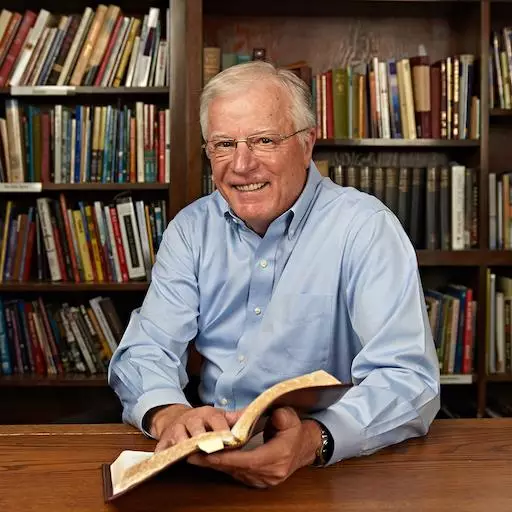
From the Moody Church in Chicago, this is Running to Win with Dr. Erwin Lutzer, whose clear teaching helps us make it across the finish line. Today, Pastor Lutzer brings the first of several messages from the shepherd's psalm as he speaks on "The Shepherd Cares for His Sheep." Pastor, wasn't King David being pursued by his enemies when he wrote this psalm?
Erwin W. Lutzer: Yes, Dave, we don't know exactly when he wrote it, but certainly his enemies were always around him. But here's what I want to emphasize. He did not say the Lord is a shepherd. He said the Lord is my shepherd. And that is so critical to everyone who is listening. I want to ask you this question: is the Lord your shepherd?
We're making available a book entitled *The New Birth* by Peter Mead. And one of the things that it emphasizes is that God actually changes our hearts when we are born again. It isn't simply an intellectual exercise. It isn't simply the mind. It has to do with the heart, and that's what makes the new birth so transforming. And once you are born again, you'll be able to say, "The Lord is my shepherd."
For a gift of any amount, we're making this book available for you. At the end of this message, I'm going to be giving you some contact info because we want to get this resource into your hands. Meanwhile, let us remember that little word "my." The Lord is my shepherd.
If people would repeat Psalm 23 seven times before going to sleep each night, we would rarely see an emotional breakdown. That was said by a Christian psychiatrist by the name of Charles Allen. He says that Psalm 23 is really God's psychiatry. Why is it that there is so much power in these 115 words? The Lord is my shepherd.
Well, as we study this psalm—and I certainly do invite you to take your Bibles and turn to Psalm 23—even if you know it by memory, you should turn to it. As we study Psalm 23 together, we will see that if we were to understand the intimacy of the relationship between a shepherd and his sheep and we remember that the Lord is our shepherd, we would indeed sleep well at night.
There is a legend that says that when the gods created the world, they wondered what they should do with the secrets that would unlock the meaning of the universe. They wanted to hide them from men and some said, "Well, let's bury them in the valleys," or "Let's hide them on the mountaintop." And then the decision was made, "No, we will make them very obvious, and only the thinking people will then recognize them."
Well, that's only a legend, of course. But the point is that oftentimes that which is most obvious is not that which is most appreciated. So even though we all know Psalm 23—and I hope that there's no one listening either here or by radio who doesn't know Psalm 23 by memory—still, the fact is that since it is familiar, it might actually be a barrier to studying it because we may say, "Well, we know everything about it that there is to know. We can quote it."
There's a second possible barrier, and that is that those of us who live in the big cities of this world, we are not used to the whole idea of sheep. Even though I was born and reared on a farm, we did not have sheep. And the most that I knew about sheep until I began this study was Little Bo Peep lost some sheep. How does it go? "Eating her curds and whey, along came a spider and sat down beside her, and wherever Mary went, the lamb was sure to go." That's the way I remembered it.
And so what we need to do is to understand the characteristics of sheep. Someone actually suggested that maybe the reason that God created sheep—stubborn, self-willed, independent—is because he said to himself, "I need a good illustration for human beings. So I will go ahead and create them, and then they will illustrate so that they will understand what it is that I put up with, once they understand the role of a shepherd."
Well, with that introduction, let's just plunge right into the text. Psalm 23: "The Lord is my shepherd," asking and answering two simple questions. The first question is: Who is the Lord? And the second question will be: What does he do? Who is the Lord? The Lord Yahweh, the Lord Jehovah, is my shepherd.
And Jesus clarifies that in John chapter 10, which we will not turn to today, though in another message we probably will. It is a companion part of the New Testament where Jesus said, "I am the good shepherd. I am the good shepherd." It is Christ that is spoken of. And what can we say about Christ? Yahweh, as the Jewish people pronounce it, or Jehovah?
Well, we can say first of all, he is a suffering shepherd. He suffers for the sheep and he suffers with the sheep. Your Bible is open. I want you to notice that Psalm 23 is in the middle of a trilogy of three psalms that are Messianic, that refer to Jesus Christ. If you look at Psalm 22, you notice that Jesus says, "My God, my God, why hast thou forsaken me?"
Those are words that were quoted at the cross. And all of Psalm 22 is actually fulfilled at the cross. This is Jesus who is suffering. You look at Psalm 24 and you pick it up in verse 11: "Lift up your heads, O gates, and be lifted up, O ancient doors." That is Jesus Christ returning to earth someday, possibly his ascension into heaven but also his glorious return. Who is this King of Glory? It is the Lord strong and mighty.
In Psalm 22, Jesus Christ died that we might be free from the penalty of sin. Psalm 23, we are free from the power of sin. Psalm 24, eventually, we will be freed from the very presence of sin. Psalm 22 is what the Good Shepherd did for us in the past. Psalm 23 is what he does for us now. Psalm 24 is what he will someday yet do in the future, when we see him face to face.
So first of all, he is a suffering shepherd. He died for the sheep. Jesus said, "I lay down my life for the sheep." Also we know that he is a knowledgeable shepherd. He is a knowing shepherd, we could put it that way. He knows his sheep. Jesus said in John chapter 10, "I know my sheep and am known of mine." One of the things about shepherds is that they can recognize their sheep. They can recognize them from afar.
I read this week about a shepherd who saw 2,000 sheep that were all to be slaughtered. And he said that as he walked by, he recognized those that were his. Well, translate that now to Jesus Christ. He is omniscient. He knows all things. He knows our parents, he knows our grandparents. Some of you are searching for your parents, perhaps, because you were adopted and you're restless because you do not know your roots.
Be contented in knowing that the Good Shepherd knows all things. He knows the scrapes and the sores and the hurts and the pains that we experience along the journey of life. He knows the terrain. He knows where he is leading us. He knows in advance all those sheep who are going to try to get lost along the way, to lose themselves. All these things are known by the Good Shepherd.
He is sacrificial, he is knowing, he is caring. Casting all your care upon him, because he careth for you. If we believe that this morning, we would indeed sleep well, though I would like to insist that that happen a little later rather than right now. But the point is, it says in Isaiah chapter 40, "He shall feed his flock like a shepherd. He shall carry the lambs in his bosom and gently lead those that are with young." God cares. And that's who the Good Shepherd is.
Now, what does the shepherd do? What does the shepherd do? You'll notice he says, "The Lord is my shepherd, I shall not want." We'll go to verse 2: "He makes me lie down in green pastures." Now, this week I learned a lot about sheep because I did some reading about them, and I read some books about people who know more about sheep than I do.
And I discovered that sheep find it very difficult to lie down unless certain requirements are met. And you'll notice that the text says that he causes me—he makes me—to lie down in those green pastures. What is it that the sheep need to be content enough to lie down? First of all, they have to be free from all of the anxieties, the anxieties that they might bear.
For example, a rabbit coming out from under a bush and scurrying across the desert—that very rabbit might cause the entire flock to stampede. And they all run away, and they look at one another. And when one runs, the other runs even though the majority of them do not know why they are running. But they'll go ahead and they'll do it because one does and everyone else follows.
They all believe the account of one single sheep. So there's a tremendous amount of anxiety, especially if there are wild beasts near. In fact, sheep are so helpless that when they begin to run, they can't run very fast, they can't run very far, that a single dog can kill as many as a hundred sheep in one night.
And so there's only one way to calm the sheep so they can lie down, and that is the presence of the shepherd. When they see the shepherd, they stop focusing on the possibility of all of the wild animals out there, and they begin to be content enough to lie down. Not only freedom from those kinds of fears, but freedom from distractions.
You have all of the parasites that play on the sheep. You have insects, flies, fleas—all of these things. And when sheep are overcome by these and tormented, they cannot lie down. They will stomp their feet, they will shake their heads, they will run for the bushes, they will do whatever they possibly can do to get away from the agitation of it all. But they aren't content enough to lie down in green pastures.
That's why a good shepherd will use some repellent, some oils that will be put on the sheep to keep all of these insects away. And the Good Shepherd, *the* Good Shepherd, the Lord Jesus Christ, through the ministry of the Holy Spirit—through the oil that is representative of the Spirit of God—enables us to be at peace even despite our tormentors so that we might be able to lie down and rest. Jesus, I am resting, resting in the joy of what thou art. It is possible.
And then something else needs to happen before this anxiety can be taken away, and that is there has to be a freedom from conflict, freedom of conflict. I found this to be very interesting. I'm told that in the average flock, there is always one sheep that begins to take ascendancy because even in the social life of animals, you have a theory of dominance.
For example, when it is among chickens, we call it a pecking order. When it is among sheep, it is called a butting order. And usually it is an old ewe who takes charge of the flock. And everyone has to follow her, and if someone gets ahead and gets some pastureland first, she takes care of that particular sheep by butting it.
Strutting oftentimes with a craned neck and with a tilted head and a confident gait, saying in effect, "Get out of my way." And everybody else has to follow in order of their butting order. They all have to be in line, and if somebody gets out of line, there's conflict. Incidentally, Phillip Keller, in his book on Psalm 23, says that the sheep that are most content, who are farther on in this butting order, are usually indeed the most content.
It is those that are constantly striving for position, for the best of the pastureland, that bear the most anxiety and concern. Once again, what ends all this conflict among sheep? It is the presence of the shepherd. When the shepherd is there, all of this rivalry ends and the flock ends up with a sense of peace and tranquility.
Number one, they must be free from all these anxieties. And that's what the shepherd is for, to deliver the sheep from all that would cause them to have to stand rather than lie down. Secondly, they have to be free of hunger, free of hunger. Most of the time when you have a flock of sheep and you have pictures of them, almost always they are in countries that are semi-arid.
If you've ever been to Jerusalem or Israel, you notice that the Judean Desert is largely indeed a desert. And therefore pastureland is very difficult to come by. And oftentimes it is the responsibility of the shepherd to make sure that his flock has pasture and he will grow the pasture.
Shepherds will take huge stones that they find and they'll dig them out, and they will pull up clumps of trees and bushes. And then they will seed grass, and then they will water the grass. And their goal is that they might be able to have a crop of grass that would be knee-high so that the sheep can enjoy themselves and they can be well fed.
Now, I find it interesting of course, we all know that sheep do not appreciate that. They enjoy it and they accept it, but they do not seek to thank the shepherd—at least real sheep don't—because it is taken for granted. They have no idea of the work that the shepherd does on their behalf. And of course that is the same with our Chief Shepherd, the Lord Jesus Christ.
I think that Jesus comes into our lives and he works on stones of bitterness and he digs them out. And anxieties, the bushes, the concerns of life—and he's constantly taking our hearts and pruning them. And then he sows his word within us with the intention of bringing us to the place of peace and contentment and satisfaction.
And then I want you to notice that also, of course, they have to be free of thirst. Free of anxiety, free of hunger, and also free of thirst. The scripture says that he leads me beside quiet waters. Of course, if sheep don't have water, like other animals, they become dehydrated, they become very sickly, and of course they are very discontent.
And the responsibility of the shepherd is to find those places where sheep can drink and drink with contentment in the pure streams of water. Now, sometimes sheep don't need too much water when there is a lot of dew on the grass, and they go out early and that dew begins to water them. But all of them eventually need the quiet pool.
Now, sometimes a stream, even though it may contain good water, is frightening to the sheep because they come and the rushing water makes them afraid. They don't want to bow down that they might be able to drink. So it's the responsibility of the shepherd to make sure that they have a quiet place to drink.
And he will actually take this pond and build a kind of dam. You know, when it says here, "He leads me beside still waters," we could translate it, "He leads me beside stilled waters." They have become quiet, and so the shepherd makes a special place for the sheep to drink.
But stubborn as they are, difficult to work with, even as they are going on their way to the fresh stream, they often stop at polluted streams along the way, drinking water that causes parasites within them that causes disease. And they simply will not follow the shepherd to where the real stream of water is.
You remember God's word in the book of Jeremiah? He said, "My people have forsaken me, the fountain of living water, and they have hewn out for themselves cisterns, broken cisterns that can hold no water." David, you remember, says, "As the deer pants for the water brooks, so my soul pants for thee, O my God."
And yet you and I know what it's like to drink from forbidden fountains, to drink from the polluted streams because we're thirsty. Something has to satisfy us. "Come and quench this thirsting of my soul," we say to the Lord Jesus Christ. And he is the one who can do it. But if we are not careful, like those stubborn sheep that constantly get sidetracked, we can find sources of satisfaction that are temporary, that will end up eventually being bitter.
It is the Lord who is our shepherd, and it's his responsibility to refresh us, and he can. Now, we look at this text again and we ask ourselves the question: Who is the Lord? Well, that is the Lord Jesus Christ, the Good Shepherd. What does he do? He makes us content so that we can lie down by feeding us through the word of God, through the Spirit of God, by making us content so that we receive the water, by satisfying our inner being.
And what about the sheep themselves? Notice David said, "The Lord is my shepherd," my shepherd. There is ownership obviously that is involved. One of the first things that a shepherd does, if he doesn't have a flock of sheep, is to purchase them. He purchases the sheep. They become his.
And you and I, of course, were purchased at very high cost, as you know. And then after they become his—though this may create some sadness in our sensitive hearts—those sheep have a knife mark on their ears. The ear is put on a block and a knife is taken, and every single sheep has a different marking so that it can be identified should the flocks get confused or mixed up.
And it's the responsibility of the shepherd to put his own mark on the sheep, and that creates a bonding, a bonding that is really with them for as long as the sheep lives. The Bible says that Jesus said, "If any man will come after me, let him deny himself, let him take up his cross and let him follow me." And the cross of Jesus Christ becomes the bonding.
He, of course, was crucified on the cross. We accept that cross and that is our mark. And Paul even says, "I bear in my body the marks of Jesus Christ." And we become his forever.
Now, my friend, if I could talk to you directly and ask you this question: Are you born again? How would you answer? And if your answer is yes, I would ask you another question, namely: On what basis? How do you know that you are born again? How do you know that you're one of God's sheep?
The book that I'm holding in my hands, entitled *The New Birth* by Peter Mead, will help you to answer those kinds of questions. We here at Running to Win are deeply committed to getting the good news of the gospel of Jesus Christ to as many people as possible. But it is not enough to simply hear the good news; we must respond to it.
Very quickly, this resource can be yours. Here's what you do: Go to rtwoffer.com. That's rtwoffer.com. Or you can pick up the phone and call us at 1-888-218-9337. You know, even as this series of messages on Psalm 23 continues, it is a reminder of the fact that belonging to Jesus Christ is the most important thing about us. There are many things that we can be wrong about, but let us not be wrong about the new birth.
Dave McAllister: You can write to us at Running to Win, 1635 North LaSalle Boulevard, Chicago, Illinois, 60614. Many of us think we can handle life until we can't. There comes a point where we know we need help, just like a sheep needs help when facing attacks or wanting water.
Being able to say, "The Lord is my shepherd," means there is someone out there who cares for me, no matter what life brings. Next time, more about the care God provides for his own. Plan to join us. Thanks for listening. For Pastor Erwin Lutzer, this is Dave McAllister. Running to Win is sponsored by the Moody Church.
Featured Offer

Because of grace we don’t have to earn our salvation but sometimes that leaves us wondering what our part in holiness should be. Jerry Bridges helps us see where we should rely on God―and where we should accept responsibility and exercise discipline. Click below to receive this book for a gift of any amount or call us at 1.800.215.5001.
Past Episodes
- Changed By The Word
- Children of an Awesome God
- Chiseled By The Master's Hand
- Christ Among Other Gods
- Christ Before Bethlehem
- Christ, God's Gift at Christmas
- Christians In Conflict
- Come and See Jesus
- Cries from the Cross
- Crowning Christ Lord
- Seven Convincing Miracles
- Seven Reasons You Can Trust The Bible
- Seven Secret Snares
- Sharing Secrets With God
- Slandering Jesus
- Suffering Wrong
- Ten Lies About God
- Thanksgiving
- The Battle for America’s Youth
- The Church in Babylon
- The Darwin Delusion
- The Flurry Of Wings
- The High Cost Of Lost Opportunities
- The Invisible War
- The Invisible World
- The King Is Coming
- The Legacy of a Converted Man
- The Man Who Cradled God In His Arms
- The Manger And The Sword
- The Power of a Clear Conscience
- The Triumph of the Gospel
- The Triumph Of Unanswered Prayer
- Till Death Do Us Part
- What Do These Stones Mean?
- What is God Up To
- What Jesus Thinks Of His Church
- What We Believe
- What Would Jesus Do?
- When a Nation Forgets God Interview
- When God Is First
- When God Shows Himself
- When the Spirit Has His Way
- When You've Been Wronged
- Who Are You To Judge?
- Why Good People Do Bad Things
- Why The Cross Can Do What Politics Can't

Video from Dr. Erwin W. Lutzer
Featured Offer
Because of grace we don’t have to earn our salvation but sometimes that leaves us wondering what our part in holiness should be. Jerry Bridges helps us see where we should rely on God―and where we should accept responsibility and exercise discipline. Click below to receive this book for a gift of any amount or call us at 1.800.215.5001.
About Running To Win
Running the race of life is hard. But with the Bible front and center and a heart to encourage, Pastor Erwin Lutzer presents clear Bible teaching, helping you make it across the finish line. Since 2011, this 25-minute program has provided a Godward focus and features listeners’ questions.
About Dr. Erwin W. Lutzer
Dr. Erwin W. Lutzer is Pastor Emeritus of The Moody Church where he served as the Senior Pastor for 36 years (1980-2016). He earned a B.Th. from Winnipeg Bible College, a Th.M. from Dallas Theological Seminary, a M.A. in Philosophy from Loyola University, and an honorary LL.D. from the Simon Greenleaf School of Law (Now Trinity Law School).
A clear expositor of the Bible, he is the featured speaker on two radio programs: Running to Win—a daily Bible-teaching broadcast and Songs in the Night—an evening program that’s been airing since 1943. Running To Win broadcasts on a thousand outlets in the U.S. and across more than fifty countries in seven languages. His speaking engagements include Bible conferences and seminars, both domestically and internationally, including Russia, the Republic of Belarus, Germany, Scotland, Guatemala, and Japan. He has led tours to Israel and to the cities of the Protestant Reformation in Europe.
Pastor Lutzer is also a prolific author of over seventy books, including the bestselling We Will Not Be Silenced, One Minute After You Die, and the Gold Medallion Award winner, Hitler’s Cross. Pastor Lutzer and Rebecca live in the Chicago area and have three grown children and eight grandchildren. Connect with Pastor Lutzer on X (@ErwinLutzer) or moodymedia.org.
Contact Running To Win with Dr. Erwin W. Lutzer
media@moodychurch.org
http://moodymedia.org/
Moody Church Media
1635 North LaSalle
Chicago, IL 60614
1.800.215.5001
Monday – Friday
8:00am – 5:00pm CST
Fax Number
1.312.642.4904