

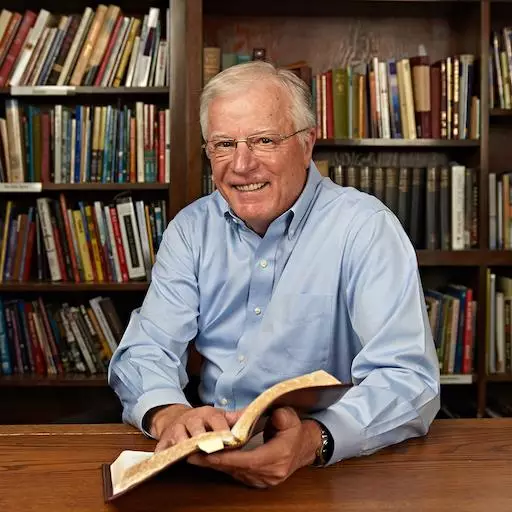
The Discipline Of Prayer – Part 2 of 2


Too often, our prayers are focused on our own agenda. We often focus on our physical needs, while God wants to change our motivations. In this message, Pastor Lutzer unfolds three advantages to praying the Scriptures back to God. Imagine our prayer life coming alive as we are shaped and fueled by God’s Word.
Dave McAllister: There's a startling disconnect between the things the Apostle Paul prayed for and the things most of us pray for. We focus on our physical needs while God wants to work on our motivations. Today, learn to pray for the things God wants by praying His Word back to Him. From the Moody Church in Chicago, this is Running To Win with Dr. Erwin Lutzer, whose clear teaching helps us make it across the finish line. Pastor Lutzer, you're telling us about four disciplines of the soul. Now your focus is on prayer, and it could be that some of us are not praying for the right things.
Dr. Erwin W. Lutzer: You know, Dave, I would frame that a little differently and say that we are probably praying about the right things, but we are praying only about a certain category of needs. We don't understand that we should be doing what I like to call kingdom prayers. Kingdom prayers is, as you outlined, praying Scripture, recognizing that there's more to prayer than simply having our immediate needs met. It's not wrong for us to be able to zero in on those immediate needs, but we must get beyond them and understand that God wants us to pray His Word back to Him. In my opinion, that changes everything.
We're so excited here at Running To Win to be able to make available for you a book entitled *How to Begin the Christian Life*. Now this was written by Pastor George Sweeting, who for many years was the pastor of Moody Church and then also the president of Moody Bible Institute. We think it's going to be a help in your spiritual journey, and one of the chapters has to do with prayer and Bible study. At the end of this message, I'm going to be giving you some contact info as to how this book can be yours. For now, let us listen even as we go to the pulpit of the Moody Church.
A simple fact is it is our opportunity to pray back to God the things that have been written in God's Word. Now there are so many examples that obviously every Psalm is an example. But let's suppose that you're going through a difficult time because someone at work is persecuting you or you're in a situation where someone has it in for you and you're going through this difficult time of wondering whether or not God is going to defend you because you have an enemy or two out there somewhere. What about a Psalm like Psalm 31?
We don't have time to read it, but many of you are going to remember that now, aren't you? Psalm 31: "In you, O Lord, I've taken refuge; let me never be put to shame; deliver me in your righteousness. Turn your ear to me." I must skip these beautiful verses. Verse four: "Free me from the trap that is set for me, for you are my refuge. Into your hands I commit my spirit; redeem me, O Lord, the God of truth." One of the loveliest passages quoted by Jesus even on the cross is verse 13: "For I hear the slander of many; there is terror on every side. They conspire against me and plot to take my life. But I trust in you, O Lord; I say, 'You are my God.' My times are in your hands; deliver me from my enemies and from those who would pursue me. Let your face shine on your servant; save me in your unfailing love." What an expression for those who are going through times of difficulty. What a way in which we can pray to God as we take His Word and we're praying His Word back to Him.
Now I could give you many other illustrations. You say, "Well, that's the Psalms. What about the Epistles of Paul?" They are very, very easy to pray. By the way, the Epistles are not the wives of the Apostles. The word epistle means letter or writing. In Ephesians, for example, you have two wonderful prayers. If you ever wonder how you should pray for us as members of the pastoral staff, if you're ever thinking of how do I pray about a missionary and I don't know what his needs are, that's not right. You know exactly what his needs are.
Ephesians chapter 1: you pray that the eyes of his heart will be enlightened, that he might know the hope of his calling and know who he is in Christ and experience the length and the depth and the love of Christ. That's the next prayer, actually, in Ephesians chapter 3. You begin to pray this because when the Apostle Paul prayed, he was always praying for people spiritually. Now I don't want to play down the need to pray for people in their physical ailments and in their needs and so forth, but when you look at Paul's prayers—and there's more than a dozen of them in his writings—every one of them focused on people's relationship with God.
Nothing was said about their physical needs, about their conflicts, because Paul was convinced that if people are rightly related to God and if the eyes of their mind are enlightened as to who they are in Christ, they can endure what it is that they're going through. Often I've prayed Colossians 1 for my children. What a marvelous prayer, but we do not have time to turn to it, but you do, and you pray it phrase by phrase. Seven requests Paul makes that could be made for any Christian, and you pray those requests.
Yesterday, I was praying through Romans chapter 12. As you know, I have prayer partners, and many of my prayer partners pray this way for me. One day, one of them read the entire 12th chapter of Romans for me as a prayer. Wow. Can you imagine being prayed for in that way? It says in Romans chapter 12, "Therefore, I urge you, brothers, in view of God's mercy, to offer your bodies as living sacrifices, holy and pleasing to God." I stopped there.
I prayed for myself that my body would be a living sacrifice, holy and pleasing to God. This is my spiritual act of worship. Then the Lord brought to mind the need to pray for our three daughters and for their husbands. So I prayed Romans chapter 12, verses 1 and 2, where it goes on to talk about holiness, pleasing God, and the mind being transformed by the Word of God and by the Spirit of God. I prayed that for our sons-in-law. Then I prayed it for others. I have to tell you, I did not get beyond verses 1 and 2 because so many people came to mind for whom I began to pray that this would be true of them. You see how this works?
So that you're not simply praying, "Lord, bless somebody," what you're doing is you are praying God's thoughts. What are the advantages of this kind of prayer? Let me give them to you very quickly because as I've already emphasized, we are now praying God's agenda and not ours. What if I were to speak to a businessman and I were to say to him, "Would you share with me, please, how your relationship with God is coming along? What kind of a relationship do you have with the Almighty?" And he were to say, "Well, you know, I don't really like my job. As a matter of fact, I wish I could change jobs."
I would say, "Look, that's not the question that I'm asking. I'm asking you a different question. How is your relationship with God?" And he were to say, "Well, you know, if we had more money, we could do a lot of other things, but we're really short on money. We can hardly pay our bills." I am saying, "Hey, that's not what I'm asking you. How's your relationship with God?" Then he says, "Well, I want you to know that I've had a lot of trouble with my back recently and it hurts." I am saying, "Don't you get it? That's not what I'm asking."
We do that with God all the time. God's on a different trajectory. What are we doing? We're talking about this and God says, "You know, everything in my sight is important, but I'm not worried about the circumstances here. That's not my big agenda. My big agenda is your heart and your purity and your holiness and your ability to endure. That's much more important to me than solving all your problems. Every time you come, all that you think of me as is a problem solver."
Spurgeon, you remember, said, "Oh, blessed axe of sorrow that cuts a pathway to my God by chopping down the tall trees of human comfort." All that we're doing is we're praying for our creature comforts. "Make it easier. Solve the problems." God says, "That's not my agenda." We keep coming to Him with an agenda that isn't really His; it's ours. Boy, when you're praying Romans 12—and if you've turned to that passage, I hope you stay there because we're going to return to it in a moment—but when you're praying that, now suddenly you're getting the mind of the Lord. You're discovering what the will of God really is for your life.
Secondly, God uses His Word to trigger our memories and our concerns. You see, when you're reading the Bible, oftentimes you'll come across passages that really don't apply to you. So what you do is you say, "Oh, blessed Holy Spirit, does this passage apply to other people? Help me to know, Lord, other people for whom I can pray this." God will bring people to mind and situations to mind for which you will be able to pray now and use the Scripture in the process of doing the praying. What a wonderful experience that is.
Now, if there's a passage that absolutely does not lend itself to prayer—and that may be true of some of the historical sections of the Bible—then what you do is you simply read it and if possible, if you can't read it out loud, at least read it and let your lips move. Read it to God. Say, "Lord, I'm reading your Word, but I'm reading your Word in your presence and I'm reading this Word to you." In the process, God is honored because He says He has exalted His Word as high as His name.
You say, "Well, Pastor Lutzer, what about posture in prayer?" Well, I have my own convictions, but actually, the way in which the posture is not that important; it is the heart. I read about one man who never prayed because he could never have the right posture. When he knelt, his suit got creased. When he stood, his legs ached. When he sat, it seemed to be too irreverent. But one day he was walking through an open field and fell head-first into a narrow well.
He discovered there are moments when posture is not that big a deal. In fact, you can even pray upside down if you really have to. You say, "Yes, but Pastor Lutzer, what about the distractions? Now, when you begin to do this, you're going to find all kinds of distractions because remember, the devil is now going to really awaken. He who has been asleep is suddenly going to come alive and say, 'I can't let this go on.'" So what will happen is you're going to be distracted. You're going to have so many concerns.
Years ago, sometimes what I would do is—there are two answers to this, by the way. The first is to pray for the thing that has distracted you. It's probably an anxiety. So what you do is as that distraction comes, you say, "Lord, this has come to mind and this is distracting me now. So I want to give this to you. I want to pray through that so that I can get back to my adoration of you and get back to the Scriptures." In fact, there were times earlier, many years ago, when I would actually have a notepad next to my open Bible.
The minute I would go down to pray, suddenly I remembered what I should do. I was thinking about this and so forth, and then I couldn't let go of those thoughts because I thought I might forget what it is that I have to do. So I would simply write it down. You write it down and take care of it so that you can get back to the business of praying. I don't necessarily think that you should always put your Bible in your left hand and your notepad on your right, but something has to be done so that we can get back to the business of praying and so that our distractions are used for the glory of God instead of destroying the communion that God wants us to have with Him.
God triggers our memories. Just try this. I was reading in Psalms the other day where it says, "The fool hath said in his heart, there is no God." What do you do with a verse like this? Well, immediately I began to think, "You know, I have never prayed for atheists. This might be a good opportunity to do that." Father—and a few do come to mind—I pray that you will help them to understand how foolish this is. God, have mercy upon their souls. Do you see how reading God's Word will trigger in our minds other things and people to pray for that we would never think of on our own?
You say, "Well, should you have a prayer list?" Yes, a prayer list is good because what it does is it helps focus our wandering mind. But in praying this way, we will never pray the same old thing in the same old way. Finally, we now have a prayer that will stay with us all during the day because we've combined meditation and intercession. Now I encourage you to do this. I encourage you to do it for a month. Commit yourself to a month. What you'll discover is the hunger and the burden for God's Word and the desire to be in God's presence will grow so much that afterwards, it'll simply become a part of your whole habit and experience. But the first few weeks will be difficult, and you know who's going to try to make it difficult for you.
I asked you a moment ago to keep your Bibles open to the 12th chapter of Romans. Wouldn't it be wonderful—and I just thought of this idea this morning—if we as a church were to take verse 9 of Romans chapter 12 to the end of the chapter, and all of us pray it this week for Moody Church? Can you imagine? "Love must be sincere." Oh, God, we pray, make us people who are sincere and devoted. There may be specific situations that the Lord brings to mind that you need to commit to Him in your own life and in the lives of others here at the church. Oh, God, as a congregation, may we hate what is evil. May we cling to what is good. Ask God to give us a burden to intercede for those who are tied up with evil, who are bound by evil. Then be devoted to one another in brotherly love and go down all the way and pray that prayer for our congregation. It won't just simply be now, "Bless Moody Church."
It'll be God's agenda for God's people. What will happen if we begin to pray this way? We'll finally obey the words of Scripture which say pray continuously because the words will be in our mind and our hearts. As we meet God in the morning, and as we finally surrender the day to Him and begin every day at the foot of the cross, so to speak, and as we commit ourselves to Him and as we're meditating and praying, we'll have something to take with us throughout the day. The prayer that we prayed in the morning will be in our minds and in our hearts.
Yes, we will be rebuked, exhorted, encouraged, smitten with conviction, given hope—all of those things will take place if we treat the Scriptures in this way. We'll discover, as someone has said, that when we pray something that is not God's will, He'll say no. If we pray something that is not His timing, He will say slow. If we pray in a way and God sees that we are the problem, He will say grow. But in the process, we'll finally meet God.
What we'll discover is that it's not abnormal to be able to say that you belong to the prayer watch and spend an hour with the Lord because what you're doing is you're reading His Word. Your prayer list is on one side of your hand and the Bible is on the other, and you're connecting the two and God is leading you into the depths of prayer. Some of you are here today and you're surprised at the intimacy that all of us want with God. The reason may be is because you personally have never trusted Jesus Christ as your Savior.
You say, "Well, how do you do that?" That's what a man asked me one time. He said, "How do you do that? What do you say?" Well, of course, it's not the words that are important, but it is the expression of the heart. But there is a prayer in the Bible that you can pray and some of you need to pray it this morning. The Bible tells the story about two people who went into a temple to pray. Now both were praying. But the one man was praying his own agenda. He was not praying God's agenda at all. He said, "I thank thee, Lord, that I'm not like other men. They are extortioners and adulterers, but I fast twice a week and I give tithes of everything that I possess." You don't find that in the Bible, bragging like that. Where's that coming from? He's praying his own ideas. He's exalting himself in the very presence of the God who should humble him.
But next to the Pharisee, there was another man, a publican, despised, thought of to be lower class. The Bible says that he would hardly even look to heaven. He couldn't stand to look up as if he would see the face of God. He simply smote his breast. And here's the prayer that he prayed that some of you really should pray today. He said, "God, be merciful to me, the sinner." Jesus said that that man, the second man, went home justified and the other did not. How do we connect with God? We connect by acknowledging our own sinfulness and our need of a Savior. And we say, "Oh, God, I receive your mercy as it is given to us in Jesus Christ our Lord. We receive our mercy from His loving hand." It is a gift given to those who finally give up all dependence upon works and trust Christ alone. "God, be merciful to me, the sinner." Let's pray together.
Our Father today, we want to pray as earnestly as the disciples did when you were here on earth, Lord Jesus, when they said, "Lord, teach us to pray." We confess today that there are many people who have listened to this message who have never gotten beyond good intentions. Transform today, we pray. Make it different. We ask today that you will help us to be able to meditate and to pray and to pray your thoughts back to you and to pray your agenda and not ours. Make us a praying people, we ask. Oh, we think, Lord, of those who perhaps have never attended a prayer meeting here. Would you share with us that burden and that hunger that would transform our lives and the lives of our community and our family through burning, continued, faithful, intercessory prayer? And for those who have never trusted Christ, we pray today that they might cry out to Him and say, "Yes, be merciful to me, the sinner," and receive your grace. We ask in Jesus' name, Amen. Amen.
Dr. Erwin W. Lutzer: And my friend, in a moment, I'm going to be praying and I'm going to invite you to pray with me a similar prayer. I can't help but think that there are many of you who are listening who have never savingly believed on Christ, and the Holy Spirit of God is working in your heart to bring you to faith. We're so glad here at Running To Win that we're able to make available resources that will help you in the Christian life. I'm holding in my hands a book written by Dr. Sweeting entitled *How to Begin the Christian Life*.
Now many of you have walked with God for several years and you may wonder whether or not you need this book. But if you're like me, you discover that you often have to relearn that which you already know. And if you're a new Christian, this is a perfect opportunity for you to see all of the elements that are necessary for you to grow in Christ. I do hope that you have a pen or pencil handy because this is how this book can be yours. You can go to rtwoffer.com. Of course, rtwoffer is all one word. Or you can pick up the phone and call us at 1-888-218-9337. By the way, this is the last week when you have the opportunity of receiving this resource.
And now for those of you in whom the Holy Spirit of God has been working, would you join me in prayer? Father, I know that I have sinned, I cannot save myself. I thank you for revealing to me that my works do not save me. Father, I thank you that when Jesus died on the cross, He did all that ever will be necessary for me to stand in your presence. I want to receive that gift through repentance and faith. So I turn from my sin and I turn to the only one who's able to rescue me from the judgment to come. I receive Christ. In His name, I pray, Amen.
Dave McAllister: You can write to us at Running To Win, 1635 North LaSalle Boulevard, Chicago, Illinois, 60614. Running To Win is all about helping you find God's roadmap for your race of life. Running To Win comes to you from the Moody Church in Chicago. Real worship—it's not about how it makes us feel. Genuine worship is about ascribing worth to God whether we feel like it or not. Next time on Running To Win, some straight talk about what worship really is and why it takes discipline to worship God properly. Thanks for listening. For Pastor Erwin Lutzer, this is Dave McAllister. Running To Win is sponsored by the Moody Church.
Featured Offer

This short but powerful work delivers on its significant promise. Pastor Lutzer explores a wide array of Scriptural teachings and siphons them into clear, cohesive truths. It is straight gospel—applicable to the skeptic, newly saved, and long-time believer alike. Click below to receive this book for a gift of any amount or call Moody Church Media at 1.888.218.9337.
Past Episodes
- Changed By The Word
- Children of an Awesome God
- Chiseled By The Master's Hand
- Christ Among Other Gods
- Christ Before Bethlehem
- Christ, God's Gift at Christmas
- Christians In Conflict
- Come and See Jesus
- Cries from the Cross
- Crowning Christ Lord
- Seven Convincing Miracles
- Seven Reasons You Can Trust The Bible
- Seven Secret Snares
- Sharing Secrets With God
- Slandering Jesus
- Suffering Wrong
- Ten Lies About God
- Thanksgiving
- The Battle for America’s Youth
- The Church in Babylon
- The Darwin Delusion
- The Flurry Of Wings
- The High Cost Of Lost Opportunities
- The Invisible War
- The Invisible World
- The King Is Coming
- The Legacy of a Converted Man
- The Man Who Cradled God In His Arms
- The Manger And The Sword
- The Power of a Clear Conscience
- The Triumph of the Gospel
- The Triumph Of Unanswered Prayer
- Till Death Do Us Part
- What Do These Stones Mean?
- What is God Up To
- What Jesus Thinks Of His Church
- What We Believe
- What Would Jesus Do?
- When a Nation Forgets God Interview
- When God Is First
- When God Shows Himself
- When the Spirit Has His Way
- When You've Been Wronged
- Who Are You To Judge?
- Why Good People Do Bad Things
- Why The Cross Can Do What Politics Can't

Video from Dr. Erwin W. Lutzer
Featured Offer
This short but powerful work delivers on its significant promise. Pastor Lutzer explores a wide array of Scriptural teachings and siphons them into clear, cohesive truths. It is straight gospel—applicable to the skeptic, newly saved, and long-time believer alike. Click below to receive this book for a gift of any amount or call Moody Church Media at 1.888.218.9337.
About Running To Win
Running the race of life is hard. But with the Bible front and center and a heart to encourage, Pastor Erwin Lutzer presents clear Bible teaching, helping you make it across the finish line. Since 2011, this 25-minute program has provided a Godward focus and features listeners’ questions.
About Dr. Erwin W. Lutzer
Dr. Erwin W. Lutzer is Pastor Emeritus of The Moody Church where he served as the Senior Pastor for 36 years (1980-2016). He earned a B.Th. from Winnipeg Bible College, a Th.M. from Dallas Theological Seminary, a M.A. in Philosophy from Loyola University, and an honorary LL.D. from the Simon Greenleaf School of Law (Now Trinity Law School).
A clear expositor of the Bible, he is the featured speaker on two radio programs: Running to Win—a daily Bible-teaching broadcast and Songs in the Night—an evening program that’s been airing since 1943. Running To Win broadcasts on a thousand outlets in the U.S. and across more than fifty countries in seven languages. His speaking engagements include Bible conferences and seminars, both domestically and internationally, including Russia, the Republic of Belarus, Germany, Scotland, Guatemala, and Japan. He has led tours to Israel and to the cities of the Protestant Reformation in Europe.
Pastor Lutzer is also a prolific author of over seventy books, including the bestselling We Will Not Be Silenced, One Minute After You Die, and the Gold Medallion Award winner, Hitler’s Cross. Pastor Lutzer and Rebecca live in the Chicago area and have three grown children and eight grandchildren. Connect with Pastor Lutzer on X (@ErwinLutzer) or moodymedia.org.
Contact Running To Win with Dr. Erwin W. Lutzer
media@moodychurch.org
http://moodymedia.org/
Moody Church Media
1635 North LaSalle
Chicago, IL 60614
1.800.215.5001
Monday – Friday
8:00am – 5:00pm CST
Fax Number
1.312.642.4904