

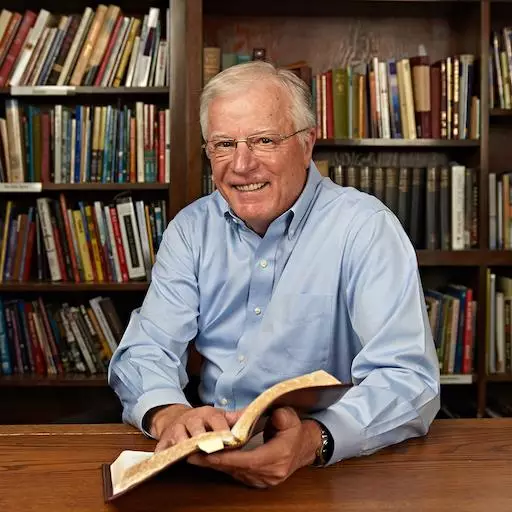
The Book We Trust – Part 1 of 2


The Bible displays the styles of its various human authors on every page. So, is the Bible a human book or is it a divine book? In this message, Pastor Lutzer addresses five honest questions many people have about the divine and human nature of the Bible. The Word of God is powerful and living, and it is available to all.
Dave McAllister: Let us run with endurance the race that is set before us, looking to Jesus, the founder and perfecter of our faith. For Christians, the Bible is at the center of what we believe. Can we rely on this ancient book? Today, we begin a series on the key doctrines that define what Christianity is all about. To learn why the Bible can be trusted, stay with us.
From the Moody Church in Chicago, this is Running to Win with Dr. Erwin Lutzer, whose clear teaching helps us make it across the finish line. Pastor Lutzer, why is what we believe so important?
Dr. Erwin W. Lutzer: It’s so important for us to recognize that Christianity isn’t simply scattered truths. It is a coherent body of truth. And of course, at the beginning, we have to emphasize the fact that the Bible is the Word of God. Now, what this series of messages does is it introduces us to the Bible, its authenticity, but it also shows us why we must worship God the Father, speaks about our relationship with Jesus Christ, the Holy Spirit, and so forth.
But I have to say to you very candidly that we’re living in a day and age where people take various ideas from different religions, from different human philosophies, and they think that this is somehow coherent with Christianity. We must recognize that Christianity cannot be compromised and still call it Christianity. I remember very clearly preaching this series of messages with a great deal of conviction because we are indeed living in an age when people call themselves Christian and really don’t know what Christianity is all about. May I encourage you to call your neighbors, your friends, encourage them to listen to this series of messages so that they might know what it is we believe and why we believe it. Even now, as I speak about the book we trust.
I begin today with a question. Is the Bible a human book or is it a divine book? That’s the question of the hour. Yesterday, I was reading in the book of Jeremiah, and I think it’s in chapter 34, where Jeremiah was asked by God to write a scroll, and God gave him the wisdom to do that. After writing it, he gave it to his scribe to read to the people because he himself was banned.
And then it was given to the king. And when it was read to the king, the Bible says that as his assistant read it, column by column, the king took a knife and cut it and put it in the fire in defiance. Later on, God said to Jeremiah, "Jeremiah, you’re going to have to redo that." I often wonder, did he come up with exactly the same words that he had used previously, or did he change it just a little bit without affecting its meaning?
You know, we come to the book of Mark in the New Testament, and you find that Mark loved the vivid present tense. Over 150 times, Mark would say, "Jesus goes to Jerusalem. Jesus heals." He loved it. His Greek is very different from the Greek of John, who also wrote a book in the New Testament. You get to Luke. Luke actually says, "Look, many people decided to write about the life of Jesus, and I’ve investigated what they’ve written, and now I’m putting things in order and writing my own account that you might believe, O Theophilus."
Think of Paul. First Corinthians chapter 1 verse 16, he says, "Now," he says, "when I was with you, I baptized some people, and I baptized the house of Stephanas, but," he said, "I can’t remember whether or not I baptized anyone else." Well, if Paul had had a better memory, would he have put some other names in the Bible for us in God’s holy book? And at the end of 2nd Timothy, he says, "Timothy, when you come, bring my coat." You know, after all, he’s in prison, and he’s cold, and he says, "Bring my coat and bring the books, and especially the parchments." Sounds like a very human book to me.
On every page, you can see its humanness, the styles of the writers. But yet, at the same time, we’re confronted with this question: Is it only a human book? More than 1,500 times, the Bible claims to be the Word of God. God says to Moses, and then comes a quote all the way through the Pentateuch. Jeremiah, who had that experience of his scroll being burned, the Lord says to him in chapter 1 verse 2, it says, "The word of the Lord came to Jeremiah." And four other times in chapter 1, it says that the word of the Lord came to Jeremiah.
And Paul, who couldn’t remember whether he baptized other people, having a senior moment himself, Paul going through that experience says in 1st Corinthians, "If anyone is spiritual, let him know that I am telling you the commandment of God." Is the Bible human or is it divine? The answer is, of course, it is both human and divine. And the best example of that is Jesus. Was Jesus human or divine? John chapter 4, Jesus, the Bible says, being wearied with his journey, sat on the well, wearied with his journey. Well, we say Jesus is God. You’re telling me that God got tired and had to sit down for a few moments?
Well, Jesus is both God and man. And when I speak about Jesus the Son in this doctrinal series, we’re going to talk about the incarnation, its complexity but also its mystery. What is Jesus called in the Bible? Among other names, he is called the Word of God. In the beginning was the Logos, the Word. And Revelation expressly calls him the Word of God. And the parallels between Jesus and the Bible are really astounding. Both are eternal. Jesus is eternal, yet, "Thy word, O Lord, forever is settled in heaven."
"Heaven and earth shall pass away, but my word shall not pass away." Both are eternal. Both were conceived by the Holy Spirit. Jesus, yes, but also the writers of Scripture were borne along by the Holy Spirit, the Bible says. Also, let’s keep in mind that both are without error. Jesus was a man, yet sinless. The Bible is a human book, but because it’s also a divine book, it is without error. It is inspired. It is inspired by God and kept free of error.
You say, "Well, Pastor Lutzer, what do we mean when we say that the Bible is inspired? Do we mean just that it’s an inspiring book?" No, we don’t mean that. There are plenty of inspiring books that are out there. And quite frankly, there are some parts of the Bible that you read at times might not be that inspiring, especially when you get into the Old Testament. That’s not what we mean. It’s much more than that. It’s also much more than the notion that the Bible is reliable in matters of doctrine but not in matters of science and matters of history.
That notion just does not wash. It is illogical. And the reason is because history in the Bible is doctrine. The resurrection of Jesus—is it a matter of history or a matter of doctrine? The answer is it’s both. The creation of the world—is that a matter of science and not theology? The whole doctrine of creation lies at the very root and the heart of Scripture and doctrine. Furthermore, think about it for a moment. If we cannot trust the Bible in matters of science and history, if it is wrong there, why should we believe it and trust it in matters of doctrine?
If it’s wrong in these issues, it might just as well be believed that it is wrong in everything. So that’s not what we mean when we speak of inspiration. You say, "Well, does it mean that just the ideas were inspired? Just the ideas." That’s a popular notion. The problem is that words and ideas are bound together. Sometimes your salvation rests on a single word, one word. Jerome, translating the Bible into Latin, translated the words of Jesus. He did not translate it "repent for the kingdom of heaven is at hand." He translated it "do penance for the kingdom of heaven is at hand."
Now, maybe he thought that the word penance meant repentance. The problem is that from that word, a whole tradition of penance developed. When Luther discovered the error, it was revolutionary. One single word. You say, "Well, Pastor Lutzer, didn’t the writers of Scripture have any leeway?" Scholars see very clearly their styles. And the answer is, of course, they had leeway. For the most part, the Bible was not dictated. Holy men of God were moved by the Holy Spirit. Some of it was dictation. Much of it wasn’t.
Of course, you see Mark loved the present tense: "Jesus goes to Jerusalem." Matthew, writing about the very same event, might say, "Jesus went to Jerusalem." Maybe John says, "Jesus proceeded to Jerusalem." Another writer might say, "Jesus arrived at Jerusalem." God says, "Choose whatever word you want within your style as long as you remain within the boundaries of truth." The Bible is a human book, and it’s a divine book. Years ago, when I was in Bible college—and that is more years ago than it used to be—I remember memorizing this little poem, and I don’t know who wrote it, speaking of the Bible.
"Deep strike thy roots, O heavenly vine, into our earthly sod. Most human, yet most divine, the flower of man and God." You hold in your hand today, if you’ve brought your Bibles like I assume you did, you hold the flower of man and God. We believe in what is known as verbal plenary inspiration. The word plenary means full, extends to all of Scripture. Verbal has to do with words. So I came up with this definition, actually based on other similar definitions: God superintended the authors that although they used their background and style, they nevertheless wrote his message to us without error in the original autographs or manuscripts.
What they wrote and taught was without error. You say, "Yeah, but we don’t have the originals." That’s true. Thank God we don’t have the originals. We’ve already got enough people lining up to see a piece of bone that belongs to someone in the past. Can you imagine if we had the originals of Paul, how people would be worshipping that piece of parchment? But we have copies of copies. And here’s the deal: yes, there are variations. But that’s what scholars do. They go back and they reconstruct the original and through many different sources are able to reconstruct essentially exactly what Paul wrote and what Mark wrote.
It is oftentimes said that when you open your Bible, you know that the text upon which it is based is 99.5 percent exactly what the original was, and the other little one-half of one percent has to do with variations that do not affect doctrine. Let me say to you with authority today that when you hold this book in your hands, you can with confidence say that you are holding the Word of God that lives and abides forever. This book is God’s book, God’s love letter to us. This is his Word.
Now, the question is, of course, how do we know that the Bible is the Word of God? Come with me to a university classroom. I’m maybe 25, maybe 24, maybe 23, taking a course in philosophy in a Canadian university. And the professor is teaching us logic, good professor. And he brings to class a snippet that he cut out from a newspaper that said that a Christian was asked, "How do we know the Bible is the Word of God?" And the Christian said, "We know it’s the Word of God because it claims to be the Word of God." And the professor said, "This is an example of circular reasoning," the best example he had.
"The Bible’s the Word of God because it claims to be the Word of God. You’re assuming the point to be proven." I think that all of us would admit to say that the Bible is the Word of God because it claims to be the Word of God sounds a little bit like, "Well, I knew that he was telling me the truth because he told me he was telling me the truth." And we know that that, of course, is logically suspect. But let me ask you this question: Is it wrong for us to find out what the Bible says about itself?
Is that illegitimate? I think that’s a very good enterprise. Let’s suppose that you had a visitor come in a very strange boat and land on some distant shore. Wouldn’t it be okay to interview him to ask him where he came from? If he gave an explanation, we’d look for consistency, but we’d also bring in experts in boat manufacturing and clothing to try to verify it. But it would be all right, in fact maybe helpful. Maybe he would tell us things about his origin that we couldn’t learn in any other way. It’s legitimate to ask what the Bible teaches about itself.
Even in a court of law, the defendant is able to stand up and defend himself. So I think it’s very right that we should ask the Bible: what do you say about yourself and your origin? Well, I’ve already told you that about 1,500 times, the Bible claims to be the Word of God. The Bible claims to be God-breathed. All Scripture is given by inspiration of God. It’s given by the breath of God. It says in Psalm 33 that the heavens were made by the breath of God, the host of them by the breath of his mouth.
And the very same breath as God breathed out by his Spirit resulted in the book that we call the Bible. It claims to be inspired of God. In fact, it goes on to say that the words of the Lord are pure words, as silver tried in a furnace refined seven times—the pure word of God. "Heaven and earth shall pass away," said Jesus, "but my word shall not pass away. The flower fades, but the word of our God stands forever." It’s almost on every page of Scripture. It claims to be God’s book.
Now, here’s the question. Follow carefully. There are some people whom we call religious liberals. I’m not talking about political liberals now; I’m talking about religious liberals. And this is what they say: "We don’t believe that the Bible’s a word from God. We think it’s a purely human book. It’s the story of the Jews in the Old Testament coming to grips with monotheism, and that’s all that it is. But nonetheless, we should treat it with reverence because it has so much good things in it, and we have to respect it." Oh, really?
You’re going to respect a book that has in it at least minimally 1,500 lies? You’re going to respect this book? I don’t think so. You say, "Well, let’s put the best face on it. These guys, yeah, they were not writing God’s word, but they thought they were." Are you going to accept the words of authors who were so befuddled that they couldn’t tell the difference between their thoughts and God’s? I don’t think so. Let’s suppose someone wrote a biography about Winston Churchill, and throughout the biography said, "Now Churchill said to me." And then we discover the guy never met Winston Churchill even once.
Would we say, "Well, you know, he was wrong regarding that. It’s true he told us all these lies, but I think that this is a very helpful biography. I think I’d use it to warm myself in winter, quite frankly." What I’m saying to you today is this: if the Bible is mistaken regarding its origin, it has nothing else to say to us that is worthwhile. Oh, yeah, there are some wonderful sayings that Jesus gave on the Sermon on the Mount, but a lot of those can be found in other religions. How do you respect a book that’s wrong so many times? You simply can’t.
Either the Bible is a good book or it is a bad book. Either it is a book that tells us the truth or it tells us a pack of lies. Either it was written by honest men who heard from God, or it was written by deluded prophets and men whose meanderings are not worth reading. It is one or the other. And so I say to you today, make up your mind as to what you believe about the origin of the Bible that claims to be God’s Word, God’s book.
Dave McAllister: My friend, as we all know, the Bible has often been criticized. Critics have taken it; they have tried to shred it, in a sense. They’ve tried to show contradictions. They, of course, have gone looking for various historical errors. And yet, at the same time, there the Bible is. It stands against all of these attacks. And if you have doubts about the Scriptures, I encourage you to read them. Read a book like the Gospel of John and ask yourself the question, "Who is this Jesus that is spoken about?"
As a matter of fact, many people who have doubted the Scriptures have come to faith in Christ once they began to read the Scriptures. I trust that this series of messages which we have begun today is going to lay a foundation for your faith that will indeed be powerful and continuous. At the same time, we here at Running to Win are very anxious to help you with various resources as you run the race of life. I’m holding in my hands a book by Dr. Warren Wiersbe.
I’ll never forget walking into the Moody Church way back in 1977, meeting him in the lobby, and he was on his way home because he was ill and asked me to preach at the Moody Church that very morning. Well, that was one of the dominoes that God set up by which eventually I would be the pastor. That being said, Dr. Wiersbe is a wonderful author, thoroughly scriptural, relevant, and I think you’re going to be blessed by a book he’s written entitled Be Joyful. It’s actually based on the book of Philippians in the New Testament where the apostle Paul, though in prison, continues to be joyful.
The first chapter has to do with joy stealers. What is stealing your joy today? Well, for a gift of any amount, this book can be yours. Here’s what you do: you go to rtwoffer.com. That’s rtwoffer.com. Or pick up the phone and call us at 1-888-218-9337. How wonderful in an age in which there is so much instability, we can go back to the Word of God, and yes, we can be joyful.
It’s time once again for you to ask Pastor Lutzer a question about the Bible or the Christian life. Today’s question, Pastor, comes to us from an anonymous lady in Ohio. It’s short and sweet. "If God planned it all, why should we worry?"
Dr. Erwin W. Lutzer: Well, that’s an excellent question, and we’ve all been troubled by that, haven’t we? Because if it is all on God’s shoulders, why should any of it be on ours? Now, in an ideal world, it would be true that all of our burdens would be given to God. We would be totally carefree, and we’d never have to bear any kind of anxieties. But it’s not that way, is it? And that’s because we’re human. We have human emotions. When we experience grief, we cry, whether God planned it all or not.
But here’s what I’d like to leave with you today: that the better we know God, the more able we are to commit to him everything that concerns us. And then we discover that the peace of God which passes all understanding keeps our minds and hearts, as the apostle Paul said. Think about this: when Potiphar committed the affairs of his household, all of the matters that pertain to running his huge palace, when he committed that to Joseph, the Bible says that he concerned himself with nothing that was going on in the house. What a wonderful example of commitment. And when we give ourselves to God and our children to God and our anxieties to God, we should concern ourselves with nothing because it has been removed from our shoulders to his. Yeah, good question. If God is in charge, why should we worry?
Dave McAllister: Thank you, Dr. Lutzer. If you’d like to hear your question answered, go to rtwoffer.com and click on Ask Pastor Lutzer. Or you can call us at 1-888-218-9337. That’s 1-888-218-9337. You can write to us at Running to Win, 1635 North LaSalle Boulevard, Chicago, Illinois, 60614.
Running to Win is all about helping you understand God’s roadmap for your race of life. You’re being chased by natives toward a gorge. A fragile rope bridge spans the gulf. Do you take it or face the spears? Dramatic, yes, but this is the bottom line when it comes to the Bible. At some point, your doubts have to give way to faith that it is what it says it is: the Word of God, the only book that can take you across the gorge of death into eternity. On our next Running to Win, find out more about why you can trust the Bible. Thanks for listening. This is Dave McAllister. Running to Win is sponsored by the Moody Church.
Featured Offer

This short but powerful work delivers on its significant promise. Pastor Lutzer explores a wide array of Scriptural teachings and siphons them into clear, cohesive truths. It is straight gospel—applicable to the skeptic, newly saved, and long-time believer alike. Click below to receive this book for a gift of any amount or call Moody Church Media at 1.888.218.9337.
Past Episodes
- Changed By The Word
- Children of an Awesome God
- Chiseled By The Master's Hand
- Christ Among Other Gods
- Christ Before Bethlehem
- Christ, God's Gift at Christmas
- Christians In Conflict
- Come and See Jesus
- Cries from the Cross
- Crowning Christ Lord
- Seven Convincing Miracles
- Seven Reasons You Can Trust The Bible
- Seven Secret Snares
- Sharing Secrets With God
- Slandering Jesus
- Suffering Wrong
- Ten Lies About God
- Thanksgiving
- The Battle for America’s Youth
- The Church in Babylon
- The Darwin Delusion
- The Flurry Of Wings
- The High Cost Of Lost Opportunities
- The Invisible War
- The Invisible World
- The King Is Coming
- The Legacy of a Converted Man
- The Man Who Cradled God In His Arms
- The Manger And The Sword
- The Power of a Clear Conscience
- The Triumph of the Gospel
- The Triumph Of Unanswered Prayer
- Till Death Do Us Part
- What Do These Stones Mean?
- What is God Up To
- What Jesus Thinks Of His Church
- What We Believe
- What Would Jesus Do?
- When a Nation Forgets God Interview
- When God Is First
- When God Shows Himself
- When the Spirit Has His Way
- When You've Been Wronged
- Who Are You To Judge?
- Why Good People Do Bad Things
- Why The Cross Can Do What Politics Can't

Video from Dr. Erwin W. Lutzer
Featured Offer
This short but powerful work delivers on its significant promise. Pastor Lutzer explores a wide array of Scriptural teachings and siphons them into clear, cohesive truths. It is straight gospel—applicable to the skeptic, newly saved, and long-time believer alike. Click below to receive this book for a gift of any amount or call Moody Church Media at 1.888.218.9337.
About Running To Win
Running the race of life is hard. But with the Bible front and center and a heart to encourage, Pastor Erwin Lutzer presents clear Bible teaching, helping you make it across the finish line. Since 2011, this 25-minute program has provided a Godward focus and features listeners’ questions.
About Dr. Erwin W. Lutzer
Dr. Erwin W. Lutzer is Pastor Emeritus of The Moody Church where he served as the Senior Pastor for 36 years (1980-2016). He earned a B.Th. from Winnipeg Bible College, a Th.M. from Dallas Theological Seminary, a M.A. in Philosophy from Loyola University, and an honorary LL.D. from the Simon Greenleaf School of Law (Now Trinity Law School).
A clear expositor of the Bible, he is the featured speaker on two radio programs: Running to Win—a daily Bible-teaching broadcast and Songs in the Night—an evening program that’s been airing since 1943. Running To Win broadcasts on a thousand outlets in the U.S. and across more than fifty countries in seven languages. His speaking engagements include Bible conferences and seminars, both domestically and internationally, including Russia, the Republic of Belarus, Germany, Scotland, Guatemala, and Japan. He has led tours to Israel and to the cities of the Protestant Reformation in Europe.
Pastor Lutzer is also a prolific author of over seventy books, including the bestselling We Will Not Be Silenced, One Minute After You Die, and the Gold Medallion Award winner, Hitler’s Cross. Pastor Lutzer and Rebecca live in the Chicago area and have three grown children and eight grandchildren. Connect with Pastor Lutzer on X (@ErwinLutzer) or moodymedia.org.
Contact Running To Win with Dr. Erwin W. Lutzer
media@moodychurch.org
http://moodymedia.org/
Moody Church Media
1635 North LaSalle
Chicago, IL 60614
1.800.215.5001
Monday – Friday
8:00am – 5:00pm CST
Fax Number
1.312.642.4904