

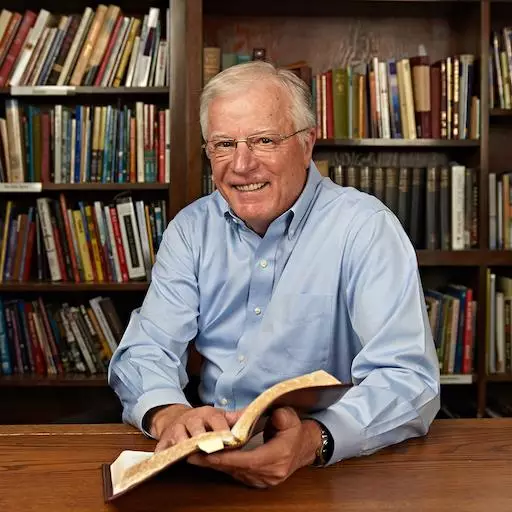
People Will Pray – Part 1 of 2


We need revival. While we can’t force the hand of God, we can pray, rejoice, serve, and worship as we wait. In this message, Pastor Lutzer shares the story of America’s Great Awakening through people like Edwards, Finney, and Moody. May faith be quickened in our hearts as we pray for revival.
Dave: Pastor Lutzer, what is the connection between times of revival and the renewed commitment of a church to pray?
Dr. Erwin W. Lutzer: You know Dave, there are many mysteries regarding prayer, but one thing we know for sure: when God intends to work, He gives people a burden to pray. And one of the things that we need here in the West, as well as around the world, is that burden to pray. We have to be available for God to share His burden with us.
Well, this is the last day we're making a special resource available for you. It's entitled *Managing Your Emotions: God's Good Gifts Gone Wrong*. Now, of course, it's very important to recognize that emotions are a gift from God, but at the same time, they can lead us astray. That's why I've written the book, and for a gift of any amount, we're making it available for you. You can go to rtwoffer.com or call us at 1-888-218-9337. Now, because this is the last day we're making this resource available, I'm going to be giving you that contact info again at the end of this message.
Let's pray together. Father, we thank you so much for what you have done in the past. In your sovereign will and purpose, we pray, do it again. Enliven our hearts and give us faith to believe that you can and even that you will, in Jesus' name. Amen.
When God comes to church, many wonderful things happen. I know that God is always in church, but there are times when God does something very special on a wide scale and many people are affected. When that happens, we sometimes call it a spiritual awakening or we call it revival. It happened in the church in Thessalonica, which we were studying to see their impact of a small church upon a whole community and their part of the world.
But it's also happened in America. God has done some unusual things in these United States. Today's message is a little unusual because I'm not going to be giving an exposition of Scripture, though at the end we will turn to 1 Thessalonians 5, if you want to turn there now, and we'll be talking about what to do while we are waiting for an awakening. But today, I'm going to tell you the story of America's great awakenings so that, number one, faith might be quickened in our hearts and we might say, "My goodness, if God did it then, why can't He do it now?" and that we might pray more effectively toward that end.
Usually, God sends rain to water the earth, but there are times when God sends a downpour, when there's a cloudburst, and there are cloudbursts in history of the mercies of God. In order to tell you what happened in Chicago, and you're going to be, I hope, pleasantly surprised if you've not known this, I'm going to begin back further and tell you that there were these three great awakenings in American history, and I'm going to give you a thumbnail sketch of all three.
First of all, we have the Great Awakening of 1740 to '43. That's known as the first Great Awakening. Northampton, Massachusetts, Solomon Stoddard is preaching to his congregation and tells them that God sometimes does unusual things and builds their faith. He dies, and his grandson, Jonathan Edwards, who was an associate pastor, takes over and he becomes the great revivalist. Jonathan Edwards is known for his sermon, *Sinners in the Hands of an Angry God*. It's a very scriptural sermon, but not well thought of today.
Someone said that when Edwards preached, he was so vivid and solemn that the impression that was made upon them was so strong that this listener said he thought that when Mr. Edwards would close his discourse, right then the judge would descend and the final separation take place. He expected God to come right there when the sermon was finished. But Edwards became friends with a man by the name of George Whitefield, an Englishman who preached all over the eastern part of the United States to large crowds. Now, we're talking 1700s, no PA systems, and he was able to preach to large crowds in the Boston Common, and Benjamin Franklin would attend and even try to see how far Whitefield's voice could really carry right there in the Boston Common.
In New York, in Massachusetts, in other places, huge crowds would come. Repentance was everywhere. The conviction of sin was so strong that it is said that when boats came from England, before the soldiers even got to the shore of the United States and hearing what God had done, they were convicted already of their sin. Multitudes were converted. As a result of this Great Awakening, it is believed that perhaps 50,000 people were converted, taverns were closed, families were reconciled, and the whole culture of Northampton and other places were transformed. Unusual, unusual work of God.
Well, that's the first Great Awakening, and needless to say, I'm not doing it justice. But we must hurry. The second Great Awakening, we're going to put from 1790 to 1860, a long period of time, and it has two different aspects. First of all, in the West. I don't know if there's anybody listening from Kentucky, but I've always wondered where Cane Ridge is in Kentucky. That's where camping ministry began. That's where they would hold camp meetings and come to hear preachers, and 10 to 15,000 covered wagons came for meetings, and circuit riders went throughout Kentucky and throughout the West. A historian says that God confounded infidelity and brought untold numbers to the faith. What a story.
Timothy Dwight, who is the grandson of Jonathan Edwards, gives a lecture at Yale University because he's president on why the Bible is the Word of God. 75 out of the 225 students at Yale are converted, and they go home on spring break and they don't go to Daytona. Praise God. They go home to their churches and tell about the wonderful things that God is doing and the marvelous conversions they're experiencing, and revivals begin to break out. That's where you have the beginning of the modern missionary movement.
The great revivalist during this period of time was Charles Finney, who preached in the East. Rochester, New York would stop everything over their noon hours in order to pray. Finney was the great revivalist. His theology at points we don't agree with, but he was mightily used of God. By the way, he founded Oberlin College. One day I was at Oberlin visiting. It's a very theologically liberal school today, and it is embarrassed by its heritage of Finney. There's a Finney Chapel in Oberlin that is along the street. It was locked, I couldn't go into it, so I just knelt outside the chapel along the street. I didn't care that other people were walking by. They could think whatever they wanted to. Now, if somebody actually called the cops, that would be something else.
But I said to myself, "Somebody walking past this chapel needs to give thanks to God for the ministry of Finney who is now being evil spoken against in this school." So I knelt to thank God for Finney. I even went and visited his grave, which is also in the area. It is estimated that during this period of time, God was working mightily through so many different people and in so many different ways that perhaps a million people came to the faith.
But now we get to the third Great Awakening, and that's our focus today. 1857 to 1859, just two years in which God worked mightily. Well, it began in New York City, and I want to read you the story of how it began, and then we're going to talk about Chicago here because this is going to get better and better as we go along. All right, it is summertime 1857, a man by the name of Jeremiah Calvin Lanphier is walking the streets of New York and saying, "What can I do here in the business district?" He gives out a tract inviting people to pray, and we have Xeroxed copies of it.
On it is written, "How often shall I pray? As often as the language of prayer is in my heart, as often as I see my need of help, as often as I feel the power of temptation, as often as I am made aware of my spiritual declension or feel the agitation of a worldly spirit. In prayer, we leave the business of time for that of eternity and fellowship with men for fellowship with God." He invited men to pray. September 23rd, 1857, the door is open at the meeting hall. He prays alone for a half-hour, but a half-hour later at 12:30, about six others show up and they have a prayer meeting. Now, there were other prayer meetings that began before that time and continued as a result of that.
But a little later on, October 1857, the stock market crashed. People felt a great need to seek God. Within six months, a total of 10,000 men were gathering daily for prayer in many places throughout New York City. The churches were packed, so the prayer meetings were moved to the theaters. With some sarcasm, the New York Herald of March 6th said, "Satan is busy all morning on Wall Street among the brokers, and in the afternoon and evening, the churches are filled, crowded with saints who gambled in the morning."
Now you say, well, what happened? Well, the media began to pick up the story. And so you have the story of Philadelphia. Anybody from Philadelphia? Have you ever heard of Jaynes Hall? I don't know if it's still there, but on February the 1st at a prayer meeting there, there is this report: "3,000 souls at once on one weekday after another at its busiest hour bow before God in prayer for the revival of His work." That's Philadelphia. What about Boston? It says, "To see a thousand men leaving their counting rooms and shops at the noonday hour and flock with one purpose to the place where prayer is made, to see the tone and tearful interest pervading these assemblies, is a new thing in this city."
All right, what about the city of Chicago? A newsman said here in Chicago, and this is the *Chicago Daily Press*. Now I need to tell you that 15 years ago, I walked across the street to the Historical Society and spent a couple of afternoons looking at old microfilms of the newspapers here in the city of Chicago and what they had to say about the revival. I wrote a little book on the topic and I'm going to be reading from it. Across the street in the Historical Society, here's a quote. It says, "Writing from a news point, this is the Chicago Daily Press." Eight newspapers in those days, two of them in German, by the way.
It says, "Writing from a news point, the prominent topic of thought and conversation in Chicago, in our streets, in our places of business, and in our homes, is the subject of the religious awakening now in progress in this community and it is all-absorbing. It is upon the lips of Christians and of unbelievers. There are no scoffers, few who sneer publicly and openly at what is transpiring without excitement, without noise, and cannot be called fanaticism. The remarkable thing about this revival is it had no great leader, no Finney, no Edwards, no Whitefield. It was known as the Businessmen's Revival because it was led oftentimes by a pastor. The prayer time was led by a pastor, but generally speaking, anyone could lead it." And therefore, there was very little criticism of it.
Now, let's look at the newspapers. This is what I discovered across the street at the Historical Society. This is the *Chicago Tribune* of March 25th, 1858: "The noon prayer meeting at Metropolitan Hall." I have to pause here. I wanted to go to Metropolitan Hall to see where these prayer meetings were held day after day after day at noon where people could not get in, and I discovered it no longer exists today. It's across the street from the Thompson Center, and there's a different building there now. But some of us, five or six of us, actually went there anyway. We said, "We want to be approximately where the Metropolitan Hall once was."
Now listen: "It was the largest and most interesting that has yet been held. The body of the house, the gallery were filled considerably before 12 noon, and at the time for beginning the exercises, the platform, the stairways, the aisles, the entry were all occupied by persons standing up. During the whole hour, the stairs leading down to the streets were filled with persons arriving or retiring, unable to gain entrance for a noon prayer meeting that took place every single workday." In fact, I'm sorry I didn't get the quote, but when I was reading it over in the Historical Society, I discovered that one newspaper said that if women wouldn't wear skirts with hoops—I hope that that's the right word, I didn't check on this before—more people could get into Metropolitan Hall to pray.
John Wentworth, the mayor of Chicago at the time, stood near the rear of the hall and listened with great attention to all, and later said, "The effect of the present religious movement are to be felt in every phase of society." That is in Chicago newspapers. Someone else says it was the perfect union of all evangelical churches. The *Chicago Daily Journal* of March 20th, 1858 reported that the revival was universal and not limited to a single city or even state, but has spread like fire in every direction. Such an outpouring of religion has not been seen since before the days of Edwards.
That happened here in the city of Chicago. What took place is, in May of the year 1859, the prayer meetings disbanded, but they went into the churches. The estimate was that 1,800 people were meeting for prayer at noon and 5,000 in various churches were meeting for prayer in the evening. Now let's do the math. Let's remember our chronology. In 1856, D.L. Moody came to the city of Chicago, that's two years before the awakening. One of his biographers said that it was this awakening that thrust D.L. Moody into his revival ministry.
D.L. Moody, of course, began, he rented pews in the Plymouth Church and they kicked him out because they said that these boys that you're bringing in are so rowdy. So he had to begin his own church, but he says to his mother during this Great Awakening, "There is a great revival of religion in this city. I go to meeting every night." Remember D.L. Moody's English, it needed a little bit of help. It is said that he was able to pronounce the word "Mesopotamia" in one syllable. "There is a great revival of religion in the city. I go to meeting every night. Oh, how I enjoy it. It seems as if God Himself is present. Oh, mother, pray for us. Pray that this will go on until every knee is bowed." And so it is that D.L. Moody received his thrust into ministry through this Great Awakening, this prayer revival that took place here in the city of Chicago. And you know, my friend, it's been my privilege, and yours as well, to participate in the legacy that Moody left. As a result of all that he did, Moody Church, of course, was established, Moody Bible Institute. We thank God for the ministry that goes around the world.
Well, this is the last day we're making a special resource available for you. It's a book entitled *Managing Your Emotions*. Hope that you have time now to get a pen or pencil because I'm going to be giving you some contact info. But let me read some of the chapter titles: "Those Feelings of Love," "Defeating Depression," "Living with Rejection," "When Fear Envelops You," "Loneliness: The Quest for Companionship," "Controlling Anger," "Overcoming Disappointment," "Moving from Regret to Restoration." We believe that this book is going to be a tremendous help in a time of anxiety and fear and uncertainty, and our emotions can unsettle us.
Well, as I've mentioned, for a gift of any amount, we're making it available, and I do hope that you have that pen or pencil. Here's what you can do: go to rtwoffer.com or call us at 1-888-218-9337. Be sure to get your copy today. Go to rtwoffer.com or call us at 1-888-218-9337. Let's pray for each other. Let's ask God to help us, to give us emotional stability that we might be able to encounter the future with faith and not with fear. The title of the book, *Managing Your Emotions*.
Dave: It's time now for another chance for you to ask Pastor Lutzer a question you may have about the Bible or the Christian life. Today's question, Dr. Lutzer, comes from Patrick, and he lives in North Carolina. He says, "I'm 83 years old and made a profession of faith in 1951. I believe I went through a period of reformation, but I'm not sure I was regenerated. My behavior has changed, but I have been looking for the assurance of salvation for over 50 years. I've heard you say, 'Saving faith is the deep, settled conviction that what Jesus Christ did on the cross for us is all that we need to stand in the presence of a holy God.' I believe that, but I'm not sure that I've ever appropriated that for myself. Many years ago, a preacher told me I was going by my feelings. Maybe so, but I can't stop looking within. The Bible says the Spirit bears witness with our spirit. I want that witness. I know I'm a sinner and I'm lost unless I've been genuinely converted. I have some faith, but I'm not sure it's saving faith. I need a real work of God in my heart. Can you help me?"
Dr. Erwin W. Lutzer: Oh, Patrick, I'm so glad that you wrote, and I wish that we could have a cup of tea together and then we'd be able to dialogue regarding your spiritual journey and I might be able to find out a little bit more as to why you continue to have these doubts. But I'll tell you this: I take very seriously what you say. I don't simply brush it off by saying, "Well, your behavior has changed, therefore you're a Christian." I appreciate your desire for a real work of the Spirit.
But what I'm going to say to you, Patrick, might surprise you. I think you need to stop looking for a work of the Spirit in your heart. You say, "Wait a minute, I want to be born of the Spirit." Yes, but the Holy Spirit's job is not to point to Himself. His job is to point to Jesus. And you quote the Spirit bearing witness with our spirit. How does He do that? He does that as we look at Christ and we find in Christ our all-sufficiency. It is then that the Spirit says, "What you are looking at is enough." If you look for the Spirit's work, you're going to always be disappointed because you're always going to see your own sin, your own failure, and your own doubts.
Patrick, imagine this: imagine a man who's in a dark room and he wants to see the sun. And he says, "You know, if the sun were really out there, I'd have a certain feeling of warmth." So he's checking his nerve endings to see if he's warm. He's looking at his own skin to see if there's any tan. And then he says, "Wait a minute, maybe I should look out the window." He looks out the window and he see the sun, and the moment he sees the sun, he doesn't have to check his feelings anymore to know the sun is there. The sun is its own witness.
Jesus Christ, Patrick, is His own witness. You must look away from yourself. You must look away from even the work of the Holy Spirit. You look to Jesus, you look to His finish work, and you say, "Lord Jesus, I'm a sinner, but you are a great Savior, and I'm trusting what you did for me." And then you rest there. And as you rest there, the Holy Spirit will, in His own time and His own way, give you that assurance. But as long as you're looking for the assurance, you're looking at the wrong thing. Look to Jesus.
Dave: Thank you, Dr. Lutzer. If you'd like to hear your question answered, go to our website at rtwoffer.com and click on "Ask Pastor Lutzer" or call us at 1-888-218-9337. That's 1-888-218-9337. You can write to us at Running to Win, 1635 North LaSalle Boulevard, Chicago, Illinois, 60614. Running to Win is all about helping you make it across the finish line. Next time, Pastor Lutzer speaks on what you and I should be doing as we wait for God's power to visit our churches. For Dr. Erwin Lutzer, this is Dave Anderson. Running to Win is sponsored by the Moody Church.
Featured Offer

This guide to the last days will stoke your trust in God’s glorious plans for the future. You will be empowered to live with boldness and readiness like never before. Click below to receive this book for a gift of any amount or call us at 1.888.218.9337.
Past Episodes
- Changed By The Word
- Children of an Awesome God
- Chiseled By The Master's Hand
- Christ Among Other Gods
- Christ Before Bethlehem
- Christ, God's Gift at Christmas
- Christians In Conflict
- Come and See Jesus
- Cries from the Cross
- Crowning Christ Lord
- Seven Convincing Miracles
- Seven Reasons You Can Trust The Bible
- Seven Secret Snares
- Sharing Secrets With God
- Slandering Jesus
- Suffering Wrong
- Ten Lies About God
- Thanksgiving
- The Battle for America’s Youth
- The Church in Babylon
- The Darwin Delusion
- The Flurry Of Wings
- The High Cost Of Lost Opportunities
- The Invisible War
- The Invisible World
- The King Is Coming
- The Legacy of a Converted Man
- The Man Who Cradled God In His Arms
- The Manger And The Sword
- The Power of a Clear Conscience
- The Triumph of the Gospel
- The Triumph Of Unanswered Prayer
- Till Death Do Us Part
- What Do These Stones Mean?
- What is God Up To
- What Jesus Thinks Of His Church
- What We Believe
- What Would Jesus Do?
- When a Nation Forgets God Interview
- When God Is First
- When God Shows Himself
- When the Spirit Has His Way
- When You've Been Wronged
- Who Are You To Judge?
- Why Good People Do Bad Things
- Why The Cross Can Do What Politics Can't

Video from Dr. Erwin W. Lutzer
Featured Offer
This guide to the last days will stoke your trust in God’s glorious plans for the future. You will be empowered to live with boldness and readiness like never before. Click below to receive this book for a gift of any amount or call us at 1.888.218.9337.
About Running To Win
Running the race of life is hard. But with the Bible front and center and a heart to encourage, Pastor Erwin Lutzer presents clear Bible teaching, helping you make it across the finish line. Since 2011, this 25-minute program has provided a Godward focus and features listeners’ questions.
About Dr. Erwin W. Lutzer
Dr. Erwin W. Lutzer is Pastor Emeritus of The Moody Church where he served as the Senior Pastor for 36 years (1980-2016). He earned a B.Th. from Winnipeg Bible College, a Th.M. from Dallas Theological Seminary, a M.A. in Philosophy from Loyola University, and an honorary LL.D. from the Simon Greenleaf School of Law (Now Trinity Law School).
A clear expositor of the Bible, he is the featured speaker on two radio programs: Running to Win—a daily Bible-teaching broadcast and Songs in the Night—an evening program that’s been airing since 1943. Running To Win broadcasts on a thousand outlets in the U.S. and across more than fifty countries in seven languages. His speaking engagements include Bible conferences and seminars, both domestically and internationally, including Russia, the Republic of Belarus, Germany, Scotland, Guatemala, and Japan. He has led tours to Israel and to the cities of the Protestant Reformation in Europe.
Pastor Lutzer is also a prolific author of over seventy books, including the bestselling We Will Not Be Silenced, One Minute After You Die, and the Gold Medallion Award winner, Hitler’s Cross. Pastor Lutzer and Rebecca live in the Chicago area and have three grown children and eight grandchildren. Connect with Pastor Lutzer on X (@ErwinLutzer) or moodymedia.org.
Contact Running To Win with Dr. Erwin W. Lutzer
media@moodychurch.org
http://moodymedia.org/
Moody Church Media
1635 North LaSalle
Chicago, IL 60614
1.800.215.5001
Monday – Friday
8:00am – 5:00pm CST
Fax Number
1.312.642.4904