

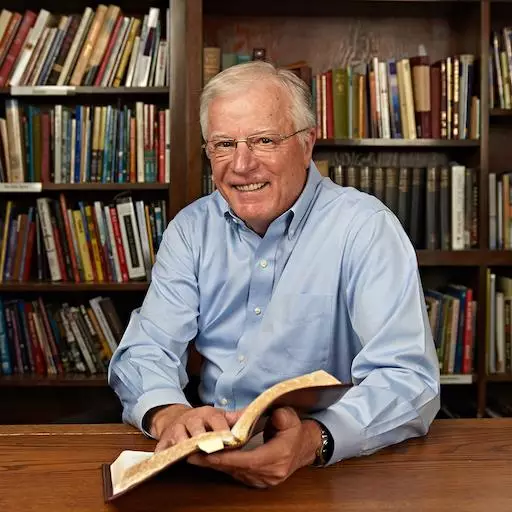
Knowing For Sure – Part 1 of 2


Why do Christians still struggle with doubt? While some simply need the assurance of their security, others should honestly examine if they are truly in the faith. In this message, Pastor Lutzer offers five reasons people doubt their salvation. It’s time we took a good look at our doubts without brushing them aside.
Dave McAllister: Let us run with endurance the race that is set before us, looking to Jesus, the founder and perfecter of our faith. Believers in Christ look forward to a certain home in heaven, and this outlook turns their inward look to an upward look, a look full of promise and hope.
This hope is something we can share with all who ask why we have that hope. From the Moody Church in Chicago, this is Running to Win with Dr. Erwin Lutzer, whose clear teaching helps us make it across the finish line. Today, Erwin Lutzer begins the final message in a series on how you can be sure that you will spend eternity with God. Pastor, tell us about knowing for sure.
Erwin W. Lutzer: Dave, there are many people who would argue that it's not possible to know that you have eternal life because, after all, we look at the Bible, we have never seen God with our eyes. How can we be brought to the assurance of faith?
That's why this message is so critical. That's why a book I've written entitled *How You Can Be Sure That You Will Spend Eternity With God* is one of the most important that I think anyone can read beside the Scriptures. After all, knowing the answer to that question is critical.
Very briefly, how do we know? I trust everyone will listen to this message. At the end of this message, by the way, I'm going to be giving you some contact info by which this book can be yours. But also speaking briefly to the question, how can we be sure? For now, I want us simply to listen.
When Michelangelo painted the picture called *The Last Judgment*, he painted the faces of those who were awaiting to meet God. Faces were filled with consternation and fear. I suppose the question is if your face were to be painted, knowing that you were to meet God in, say, one hour, what would it be like?
I've often thought of those who've been executed, who knew exactly the time that they were about to die. They always talk about that last meal that everybody wants. I'm not so sure that I would be interested in that big last meal. But let me ask you a question: is it possible for us to know that all will be well when we meet God, or do we just have to wait and see?
That's the topic of this morning's message. Now, there are many people who doubt their salvation. They doubt that things are going to go very well when they meet God. At best, they have a very vague hope and they kind of punt the ball to God's mercy and say, "Well, I just hope that God will be generous." But they have no assurance.
If you fall into that category today, I want you to know that your doubts are very legitimate. Because if you do not have the assurance in your heart that all will be well when you meet God, it could well be that the reason is because you are unprepared to meet Him. Because those who punt the ball to His mercy and hope for the best will be lost.
So, if you're in that category today, I want to take your doubts and I want to exploit them. I want to magnify them. I hope that you are awash with doubt because you have a right to doubt. Now, there are some who perhaps don't doubt and yet they should be doubting. They're confident things will be okay when they meet God, and they don't realize that they won't be.
Something like filling your car with gasoline, walking into the service station with a great deal of confidence that you'll be able to pay, and opening your wallet and discovering that your children removed the 20-dollar bill that you thought was there. Now, you walked with confidence. You thought that everything was going to be okay, but your faith was misplaced. And that is going to be the experience of many people in the day of judgment.
You remember the first message in this series was "The Crisis of Misplaced Faith," where I explained that in more detail. But now what I'd like to do is to discuss those of you who are genuinely saved. You know God through Christ, and you are confident that your name is written in the Lamb's Book of Life, and still you have doubts.
Why do genuine Christians sometimes still have doubts? Well, let me give you a couple of reasons. First of all, because they can't point to a time or a date when they really were saved. Now, most Christians can. If we had a microphone and interviewed all 1,200 or 1,300 of you, many of you would be able to say, "On April the 11th," and you'd give us the year when you were converted.
But it's not necessary to do that because there are some people who are trusting Christ and they are saved, and they can't remember when they crossed the line, particularly those who were reared in Christian homes. They may not know exactly, but it's possible to know even if you don't know the date and time of your conversion.
There's a second reason, and that is because of guilt and remorse. Something happens in your life and you are awash with failure, and because of the sensitivity of your conscience, you say to yourself, "I just did something that no Christian could ever do." William Cowper, whose poetry I love to quote, was one who was so filled with a sense of guilt.
Here he wrote these beautiful words: "God works in mysterious ways His wonders to perform; He plants His footsteps in the sea and rides upon the storm. Blind unbelief is sure to err and scan His work in vain; but He is His own interpreter and He will make it plain." My friends, the evening he wrote those words, he tried to commit suicide.
He was a neurotic filled with guilt. What was wrong with William Cowper? I think that he will be in heaven because there is some very strong evidence that his faith was placed in Christ alone. The problem is his faith seemed to be so lacerated. His faith was so destroyed by this overwhelming sense of guilt. You say he had psychological problems. No, he didn't have psychological problems; he had theological problems. He could not grasp the wonder of God's grace.
But that's why many Christians doubt, because of guilt. Thirdly, because of wrong teaching. My parents came from Europe. My mother was baptized a Lutheran, confirmed in the Lutheran church, came to Canada, had no assurance that she had ever met God because she hadn't. And sought out preaching where she could know that she had been converted and that she belonged to God. And she found a church and she attended night after night, and at last the truth came home to her and she was marvelously saved.
But I was brought up in a home in those days at least where my parents believed that it was possible to lose your salvation. And so there was always that instability, always that sense of uncertainty that accompanied their own experience until later on in life when they became more firm in their understanding of the word.
Those of you who were brought up Catholic, by the way—and if you are here today and you are a Catholic, I want you to know that you are not only welcome, but you are in good company. About 25 percent of all of the new members at Moody Church were brought up in the Catholic church, so you have plenty of friends sitting around you.
But you know that the Catholic church has traditionally said that assurance of salvation cannot be had. Council of Trent, 1546: "Those who believe that one can be assured of eternal salvation, let them be anathema, let them be accursed." And if you're taught that way, it's a hard hump to get over.
Now, there's another reason, and that is that there are some Christians who are backslidden. And when you're backslidden and you think that God has abandoned you—He hasn't, if you're a genuine Christian—but you have that sense of failure. It's easy to begin to think that you are really not saved.
And then there are those who are just the chronic doubters. If they were applying for a job and someone were to say, "What do you do well?" they'd say, "I doubt. That's my great strength. That's my spiritual gift. That's where I find my groove." Usually, it's associated with worries. They go to bed at night thinking that maybe tomorrow morning when they wake up, two plus two will no longer be equal to four.
And being very introspective, they are awash with doubt. Some of those doubts at times legitimate, some of the times illegitimate. What is the bottom line? Well, the bottom line is I want you to take a good look at your doubts today. I want you to own them. I don't want you to brush them aside. It is okay to doubt because it has been said, "He who has never really doubted has never really believed." So I invite you today: bring your doubts. And if you're here, I'm sure that you have brought them with you because it would be difficult to separate your doubts from you on second thought, wouldn't it?
Now, what I'd like to do before I talk about assurance and true faith, I would like to speak about false faith for just a moment. Because I'm still thinking that there are some of you here who aren't doubting enough, because you are not saved and you have some false confidence. So what I'd like to do is to rattle your cage just a little bit.
First of all, what is a false faith? False faith is based on a change of mind but not a change of heart. Example: Judas. He betrayed Christ, he got his silver, and then when he saw that Jesus was condemned, he thought that Jesus would escape somehow. When he saw that Jesus is condemned, the Bible says he took the money, he threw it down in the sanctuary, and it says he repented. And then he did what 30,000 Americans do every year: he went out and committed suicide.
His repentance did not bring about salvation. Repentance is a change of mind. He felt sorry that he did it, but it didn't change his relationship with God. It is okay to feel sorry, but feeling sorry does not change your relationship with God, even if you decide to do better next time. That is not the faith that leads to salvation. So there is a kind of faith that actually brings about a change of mind without a change of heart.
Secondly, false faith is a misdirected faith. I gave an illustration a moment ago about somebody going into a service station thinking that he has money to pay. And there are people who think, "Well, surely God is going to accept me because of my participation in the sacraments. Surely God is going to accept me because I have been good." And you remember in the series of messages—and this is the last of six and they are really one garment and they're all related—we have commented on that kind of a faith which is misdirected.
But now I want to speak to us Protestants. I want to speak to us who are evangelical to the core, those of you who were brought up in Christian homes, or those of you who have been brought up in modern-day evangelicalism. There is such a thing as a decisional faith that does not bring about salvation. People who make decisions for Christ and they aren't saved after they've made those decisions.
They may pray a prayer, but they don't realize prayer has never saved anyone. Never has, never will. And yet, if you're brought up in a Christian home, your parents may actually say to you, "Well, you know, at the age of four, you prayed a prayer to accept Jesus. You're saved." Could I say parenthetically, Christian parents, if your kids doubt their salvation, let them doubt. Don't you dare tell them they have been saved. You don't have that right. God will tell them. God will tell them when they're properly instructed.
So, the point is that there are those who make decisions. There are those particular sections of this country where coming forward in an invitation is inextricably bound up with getting saved. So they came forward in a meeting and they say, "Well, I made my profession," or "I made my decision." Maybe genuine, maybe not. But they say, "I can tell you when I went forward." That is decisional faith.
You know, Jesus made an astounding statement. He said, "Every plant that My heavenly Father has not planted shall be rooted out." Think about that for a moment. All of the superficial decisions, all of the well-meaning decisions—he who has never been planted by God shall be uprooted.
Years ago here at the church, I told you the story of how in Canada there were some people who sold evergreens. They went door-to-door and they got the whole city block to agree that they were going to chip together and get some evergreens. And they came and they planted the evergreens. They got their money and then they planted the evergreens. And the people watered them and watered them and watered them.
And all that they did is turn brown and die. And they couldn't understand it. And then somebody went and picked one of them up and discovered that what they had done is they had just simply taken branches and shoved them in the ground. There was no root whatever. Have you ever wondered why it is there are people who make a decision to follow Christ?
They say, "I have decided to follow Jesus," or "I have prayed this prayer," and then you look at their lives and there's no evidence of it. And their leaves are withering and there is no root. And you say, "What happened?" Jesus said, "Every plant that My heavenly Father has not planted will be rooted out." Think about that, those of you who have taught Sunday school at Moody Church for many years. Think about it, you deacons and you ushers and you choir members. If you have not been planted by God, in the end, your faith will be shown to be false.
Well, I told you I was going to rattle your cage. I hope I've done it. Now the question is, how can we know? What is saving faith? Well, what I want you to do is to take your Bibles and we're going to look at a couple of passages. First of all, let us turn to Hebrews chapter 10 where we have a definition, really, of faith. It is a definition of faith, though it does not give us specifically the content. And I mentioned Hebrews 10; you can turn to that if you wish, but actually it's going to be Hebrews 11.
So, if you want to be with me, it's Hebrews chapter 11. Now, notice what the Bible says. It says, "Faith"—and I'm reading from the New American Standard—"faith is the assurance of things hoped for, the conviction of things not seen." If you have a King James Version, you know that it says, "Faith is the substance of things hoped for, the evidence of things not seen." What is that word substance, *hupostasis*?
Well, the King James translated it substance, and sometimes it can be translated substance. But it's interesting to know how the author of the book of Hebrews uses the word elsewhere in the book. In chapter 3, verse 14, it is translated confidence. He says we should hold our confidence steadfast to the end. And that's why the New American Standard translation translates it assurance.
Faith is the assurance of things hoped for, the conviction of things not seen. What is faith? Faith is the conviction; it is the persuasion of something. You are persuaded when you believe. Now, I told you that this text in itself does not tell us the content of what we should believe because it goes on to talk about heroes of faith.
But in order that we might know what to believe, let's turn to the passage that was read to us in 1 John chapter 5. 1 John chapter 5. You know, the book of John and Jude precede the book of Revelation. 1 John chapter 5, verse 10. It says, "The one who believes in the Son of God has the witness in himself. And the one who does not believe has made Him a liar."
Boy, that's an awesome statement. If you don't believe today, you're making God a liar. "Because he has not believed in the witness that God has borne concerning His Son." You say, "Well, what is the witness within himself?" And verse 11 says, "The witness is this, that God has given us eternal life, and this life is in His Son. And he who has the Son has life; he who does not have the Son of God does not have the life."
The witness is the persuasion; it is the conviction that if you have Christ, you have all that you need for your salvation. We can fill out the details from other passages of Scripture which say that God laid upon Christ the iniquities of us all. "I am come that you might have life, that you might have it more abundantly." The texts that we have talked about in previous messages, that salvation is a free gift of God.
Let's put it all together and let me be clear. Saving faith is the deep settled conviction that what Jesus Christ did on the cross for us is all that we need to stand in the presence of a holy God. That's what saving faith is. Now, if you're here today and you're saying, "You know, I don't think I can be a Christian because I cannot live the life," you still have misunderstood. You still don't understand. I'm glad that you're here, but you still do not understand.
Because if you say, "I do not know whether I can live the life," you are still thinking that somehow salvation is a cooperative effort between you and God, where God does His part and you do yours. And you do not understand, if I may repeat it again, that what Jesus Christ did on the cross is all that you need to stand in the presence of a holy God. We sometimes sing, "Jesus paid it all, all to Him I owe; sin had left the crimson stain, He washed it white as snow."
In fact, at the risk of being repetitious, not only must you be persuaded that Jesus is all that you need to stand in the presence of a holy God because of what He has done, but Jesus is all that you will ever need to stand in the presence of a holy God. How do you understand when Michelangelo painted those faces with so much fear? Because medieval theology taught that salvation was a cooperative effort between man and God, where you do your part and God does His, and the both of you work it out.
He gives us His mercy and we give Him our works and our obedience. If that were the gospel, Michelangelo should have painted those faces with even more terror, because who can know that he has done enough to merit the righteousness of God? No one. Not even the Virgin Mary. My dear friend, do you now understand why people who pray prayers sometimes are not saved?
You know, we say to people, "You know, you need God," and they say, "Yes, I know I need God. You should accept Jesus as your Savior." I've had people say, "Sure, it can't hurt." Oh, wow. Or they think to themselves, "You know, I need God's help, and if accepting Jesus as my Savior gives me God's help, I'll try it." My dear friend, if you are here today and you do not know Christ as your Savior, you need something more radical than just God's help. You need God's forgiveness. That's what you need.
And you need your self-confidence shattered so that you come to God with nothing in your hand but become persuaded that Jesus Christ and His death on the cross is all that you will ever need to stand in the presence of a holy God. One other reason that many people don't have assurance of faith is they still come to Christ for help.
But as I emphasized in this message, they don't understand how bankrupt they are. They have no understanding of how they must be saved by grace alone through faith alone. They withhold from the cross of Christ something that they think they must still do. No, it's more radical than that. It means that God is the one who does it all. You come empty-handed. You don't come to give; you come to receive because you see that you're a sinner and you need God's intervention and grace.
Well, for a gift of any amount, we're making available for you a book I've written entitled *How You Can Be Sure That You Will Spend Eternity With God*. I sure hope that you have a pen or pencil handy because this is the last week we're making this resource available. And so as you take down this info, I want you to respond because the book, I think, will be a blessing to you and to those to whom you give it.
Here is what you do: go to rtwoffer.com. That's rtwoffer.com, or you can call us at 1-888-218-9337. Now, because as I have already emphasized, this is the last week, here's that contact info again. Go to rtwoffer.com; for a gift of any amount, the book can be yours. rtwoffer.com, or pick up the phone and call us at 1-888-218-9337. Be wrong about many things, but don't be wrong about your eternal soul. Go to rtwoffer.com or call us at 1-888-218-9337.
Dave McAllister: You can write to us at Running to Win, 1635 North LaSalle Boulevard, Chicago, Illinois, 60614. Faith in Christ is the non-negotiable factor that transforms people from darkness to light and changes their destinies from hell to heaven. Nothing is more important to understand. And next time on Running to Win, you'll hear a crystal clear explanation of the difference between false faith and saving faith. Thanks for listening. For Pastor Erwin Lutzer, this is Dave McAllister. Running to Win is sponsored by the Moody Church.
Featured Offer

This short but powerful work delivers on its significant promise. Pastor Lutzer explores a wide array of Scriptural teachings and siphons them into clear, cohesive truths. It is straight gospel—applicable to the skeptic, newly saved, and long-time believer alike. Click below to receive this book for a gift of any amount or call Moody Church Media at 1.888.218.9337.
Past Episodes
- Changed By The Word
- Children of an Awesome God
- Chiseled By The Master's Hand
- Christ Among Other Gods
- Christ Before Bethlehem
- Christ, God's Gift at Christmas
- Christians In Conflict
- Come and See Jesus
- Cries from the Cross
- Crowning Christ Lord
- Seven Convincing Miracles
- Seven Reasons You Can Trust The Bible
- Seven Secret Snares
- Sharing Secrets With God
- Slandering Jesus
- Suffering Wrong
- Ten Lies About God
- Thanksgiving
- The Battle for America’s Youth
- The Church in Babylon
- The Darwin Delusion
- The Flurry Of Wings
- The High Cost Of Lost Opportunities
- The Invisible War
- The Invisible World
- The King Is Coming
- The Legacy of a Converted Man
- The Man Who Cradled God In His Arms
- The Manger And The Sword
- The Power of a Clear Conscience
- The Triumph of the Gospel
- The Triumph Of Unanswered Prayer
- Till Death Do Us Part
- What Do These Stones Mean?
- What is God Up To
- What Jesus Thinks Of His Church
- What We Believe
- What Would Jesus Do?
- When a Nation Forgets God Interview
- When God Is First
- When God Shows Himself
- When the Spirit Has His Way
- When You've Been Wronged
- Who Are You To Judge?
- Why Good People Do Bad Things
- Why The Cross Can Do What Politics Can't

Video from Dr. Erwin W. Lutzer
Featured Offer
This short but powerful work delivers on its significant promise. Pastor Lutzer explores a wide array of Scriptural teachings and siphons them into clear, cohesive truths. It is straight gospel—applicable to the skeptic, newly saved, and long-time believer alike. Click below to receive this book for a gift of any amount or call Moody Church Media at 1.888.218.9337.
About Running To Win
Running the race of life is hard. But with the Bible front and center and a heart to encourage, Pastor Erwin Lutzer presents clear Bible teaching, helping you make it across the finish line. Since 2011, this 25-minute program has provided a Godward focus and features listeners’ questions.
About Dr. Erwin W. Lutzer
Dr. Erwin W. Lutzer is Pastor Emeritus of The Moody Church where he served as the Senior Pastor for 36 years (1980-2016). He earned a B.Th. from Winnipeg Bible College, a Th.M. from Dallas Theological Seminary, a M.A. in Philosophy from Loyola University, and an honorary LL.D. from the Simon Greenleaf School of Law (Now Trinity Law School).
A clear expositor of the Bible, he is the featured speaker on two radio programs: Running to Win—a daily Bible-teaching broadcast and Songs in the Night—an evening program that’s been airing since 1943. Running To Win broadcasts on a thousand outlets in the U.S. and across more than fifty countries in seven languages. His speaking engagements include Bible conferences and seminars, both domestically and internationally, including Russia, the Republic of Belarus, Germany, Scotland, Guatemala, and Japan. He has led tours to Israel and to the cities of the Protestant Reformation in Europe.
Pastor Lutzer is also a prolific author of over seventy books, including the bestselling We Will Not Be Silenced, One Minute After You Die, and the Gold Medallion Award winner, Hitler’s Cross. Pastor Lutzer and Rebecca live in the Chicago area and have three grown children and eight grandchildren. Connect with Pastor Lutzer on X (@ErwinLutzer) or moodymedia.org.
Contact Running To Win with Dr. Erwin W. Lutzer
media@moodychurch.org
http://moodymedia.org/
Moody Church Media
1635 North LaSalle
Chicago, IL 60614
1.800.215.5001
Monday – Friday
8:00am – 5:00pm CST
Fax Number
1.312.642.4904