

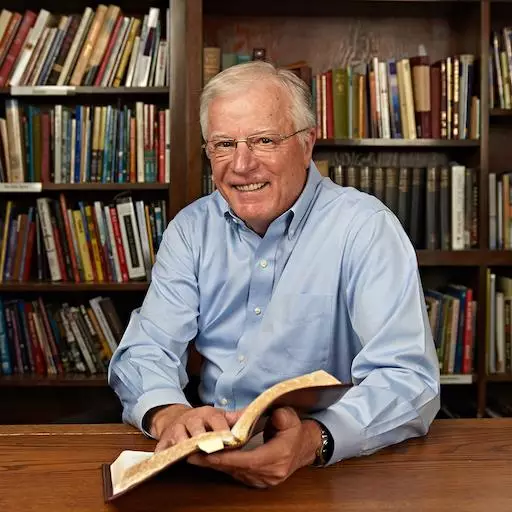
He Owns Our Status – Part 2 of 2


God has called every believer to a vital task in His kingdom. When we serve in the power of the Holy Spirit, it turns ordinary tasks into powerful testimonies. In this message from Acts 6, Pastor Lutzer shares three takeaways from the first deacons. Which was more important to the early church: waiting on tables or preaching the Word?
Dave McAllister: Let us run with endurance the race that is set before us, looking to Jesus, the founder and perfecter of our faith. God has called each believer to a task in his kingdom, and the book of Acts shows us how he makes his calling known. Today, meet God's personnel department for your local church. As you go in, be sure of this: there's a job waiting for you. Stay with us. From the Moody Church in Chicago, this is Running to Win with Dr. Erwin Lutzer, whose clear teaching helps us make it across the finish line. Pastor Lutzer, in Acts chapter six, it's clear that God sets high qualifications, even for people waiting on tables.
Dr. Erwin W. Lutzer: Because again, I'd like to emphasize that the issue is not what you do, but who you do it for. You can do a very humble task and at the same time be drawing attention to your humility, and in the process, God may not be pleased. In other words, we should be able to serve the Lord with a sense of humility and gratefulness, no matter what he has given us to do.
We here at Running to Win rejoice in the fact that these broadcasts are in 50 different countries in seven different languages. At the end of this message, I'm going to be reading a testimony from someone in Egypt who listens to the ministry of Running to Win in Arabic. I do that for this reason: I want you to understand that this ministry is your ministry. It's not the ministry of a church; it's not the ministry of a person or an organization. This ministry belongs to the people of God, and we want to thank you so much for your partnership. At this time, we're going to be listening, but be sure to continue to listen. I want to share with you a very encouraging word.
Dave McAllister: My dear friend, D.L. Moody said that character is what we are in the dark. A tested character, dependable, faithful; that's the second requirement to wait on tables. Let's go on to a third. I love this third. You'll notice it says, "Full of the Spirit."
Dr. Erwin W. Lutzer: Today, doesn't this blow a hole right through that notion that the filling of the Spirit is for spiritual people like pastors and missionaries and other people who go to heaven every evening and return again in the morning? It's for people like that, but it's not for the ordinary person who works at a Ford Motor Company or who works in a sawmill or who works in a bank, an office, or a hospital. It's not for those kinds of people, and it's not for those who are ushers. Oh no, not for those who park cars or greet people.
I want you to know that the filling of the blessed Holy Spirit is for every believer, and it is a requirement for those who serve in the church, no matter what their responsibility is within the church. Why is it necessary? I don't have to be filled with the Holy Spirit to do some of these things. I should pause and tell you that I have often been deeply convicted by the words of George MacDonald, who said this: "Whatever a man does without God, in that he must either fail miserably or succeed even more miserably."
One of our problems is we can do these things in the energy of the flesh. But there's no substitute for the work that Jesus Christ wants to do in our hearts. Remember that one of the purposes of the church is to make the invisible God visible to everyone who comes. When people come to Moody Church, what should they say based on 1 Corinthians? "Surely God is in that place." That's why we need spirit-filled ushers and spirit-filled parkers and spirit-filled people who work at camp and spirit-filled people who work in our kitchens because apart from Jesus, he said we can do nothing. Nothing. Do I have a witness, or am I all alone up here?
I've been deeply convicted this past week reading a book by Jim Cymbala on the power of the Spirit. I'd read parts of it before, but it is speaking to my heart, and I have determined that in my own life and ministry, the thing that I need more of is to seek the filling of the Holy Spirit. You say, "Aren't you filled with the Spirit?" Yes, I'm filled with the Holy Spirit, but interestingly in the New Testament, it says that they were filled with the Holy Spirit, then it says again they were filled with the Holy Spirit. Why? It's a continuous experience. I testify with D.L. Moody that I leak.
Well, we don't have to seek the Spirit's fullness; we have the Spirit indwelling within us. Yes, that's a blessed truth. It's just like saying that when we are saved, we have found Jesus as our Savior. More accurately, of course, he has found us. But we've connected with Jesus, and yet we seek him out. We constantly keep saying, "God, we need more. We need more. We need to enter into the fullness of the blessed Holy Spirit." That is for every single believer, every believer.
There's a fourth requirement, and that is there to be filled with wisdom. Filled with wisdom—I mean just sanctified common sense and spirit-led direction. I've been in the ministry long enough to work with a variety of different people. The best people I've ever worked with in my life, by the way, I'm working with right now: marvelous pastoral staff, elders, leadership at the church. Praise God.
But sometimes we put people in positions of responsibility who shouldn't be there. We may do it because we kind of like them; we don't want to hurt their feelings and everything like that. But they're in a position of responsibility for which they are not qualified. I'm not talking about giftedness; I'm talking about character. I'm talking about being filled with the Spirit and just having sanctified common sense or what we could call wisdom.
The Bible says that there is a wisdom that is from the earth; it is earthly. I'm amazed at the number of Christians who raise their children based solely on human wisdom. We have the great danger of accepting human wisdom and thinking that it's wise when there is divine wisdom. I've participated in many discussions that go like this: "Should the church be run as a business?"
Let me ask you, should the church be run as a business? It's a trick question. The reason it's a trick question is it depends what you mean. If you mean should the church be run smoothly, administratively, accurately, and with accountability in the best possible way—if that's running the church as a business, then the church should be run as a business. We thank God for those here in the leadership of Moody Church in areas such as finance and others who are really expert in being able to bring that kind of giftedness to us so that we maintain high standards of integrity and reporting procedures. Of course, it should be run as a business if that's what we're talking about.
But if what we mean when we say the church should be run as a business is that it's based on promotion, it's based on slick methodology, and it's based on being able to get ahead of the next person or having such a slick campaign that you really don't need God, then the answer is no, the church should not be run as a business. The church has to move forward on its knees, seeking God. That's how we move forward as a church and as a congregation.
And so, what the early disciples did is they said, "Now, we want you to choose these people, and they're to wait on tables." You say, "Pastor Lutzer, the requirements here, you mean that these are the preachers of the word?" No, no, these are the table waiters. These are the ushers. The Bible is very, very clear that God intends that his blessed Holy Spirit inhabit the whole church.
I don't know whether or not I should say this, but I'm going to say it and then decide later should I have said that. That's one of the things about preaching is that you get a chance to say it and then you get a chance to think about whether or not you should have said it. There are some of you serving in this church maybe who should disqualify yourself from your service because you know that you don't come anywhere near the requirements of serving in the house of God.
I had the privilege of being at the Brooklyn Tabernacle a few years ago, and I was told by someone who visited that on a Saturday morning, he was downstairs praying with a group of people before they went out witnessing. As he was leaving, he heard another prayer meeting going on in another room. He said, "What's going on there? Another group going out witnessing?" He says, "No, those are the custodians who meet and cry to God and pray before they begin to clean the Lord's house for the Lord's day."
You understand that the requirements of serving in the house of the Lord—be ye holy, ye who bear the vessels of the Lord. The dishes downstairs are holy dishes. The aisles are holy aisles. The car park is a holy place where God is represented in his people.
Let me give you two important lessons and then we shall ask God to change us forever. Number one: it's not what you do really that makes the difference; it's for whom you do it that gives every act significance. For whom do I preach? For whom do you sing, choir? For whom do you serve? For whom are you involved in any level of ministry here? For whom do you do children's ministry? We have to ask ourselves the question: is it done for others? Is it done that we might be well thought of? Is it done so that we can get our rewards here on earth and be told how wonderfully we are doing it? Or do we really genuinely say, "Jesus, this is for you"?
We think of Jesus preaching the Sermon on the Mount, marvelous experience and a wonderful sermon. Best sermon that's ever been preached. But then in another context, we see Jesus washing the dusty, dirty feet of his disciples. What Jesus is saying is, "Look, it doesn't matter whether I preach the Sermon on the Mount; it doesn't matter whether or not I change diapers or wash the disciples' feet because this is what my Father planned for me to do, and I do always those things that please him."
Therefore, my motivation is to say, "Does this please the Father? Does this glorify the Father?" That's our true motivation in service, and it cleanses us from all of those fleshly desires of self-exaltation because when God is first, as the sermon title indicates, he owns our status, and we're satisfied with where he puts us within the body. God does a deep work in the human heart when he is first.
I think one of the best examples of someone here at the Moody Church is probably not here listening to this message. His name is Bervin Peterson. Berv is the chairman of our board of elders, a man who gives us good guidance and good, sane, godly wisdom and advice. But Berv doesn't come on the first Sunday of the month. Really? Yeah, that's right. He's probably not here. I don't know if he is, but I don't think so. I'll find out later, needless to say.
Berv is over at the parking lot, parking people's cars and making sure that those cars are still there when the service is over. On the one hand, he serves so well in the ministry, but he sees no hesitation or contradiction or something beneath him to be out there in good weather and bad weather, in storm and in rain, and in sunshine helping people park their cars and needing to miss the service because that's where he's serving. It doesn't matter what you do. It's for whom you do it that really matters. He's going to be shocked to discover that he was a sermon illustration today, so take it easy on him. But we love him and praise God for his leadership.
Second big lesson is that faithfulness in one responsibility leads to greater faithfulness in another. You say, "Well, what was more important: waiting on tables or preaching the word?" The answer is they were equally important, but preaching the word undoubtedly has greater responsibility. The Bible is clear about that. There's a difference between equal importance and equal responsibility. The preaching of the word, the Bible is clear, brings much more condemnation if it's not done well and accurately and truthfully. But still, in terms of importance, all of these things were equally important—the waiting on the tables.
Isn't it interesting what God did? He took two people: Stephen was one of the ones that was chosen, and next week we're going to discover that he was the first martyr. I've already been working on that sermon when he dies and looks into heaven. As the young people would say, I'm excited about it already. I'm pumped, as they would say. Next week's sermon. He becomes the first martyr and Philip, God bless him, becomes the first evangelist, and we're going to be talking about him the next week. God says, "You're faithful in waiting on tables; I have someone here I can now trust with greater responsibility, the ministry of the word. I can entrust him with the courage to die for Jesus because he was faithful."
The Bible says that those who serve—and these are really deacons even though the name is not mentioned—a deacon means a servant. It says they have used the office of a deacon or a servant well; they purchase for themselves a good degree, great boldness in faith, which is in Jesus Christ. Jesus said this regarding money: "If I cannot trust you with that which is a little thing—pardon me, Jesus, did I hear you right? Money a little thing?" I once had someone in another church, this is a true story, used to say, "Money isn't first, but it beats whatever comes second." Shame on him.
Jesus said it's a little thing. He says, "If I can't trust you with a little thing, if you get jittery when there's an offering taken at the church or when there's a desire for us to see God do something wonderful so that we can build a building, if you get nervous about this, who's going to entrust to you the true riches?" If you can't wait on tables, how are you going to preach?
There's a final word and lesson, and that is that we don't give until we've received. The choir sang so beautifully, "Come to the fountain, come to the water, come to receive everlasting life." We already gave you that opportunity because salvation is free. It's given to needy sinners who know how bad off they are. But having been saved, we are called to ministry, called to involvement—not to be spectators, but to say, "Oh God, here's my talent, here's my time, here's my treasure, here's all of me." As we fall at his feet and say, "God, use us in whatever way we desire." If we were all spirit-filled, marching in the victory of the resurrection Christ, Chicago would know about us. Join me as we pray.
Our Father, in Jesus' name, we want to give ourselves to you, all those pockets of resistance and those areas in which we say, "Yeah, but." Oh Father, may they be like puffs of smoke in the presence of your word. We can't change human hearts; we cannot transform bitterness into love. We cannot take people who do not want to serve and cause them to; that's all your work. That's all your work. We cry to you and we ask you, God, make us a transforming community, an irresistibly transforming community. In Jesus' name, amen.
Dave McAllister: Yes, my friends, we all want to be a transforming community, and thank God for the ministry of radio and the internet because we are actually heard all throughout the Middle East in Arabic. Now, I'm holding in my hands a letter, and I want you to listen carefully because this blesses my own soul. This makes all of our efforts so worthwhile.
This person writes: "I wanted to know more about Jesus. I didn't usually talk about him, especially in my country, but I can't deny my hunger anymore. I want to follow Jesus. I began listening to your Arabic program. When I heard how Jesus loved his enemies and forgave those who crucified him, it hit something very deep inside of me. I prayed and I asked the Lord Jesus into my heart. Thank you for leading me to Christ's love and salvation. I hope to be baptized someday."
Dr. Erwin W. Lutzer: Now, I don't know about you, but my heart rejoices. It reminds me of the fact that God has given us the privilege of sharing the good news with millions of people around the world, but we could not do it without people just like you. Would you investigate the possibility of becoming what we call an endurance partner? I sure hope that you have a pen or pencil handy because I want to give you some contact info.
Endurance partners are people who stand with us regularly with their prayers and their gifts. Here's what you do: you can call 1-888-218-9337 or you can also go to rtwoffer.com. When you're there, you click on the endurance partner button. Once again, let me give you that info: go to rtwoffer.com, click on the endurance partner button, or call us at 1-888-218-9337.
Thank you so much for joining hands with us as we go around the world with the gospel of Jesus Christ. Here's what you can do: go to rtwoffer.com or call us at 1-888-218-9337.
Dave McAllister: It's time again for you to ask Pastor Lutzer a question you may have about the Bible or the Christian life. Today's question comes from a lady who lives in Ohio. "I have a question about God's will. I've heard you say that as humans, we often carry burdens God never intended us to bear. Do you mean to tell me that the disasters going on in the world today are all by him? Does he do evil?"
Dr. Erwin W. Lutzer: Well, my friend, I'm so glad for your question, but actually you asked several questions, three questions really. The first question has to do with do we sometimes bear burdens that God does not want us to bear, and the answer is yes. You read the sixth chapter of the book of Matthew where Jesus is saying that God takes care of the birds and the grass, and he'll certainly take care of us. So yes, I'm afraid that our anxieties oftentimes overwhelm us when God is available and willing to bear our burdens.
Now, the second question that you ask is about natural disasters. The answer to that question is yes, God takes responsibility for natural disasters. In the Bible, it is very clear that whether it is the darkness during the times of the plague or Jesus stilling the storm as he did on Galilee, all throughout the Bible, you have God involved in the convulsions of nature. Does he do these directly? Well, perhaps not; he does them indirectly because the earth is fallen. But of course, he could choose to not let them happen. So in that sense, everything is traceable to God.
But then your next question was, "Does God do evil?" and the answer to that question is no. God does not do evil. That involves a huge discussion, doesn't it? But God is able to run his universe in such a way that the things that happen in the universe do happen, and oftentimes evil happens that he does not stop, and yet he remains blameless.
He remains blameless for two reasons: first of all, he is God, so he runs things according to his particular rules and outlook; but secondly, he does not do the evil, even though it may be used as a part of his plan. I know that's a philosophical and theological conundrum, if I can use that word, but both of those things are taught in scripture. Human beings are responsible for evil, and yet God rules among the inhabitants of the earth.
Dave McAllister: Thank you, Dr. Lutzer. If you'd like to hear your question answered, go to our website at rtwoffer.com and click on "Ask Pastor Lutzer" or call us at 1-888-218-9337. That's 1-888-218-9337. You can write to us at Running to Win, 1635 North LaSalle Boulevard, Chicago, Illinois, 60614.
Running to Win is all about helping you find God's roadmap for your race of life. Most of us plan for the days ahead, at least for retirement, but what about after that? Can God handle the unknowns that lie ahead? Next time on Running to Win, Pastor Lutzer will tell us what happens when God owns our future. For Pastor Erwin Lutzer, this is Dave McAllister. Running to Win is sponsored by the Moody Church.
Featured Offer

This short but powerful work delivers on its significant promise. Pastor Lutzer explores a wide array of Scriptural teachings and siphons them into clear, cohesive truths. It is straight gospel—applicable to the skeptic, newly saved, and long-time believer alike. Click below to receive this book for a gift of any amount or call Moody Church Media at 1.888.218.9337.
Past Episodes
- Changed By The Word
- Children of an Awesome God
- Chiseled By The Master's Hand
- Christ Among Other Gods
- Christ Before Bethlehem
- Christ, God's Gift at Christmas
- Christians In Conflict
- Come and See Jesus
- Cries from the Cross
- Crowning Christ Lord
- Seven Convincing Miracles
- Seven Reasons You Can Trust The Bible
- Seven Secret Snares
- Sharing Secrets With God
- Slandering Jesus
- Suffering Wrong
- Ten Lies About God
- Thanksgiving
- The Battle for America’s Youth
- The Church in Babylon
- The Darwin Delusion
- The Flurry Of Wings
- The High Cost Of Lost Opportunities
- The Invisible War
- The Invisible World
- The King Is Coming
- The Legacy of a Converted Man
- The Man Who Cradled God In His Arms
- The Manger And The Sword
- The Power of a Clear Conscience
- The Triumph of the Gospel
- The Triumph Of Unanswered Prayer
- Till Death Do Us Part
- What Do These Stones Mean?
- What is God Up To
- What Jesus Thinks Of His Church
- What We Believe
- What Would Jesus Do?
- When a Nation Forgets God Interview
- When God Is First
- When God Shows Himself
- When the Spirit Has His Way
- When You've Been Wronged
- Who Are You To Judge?
- Why Good People Do Bad Things
- Why The Cross Can Do What Politics Can't

Video from Dr. Erwin W. Lutzer
Featured Offer
This short but powerful work delivers on its significant promise. Pastor Lutzer explores a wide array of Scriptural teachings and siphons them into clear, cohesive truths. It is straight gospel—applicable to the skeptic, newly saved, and long-time believer alike. Click below to receive this book for a gift of any amount or call Moody Church Media at 1.888.218.9337.
About Running To Win
Running the race of life is hard. But with the Bible front and center and a heart to encourage, Pastor Erwin Lutzer presents clear Bible teaching, helping you make it across the finish line. Since 2011, this 25-minute program has provided a Godward focus and features listeners’ questions.
About Dr. Erwin W. Lutzer
Dr. Erwin W. Lutzer is Pastor Emeritus of The Moody Church where he served as the Senior Pastor for 36 years (1980-2016). He earned a B.Th. from Winnipeg Bible College, a Th.M. from Dallas Theological Seminary, a M.A. in Philosophy from Loyola University, and an honorary LL.D. from the Simon Greenleaf School of Law (Now Trinity Law School).
A clear expositor of the Bible, he is the featured speaker on two radio programs: Running to Win—a daily Bible-teaching broadcast and Songs in the Night—an evening program that’s been airing since 1943. Running To Win broadcasts on a thousand outlets in the U.S. and across more than fifty countries in seven languages. His speaking engagements include Bible conferences and seminars, both domestically and internationally, including Russia, the Republic of Belarus, Germany, Scotland, Guatemala, and Japan. He has led tours to Israel and to the cities of the Protestant Reformation in Europe.
Pastor Lutzer is also a prolific author of over seventy books, including the bestselling We Will Not Be Silenced, One Minute After You Die, and the Gold Medallion Award winner, Hitler’s Cross. Pastor Lutzer and Rebecca live in the Chicago area and have three grown children and eight grandchildren. Connect with Pastor Lutzer on X (@ErwinLutzer) or moodymedia.org.
Contact Running To Win with Dr. Erwin W. Lutzer
media@moodychurch.org
http://moodymedia.org/
Moody Church Media
1635 North LaSalle
Chicago, IL 60614
1.800.215.5001
Monday – Friday
8:00am – 5:00pm CST
Fax Number
1.312.642.4904