

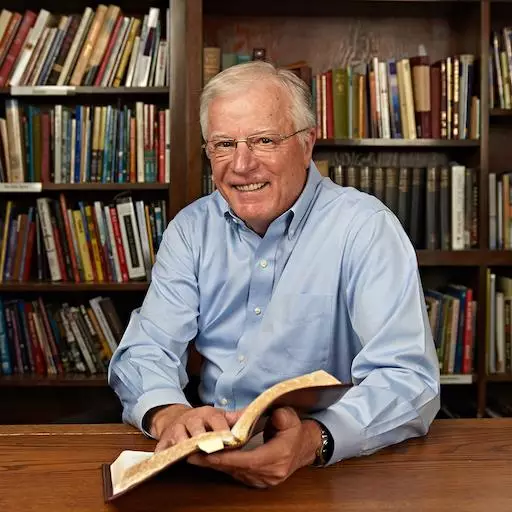
He Owns Our Reputations – Part 2 of 2


God disciplined Ananias and Sapphira for their fraudulent and insincere giving. God may not instantly remove us from Earth if we give insincerely, but we will be held accountable. In this message, Pastor Lutzer shares two final lessons about giving our reputations to God. How would we view our reputations if God was first?
Dave McAllister: Let us run with endurance the race that is set before us, looking to Jesus, the founder and perfecter of our faith. People who support winning candidates expect something in return. Sadly, the same can be true in churches. Heavy contributors are often the heavy decision makers. This may have played a part in the story of God purifying the motives of givers in the early church. Stay with us.
From the Moody Church in Chicago, this is Running to Win with Dr. Erwin Lutzer, whose clear teaching helps us make it across the finish line. Pastor Lutzer, we read the story of Ananias and Sapphira in Acts chapter five. One thing is very clear: God does not tolerate it when believers lie.
Dr. Erwin W. Lutzer: You know, Dave, there's so much in that passage of scripture that is critically important. One of the most obvious is this: that there are many people who live their lives in two compartments. At home, the man might be an abuser, he might be an alcoholic, but when he gets to church, it's very important for him to appear very godly and as if he's the kind of person that people should be able to trust. That's the way human nature is.
Now having said that, there's something else in this passage. Peter said, "Why has Satan filled your heart to lie to the Holy Spirit?" Now I have to say this, and I keep repeating this whenever I preach on the passage: it is so important for us to recognize that Satan can put ideas in our minds that we think are our own. Ananias and Sapphira would have never guessed that their lie came from Satan, but it did.
All that to say that we here at Running to Win are so concerned about our own lives and also helping people to close the gap between who they really are and who people think they are. We're making a resource available for you. It's actually a book written by Dr. Sweeting entitled How to Begin the Christian Life.
And of course, as I like to emphasize, even though many of you may have walked with God for a long time, it goes over the basics of the Christian life that we need to review and review frequently. Something else: you might want to give this resource to a friend—maybe somebody who isn't a Christian or someone who is a new Christian. For a gift of any amount, we're making it available for you. Here's what you do: go to rtwoffer.com. That's rtwoffer.com or pick up the phone and call us at 1-888-218-9337. I'm going to be giving you that contact info again at the end of this message. But let us ask ourselves this question: are we consistent in our walk with God?
Dave McAllister: Ananias and Sapphira answer the question of what do we give and to whom do we give it. There was a minister who was taking an offering for missions and said, "I want you to give this offering tonight, and I want you to visualize that you are actually placing it into the nail-pierced hand of Jesus." And a woman who was there took out her five-dollar bill which she was going to give and then put it back, pulled out a fifty instead, and said, "If I'm giving it to the nail-pierced hand of Jesus, how can I let the offering plate go by giving so little?"
The first lesson that Ananias and Sapphira teach us is the lesson of motivation: proper, single-minded motivation. We give to God, and we do give to the nail-pierced hand of Jesus. There's a second lesson very quickly, and that is the law of mutual influence or corporate influence. That is to say, why did God take this sin so seriously? It is because this was going to be something like leaven within the lump.
Dr. Erwin W. Lutzer: The Bible says that a little leaven leavens the whole lump. I already spoke about how their witness and their ministry would have on it this deceit. And as a result of that, as people found out about it, people would begin to think it would be safe to sin. And so God says, "What I want to do is to show you that you have sinned before God, but you've also sinned against the body." And we are all connected. You see, your spiritual life and my spiritual life—we're all connected with one another. When you're hot for God, it makes me a little hotter for God. When you're cold for God, it makes me a little colder. We are members of one another.
And some of you, God bless you, you've been attending Moody Church for a long time and you've never become a member. Sometimes I hear people say, "Well, you know, I belong to the invisible church." The invisible church. Well, I have some news for you. I do believe that there is a church of the elect that are in various churches and congregations who truly do belong to God. But I need to inform you the fact that so far, the invisible church has not sent a missionary team to Osiri in southern Africa.
The invisible church has never sent tutors to Cabrini-Green. The invisible church, last time I checked, never visited anyone in the hospital. This invisible church doesn't do much. Everything that we have done here is a part of the very visible local congregation. And I'm pleading to you for your involvement, for your prayers, for your giftedness that is necessary here at the church because we're all connected. And God says a little bit of sin over here is going to affect the entire church.
I hope I'm not speaking too harshly. I'm always concerned about that. And then on the other hand, I say, "Well, you know, sometimes we have to be clearer than we'd need to be." There are some people who are more devoted to their bowling league than they are the church. There are some people who are much more devoted to being on work on time than they are to be to church on time. Or it would take a much more to keep them away from work than it would keep them from being away from church.
And so I ask you today: you're a part of the body. You are important to the whole. Don't think to yourself that your walk with God does not affect everyone else. God says this couple, this deceitful couple, would affect everyone else. And so does your deceit affect everyone else, or my deceit affect everyone else. It's the law of mutual influence.
Let's go to a third: the law of final accountability. What a story. You do know it, don't you? Notice what the text says. When Ananias heard this, that is when he heard Peter speak, he fell down and died. And great fear seized all who heard what had happened. I guess so. Then young men came forward and wrapped his body and carried him out and buried him.
About three hours later, his wife came in, not knowing what had happened. And Peter said to her, "Tell me, is this the price you and Ananias got for the land?" You see, he was mentioning the price that they gave to the apostles. And she said, "Yes." A lie. Direct lie. This was a great chance for her to say, "No, we lied." But she didn't. She said, "Yes, that's the price."
Peter said to her, "How could you agree to test the Spirit of God? Look, the feet of the young men who buried your husband are at the door, and they will carry you out also." At that moment she fell down dead at his feet and died. Then the young men came in and, finding her dead, carried her out and buried her beside her husband. Great fear seized the whole church and all who heard about these events. Don't you at this point just want to say, "Wow"?
Were these people Christians? Of course, I think they were. I think that the fact that they sinned against the Holy Spirit—now the church was walking in the energy of the Spirit; they were constantly filled with the Holy Spirit—here's somebody who lies against the Holy Spirit. So I think they were Christians. I think they arrived in heaven. I think we shall see them someday. Can't you just imagine? "Oh, Ananias and Sapphira, you're the ones! Yeah, yeah, you know, I preached about you one time. Sapphira, where were you during that three-hour period? Could it be that you were shopping at the mall with the money that you had, Sapphira?" I'm sure that in heaven we won't be talking about those things, but there they are.
You say, "Well, Pastor Lutzer, why did God judge them like this so severely? I mean, isn't this overkill?" To use a choice of words. Overkill, yes. You know, whenever God begins something new, he wants to teach us a lesson. For example, in the Old Testament, he sets up the tabernacle. Then you have Nadab and Abihu, the seminary students, who come in with some strange fire saying, "You know, we can worship God in our own way." They were very 21st-century. "Well, we can get to God in our own way." And God zaps them and they're dead.
Then a little later, you have the people going into the promised land. They finally do make it into the promised land; they cross the Jordan River. And a guy by the name of Achan steals something that he shouldn't steal and hides it in his tent. And God comes along and says, "I'm going to help you find the culprit, and after you've found him, I want you to stone him." And here God begins the church, and you have deceit, and God has these people die right in Peter's presence.
You see what God is saying is: "I take sin seriously." You say, "Well, Pastor Lutzer, of course he doesn't do this today." I heard one pastor say if God did this today, every church would need a morgue in its own basement. Well, remember in 1 Corinthians 11, it does say that some people who participate in Communion, the Lord's Supper, and they do so in an unworthy, frivolous way, Paul says, "Many are sick because of that, and some of you have died as a judgment from God because there is a sin unto death."
So I wouldn't be so sure that God doesn't do it today. But also, it may indicate how far we have drifted from New Testament Christianity where God was constantly purifying his church, where God was disciplining his church. Maybe the fact that it doesn't happen today, at least very often, is an indication of the fact that we have drifted so far from where the early church was. But one thing is sure: whether you die immediately or die in 50 years, you are going to have to give an account to God.
God's going to open your checkbook. Now, there are many other things that he's going to ask you about, but your checkbook is going to be gone through. That's why one of the assignments we were to do this past week is to open ours, because it's practice for the judgment seat of Christ. And God is going to judge us as we stand before him. We may get to heaven indeed, but we shall give an account for the deeds done in the body, whether they be good or bad, the Bible says. And there is final accountability.
Yesterday I spent a delightful afternoon with a member of our church called Ken Muller. I hope he doesn't mind me saying this, but Ken is into cemeteries. He's visited them all; he knows who's buried where. And so we just went to three different cemeteries. We found the grave of Billy Sunday; I always wanted to go to Billy Sunday's grave. We also found the grave of Al Capone. We found the grave of Field and a whole host of dignitaries, important Christians, and those who clearly probably were not Christians.
But what a reminder of the fact of our mortality, that someday we're going to be there. We're going to get some kind of a grave marker, I hope. And we'll be ushered into the presence of God, and God will review our lives year by year to give an account for what we did. The law of final accountability. Sometimes we say, "Well, you know, I want to give because God has given me so much." It's okay to say that, but could I tweak that just a little bit and say that God hasn't really given us anything? He has just lent us whatever we have. It's on loan, and we are stewards, and we will someday give an account. Wow, Ananias and Sapphira did, and so shall we.
Two final lessons. First lesson is simply this: that when God is first and our reputations have been given to God—it's one of the most difficult things to surrender, but when God is first and our reputations are given to him—our secret sins are just as important as our public ones. You see, Ananias and Sapphira thought that we could just hold all of this greed in our hearts and nobody will know that we're hypocrites.
But my dear friend, they did this in the presence of God. God is watching. Our lives are an open book. The Bible says that all things are naked and open unto the eyes of him we have to do. When we choose to sin, we choose to sin in the very presence of God. And when we give God our reputations, that becomes important. Someone has said that a secret sin on earth is an open scandal in heaven. You see, because God gets involved because he's been offended.
Satan gets involved and tells God, "You can't accept this as one of your people because if they were to die, they would defile the courts of heaven, so you can't have sinners like that and have fellowship with them." And then Jesus gets involved. Jesus says, "Wait a moment now; I died for that sin. And because of that, I bore the wrath of that sin." And so it's a big deal in heaven. And when God is first, it is also a big deal to us.
Second: when we give our reputations to God and he is first, what he thinks is more important than what people think. The end of the day, all the image building, all the desire to be well-thought-of and the things that we do to kind of brush up our image so that we're thought of as being more spiritual than we really are, and all of the nice, sweet talk that we give, and all of the fact that we deny the ugliness within us so that we can project this image—all that suddenly comes to an end and we say, "Oh God, Oh God, at this moment what you think really matters more."
It's important what people think, but not that important—not as important as what God thinks. So you can even endure hurts more easily because you know that he knows the truth. You can forgive more easily. You can be pure more easily because now you know that ultimately, it is the inside of you that is the most important part of who you are.
You say, "Well, Pastor, how do we give God our reputations? I mean, that is just such a difficult thing." I'm reminded of Galatians chapter 2, verse 20, where it says, "I am crucified with Christ; nevertheless I live, yet not I, but Christ lives in me. And the life that I now live in the flesh, I live by faith in the Son of God, who loved me and gave himself for me." We accept our co-crucifixion with Christ and say, "I want to be on that cross with Jesus." Now there's one characteristic of somebody who's hanging on the cross, and that is: he has no future plans of his own.
And when we come to that cross and when we say, "Jesus, I want to hang there with you," we give him our reputations, we give him our desires, we give him that part of us that we keep denying and we say, "Here I am." The surrender is awesome and the freedom that comes is beautiful. But there's a fight every step of the way. Let's pray.
Our Father, we confess that there is hypocrisy in our hearts. We think of how often we've impressed people, coming across much better than we are. We think, Father, of how we desire to project a certain kind of image; we want people to see what we want them to see. And now, Father, everyone bowed in your presence, along with those listening on the radio or the internet, every single one is open. The hearts are open. There's not a single secret.
Would you cleanse us from hypocrisy and enable us to walk with integrity and truthfulness? What has God said to you today that you need to talk to him about? Let's just have a moment of prayer. Father, for those who continue to rationalize, continuing to hang on, continuing to argue about the part of themselves that they will not give, oh Father, would you just break through by your Holy Spirit? Would you just overcome all the resistance, all of the deceptions, all of the ways in which we like to believe our own lies? Come, Father, we pray for cleansing, for honesty. Oh, we pray in Jesus' name, Amen. Amen.
Dr. Erwin W. Lutzer: My friend, this is Pastor Lutzer, and there's no doubt that God sanctifies us, but he does it over a period of time. That's another way of saying that you may yield to God on one hand, and then you discover later on that you need to re-yield over and over again. Every single day we are tempted to go our own way; we are tempted to be hypocrites.
I'm holding in my hands a book that has a chapter entitled "How to Grow in the Christian Life," because as I mentioned, growth is a process. This actually is part of a book entitled How to Begin the Christian Life, written by Dr. Sweeting. And he, of course, was president of Moody Bible Institute as well as the pastor of Moody Church. Dr. Sweeting wrote this book with the intention of helping all of us in our spiritual journey. And we're making it available for you for a gift of any amount.
Well, I sure hope that you have a pen or pencil handy because I'd like to give you some contact info. Here's what you do: you can go to rtwoffer.com. Rtwoffer is of course all one word. Rtwoffer.com or call us at 1-888-218-9337. You know, there are times when we just have to back up, take some time out of our lives, and ask ourselves this question: "How are we doing on our spiritual journey? What resources can we use in order to remind us of what we may already know, but at the same time to grow in the Christian faith?" Well, I think that this book will help you. Remember the title: How to Begin the Christian Life. Thank you so much for joining hands with us as we go around the world with the gospel of Jesus Christ.
Dave McAllister: It's time again for another chance for you to ask Pastor Lutzer a question you may have about the Bible or the Christian life. Today's question, Dr. Lutzer, comes to us from Andrew, who lives in Illinois.
"Our 29-year-old daughter is now a Christian, but when she was 18, she rebelled and left home. She now has an eight-year-old son whom we adopted at age two and a half. She's divorced and is an ex-cocaine user. We're helping her financially so she can finish nursing school. She's trying to get her life together, and we feel that if we don't help, she'll give up. We're struggling financially, and we're using some of our tithes to pay for her expenses. Are we interfering with God by using some of those tithes to pay her living expenses? Yes, it does bother me that we don't bring all the tithes into the storehouse. After all, she is past the age of accountability. My flesh wants to cut her off from the family, but the Holy Spirit won't let me. After all, I sin, and God is long-suffering with me."
Dr. Erwin W. Lutzer: Well, Andrew, I want you to know that you should be under no great obligation or guilt because you are taking some money that you would normally give to the church to help your poor daughter. You know, in the New Testament, we do not have the same laws that were laid down in the Old Testament. And I believe that all Christians should give at least 10%, maybe a little bit more.
But there are times when perhaps we can't. And you're in a situation right now where you have to make that very, very tough decision. And there's something about your question that really does touch my heart because you want to do what is right. The only caution that I would say is be sure that you are not simply an enabler with your daughter. She's come through a very difficult period of life; she has some addictions that apparently she is getting over. So make sure that any investment that you make in her life is one that is going to be productive.
And from your letter, it appears as if you're doing just that. So you sit down with your wife in the presence of God and decide how you are going to allocate your money. But from my heart to yours today, I put no guilt upon you because once you and God have it figured out, he will lead you all the way.
Dave McAllister: Thank you, Dr. Lutzer. I'm sure that Andrew is appreciative of your answer. If you'd like to hear your question answered, go to rtwoffer.com and click on "Ask Pastor Lutzer." Or call us at 1-888-218-9337. That's 1-888-218-9337.
You can write to us at Running to Win, 1635 North LaSalle Boulevard, Chicago, Illinois, 60614. Running to Win is all about helping you find God's roadmap for your race of life. Is Donald Trump your role model? If so, join us next time when Pastor Lutzer tells us what happens when God owns our status. For Pastor Erwin Lutzer, this is Dave McAllister. Running to Win is sponsored by the Moody Church.
Featured Offer

In spite of his dire situation as a prisoner in a Roman jail, Paul's letter to the church at Philippi overflows with joy. Discover Paul’s secret to finding joy in Christ as Dr. Warren Wiersbe leads you on a verse-by-verse tour through the book of Philippians. Learn how your joy can also be complete in Christ. Click below to receive this book for a gift of any amount or call Moody Church Media at 1.888.218.9337.
Past Episodes
- Changed By The Word
- Children of an Awesome God
- Chiseled By The Master's Hand
- Christ Among Other Gods
- Christ Before Bethlehem
- Christ, God's Gift at Christmas
- Christians In Conflict
- Come and See Jesus
- Cries from the Cross
- Crowning Christ Lord
- Seven Convincing Miracles
- Seven Reasons You Can Trust The Bible
- Seven Secret Snares
- Sharing Secrets With God
- Slandering Jesus
- Suffering Wrong
- Ten Lies About God
- Thanksgiving
- The Battle for America’s Youth
- The Church in Babylon
- The Darwin Delusion
- The Flurry Of Wings
- The High Cost Of Lost Opportunities
- The Invisible War
- The Invisible World
- The King Is Coming
- The Legacy of a Converted Man
- The Man Who Cradled God In His Arms
- The Manger And The Sword
- The Power of a Clear Conscience
- The Triumph of the Gospel
- The Triumph Of Unanswered Prayer
- Till Death Do Us Part
- What Do These Stones Mean?
- What is God Up To
- What Jesus Thinks Of His Church
- What We Believe
- What Would Jesus Do?
- When a Nation Forgets God Interview
- When God Is First
- When God Shows Himself
- When the Spirit Has His Way
- When You've Been Wronged
- Who Are You To Judge?
- Why Good People Do Bad Things
- Why The Cross Can Do What Politics Can't

Video from Dr. Erwin W. Lutzer
Featured Offer
In spite of his dire situation as a prisoner in a Roman jail, Paul's letter to the church at Philippi overflows with joy. Discover Paul’s secret to finding joy in Christ as Dr. Warren Wiersbe leads you on a verse-by-verse tour through the book of Philippians. Learn how your joy can also be complete in Christ. Click below to receive this book for a gift of any amount or call Moody Church Media at 1.888.218.9337.
About Running To Win
Running the race of life is hard. But with the Bible front and center and a heart to encourage, Pastor Erwin Lutzer presents clear Bible teaching, helping you make it across the finish line. Since 2011, this 25-minute program has provided a Godward focus and features listeners’ questions.
About Dr. Erwin W. Lutzer
Dr. Erwin W. Lutzer is Pastor Emeritus of The Moody Church where he served as the Senior Pastor for 36 years (1980-2016). He earned a B.Th. from Winnipeg Bible College, a Th.M. from Dallas Theological Seminary, a M.A. in Philosophy from Loyola University, and an honorary LL.D. from the Simon Greenleaf School of Law (Now Trinity Law School).
A clear expositor of the Bible, he is the featured speaker on two radio programs: Running to Win—a daily Bible-teaching broadcast and Songs in the Night—an evening program that’s been airing since 1943. Running To Win broadcasts on a thousand outlets in the U.S. and across more than fifty countries in seven languages. His speaking engagements include Bible conferences and seminars, both domestically and internationally, including Russia, the Republic of Belarus, Germany, Scotland, Guatemala, and Japan. He has led tours to Israel and to the cities of the Protestant Reformation in Europe.
Pastor Lutzer is also a prolific author of over seventy books, including the bestselling We Will Not Be Silenced, One Minute After You Die, and the Gold Medallion Award winner, Hitler’s Cross. Pastor Lutzer and Rebecca live in the Chicago area and have three grown children and eight grandchildren. Connect with Pastor Lutzer on X (@ErwinLutzer) or moodymedia.org.
Contact Running To Win with Dr. Erwin W. Lutzer
media@moodychurch.org
http://moodymedia.org/
Moody Church Media
1635 North LaSalle
Chicago, IL 60614
1.800.215.5001
Monday – Friday
8:00am – 5:00pm CST
Fax Number
1.312.642.4904