

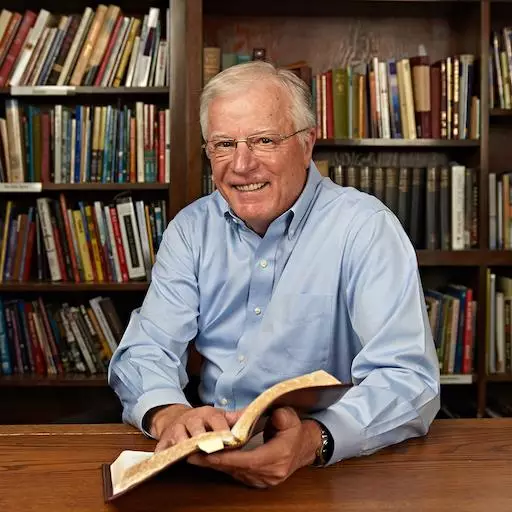
He Owns Our Money – Part 1 of 2


The early church knew how to give. United by the Holy Spirit, they joyfully gave so that the poor among them could be helped. In this message from Acts 4, Pastor Lutzer shares five laws of stewardship that both free us and honor God. If everything we have belongs to God, we can begin to give with joy.
Dave McAllister: Let us run with endurance the race that is set before us, looking to Jesus, the founder and perfecter of our faith. Win $100 million in a lottery and you become an instant media star. These days, people dream of the big bucks. Yet once they have them, those dollars often corrupt people from the inside out. How can a Christian properly handle his cash, yet stay free of its addictive allure?
Stay with us; there’s no charge. From the Moody Church in Chicago, this is Running to Win with Dr. Erwin Lutzer, whose clear teaching helps us make it across the finish line. Pastor Lutzer, people run for the hills when preachers ask for money. Set our minds at ease as you tell us today that when God is first, He owns our money.
Dr. Erwin W. Lutzer: You know, Dave, you raised a number of issues in your intro. For example, you referred to the lottery, which actually is a curse. I could expound on that, but we must hurry on. You’re absolutely right that God owns everything. We here at the ministry of Running to Win are deeply committed, by the way, to give the Gospel of Jesus Christ freely around the world. As a matter of fact, all of our resources are online and they are free because we want no one to say that they have to pay to hear the Gospel of Jesus Christ.
We want as many people as possible to have access to the Gospel. But of course, at the same time, you and I know that ministries like ours need funds. I want to thank the many of you who support us, but also I want to emphasize that when you do, we want you to give out of a heart of love, a heart of commitment to Jesus Christ and the Gospel. We believe that giving is a tremendous privilege given to us by God.
That’s why, even as we look at the New Testament, we soon discover that the early church was very generous. Why? God is generous, so we as His people should be generous. You know, for a gift of any amount, we’re making a book available entitled *How to Begin the Christian Life*. It was written by Dr. George Sweeting. He was president of Moody Bible Institute, pastor of Moody Church, and it contains a chapter "You and Your Money." We have to understand its proper place in the Christian life. But for now, I simply want you to listen.
When we speak about making God first in our lives—and that’s what we’re doing during this series of messages—remember our goal is that at the end of the series, we will own nothing because the transfer of ownership will have been completely made. Now, there are some things that are easier than others to give to God because we’re forced to give them to God. For example, I think of our futures. We can’t control our futures. Some things, but many things are beyond us. And so, God pushes us into a situation where we have to give our future to God.
The same is true regarding our health. There are some things that we can do to live longer, to feel better, but at the end of the day, ultimately, we’re not in control; God is. So we have to give that to God. We think of our children; we can’t control them. And the sooner in our lives that we give those over to God instead of trying to play the role of the Holy Spirit, the better it’ll be for them and for us when we really do transfer ownership into God’s hands.
But now, when it comes to money, that’s a very sensitive topic, isn’t it? In fact, if you’re a visitor here today, you say, "Isn’t that something? I come to Moody Church and the very first time I come, they’re talking about money." Well, just hang in with us until the end, okay? God is here to liberate you, not to put you under bondage. God is not here to try to shame you to give; He’s here to try to instruct all of us, and it may be the doorway to tremendous, great blessing.
But we struggle with the money thing because if we own it, we think it is mine, particularly if we earned it. We say to ourselves, "This is ours. It’s mine. Blood, sweat, tears went into this," and so we hang on to it until our knuckles turn white. Then we think to ourselves, "Well, let’s keep in mind that money has demonic power." There’s no question about its ability to seduce. That’s why you find people of principle, and suddenly when they’re involved in something with some serious money, all of those principles can be sacrificed for money.
Money becomes a god, and it makes all the same promises that God makes. God says, "I’ll be with you to the end." Money says, "I’ll be there when you need me, whether in health, whether in sickness, whether in difficulty, whether in trouble, it will be there." I will be there for me if you keep it in a safe place. And so, because of that, you see, it has this awesome power to be able to hold us back and to keep us bound.
And then we think of the question of what does it mean to give our money to God? That’s the question we’re going to ask today and hopefully answer. But there are some people listening who say, "Does that mean that I just give everything away and I end up in a homeless shelter? Is that what God wants me to do?" Now, if you have those kinds of questions in your mind, you came to the right place because hopefully, by the time the message is over, you’ll find out what it really does mean to give your money to God.
Now, in Acts chapter 4, we see a marvelous example of the early church being filled with the Holy Spirit. The Bible says in Acts 4, and I’m in verse 31, after they prayed, the place where they prayed was shaken, it says. And they were all filled with the Holy Spirit and spoke the word of God boldly. Whether or not you like this message to some extent is going to depend on whether you are filled with the Holy Spirit. The more filled you are with the Holy Spirit, the more you’re going to enjoy this liberating message of commitment and stewardship.
But if you are miserly—and did you know that the word miserly is the word that we have from the same root misery—if you are miserly and stingy, you might not like this message. But the Bible says that they were all filled with the Spirit. That’s why when we began this series, the first message, if you recall, was on the filling of the Spirit because if we don’t know the filling of the Spirit, we’re going to find it very difficult to put God first. And so this is a message to people who know something of what it is like to be filled with the Spirit.
And the Bible says that they all walked in unity. Verse 32: "All the believers were one in heart and mind." What does God do when He’s first? He resolves the differences between people. He enables us to lay down our bitternesses so that we can be one in mind and heart. That is the true work of the blessed Holy Spirit of God given to the church. And the early church as they waited on God, God did this for them in a spectacular way, as we’ve already learned, because they were so committed to the fullness of the Holy Spirit. They said, "We will not allow anything to stand in the way of the Spirit’s fullness." And I hope that we as a church and as individuals meet that requirement, too.
Now what we’d like to do is to introduce you to five laws. I know that your notes, I think, say principles, but I was thinking about it and saying, "You know, that’s too tame." Five laws of stewardship that will liberate us, that will set us free, that will help us in our walk with God, that will benefit us and bring honor and glory to God at the same time. What an opportunity to learn from those who have gone on before. What are the five laws of stewardship?
First of all, the law of rightful ownership. The law of rightful ownership. You’ll notice it says there in verse 32, "All the believers were of one heart and mind," and now notice: "and no one claimed that any of his possessions was his own." Wow. Well, to whom did they belong? They belonged to God. They said, "We realize that these aren’t our possessions, our lands, our houses, our money." In fact, right from the original creation, God is the creator. When Adam was created, he was to be a steward over what God had made.
God says, "I want you to run my world, and remember, Adam, it is my world. You don’t own anything, but you’re a steward. You’re the one who is to administer my blessings." And so Adam did that until the fall. And after the fall of man into sin, what you now have is man goes from being a steward to an owner, and from now on, possession is going to consume him. Ownership is going to become number one. Everything that you can own, get it if you can—legally and rightfully, dishonestly if you must, but in all cases, in all instances, get it, own it, claim it, it is yours.
Now, what does God do after we are redeemed? God seeks to redeem us from that ownership. He already owns whatever we have, most assuredly, but He wants us to recognize that. And redemption is me recognizing the fact that God wants back what He’s given me, and it is necessary for me to make that transfer of ownership of everything that I possess because that is part of God’s agenda. Redemption is reclamation. God is reclaiming ownership over things that we have called our own.
And so, in the end, death, by the way, death is the final act of reclamation. Somebody said to a farmer, "Who is it that owns the land next to you?" And he said, "Well, I used to always say it belonged to Mr. Jones, but I guess it isn’t his after all because he didn’t take it with him. He left this life without it." You know the old line that nobody has ever seen a U-Haul trailer at the back of a hearse? You know that. "How much did he leave?" somebody asks. Everything. It’s the final act of reclamation.
But what God says to you and to me before that act: "I want you to recognize my sovereignty over all that you have." And the early church claimed nothing as belonging to themselves; they understood the law of rightful ownership. Now, notice number two, law number two: the law of joyful generosity. Joyful generosity. Did they have to do this? Did Peter stand up and say, "Now I want all of you to sell everything that you have and I want you to bring it to us"? Absolutely not.
For one thing, that principle could not possibly be applied today. You couldn’t have a business if you sold it all and gave it all away. And that’s why what we have here in the book of Acts, this story is descriptive in the sense that it describes what happened, but it is not prescriptive in the sense that it says this is what the church should do throughout all the ages. And we know that, first of all, that it was voluntary because of the text itself.
Next week, I’m going to speak about Ananias and Sapphira. I hope that you are here next week because it’s a remarkable story. But you remember they lied about what they gave and it says in chapter 5, verse 4, Peter is speaking to them and says, "Why did you do that? Didn’t it belong to you before it was sold? And after it was sold, wasn’t the money at your disposal?" In other words, if you wanted to keep the money, keep the money because we’re not demanding it. You didn’t have to get deceptive about it.
Of course, what God is saying is that it’s voluntary. There’s no law that comes down from heaven. In fact, the New Testament doesn’t even teach tithing. It refers to it, but it doesn’t teach it as a mandatory regulation. Tithing was something done in the Old Testament; it was something like a tax. But you get to the New Testament and Paul says, "I am holding you to a higher standard. I’m holding you to the standard of generosity because you love God. I want to have cheerful givers who realize that they are giving because they have been given to." And so it liberates you from this need, this duty, this overriding obligation to give.
So I say to you today that if when you give, you give stingily—I don’t know if there’s a word like that, but let’s just say there is—if before you give, you take that nickel and you press it, and you press it because this is your contribution, keep your nickels and your dollars. Do not give unless you can give with a heart of gratitude to almighty God who first of all gave to you and to me. All right? So if you come today with a bad attitude, don’t give. You say, "Well, the offering plates have already been passed." Yeah, but I’m talking about next week, okay?
Giving is for those who love God, who understand that the blessings of God have come from heaven undeserved. Giving is for those who know that they are children of God and they delight to give because they’ve been so honored as heirs of God and joint heirs with Jesus Christ. There’s a story that comes to us from the days of Alexander the Great. He was riding along and a beggar held out his hand. Now, normally kings ignored beggars, and Alexander the Great actually gave this beggar, to whom he owed nothing, some gold coins.
And one of his assistants said to him, "Why didn’t you just give him some copper coins? They would have met his need." And Alexander, if this story is true, to his everlasting credit, said, "Copper coins may meet the need of this beggar, but copper coins are not appropriate for a king to give." It’s not just because you’re meeting the needs of other people, though you most assuredly are; it is because of the fact that we are children of the King. So we give generously and we look for places to give because we love to give and God has overcome the jealousy and the greed of our hearts.
You say, "Well, shouldn’t we tithe?" Yes, tithing is a wonderful idea. It’s a good benchmark. My wife and I have discovered that we can go beyond the tithe more each year. And so, yes, it’s a wonderful way to tithing is good, but it’s not as if we do it under obligation. Now, let me say very candidly to you that if everyone who attends Moody Church, who is a member and an attendee and believed that Moody Church was his or her home, if they were all to tithe, we would never have to emphasize Reaching Toward Tomorrow, we would never have to raise funds for our mission program.
We would never have to do that; we would have enough money to touch many hundreds of people more in this city and around the world if all that people did was to understand that tithing is a good benchmark in your giving. But let it be done with a heart of sincerity and a heart of joy. The principle, the law of joyful generosity.
There’s a third law, and that is the law of total participation. You’ll notice what it says—I’m still in the middle of verse 32; seems as if I can’t get out of it. It says no one claimed that his possessions was his own. If they were agreed, if they were unified under the Holy Spirit, of one mind and one heart, they said, "Hey, all of us understand that we have a part in this." Some people’s part bigger than others, but there was a sense of saying we all want to be in on this business of giving. Total participation. The unity of believers.
You know, when we think of our own challenges here at the church and Reaching Toward Tomorrow, we want participation on the part of everyone, including our children, our young people—everybody can give something. Why? Because we need to see that this is a community project. It is a project of the whole body and not just some of its members. Now, I need to speak to you very candidly and tell you that there are hundreds of people who attend Moody Church and consider it their church home who give absolutely nothing Sunday by Sunday.
What do you think that reveals about their relationship with God? They have not grown in what the Apostle Paul says, this grace of giving. They have never seen that it is possible to actually give away some of that selfishness and to be able to participate in what God says turns out to be a harvest of righteousness. And so our hearts go out to them, not because we need the money, though God knows we do, but our heart goes out to them because we think of what is it that they are missing in their spiritual growth.
Where is it that their hearts have been so locked, so locked to God’s Spirit? It is Jesus who said it is more blessed to give than to receive. What has happened to the joy? And so there was this emphasis of complete participation. That’s another law of stewardship.
Let me give you another law, and that is the law of proper distribution. The law of proper distribution. Now, notice. It says that they sold what they had. There was no needy person among them, for from time to time, those who owned lands or houses sold them, brought the money from the sales and put it at the apostles’ feet, and it was distributed to anyone as he had need. They said our first project here in Jerusalem is to the poor. Good idea.
We here at the Moody Church have a fellowship fund, and the fellowship committee investigates the various causes and needs that come to its attention because the Bible places a great deal of emphasis on the poor and our need to help those who are indeed needy because of all kinds of circumstances. And so what they did, though, was they took this money and they put it at the apostles’ feet. What does that tell you? It tells you that they very much trusted these apostles to do what was right. They knew that the money was going to be dispensed with integrity.
And could I say it is important in our giving that we give to a ministry that does have integrity? Once again this week, just for a few moments, I was watching a television evangelist. Now, this isn’t true of all of them. There’s something about me that if I’m surfing, I can’t seem to get past these folks and tune in for just a moment. But as I was listening to him, I thought, "Is there anyone on planet Earth who actually cannot see through this man and his greed and his deceptions?" I’m amazed at where some of God’s people put their money.
And indeed, it is important that we have a sense of integrity and knowing what we are giving the money for and knowing that it’s going to be properly taken care of. I hope I don’t need to say this, but here at the Moody Church, integrity with our finance committee, where everything is accounted for, not just to one person but a committee and then a larger executive committee, is actually fundamental to who we are because we need to be able to say, "God, these are not our funds to be just distributed according to our own whims or for our own benefits."
These funds belong to You. They have been given by God’s people, and because they are God’s, what we do with that money is much more important than what we do with the money that we hold back, because this is God’s. And so there was this commitment to proper distribution. The belief that my gifts and my commitment is going to go where it ought to go.
Well, my friend, this is Pastor Lutzer. I wish that I could emphasize that to every Christian organization. Integrity is so important. But at the same time, what we also need to recognize is that generosity is also important. And if you today withhold your funds because of anger, because of something that has happened in your life, well, I want you to deal with that anger, and that is more important than whether or not you give. But this is what the Bible teaches with such clarity: that God is generous and God loves a cheerful giver.
Now, that’s a very puzzling verse because you may say, "Well, Pastor Lutzer, does He not love everyone who belongs to Him equally?" Yes, of course. But there must be a sense in which God especially loves those who are generous and who are cheerful. And I have to say, whether you are rich or poor, if you do not have a heart of generosity, would you get on your knees and repent of that and ask God what’s wrong with your life? You may not be able to give a great deal, but thank God that we can all give something as an expression of our own gratitude.
It does not contribute to our salvation, of course, but at the same time, what it does is it’s a reflection of our gratitude to almighty God. Now, we’re making a resource available for you that actually has a chapter entitled "You and Your Money." This is from the book entitled *How to Begin the Christian Life*, written by Dr. George Sweeting.
Here’s what you can do: go to rtwoffer.com. That’s rtwoffer.com or pick up the phone and call us at 1-888-218-9337. You and I always have to go back to the basics. If you’re like me, you have to relearn lessons you learned long ago. Ask for the book *How to Begin the Christian Life*. Right now, go to rtwoffer.com or call us at 1-888-218-9337.
Dave McAllister: You can write to us at Running to Win, 1635 North LaSalle Boulevard, Chicago, Illinois, 60614. Running to Win comes to you from the Moody Church in Chicago to help you understand God’s roadmap for your race of life. So are you an owner or a caretaker? Looking ahead, more about managing what are really God’s resources, then later, losing the game face and being who you really are. Thanks for listening. For Pastor Erwin Lutzer, this is Dave McAllister. Running to Win is sponsored by the Moody Church.
Featured Offer

In spite of his dire situation as a prisoner in a Roman jail, Paul's letter to the church at Philippi overflows with joy. Discover Paul’s secret to finding joy in Christ as Dr. Warren Wiersbe leads you on a verse-by-verse tour through the book of Philippians. Learn how your joy can also be complete in Christ. Click below to receive this book for a gift of any amount or call Moody Church Media at 1.888.218.9337.
Past Episodes
- Changed By The Word
- Children of an Awesome God
- Chiseled By The Master's Hand
- Christ Among Other Gods
- Christ Before Bethlehem
- Christ, God's Gift at Christmas
- Christians In Conflict
- Come and See Jesus
- Cries from the Cross
- Crowning Christ Lord
- Seven Convincing Miracles
- Seven Reasons You Can Trust The Bible
- Seven Secret Snares
- Sharing Secrets With God
- Slandering Jesus
- Suffering Wrong
- Ten Lies About God
- Thanksgiving
- The Battle for America’s Youth
- The Church in Babylon
- The Darwin Delusion
- The Flurry Of Wings
- The High Cost Of Lost Opportunities
- The Invisible War
- The Invisible World
- The King Is Coming
- The Legacy of a Converted Man
- The Man Who Cradled God In His Arms
- The Manger And The Sword
- The Power of a Clear Conscience
- The Triumph of the Gospel
- The Triumph Of Unanswered Prayer
- Till Death Do Us Part
- What Do These Stones Mean?
- What is God Up To
- What Jesus Thinks Of His Church
- What We Believe
- What Would Jesus Do?
- When a Nation Forgets God Interview
- When God Is First
- When God Shows Himself
- When the Spirit Has His Way
- When You've Been Wronged
- Who Are You To Judge?
- Why Good People Do Bad Things
- Why The Cross Can Do What Politics Can't

Video from Dr. Erwin W. Lutzer
Featured Offer
In spite of his dire situation as a prisoner in a Roman jail, Paul's letter to the church at Philippi overflows with joy. Discover Paul’s secret to finding joy in Christ as Dr. Warren Wiersbe leads you on a verse-by-verse tour through the book of Philippians. Learn how your joy can also be complete in Christ. Click below to receive this book for a gift of any amount or call Moody Church Media at 1.888.218.9337.
About Running To Win
Running the race of life is hard. But with the Bible front and center and a heart to encourage, Pastor Erwin Lutzer presents clear Bible teaching, helping you make it across the finish line. Since 2011, this 25-minute program has provided a Godward focus and features listeners’ questions.
About Dr. Erwin W. Lutzer
Dr. Erwin W. Lutzer is Pastor Emeritus of The Moody Church where he served as the Senior Pastor for 36 years (1980-2016). He earned a B.Th. from Winnipeg Bible College, a Th.M. from Dallas Theological Seminary, a M.A. in Philosophy from Loyola University, and an honorary LL.D. from the Simon Greenleaf School of Law (Now Trinity Law School).
A clear expositor of the Bible, he is the featured speaker on two radio programs: Running to Win—a daily Bible-teaching broadcast and Songs in the Night—an evening program that’s been airing since 1943. Running To Win broadcasts on a thousand outlets in the U.S. and across more than fifty countries in seven languages. His speaking engagements include Bible conferences and seminars, both domestically and internationally, including Russia, the Republic of Belarus, Germany, Scotland, Guatemala, and Japan. He has led tours to Israel and to the cities of the Protestant Reformation in Europe.
Pastor Lutzer is also a prolific author of over seventy books, including the bestselling We Will Not Be Silenced, One Minute After You Die, and the Gold Medallion Award winner, Hitler’s Cross. Pastor Lutzer and Rebecca live in the Chicago area and have three grown children and eight grandchildren. Connect with Pastor Lutzer on X (@ErwinLutzer) or moodymedia.org.
Contact Running To Win with Dr. Erwin W. Lutzer
media@moodychurch.org
http://moodymedia.org/
Moody Church Media
1635 North LaSalle
Chicago, IL 60614
1.800.215.5001
Monday – Friday
8:00am – 5:00pm CST
Fax Number
1.312.642.4904