

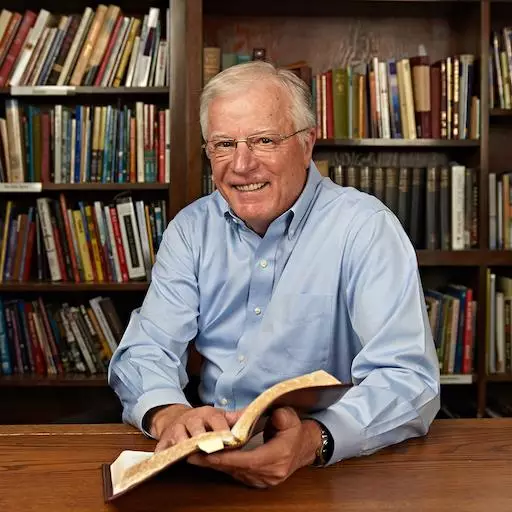
Ensnared By Images – Part 1 of 2


God prohibits making images to represent Him. Yet even today, people give worship to a wide array of idols, carvings, pictures, and icons. In this message, Pastor Lutzer provides three Scriptural reasons why we should not use objects in worship. Why is there still so much controversy about the second commandment?
Dave McAllister: Let us run with endurance the race that is set before us. Looking to Jesus, the founder and proctor of our faith. Is a picture ever wrong? We need to understand God's commands that prohibit images meant to represent him. People disobey this commandment daily, giving worship to a vast array of idols, carvings, pictures, and icons. Are they sinning? Stay with us. From the Moody Church in Chicago, this is running to win with Dr. Irwin Lutzer, whose clear teaching helps us make it across the finish line. Pastor Lutzer, we're in awe when we visit great European cathedrals with their statues, stained glass, and wonderful artwork.
Should a believer refrain from enjoying images like these?
Dr. Erwin W. Lutzer: You know, Dave, this is a very controversial issue, but I think it is very important that we not venerate objects. There are many people who say, well, we don't worship them, we just venerate them. But the veneration turns out to be a form of worship. And the Bible forbids the kind of images that lead us into distraction because we are not worshiping the invisible God. The reason that the golden calf was so attractive to people is they wanted a God that they could see. And today we have many people who have good luck charms or perhaps they have touched an object or they have venerated it and they think that special blessing comes to them.
That's a deception. And that's what this commandment is speaking about. I want to thank the many of you who support the ministry of running to win. I've written a book entitled Why Holiness Matters. The subtitle is the Ten Commandments, Jesus, and You. And we're making it available for a gift of any amount. At the end of this message, I'll be giving you some contact info. But for now, let us listen. When Jesus was speaking to the woman at the well, he said these words. He said, God is spirit. And they that worship him must worship him in spirit and in truth.
For the Father seeketh such to worship him. If there's anything that God wants from us, it is worship. I mean, that is the desire of his heart. He seeks worshippers, Jesus said. And if there's anything that is important to God, is that our worship be done in the right way. But you know, Murphy has a law that says if anything can go wrong, it will go wrong. And given the perverseness of the human heart and the desire of Satan to interrupt and to interfere in genuine worship that God accepts, we can therefore expect that there would be some stumbling blocks and some problems that would enter into Christianity with regard to pure, unadulterated worship of God.
And throughout the history of the Christian church, there has been a debate on as to whether or not images can be used in the process of worship. In what is known today as the Eastern church, the Eastern Orthodox church, there is a great emphasis, for example, on icons and those who are brought up in that tradition find that they put icons often times in the room of every house, or I should say every room in the house. You find, for example, in the Western church that the idea of statues and the idea of various artifacts and physical representations of God or saints have been used in worship.
And all of this comes about, that is our discussion of it comes about because I'm giving a series of messages on the Ten Commandments, and today we happen to come to the second commandment. And I want you to turn with me to Exodus chapter 20 where it is stated there explicitly. Exodus chapter 20 where the Lord, first of all, in verse three gives the first commandment, you shall have no other gods before me. Commandment number one says you must worship only the true God. And then commandment number two says, you must worship the true God in the right way.
And it begins in verse four. You shall not make for yourself an idol or any likeness of what is in heaven above or on the earth beneath or in the water under the earth. You shall not worship them or serve them, for I, the Lord your God, am a jealous God, visiting the iniquity of the fathers on the children on the third and the fourth generations of those who hate me, but showing loving kindness to thousands, to those who love me and keep my commandments. There you have it. You shall not make for yourself an idol or any likeness of anything that is in heaven above or earth beneath.
That doesn't mean that you can't have pictures or art generally, but what the text says is that you cannot use these kinds of objects in worship. You shall not worship them. That's verse five. The Hebrew word actually is you shall not bow down to them. The King James, I think, translated it correctly here. You shall not bow down to them or serve them, for I, the Lord your God, am a jealous God. And so in the history of the Christian church, the question that has been raised is, can various objects be used in worship? Yes or no?
Theologians who have argued that objects can be used in worship have said that there is a difference between worship and veneration. Strictly speaking, the argument goes like this. If someone bows before a statue, say a statue to the Virgin, they are really not bowing to the statue, they are bowing to the Virgin and ultimately to God. And so it is not bowing to something that is made of stone. If someone bows before an icon, he is really not bowing before the wood and the paint, of course. He is bowing to the God or to the saint that this icon may represent.
And again, he is not worshiping the saint, he is worshiping God, but this is a channel or a means of grace and blessing, the argument goes. The problem, of course, is that all religions, even in paganism, say that they do not bow before the idol that is made of wood and stone, they are actually bowing to the God that the idol represents. In fact, did you know that in Exodus chapter 32 where the children of Israel were making the golden calf while Moses was on the mountain getting these commandments, which is rather interesting, he's up there getting the word from God and they're disobeying God because he's taking too long to get the message straight.
You'll notice that the text says that when they made the golden calf, they weren't going to worship that golden calf. Aaron said, tomorrow we're going to have a feast to the Lord, a feast to Jehovah. What these people were saying is we are not worshiping the golden calf, we are going to worship Jehovah, but we are going to do it by this physical representation because having this physical representation before us helps us in the act of worship. We are weak, we need a crutch, we need some representation of Jehovah. That was back of the golden calf.
So the question isn't whether or not you are bowing to the images or to the God behind the images. We grant that. The question is whether or not images like that should be used at all and what are the difficulties and the prohibitions and the warnings that are given in the Bible about that. Now today, folks, I realize, of course, that I'm walking through a minefield. And I suppose that when you walk through a minefield, you always take some risk, the possibility of getting some shrapnel. And I think that I am prepared to take some.
I think that that's the occupational hazard of being a minister. And if you're preaching the Bible, you have to come across certain topics and certain themes and to be fair to the scripture and to those themes, we must say what we believe God says about them. Now I want to preface my remarks, however, by saying that here at the Moody Church, we are well aware that many of you have come from say a Roman Catholic or a Greek Orthodox tradition. And you know the history of that tradition and many of you were reared in that tradition.
And today we might have visitors who are Roman Catholic and we want you to know that we we love you and we're glad that you're here, but at the same time we think that some things have to be said for the purpose of clarity and consistency and that we might know God's mind regarding certain issues. So with that backdrop, what I'd like to do today is to give you three scriptural reasons why we should not use objects in worship, so-called worship helpers. Why is it that people should not bow down before images, regardless of whether they are bowing before the image or the God behind the image?
Why is it that there is always danger involved whenever you are involved in the process of worship and you have various representations or artifacts before you? Let me give you three reasons. The first reason is because of the distortion of the concepts of God. It distorts our concepts of God. Now in order to see this, I want you to turn with me to the book of Deuteronomy chapter four where God gives some more explicit instructions regarding this commandment. Deuteronomy chapter four and the Lord says in verse 15, he's giving a rationale now as to why there should be no representations of God or no representations of anything in worship.
Deuteronomy 4:15. It says, so watch yourselves carefully, since you did not see any form on the day the Lord spoke to you at Horeb from the midst of the fire. He's saying that when you were at Mount Sinai, you did not see any form of God, so you wouldn't know how to represent God if you began to make some kind of an image. But then someone may say, well, I'm not going to make an image of God, I'm going to make an image of a saint or an image of some animal and we're going to use that in worship.
But notice verse 16. Lest you act corruptly and make a grave an image for yourselves in the form of any figure, the likeness of a male or female, the likeness of any animal that is upon the earth, the likeness of any winged bird that flies in the sky, the likeness of anything that creeps on the ground, the likeness of any fish that is in the water below the earth, and on and on it goes. What God is saying is you did not see a form at Sinai. Therefore, since God is spirit, don't ever try to represent him in any way by a physical object of any kind.
Because your representation is going to be off the mark. It is going to distort what God is like. Now let me give you an example. Let's take for an illustration the crucifix. All of us have seen a crucifix. It's a picture of Jesus Christ, of course, on the cross in great agony writhing in the midst of the pain that he endured on behalf of mankind. Now the crucifix portrays a certain picture of Jesus Christ, but it is certainly an incomplete and a distorted picture. Because it shows Jesus Christ in his weakness. It shows him in his agony.
It shows him almost as being helpless on the cross. But that's only a little part of Jesus Christ, isn't it? It doesn't show the empty tomb, it doesn't show the resurrection of Jesus Christ, it doesn't show the exalted Jesus Christ in heaven. It shows only a Christ in agony. And if you looked at that alone, you'd think that he was a victim of circumstances much like we are in the tragedies of life. Well now, let me say a word about the Protestant version of the crucifix, namely the empty cross. When I became pastor of Moody Church here, I don't think I was pastor for a month.
Someone took me aside and gave me a little bit of advice. He says, you know what you ought to do as pastor? He says, the thing that Moody Church needs is a good, big cross somewhere. And he said, you ought to have crosses in your church. Well, you know, if we had a cross here at the church, I'm sure that it would not be used in worship. I mean, I I nobody would bow down to it, nobody would want to touch it, nobody would stand in line to see it. We wouldn't have a time of prayer just immediately in its vicinity as if to say it were to make the location somewhat holier.
We wouldn't do that. But let's take the empty cross. It also is an incomplete picture of Jesus Christ. Certainly we all admit that the centrality of what Jesus Christ did for us is the cross, but if we are going to use a cross, why not a manger to celebrate his incarnation? If we're going to use an empty cross, why not an empty tomb to remind ourselves of the resurrection and his power over death? If we're going to use an empty cross, why not the ascended Jesus Christ in his glorified body? The point is that any representation of God or even Jesus Christ is a distorted representation.
It doesn't say everything and it sometimes conveys a wrong picture of what Jesus Christ did if you consider the totality of what he did. So what God is saying is since it cannot convey a complete picture and no representation can, don't bother with it. It may become a snare to you. Which leads me to say that there is no representation that can ever capture God, no representation that can capture God, and no representation of any saint or any artifact should ever be used as in some way making contact with God or being blessed by God.
So the first thing is it gives us a distorted picture of God. There's a second reason and that is it produces a distorted allegiance or a wrong allegiance. Now you mark my words very carefully and you will know that when I say this, I am speaking truth because you can see this every day of your life if you want to. Whenever you begin to tell people that through some icon or statue that they should in some way use it for worship, immediately that particular object becomes very sacred. We can understand that. And along with it becoming very sacred, what you have is people began to latch onto that object as if it has special power.
It is almost looked upon as a good luck charm. And that 's why you find sometimes in every room of a house you have one of these artifacts or statues or icons. It is looked upon as a means by which God gives his grace, his blessing, and his healing. And the thing itself detracts from the centrality of our focus on God alone because as human beings, we want to quantify God. We want to be able to take God and put him in our pocket or hang him up in our bedroom. In some way we want something that is able that enables us to get in contact with God.
Now you just take as an illustration. In the book of Numbers, the people were experiencing a disease that was sweeping throughout the people as a result of the judgment of God. And the Lord says Moses, he said, I want you to take a bronze serpent and I want you to put it on a pole and whoever looks at the serpent is going to live. Now in this case, Moses was doing that at the request of God. So even there we cannot take that passage and judge from it the general acceptance that God might have or the general judgment that God might have with regard to artifacts.
because that was a very special case where God says Moses set this brass serpent apart for that reason. All right, and it worked. The people looked at it and they were healed. What do you think the people ended up doing? They began to honor that brass serpent. They'd kept it for centuries and centuries. And because there's a little bit of idolatry in all of our hearts, you know what the people began to do? They began to honor that brass serpent and they began to take care of it and they ended up burning incense to it.
And when King Hezekiah became king, this is in Second Kings, you might like to look at this in your Bible, Second Kings, let's just look at the fact that Hezekiah was an iconoclast. That is he was a smasher of idols. Second Kings chapter 18. We have this remark in verse four. Speaking of Hezekiah, it says he removed the high places and broke down the sacred pillars and cut down the asherah. That's the different shrines at which people came to worship. He also broke in pieces the bronze serpent that Moses had made for until those days the sons of Israel burned incense to it.
Notice that they were burning incense. And so what did Hezekiah do? He took and he smashed that serpent because it had become a snare and a stumbling block. People began to attach special significance to it and they began to burn incense to it and God hated that. Now I told you that I was prepared to get some shrapnel today, so we'll just keep moving ahead through the minefield. Well, my friend, this is Pastor Lutzer and you're certainly going to have to listen to running to win next time as this message continues. But I want to warn you, it is very important that we not look at a religious object and somehow venerate it or think that it has special powers.
It is a distraction and I believe that it is a violation of the commandment that you shall make no images. It's the kind of commandment that we've just been talking about. For a gift of any amount, we're making available a book I've written entitled Why Holiness Matters. It contains an exposition of the Ten Commandments and I tried to write it in such a way that we would see their relevance for today. The subtitle, by the way, is The Ten Commandments, Jesus and You. The title of the book, Why Holiness Matters. For a gift of any amount, we're making it available for you.
I hope that you have a pen or pencil handy because I want to give you some contact info and also to thank you in advance for helping us as we get the gospel of Jesus Christ to millions of people around the world. Here's what you do. Go to rtwoffer.com. That's rtwoffer.com or pick up the phone and call us at 1888 218 9337. At a time when there is a great deal of discussion about God, but we have redefined God according to our own image, we need to get back to the biblical God.
Dave McAllister: It's time now for another chance for you to ask Pastor Lutzer a question about the Bible or the Christian life. Doing the right thing it's always admirable, but sometimes it's not clear what the right thing is. Melissa wrote to us posing this dilemma. With regard to the homeless, how do you reconcile verses such as Matthew 25:35 and Second Thessalonians 3 verses 6 through 14? I feel led to give of my time and money to the poor. I want to be obedient to that. However, I'm beginning to feel conflicted. There are those that are homeless or poor simply because they choose to be.
They would rather be idle than have to work and they expect to be supported by the government or charitable organizations. In one way, it seems that by supporting them, we perpetuate their homeless or poor state. On the other hand, am I the one to judge these things? If my charge is to serve the homeless, should I do so without regard? Melissa, thanks so much for your question. And by the way, the reference that was referred to their Second Thessalonians chapter three verse six and following emphasizes that Paul says that if a man does not work, neither shall he eat.
And so what do we do with that verse? Well, the clear implication, of course, Melissa is that he would have opportunity to work. Remember that there is some people in this world who cannot work because there are no jobs. I'm thinking particularly of other countries, though that certainly is true in America today with our financial downturn where people would love to work, but they can't. And so they've become poor because of the circumstances of life, not because of laziness. Now with regard to your specific question, are you the one to judge these things? My own view is this.
We should not resist a generous impulse. Sometimes even on the street I've given people money and I suspect that they probably took it to buy drink. And yet because I'm not sure, I say to myself, I'm giving this in the name of the Lord and I'm going to trust God. And if they misuse it, that's their responsibility. I want to be sure that I have been faithful in helping the poor. Melissa, I think the best thing though to do is to work in soup kitchens, places like this that minister to the poor where they are actually given the food and they're given the clothes and maybe a place to sleep.
At least then you know that your resources and your time are valuable and they are being wisely used. That's very different than giving money to people whom you've never met who sometimes accost us on a street corner. So when we are faced with a decision, let us always be generous. God has much to say about the poor and we should be committed to them and to their needs. I commend you, Melissa. Keep doing what God has called you to do. Thank you, Melissa, and thank you, Dr. Lutzer. If you'd like to hear one of your questions answered, go to our website at rtwoffer.com and click on Ask Pastor Lutzer or call us at 1888 218 9337.
That's 1888 218 9337. You can write to us at Running to Win 1635 North La Salle Boulevard, Chicago, Illinois 60614. I am the Lord. That is my name. My glory I will not give to another, neither my praise to graven images. No ambiguity there. It's clear that God will not tolerate the worship of images. But what about crosses, crucifixes, or icons? Some people find these objects very meaningful. Does using them violate God's commandment? Next time on Running to Win, don't miss part two of Ensnared by Images. Running to Win is all about helping you understand God's road map for your race of life.
Thanks for listening. For Pastor Irwin Lutzer, this is Dave McAllister. Running to Win is sponsored by the Moody Church.
Featured Offer

This guide to the last days will stoke your trust in God’s glorious plans for the future. You will be empowered to live with boldness and readiness like never before. Click below to receive this book for a gift of any amount or call us at 1.888.218.9337.
Past Episodes
- Changed By The Word
- Children of an Awesome God
- Chiseled By The Master's Hand
- Christ Among Other Gods
- Christ Before Bethlehem
- Christ, God's Gift at Christmas
- Christians In Conflict
- Come and See Jesus
- Cries from the Cross
- Crowning Christ Lord
- Seven Convincing Miracles
- Seven Reasons You Can Trust The Bible
- Seven Secret Snares
- Sharing Secrets With God
- Slandering Jesus
- Suffering Wrong
- Ten Lies About God
- Thanksgiving
- The Battle for America’s Youth
- The Church in Babylon
- The Darwin Delusion
- The Flurry Of Wings
- The High Cost Of Lost Opportunities
- The Invisible War
- The Invisible World
- The King Is Coming
- The Legacy of a Converted Man
- The Man Who Cradled God In His Arms
- The Manger And The Sword
- The Power of a Clear Conscience
- The Triumph of the Gospel
- The Triumph Of Unanswered Prayer
- Till Death Do Us Part
- What Do These Stones Mean?
- What is God Up To
- What Jesus Thinks Of His Church
- What We Believe
- What Would Jesus Do?
- When a Nation Forgets God Interview
- When God Is First
- When God Shows Himself
- When the Spirit Has His Way
- When You've Been Wronged
- Who Are You To Judge?
- Why Good People Do Bad Things
- Why The Cross Can Do What Politics Can't

Video from Dr. Erwin W. Lutzer
Featured Offer
This guide to the last days will stoke your trust in God’s glorious plans for the future. You will be empowered to live with boldness and readiness like never before. Click below to receive this book for a gift of any amount or call us at 1.888.218.9337.
About Running To Win
Running the race of life is hard. But with the Bible front and center and a heart to encourage, Pastor Erwin Lutzer presents clear Bible teaching, helping you make it across the finish line. Since 2011, this 25-minute program has provided a Godward focus and features listeners’ questions.
About Dr. Erwin W. Lutzer
Dr. Erwin W. Lutzer is Pastor Emeritus of The Moody Church where he served as the Senior Pastor for 36 years (1980-2016). He earned a B.Th. from Winnipeg Bible College, a Th.M. from Dallas Theological Seminary, a M.A. in Philosophy from Loyola University, and an honorary LL.D. from the Simon Greenleaf School of Law (Now Trinity Law School).
A clear expositor of the Bible, he is the featured speaker on two radio programs: Running to Win—a daily Bible-teaching broadcast and Songs in the Night—an evening program that’s been airing since 1943. Running To Win broadcasts on a thousand outlets in the U.S. and across more than fifty countries in seven languages. His speaking engagements include Bible conferences and seminars, both domestically and internationally, including Russia, the Republic of Belarus, Germany, Scotland, Guatemala, and Japan. He has led tours to Israel and to the cities of the Protestant Reformation in Europe.
Pastor Lutzer is also a prolific author of over seventy books, including the bestselling We Will Not Be Silenced, One Minute After You Die, and the Gold Medallion Award winner, Hitler’s Cross. Pastor Lutzer and Rebecca live in the Chicago area and have three grown children and eight grandchildren. Connect with Pastor Lutzer on X (@ErwinLutzer) or moodymedia.org.
Contact Running To Win with Dr. Erwin W. Lutzer
media@moodychurch.org
http://moodymedia.org/
Moody Church Media
1635 North LaSalle
Chicago, IL 60614
1.800.215.5001
Monday – Friday
8:00am – 5:00pm CST
Fax Number
1.312.642.4904