

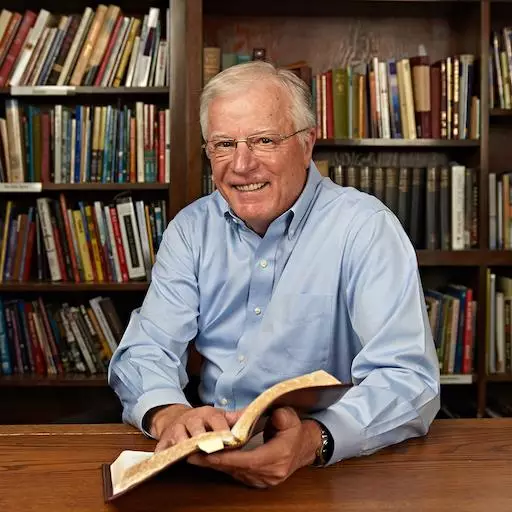
Confronted By Christ – Part 1 of 2


We can be sincerely devout and dead wrong. On a road to Damascus, a violent religious man met a blinding light. In this message, Pastor Lutzer traces Paul’s journey from darkness into the light. Even the apparently “good” are sinful, and all of us are in need of a Savior.
Dave: Let us run with endurance the race that is set before us, looking to Jesus, the founder and perfecter of our faith. You’d never find a more unlikely convert to the Christian faith. Saul was intent on capturing and killing as many believers as possible. That all changed one day when this Pharisee found himself in a blinding pool of light.
Stay with us. From the Moody Church in Chicago, this is Running to Win with Dr. Erwin Lutzer, whose clear teaching helps us make it across the finish line. Pastor Lutzer, today you begin a series on the legacy of a converted man. So, who was this man?
Dr. Erwin W. Lutzer: Well, Dave, of course, the man was the Apostle Paul. And it’s so captivating as you read his conversion story. It says that Jesus was telling him also how much he must suffer for his, that is, for Jesus' sake. And so the Apostle Paul was converted. What he reminds us of is the fact that God can take the most unlikely candidate, God can change the human heart, and as a result, the direction of our lives can be changed forever.
We have a resource that we want to introduce to you. It’s a book I’ve written entitled Failure: The Back Door to Success. I'll tell you why I wrote it. It’s because there are so many people who do not understand that God is capable of taking our failures, making the best of them, and incorporating them into his huge scheme. It becomes a part of a narrative of our lives and actually brings him glory.
If you think that you have committed such a great error, that you have failed so miserably, this book is going to give you much hope because as Corrie ten Boom once said, "There is no pit that is so deep but that God is deeper still." Now, at the end of this message, I'm going to be giving you some contact info and how this book can be yours. But for now, let us listen.
Today I begin a short series of messages entitled The Legacy of a Converted Man. I'm referring, of course, to the Apostle Paul, and there are several aims that we hope to accomplish as we look at his life. First of all, as a result of it, we shall better understand theology, specifically the theology of salvation. When you think of the Apostle Paul, he had more impact on Christianity than anyone who ever lived, except Jesus. He gave us 12 or 13 books of the New Testament, and we think of all of his writings that have blessed us. We'll understand all that better.
There's another reason, and that is that he will give us insight how to relate to a culture that is pagan, how to be able to accept persecution, and how to be bold in a moment of American history when we are shamed into silence regarding certain issues of great importance. Paul will do all that for us.
Now, a couple of comments. First of all, in the ninth chapter of the book of Acts, which is what I want you to turn to—Matthew, Mark, Luke, John, Acts—Acts chapter nine. What we'll discover is that he is initially called Saul, and today as I preach, I may continue to call him Paul because that's the way in which we know him. His name was changed later as a Christian, so we can think of Saul being his pre-conversion name and Paul being his post-conversion name. Perhaps I will even refer to him as Paul, though the text calls him Saul at this point.
Also, I was reading a small book by Dr. Sweeting, who used to occupy this pulpit, and he had a very brief outline of this passage that I liked, so I adapted it to this sermon. He said we have three different ways that we can view Paul here: Paul without the light, Paul under the light, and then Paul in the light. I kind of like that, so I took his outline.
First of all, what we're going to do is to read this passage and then talk briefly about Paul without the light. Acts chapter nine: "But Saul, as he was called then, still breathing threats and murder against the disciples of the Lord, went to the high priest and asked him for letters to the synagogues at Damascus, so that if he found any belonging to the Way"—in those days, that's what Christianity was called because Jesus has said, "I am the way, the truth, and the life"—"if he found any belonging to the Way, men or women"—notice his hardness of heart—"that he might bring them bound to Jerusalem."
He wanted to bring believers from Damascus to Jerusalem in chains, as he explained later. "Now as he went on the way, he approached Damascus, and suddenly a light from heaven flashed around him, and falling to the ground he heard a voice saying to him, 'Saul, Saul, why are you persecuting me?' And he said, 'Who are you, Lord?' And he said, 'I am Jesus, whom you are persecuting. But rise and enter into the city, and you will be told what you are to do.' The men who were traveling with him stood speechless, hearing the voice but seeing no one. Saul rose from the ground, and although his eyes were opened, he saw nothing. So they led him by the hand and brought him into Damascus, and for three days he was without sight, and neither ate nor drank." Just that far for now.
Saul without the light. Here he was, very well educated. He was educated under Gamaliel, the great Jewish scholar. Paul will say later on that he was a Pharisee, that he knew the law very, very well. And so he rejected Jesus as the Messiah. After all, how could a dead man, a man who was crucified, be the Messiah when everybody was looking for a triumphant political figure? And so what happened is he rejected Jesus and notice, in his blindness, without the light, first of all, he was walking in religious darkness. Religious darkness, believing that what he was doing was pleasing God.
Jesus predicted this in the 16th chapter of the book of John. He says, "The day is coming when you're going to be cast out of the synagogue," he said, "and when those who kill you will believe that they are doing God a favor." The words of Jesus. And so he is here, very sincere, very passionate, believing that he is doing right. Religious blindness.
Of course, we have that in history, don't we? Let me give you two examples, first from Christianity and secondly from Islam. Do you realize that after the Reformation—after the Reformation and actually, in a sense, during the Reformation—there were those who believed that one should be baptized as an adult rather than simply as an infant? So they'd been baptized as infants, but now they were being baptized as adults in profession of faith.
Did you know that official Christendom killed many of them? In fact, a scholar who spent a year in Europe writing a wonderful book said that more Anabaptists—the word "Ana" means rebaptizers—more died during the 16th century than Christians put to death in Rome in the first century. Whole villages of men, women, and children were wiped out. Why? Because infant baptism was the sign of the unity of Christendom. And so their prediction was that if you're baptized only as a believer, as an adult, Christianity, Christendom is going to break apart. And of course, that is what eventually happened, and then we have various denominations.
But the point is, among these Anabaptists were some of the most godly, committed people on the face of the earth, and they were being put to death by people who thought they were pleasing God. I don't need to go into detail about Islam. Probably today there will be, on average, two or three hundred Christians put to death in North Korea and especially in Islamic countries. Many of these people, I'm sure most of them, believe that they are doing right by Allah. They are doing what pleases Allah. Paul here is an example of someone who was religiously blind, thinking that the evil that he was doing was pleasing to God.
Imagine it. Something else about Paul here—and I'm calling him Paul, though in the text as I mentioned, he's called Saul—something else is that morally he was blind. You know, in Acts 26 where he tells his story, and it's told twice in the book of Acts in addition to this account in the ninth chapter, Jesus apparently said to him, "Saul, Saul, it is hard for you to kick against the goads." You know, a goad is a stick, and on that stick, there is a spike, and you use it to keep cows, for example, going in the direction that you want them to go.
What is Jesus referring to? It must be Saul's conscience. He knew right well, in moments of honesty, that he was doing wrong, but he overrode that knowledge by being so committed to his false doctrine that he went ahead and he kept doing what down deep inside he knew was wrong. It's called managing your sin, managing the darkness. And that's certainly what the Apostle Paul, the man who will be called the Apostle Paul, will eventually do.
In fact, he'll tell us that in moments of honesty, he says, for example, in the book of Romans, he talks about the fact that sin was within him. "The very commandment that promised life proved to be death to me. For sin, seizing an opportunity through the commandment, deceived me and through it killed me." What Paul says is, "Here I am, a devoted Pharisee, keeping all the rules, doing everything that I thought was right, but I wasn't honest with myself. Down deep in my heart, there was sin—the sin of self-righteousness surely, but later on he talks about lust. All those sins were within me, and there was nothing I could do about it."
So think this through. Religiously, he was blind without the light. And remember this: people who walk in darkness—boy, this would be a sermon by itself—people who walk in darkness believe that they are walking in the light. As Paul says, "I was deceived." That's Paul walking without light, very sincere, very committed, and very wrong.
Well, let's look now at Paul under the light. You'll notice it says he is going toward Damascus as we read, and suddenly he has something happen to him. Jesus comes, and you'll notice he says, "Saul, Saul, why are you persecuting me?" Saul answered and said, "Who are you, Lord?" And he said, "I am Jesus, whom you are persecuting."
Wow. You know, the name Jesus—there were many Jesuses. That was a very common name, something like the name John today. But Jesus said, "This isn't just any ordinary Jesus. This is the Jesus that you're persecuting because those disciples whom you are putting to death belong to me, and they are members of my body."
I find it interesting that Jesus didn't say, "Now you're persecuting my disciples," or "You're persecuting those whom I have redeemed." Jesus said, "You are persecuting me." The body of Jesus Christ that is going to be explained later on by the Apostle Paul already finds its seeds here in the book of Acts.
And you know, there are some of you here who think it's not important whether or not you belong to a church. You just don't become a member of Moody Church or any other church because you think, "Well, you know, we can come, we can be blessed, we can even give"—thank God that you can—"but we don't really need the kind of commitment of membership." My brother and my sister, would you remember that the body of Jesus Christ is the church? The church is. And it's not as if we're the only body, but we are part of the body of Christ, and you had better think twice before you take casually your lack of commitment to the body.
Jesus said, "These believers are my body." Later on, Paul is going to say, "We're members of his body, of his flesh, and of his bones." Believers are being persecuted all over the world today, and we need to keep in mind that it is the persecution against Jesus personally. And proof of Paul's apostleship, he's going to argue later that the reason he knows that he's a legitimate apostle is because of this experience of seeing the risen Christ that was so dramatic and so powerful that he recognized right away, "This is the Lord." He saw it with clarity.
So keep in mind, don't tinker with the body of Christ. By that, I mean watch, watch before you criticize the body because we are important, and if you're looking for things to criticize, you can surely find them. Watch it very carefully because you are talking about people whom Jesus redeemed, and he said, "You're really talking about me. You're persecuting me."
So here is Paul now under the light. You know, he says, "Who are you, Lord?" He recognized Jesus to be Lord right away. Lord, God, the one whom we are going to worship forever. Paul had all that in that moment of insight. And by the way, Jesus is Lord. He's not just applying for the job. He is Lord, and he is God.
Now, let's look at Paul. Let's look at Paul, and we see him in the light. Jesus said to him, "You go to Damascus, and there you are going to meet someone." And Jesus—I won't take time to read the text, though I hope you do on your own—beginning at verse 10, there's a disciple at Damascus named Ananias. And God says, "Ananias, I want you to go and I want you to communicate with Paul, who is blind, and I want you to connect with him, and when you do, the scales will fall off of his eyes."
Ananias said, "Uh-uh. Lord, here I am, send my brother, would you please? If it were me, I might have sent an intern to say you go do it." Because this man ain't a good man. The reputation of Paul had already spread all the way to Damascus. And by the way, the fact that there were believers in Damascus really shows you how quickly the church grew, to think that there were enough believers in Damascus for Paul to want to go there and bring them all back in chains to Jerusalem.
So here Paul is, and God has to speak personally to Ananias and say these words. Let's read them together. Verse 11: "The Lord said to him, 'Rise and go to the street called Straight, and at the house of Judas, look for a man of Tarsus named Saul, for behold, he is praying, and he has seen a vision. A man named Ananias will come in and lay hands on him that he might regain his sight.'"
And then God said to Ananias—and I really intended to read verse 15—"Go, for he is a chosen instrument of mine to carry my name before the Gentiles, the kings, and the children of Israel, for I will show him how much he must suffer for the sake of my name." Well, that's interesting.
God says, "Now that you are in the light and you're walking in the light, this man is going to be my chosen instrument." God chose a well-educated man, a man who could think in terms of logical terms, a man who could write with clarity and precision, and God says, "He's the one who's going to be my instrument to explain the Gospel to the Gentiles and to the Jews. And I'm going to show him how much he must suffer for my name."
Now, in the next message in this series, I'm going to be speaking about Paul's suffering and how much he had to endure because entailed in the calling of God almost always is suffering. Suffering proves that you are a legitimate apostle and proves to us that Saul's conversion wasn't fake. If it had been fake, he'd have changed his mind, he would not have been willing to suffer, he'd have gone back into Judaism with all of its supports and all of its encouragements.
In fact, he goes now and by the way, somewhere in this chapter, he actually goes to Arabia for three years. Separate story. It is there that undoubtedly he had revelations, undoubtedly he studied the Old Testament in new light, now that he knew that indeed Jesus was the Messiah.
But you'll notice that the Scripture says that they tried to kill him when he came to Jerusalem. He went back to Damascus, then they tried to kill him in Jerusalem. It says, for example, in verse 27, "But Barnabas took him and brought him to the apostles." Barnabas also, a man willing to take the risk that Paul was for real. And declared to them how on the road he had seen the Lord who spoke to him and how at Damascus he had preached boldly in the name of Jesus. So he went in and out among them at Jerusalem, preaching boldly in the name of the Lord. And he spoke and disputed against the Hellenists, but they were seeking to kill him.
And you know where he goes after that? He goes home to Tarsus, which is where he grew up. I can imagine—can you just imagine in that home the conversation between Paul and his parents? "We brought you up as a good Jewish boy. We got you the best education, sitting at the feet of Gamaliel, outstanding Jewish scholar. And now you converted to Jesus? What's going on?"
And the Apostle Paul is going to prove his apostleship by standing against all opposition and boldly living for Christ. And there are some of you who are listening. You are afraid to come to Jesus Christ because you say that your family will disown you. And the Apostle Paul is telling you—and later on as we know the words of Jesus who said very clearly, "He who loves father or mother more than me is not worthy of me, and he that does not take up his cross and follow me is not worthy of me." Salvation is free, but following Jesus can be very difficult.
You know, my friend, it is so true. Following Jesus is difficult, and very few people in the history of the church have followed him more boldly and more clearly than the Apostle Paul. In fact, if you go back into history, you find out that his life was a life of sacrifice, as we shall emphasize in the next message.
But in the meantime, I mentioned earlier a book that I've written entitled Failure: The Back Door to Success. You know, when Saul was converted, he must have reflected on his life and thought to himself, "I was the greatest sinner of all." In fact, he calls himself the chief of sinners because he persecuted the church. He saw his life as a total failure, and yet God redirected that life and made it the most successful life that we can imagine.
There are many kinds of failures. Some of them are moral, some of them are in business, some in relationships. This book that I've written entitled Failure: The Back Door to Success was written for you. I think it will help you as you process what God has allowed in your life and how he wants to bridge that to bring you into a new future. For a gift of any amount, this book can be yours. Here's what you can do. Go to rtwoffer.com. That's rtwoffer.com or call us at 1-888-218-9337. Now I'm going to give you that phone number again. 1-888-218-9337. The name of the book, Failure: The Back Door to Success.
Dave: You can also write to Running to Win, Box 11174, Chicago, Illinois, 60611. Join us next time for the conclusion of Confronted by Christ. This is Dave. For Running to Win, may your life bring glory to God as you walk the way of the cross.
Featured Offer

This book is uniquely personal and encouraging. It will make you feel free to try and unafraid to fail, knowing that God is the one at work in you, and that He's not finished yet. Click below to receive this book for a gift of any amount or call us at 1.888.218.9337.
Past Episodes
- Changed By The Word
- Children of an Awesome God
- Chiseled By The Master's Hand
- Christ Among Other Gods
- Christ Before Bethlehem
- Christ, God's Gift at Christmas
- Christians In Conflict
- Come and See Jesus
- Cries from the Cross
- Crowning Christ Lord
- Seven Convincing Miracles
- Seven Reasons You Can Trust The Bible
- Seven Secret Snares
- Sharing Secrets With God
- Slandering Jesus
- Suffering Wrong
- Ten Lies About God
- Thanksgiving
- The Battle for America’s Youth
- The Church in Babylon
- The Darwin Delusion
- The Flurry Of Wings
- The High Cost Of Lost Opportunities
- The Invisible War
- The Invisible World
- The King Is Coming
- The Legacy of a Converted Man
- The Man Who Cradled God In His Arms
- The Manger And The Sword
- The Power of a Clear Conscience
- The Triumph of the Gospel
- The Triumph Of Unanswered Prayer
- Till Death Do Us Part
- What Do These Stones Mean?
- What is God Up To
- What Jesus Thinks Of His Church
- What We Believe
- What Would Jesus Do?
- When a Nation Forgets God Interview
- When God Is First
- When God Shows Himself
- When the Spirit Has His Way
- When You've Been Wronged
- Who Are You To Judge?
- Why Good People Do Bad Things
- Why The Cross Can Do What Politics Can't

Video from Dr. Erwin W. Lutzer
Featured Offer
This book is uniquely personal and encouraging. It will make you feel free to try and unafraid to fail, knowing that God is the one at work in you, and that He's not finished yet. Click below to receive this book for a gift of any amount or call us at 1.888.218.9337.
About Running To Win
Running the race of life is hard. But with the Bible front and center and a heart to encourage, Pastor Erwin Lutzer presents clear Bible teaching, helping you make it across the finish line. Since 2011, this 25-minute program has provided a Godward focus and features listeners’ questions.
About Dr. Erwin W. Lutzer
Dr. Erwin W. Lutzer is Pastor Emeritus of The Moody Church where he served as the Senior Pastor for 36 years (1980-2016). He earned a B.Th. from Winnipeg Bible College, a Th.M. from Dallas Theological Seminary, a M.A. in Philosophy from Loyola University, and an honorary LL.D. from the Simon Greenleaf School of Law (Now Trinity Law School).
A clear expositor of the Bible, he is the featured speaker on two radio programs: Running to Win—a daily Bible-teaching broadcast and Songs in the Night—an evening program that’s been airing since 1943. Running To Win broadcasts on a thousand outlets in the U.S. and across more than fifty countries in seven languages. His speaking engagements include Bible conferences and seminars, both domestically and internationally, including Russia, the Republic of Belarus, Germany, Scotland, Guatemala, and Japan. He has led tours to Israel and to the cities of the Protestant Reformation in Europe.
Pastor Lutzer is also a prolific author of over seventy books, including the bestselling We Will Not Be Silenced, One Minute After You Die, and the Gold Medallion Award winner, Hitler’s Cross. Pastor Lutzer and Rebecca live in the Chicago area and have three grown children and eight grandchildren. Connect with Pastor Lutzer on X (@ErwinLutzer) or moodymedia.org.
Contact Running To Win with Dr. Erwin W. Lutzer
media@moodychurch.org
http://moodymedia.org/
Moody Church Media
1635 North LaSalle
Chicago, IL 60614
1.800.215.5001
Monday – Friday
8:00am – 5:00pm CST
Fax Number
1.312.642.4904