

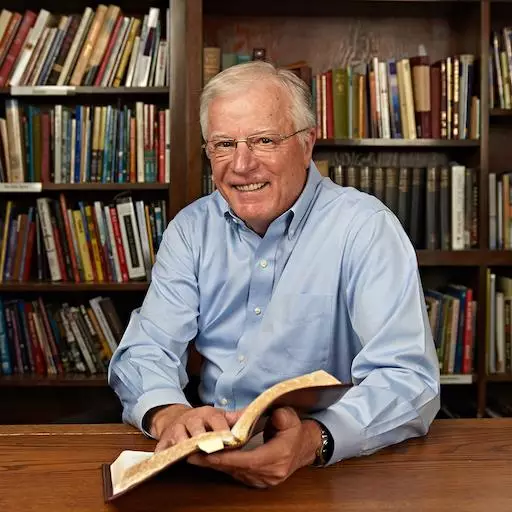
Come And See His Agony – Part 1 of 2


Jesus faced untold agony and suffering in Gethsemane. In the garden, Jesus faced a cup He alone could drink. In this message from Matthew 26, Pastor Lutzer explains what that cup truly was and how Jesus accepted the cup for us. To walk where Jesus walked means walking in Gethsemane.
Dave McAllister: Let us run with endurance the race that is set before us, looking to Jesus, the founder and perfecter of our faith. Some Christians believe the walk of faith should bring them happiness and prosperity. But our Master's real legacy includes suffering. To walk where Jesus walked means walking in Gethsemane. Here, a decision was reached that made salvation possible.
From the Moody Church in Chicago, this is Running to Win with Dr. Erwin Lutzer, whose clear teaching helps us make it across the finish line. Pastor Lutzer is showing us portraits of Christ in a series he's calling Come and See Jesus. Pastor, we've been together in Gethsemane, and few places I've ever been were so meaningful and so sorrowful. Tell us about today's lesson, Come and See His Agony.
Dr. Erwin W. Lutzer: If you remember what I did when we were in the Garden of Gethsemane, I told the tour group, sit down under a tree and just tell Jesus why you love Him. I remember seeing so many people weeping as they poured out their hearts to Jesus Christ, thanking Him that there in Gethsemane, He said yes to the plan of God the Father. Jesus Christ three times prayed that the cup would pass from Him. I personally am very glad, and I'm sure you are too, that that prayer was not answered. The decision was made. He would go to the cross for us.
I want you to visualize a scene with me. I was in Chicago a number of years ago attending a conference with 5,000 delegates representing the various religions of the world. The very first night, the speaker said all the different religions are like spokes in a wheel. At the level of the rim, they seem very different, but when you get to the hub, they are united. How would you answer that? Would you be able to respond to that? All of those kinds of questions are answered in a book I've written entitled *Christ Among Other Gods*, showing the uniqueness of Jesus.
This is a very special month. Any gift that you give during this month will be doubled. What an opportunity to make an investment to help us get the Gospel of Jesus Christ around the world. In appreciation for your gift, we're making available this book entitled *Christ Among Other Gods*. Go to rtwoffer.com or call us at 1-888-218-9337. Take advantage of this special opportunity and help us continue to get the Gospel of Jesus Christ around the world in many different platforms. For now, let us contemplate Gethsemane.
There are two famous gardens in the Bible. There's the Garden of Eden where Adam fell, being succumbed by the devil. And then there's another garden. It's called the Garden of Gethsemane where the second Adam—that's how the Bible refers to him, or the last Adam—in Gethsemane also had a tremendous fight with the devil and with his own will. Yet there he overcame. The word Gethsemane means wine press, or I should say grape press. That's where olives and grapes were sometimes pressed. I like to think of it that in Gethsemane, it's as if Jesus Christ, the flower of God, was crushed, and from him came the beautiful aroma of salvation.
When we come to the Garden of Gethsemane and the passage that I'm using is the 26th chapter of Matthew, though the other gospels have an account of it as well. Matthew chapter 26, verse 36. When we come to Jesus in Gethsemane, perhaps as nowhere else we see his humanity. Sometimes we think to ourselves, Jesus can't be my example because after all, he was God. He had a divine nature, so he really doesn't understand me and my struggle. He did not depend upon that divine nature when he lived as man. That's why he prayed. That's why he was thirsty.
One theologian put it this way: Jesus never found relief in his divinity from human suffering. He didn't suddenly slide over to his divinity and say, "This is too much as a man," but rather he took refuge in prayer. So as you see Jesus here in the garden wrestling, remember that that is an example for us because sometimes we have to also wrestle in the presence of Almighty God. But here we see his humanity in different ways. For example, he asks the disciples to come and pray with him.
Verse 36 says, "Then Jesus went with them to a place called Gethsemane, and he said to his disciples, 'Sit here while I go over there and pray.' And taking with him Peter and the two sons of Zebedee, he began to be sorrowful and troubled." Notice that Jesus said, "I am going through so much. This is going to be so bad that I can't go through this alone." Sometimes we need friends beside us. Sometimes we need people who are there for us because the need is so great, the emotional torment and the agony is beyond human comprehension. Therefore, we need someone next to us.
I remember counseling a woman whose husband had run off with their child. She was in distress, in despair, and in hopelessness. I asked if people were praying with her. She said people at church were praying for her. I said the question is, are they praying with you? Are they getting on their knees with you and agonizing? Sometimes we need people next to us when we suffer. Jesus said to Peter, James, and John, "You have seen me in my glory on the Mount of Transfiguration. Now I invite you to see me in my agony. Come and be with me."
We see the humanity of Jesus also in his honesty in revealing his feelings. In the next verse we read, "My soul is very sorrowful, even to death; remain here and watch with me." Have you ever been sorrowful even to the point of death? Sometimes we say to ourselves if you're filled with the Spirit and walking in the Spirit, you're always going to have emotional tranquility. Everything is going to go well and you're never going to suffer depression or experience the excruciating emotional turbulence.
Jesus was perfect and sinless, and look at him there in the garden with his soul troubled to the point of death. There are some of you who are listening who probably have at times been troubled to the point of death. My wife and I know a couple whose son committed a murder. When they heard of what he did, the wife said she rolled out of bed, lay on the floor, and was unable to get up for hours, her soul troubled even to the point of death. Jesus here is in great agony.
He knew that he was going to do the will of the Father, he had already agreed that he would do that, but now it was crunch time. Now the cup that the Father had given him was very near at hand. I'd like to answer two questions: what is the cup and how did Jesus accept it? First of all, the meaning of the cup. As he prayed, he said, "My Father, if it be possible, let this cup pass from me; nevertheless, not as I will, but as you will." What is this cup that he must drink?
There have been various theories throughout the years. Some people have said the cup is his human suffering. Just think of what he's going to go through. The torment awaits him. Those of us who have seen the Mel Gibson movie, *The Passion*, know a little bit more what that human suffering was about. It was beyond all imagination. They say it is that suffering, just look at the lashes and the crown of thorns. But that's not the real cup because the Romans crucified other people this way. I read one time that there were something like 30,000 crucifixions a year among the Romans.
So that isn't the cup. If we're to look at Jesus as someone who's going to inspire us as to how to approach death, this is not a very good example that you and I should approach our death this way, even if it would be a horrific death. Other people have said the cup is that Satan wanted to kill him in the garden. They say that his soul was sorrowful unto death because the devil wanted to kill Jesus there to keep Jesus from the cross. The problem with that is that's giving Satan an awful lot of power that he might not have.
Jesus said in the upper room, "The prince of this world comes, but he has nothing in me." In other words, he has no authority over me. Jesus successfully was able to reject him and to resist him through all these years, and we expect now that Jesus would be able to do that here. It seems to me that Satan was working in a different way. He had put it into the heart of Judas Iscariot to betray Christ. That's the way the devil was working. The devil probably did want to keep Jesus from the cross, but unlikely that he was trying to kill him there.
There's another reason why we know for sure that that's not the right explanation. It's because after Jesus goes through the agony of Gethsemane, it is then we read in John 18:11 when Peter tried to cut off the ear of the servant of the High Priest. He was aiming for his head but missed. Jesus said, "Peter, put your sword up. The cup which my Father hath given me, shall I not drink it?" The cup still had to be drunk after Gethsemane. It was not that Jesus was trying to survive satanic attack. That was not the cup.
What then was the cup? The cup was the knowledge that he who now was among sinners was going to be reckoned with them. The cup was the fact that he would be separated from the Father. The cup is that he would become the sin-bearer for those who would believe on him and that he would bear their sins and their penalty, the severe penalty which the Father put upon him. He would bear that on his own to the point of being separated from the Father during those difficult hours on the cross.
How long is hell? Hell is forever. Is there a lot of suffering in hell? Does one person suffer a lot in hell? Yes. What if you took all of the suffering, the infinite suffering of hell, and you compressed it into six hours, Jesus Christ bearing our hell, paying our penalty so that you and I might be forgiven? Do you now begin to understand a little bit better that as Jesus looked into that cup, he saw it in all of its ugliness, in all of its horrendous pain and emotional turbulence?
And so Jesus is here saying that this cup is so overwhelming. His soul is going to writhe in torment in ways that we cannot describe. We can say the words, but we can't describe it. In this way, Jesus knows that redemption is going to be accomplished. As a man, his soul is shrinking from the very mission for which he came to this earth. "My Father, if it be possible, let this cup pass from me." That's the cup of suffering that Jesus Christ wrestled with.
That's the meaning of the cup. How we get to the acceptance of the cup. Thank God for the last part of verse 39. "Nevertheless, not as I will, but as thou wilt." In those simple words was the determination of Jesus Christ to go through with it and say, "Father, if the cup has to be drunk, if there's no other way to redeem humanity, if there's no other way for me to be obedient to you, Father, if there is no way out, thy will be done."
And so Jesus there in the garden accepted the will of the Father, bowed humbly to receive from the Father's hand this bitter, bitter cup that he determined to drink. There were actually three cups on Calvary. There was the cup of compassion. Remember when they brought Jesus to Calvary? The first thing they did is they tried to give him some myrrh mingled with wine. That was a sedative to try to make it easy. It was a cup of compassion. They'd give that to prisoners who were being executed.
Jesus refused it. Then there was the cup of mockery. It seems to me that when Jesus was there crying, "My God, my God, why hast thou forsaken me?" and they misunderstand him and then somebody takes some cheap wine that the soldiers had, some cheap vinegar wine, and they put it on a sponge and they put it to his lips, almost mocking him. Exactly how is that going to help his excruciating thirst and the agony?
But there was a third cup on Calvary, and that was the cup that was filled with iniquity as he, the sinless Son of God, would be made sin for us. That was the cup. Jesus refused the sedative because when it came to drinking the Father's cup, he did not want a sedative; he wanted to drink it straight and drink all of it so that you and I could be redeemed. Death and the curse were in our cup, Oh Christ, 'twas full for thee, but thou hast drained the last dark drop, 'tis empty now for me.
Dr. Erwin W. Lutzer: My friend, I certainly hope that you worship the Lord Jesus Christ. I also trust that you understand that he is absolutely unique and cannot be put on the same shelf as other religious teachers. Many years ago there was a Parliament of World Religions in Chicago. As I went to the various booths that had literature from the various religions of the world, I was looking for a sinless Savior who could save me from my sins. Did you know that other religions do not have a Savior? Teachers, yes, but not a Savior.
As an expression of our appreciation for your gift this month, we will be sending you a copy of the book *Christ Among Other Gods* that will emphasize his uniqueness among the religions of the world. And here's the good news: any gift that you give will be doubled. I hope that you take advantage of this opportunity to invest in this worldwide ministry. Go to rtwoffer.com or call us at 1-888-218-9337. Thank you so much in advance for helping us.
Dave McAllister: It's time once again for you to ask Pastor Lutzer a question about the Bible or the Christian life. Kathy contacted us and has some serious questions about observing the Lord's Supper. Here's what she wrote: "First Corinthians 11:23-32 talks about the Lord's Supper. I am confused by verse 27: 'Therefore, whoever eats the bread or drinks the cup of the Lord in an unworthy manner will be guilty of sinning against the body and blood of the Lord.' What does an unworthy manner mean?"
Dr. Erwin W. Lutzer: Thank you so much for your question. We need to understand that in the church in Corinth, there was a tremendous misuse of the Lord's Supper. What happened was that the church came together, something like a potluck dinner, and after they came together, there were those who actually drank and they became drunk at the Lord's table. You see what they did is they had their supper and then the Lord's table was a part of it.
So the Apostle Paul is writing to admonish them. When he says that you should not eat or drink the cup of the Lord in an unworthy manner and then you're guilty of sinning against the body and the blood of the Lord, it means that you are really desecrating what this is all about. You are participating for the wrong purpose. You don't understand its meaning. As a church, you are having factions, the Apostle Paul says, and your guilt is not merely against other members of the body of Jesus Christ; it is against Christ himself.
So it does not say that we should not eat or drink if we are unworthy to eat or drink. On one level, all of us are unworthy. But if we've confessed our sins, if we are right with others in the church, we have a clear conscience before God, then we can participate. But we do so recognizing that this is a very special occasion because that represents the body of Jesus Christ. I think that's what the Apostle Paul was referring to.
Dave McAllister: Thank you, Pastor. She goes on with a second question: "Verse 29 says, 'For anyone who eats and drinks without recognizing the body of the Lord eats and drinks judgment on himself.' What does it mean to eat and drink judgment on yourself?"
Dr. Erwin W. Lutzer: When it says that he who eats or drinks without recognizing the body of the Lord eats or drinks judgment, eating or drinking without recognizing means discerning the Lord's body. That could mean either the body called the church, but more likely in context, it's talking about the body of the Lord. To not discern it means that you don't understand the purpose of this feast. You're not grasping the significance of what it is that you are doing.
We are after all honoring the elements—the bread and the wine—that represent the body and the blood of Jesus. We honor these elements because they represent something very special, namely the body and the blood of our Lord. To not discern that is to bring judgment to yourself. What could that judgment do? The amazing thing is that Paul there in 1 Corinthians chapter 11 said that because of this, some among you are sickly and others sleep. What he means is some among you have actually died because of your disobedience and your lack of respect for our Lord.
In today's society, we become so casual. We become so irreverent. We look around and we say, "Well, no one has been struck dead by the way in which they are acting," so we simply go our own way. Well, what God is saying is that's dangerous. You could have physical effects that would be brought on by God because you participated in an unworthy way, not understanding what you're doing, for all the wrong reasons. This is a tremendous admonition for all of us to be sure that our hearts are cleansed, we're in fellowship with other people, and we know what we are doing when we receive the bread and the cup.
Dave McAllister: Some sobering thoughts about the Lord's Supper from Dr. Erwin Lutzer. And thank you, Kathy, for that question. If you'd like to hear one of your questions answered, go to our website at rtwoffer.com and click on Ask Pastor Lutzer or call us at 1-888-218-9337. You can write to us at Running to Win, 1635 North LaSalle Boulevard, Chicago, Illinois, 60614. Next time on Running to Win, we go back to Gethsemane to learn more about the cup of suffering Jesus willingly drank for all who would believe. Thanks for listening. For Pastor Erwin Lutzer, this is Dave McAllister. Running to Win is sponsored by the Moody Church.
Featured Offer

In an in-depth analysis, this book compares the impact of Karl Marx with D. L. Moody’s ministry—contrasting Marxism with true freedom found in Jesus Christ. Click below to receive this book for a gift of any amount or call us at 1.888.218.9337.
Past Episodes
- Changed By The Word
- Children of an Awesome God
- Chiseled By The Master's Hand
- Christ Among Other Gods
- Christ Before Bethlehem
- Christ, God's Gift at Christmas
- Christians In Conflict
- Come and See Jesus
- Cries from the Cross
- Crowning Christ Lord
- Seven Convincing Miracles
- Seven Reasons You Can Trust The Bible
- Seven Secret Snares
- Sharing Secrets With God
- Slandering Jesus
- Suffering Wrong
- Ten Lies About God
- Thanksgiving
- The Battle for America’s Youth
- The Church in Babylon
- The Darwin Delusion
- The Flurry Of Wings
- The High Cost Of Lost Opportunities
- The Invisible War
- The Invisible World
- The King Is Coming
- The Legacy of a Converted Man
- The Man Who Cradled God In His Arms
- The Manger And The Sword
- The Power of a Clear Conscience
- The Triumph of the Gospel
- The Triumph Of Unanswered Prayer
- Till Death Do Us Part
- What Do These Stones Mean?
- What is God Up To
- What Jesus Thinks Of His Church
- What We Believe
- What Would Jesus Do?
- When a Nation Forgets God Interview
- When God Is First
- When God Shows Himself
- When the Spirit Has His Way
- When You've Been Wronged
- Who Are You To Judge?
- Why Good People Do Bad Things
- Why The Cross Can Do What Politics Can't

Video from Dr. Erwin W. Lutzer
Featured Offer
In an in-depth analysis, this book compares the impact of Karl Marx with D. L. Moody’s ministry—contrasting Marxism with true freedom found in Jesus Christ. Click below to receive this book for a gift of any amount or call us at 1.888.218.9337.
About Running To Win
Running the race of life is hard. But with the Bible front and center and a heart to encourage, Pastor Erwin Lutzer presents clear Bible teaching, helping you make it across the finish line. Since 2011, this 25-minute program has provided a Godward focus and features listeners’ questions.
About Dr. Erwin W. Lutzer
Dr. Erwin W. Lutzer is Pastor Emeritus of The Moody Church where he served as the Senior Pastor for 36 years (1980-2016). He earned a B.Th. from Winnipeg Bible College, a Th.M. from Dallas Theological Seminary, a M.A. in Philosophy from Loyola University, and an honorary LL.D. from the Simon Greenleaf School of Law (Now Trinity Law School).
A clear expositor of the Bible, he is the featured speaker on two radio programs: Running to Win—a daily Bible-teaching broadcast and Songs in the Night—an evening program that’s been airing since 1943. Running To Win broadcasts on a thousand outlets in the U.S. and across more than fifty countries in seven languages. His speaking engagements include Bible conferences and seminars, both domestically and internationally, including Russia, the Republic of Belarus, Germany, Scotland, Guatemala, and Japan. He has led tours to Israel and to the cities of the Protestant Reformation in Europe.
Pastor Lutzer is also a prolific author of over seventy books, including the bestselling We Will Not Be Silenced, One Minute After You Die, and the Gold Medallion Award winner, Hitler’s Cross. Pastor Lutzer and Rebecca live in the Chicago area and have three grown children and eight grandchildren. Connect with Pastor Lutzer on X (@ErwinLutzer) or moodymedia.org.
Contact Running To Win with Dr. Erwin W. Lutzer
media@moodychurch.org
http://moodymedia.org/
Moody Church Media
1635 North LaSalle
Chicago, IL 60614
1.800.215.5001
Monday – Friday
8:00am – 5:00pm CST
Fax Number
1.312.642.4904