

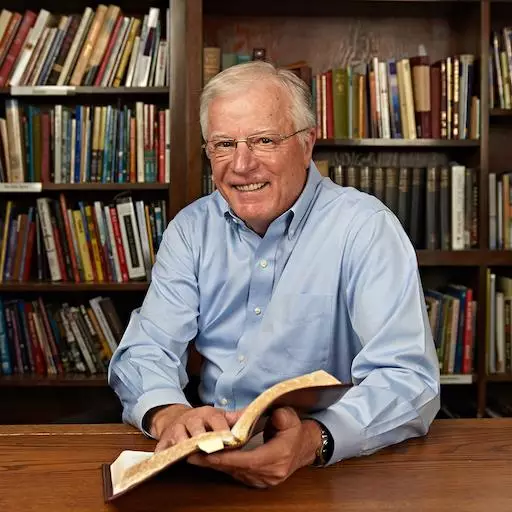
A Serving Church – Part 1 of 2


We can all be selfish in our own way. We often set our priorities toward ourselves—our success, security, and satisfaction. In this message from 1 Thessalonians 2, Pastor Lutzer describes the boldness and sacrifice of the early Christians’ proclamation of the Gospel. By putting ourselves aside, we reclaim a heart of service which puts others first.
Dr. Erwin W. Lutzer: Let us run with endurance the race that is set before us, looking to Jesus, the founder and perfecter of our faith. It's great when people give others first place. That's what happens in a church experiencing the direct moving of God. Today, Paul commends one church for its spirit-led service, and we'll learn the lessons they learned so long ago.
From The Moody Church in Chicago, this is Running To Win with Dr. Erwin Lutzer, whose clear teaching helps us make it across the finish line.
Guest (Male): Pastor Lutzer, Mark 10:45 tells us that the Son of Man came not to be served, but to serve, and to give His life as a ransom for many. What a role model.
Dr. Erwin W. Lutzer: Dave, what a role model. You're right. I often think of that verse of Scripture because I think in my own life how much easier it is to be served than to serve. And one of the things that the Gospel of Jesus Christ does for us is to help us to see that indeed we should regard other people more important than ourselves.
Now, I don't know about you, but I find that very difficult. It is so contrary to human nature. I'm so glad for the many of you who support this ministry of Running To Win. Did you know that because of you, we are actually in Arabic, Russian, Turkish, Portuguese, Spanish? Thank you for your investment in this ministry.
Would you consider becoming what we call an endurance partner? Well, if you have a pen or pencil handy, here is what you can do. You can go to rtwoffer.com. When you're there, you click on the endurance partner button or call us at 1-888-218-9337. Let us make sure in our own lives that we always desire to serve others, and the best way to serve them is to give them the Gospel.
When God comes to church, things happen. Oh, I know that God is always coming to church because God is everywhere, but I'm talking about the real intense moving of the Holy Spirit of God. When that happens, there's transformation.
One of the noticeable indications that God has come to church is the willingness on the part of people to serve. To say, “I am available for whatever God has called me to do. I'm willing to help, even at great personal inconvenience.” When you have that, you know that God has come to church.
I believe one of the great examples of where God came to church was the church at Thessalonica. You remember just north of Athens, if you go to the Aegean Sea. There you can see on a map the city of Thessalonica or where it used to be. And Paul was there only apparently three weeks, and he taught them so much and he fell in love with them in a way that was really remarkable.
There were two groups of people in the church. There were Jews who were the custodians of God's revelation. You'd think that that would have humbled them, but it had the opposite effect. They became self-righteous, just like us as Christians. The fact that if you are a born-again believer today, you above all people should be greatly humbled. We should be the most humble, broken people on earth. And yet sometimes it's a cause for pride and we strut and we swagger. And that's not Christ-like because we are undeserved recipients of God's blessing.
So there were Jews who were very proud of the fact that they were Jews and they were not interested in learning about the Messiah, but there were also some Greeks. And the Greeks, you remember, they were schooled in Plato. And I will say this to those of you who have a Greek background that Plato and Aristotle were probably two of the most brilliant men God ever created. And yet they could not get to God because human reason, human reason does not have the building blocks to solve the question of God and what He's like and His relationship to the world. And yet you had many of them believing in Jesus, and both needed the Gospel. Both needed the Gospel.
Our text today is 1 Thessalonians chapter 2. 1 Thessalonians chapter 2, where the Apostle Paul says in verse 2, “that we had boldness in our God to declare you to you the Gospel of God.” That little phrase, “Gospel of God,” can mean either the Gospel about God. It can also mean and more likely, it's the Gospel that belongs to God.
When you come to Moody Church and we proclaim the Gospel, we are proclaiming a message that no man would have ever invented. Nobody would have come up with the idea that the only way to redeem sinners is to have God Himself and the second person of the Trinity come and be crucified and offer a sacrifice and then freely give eternal life to those who turn from their sin and believe. No one would have come up with that on their own. This is God's Gospel.
And then Paul talks about himself. And he does it partially in defense, but partially also to model for us what servant leadership is really about. And that's our topic for today. And as we go through chapter 2, all 19 verses, we are going to go through as one would experience a garden. You don't stop at all of the flowers. You walk from one batch of flowers to another and you simply walk past a lot of them because you can't do it all.
And in order to do that, we're going to look at five characteristics of servant leadership. And I want to apply this message not just to the pastoral staff and the elders, but to everyone at Moody Church who serves and to those of you who aren't serving yet, but you will. Everybody with a Bible open. In the pew Bible, by the way, it's page number 986. 986. Looking at the text is always very important when you're listening to it being taught. All right, quickly. Are we ready to walk through the garden and pick some flowers?
First of all, the Apostle Paul shows us that in his servant leadership, he says his motive was pure. In fact, in verses 3 and again in verse 5, he lists all of the reasons why he did not come to Thessalonica. Undoubtedly, there were some people who were critical of him, thinking that he had come because of greed. He says, “I did not come because of error.” I wasn't preaching something I made up. He says, “Not because of impurity. I wasn't sleeping with women on my day off, nor an attempt to deceive. I wasn't using this to somehow lead you astray and to control you as false teachers do. But just as we have been approved by God and so forth.” Verse 5, “For we never came with words of flattery.”
You can use flattery. Flattery can either be truthful or it can be lies, but both are wrong if they are used to try to manipulate and to try to get that person to do what you want and to make a deal. He says, “We didn't use flattery, nor with a pretext of greed. We didn't come and leave the city with bags full of money. God is witness. Nor did we seek glory from people.”
Paul says, “I wasn't among you there.” He says, “So that others would say, 'What a wonderful teacher Paul is. Think of how much he knows.'” He said, “We weren't there to receive praise from men.” This gets to the heart of the motivation of what it means to be a servant. To be a servant means that you're not singing so that people will tell you how wonderful you are and how the song ministered to them, though you can use that encouragement from time to time. That you don't preach like I have the privilege of doing so that people will come up later and tell you what a great sermon it is. Paul says, “That is a sinful motivation.”
You say, “Well, what motivated him?” Well, it's there in verse 4. He says, “But just as we have been approved by God to be entrusted with the Gospel, so we speak, not to please man, but to please God who tests our hearts.” That's the reason that you serve is to please God. The opinion of others might have their place, but that's not the first question that you ask. The first question that you ask is, “Is this being really done so others will think well of me, or is it being done for God?” Are you content if God is satisfied, even if no one else is satisfied?
God tests our hearts. God tests our motives. This past week I heard a story of a man whom I happen to know. He's from South Africa, but he lives in Canada. And in South Africa, now, this man spends most of his time in prayer. And he was in South Africa and he fasted for 11 days and he believed that God wanted him to have some meetings in a church and other people agreed, you should go to that church. They said, “We have a place for you to stay. And what we want you to do is to have meetings there.” So, the meetings were advertised. He went to the couple's home where he was to stay. The wife was a believer. The husband was not a believer, but they were glad to house him and so he went to his first meeting. And he went there and no one showed up at seven.
He actually went to pray for a couple of hours. No one showed up at seven and then he thought, “Well, maybe there's been a mistake. Maybe the meetings were advertised at 7:30.” 7:30 came and nobody showed up. Well, he was very discouraged and he was about to go home and he said, “God, what is this?” And it was as if God spoke to him and says, “Well, for whom are you doing the preaching? Why don't you preach for me?” He said, “I thought, 'Okay, I'll preach for God. I'll preach to an empty church.'” So he did. Preached a sermon, took an offering, that would have been interesting. Took an offering, gave the benediction, went home.
They asked him, “How did the meetings go? How many people showed up?” He said, “Nobody showed up.” They said, “What did you do?” He says, “I preached a sermon for God.” And that night, that man could not sleep, the man of the house. She said, “What's your trouble?” His wife said. And he said, “It's that preacher down there. He preached a sermon for God, even though God was the one who was listening, only one who was listening. And that night, that man was converted.” Now you say, “Well, see, that's what you get for these people who spend a lot of time in prayer.”
You know, he fasted for 11 days. He goes to the church early and he prays for a couple of hours. And look at how beneficial his prayer turned out to be. Nobody showed up to the meeting. Not too fast. As those meetings continued, many people were converted and today there's a very strong church there. Some of you are discouraged because you've chosen to pray with Christ for one hour every week of this year. And you've done it a couple of times and you've noticed no difference. And you say to yourself, “Well, you see, God doesn't answer prayer.” But God is working and God will answer even if he doesn't answer it the way in which you think he should and as quickly as you think he should. So God is there.
So I have to ask you today. See, when God comes to church, he house cleans our hearts. The motives are changed. It isn't what people will think of me. Now it's what God thinks of me. It isn't for greed. It isn't for for manipulation so that you can get ahead. It has everything to do with this simple question: Is God pleased? No wonder Paul continues on and says, “You know, we were like a gentle among you, like a nursing mother,” verse 7, “taking care of her own children.” So being affectionately desirous of you, we were ready to share with you not only the Gospel of God, but also ourselves because you had become very dear to us.
You begin to live this way with a God-directed motivation, and you find that you don't just give people your time, you give people yourself. Only God can do that, and that's what happens when he shows up. How does a nursing mother do it? Does she say, “Well, you know, I'm on duty 9:00 to 5:00. This kid cries in the middle of the night, I'm sorry, wait until morning. Wait until 9:00 until I get to work.” No. Why? She is imparting not just her time, not just her ability, but she gives herself to the children as my wife did, as our children were growing up.
Paul says, “That's the way ministry should be.” That's what should be happening at the Moody Church. People giving themselves to others without a time agenda. Oh, I know we can't do it all, but with with such a sense of devotion and commitment to one another that we give not just our time, but we give ourselves.
I have a pastor who was preaching on this who had a lot more nerve than I do. But in the middle of the sermon, he asked an usher, and the idea just came to him to bring an offering plate. And so he put the offering plate on the platform and he stood in it. That's what we give to God when God comes to church. We give ourselves. Paul says that's the motivation of servanthood.
Second, notice quickly, the sacrifice. Paul says in verse 9 and following, “For you remember, brothers, our labor and toil. We worked night and day that we might not be a burden to any of you while we proclaimed to you the Gospel of God.” Paul says, “I continued to work on tents.” That's where the idea of tent making comes in. So that we never even talked about money. So nobody would say, “Paul's in it for the buck.”
Remember, he lived at a time when there were professional orators who used to come and give speeches, but they always in advance would say how much money they needed for their speech. Paul says, “That's not. I don't I want to stay away from that. And you know, of course, that the ministry has often been disgraced because people are in it for the money.” You say, “Well, Pastor Lutzer, you get paid from the church, the staff gets paid from the church.” Paul is not giving here a universal principle. In fact, later on he says that those who teach the word and preach the word have a right to be taken care of.
But what Paul is telling all of us very strongly is this, that when we do ministry, the motivation is not the motivation of money. And shame on any person who has that motivation. You receive the money in order that you might serve, but you don't serve with a view to ask the question, “How much do I get?” You don't go into the ministry because you say, “Well, this is going to make more money than than some other vocation.” And by the way, seldom does it make much money, more money than other vocations. You remember the elders in a little church that prayed, “Oh God, we promise that if you keep him humble, we promise to keep him poor.” You know, that's the agreement.
The other day I said to the staff with a smile on my face, I said, I was I was admonishing them regarding something, about the need to do something. And then I said, “Remember this, we here on the staff, we are paid to be good.” You know, we're paid to be good. We have an expectation. I said, “All of the people at Moody Church who volunteer, they're good for nothing.” Yeah. You're good for nothing.
Paul says, “We have to be willing to make financial sacrifice in ministry.” If our ministry does not in any way affect our checkbook, if it does not affect the way in which we give, if it does not affect our motivation, we are not Christ-like in our service. God has not yet come to church, as long as we're hung up on all these things. So Paul says, “I made that, the sacrifice of that, the sacrifice of devotion.”
He says, “We were holy and righteous and blameless before you.” And I say this to the pastoral staff and all the leadership at Moody Church, that we who are in leadership should be more holy, more righteous, and more blameless than we even expect our congregation to be. That's a note of conviction for all of us. So Paul says here, he says, “There's a sacrifice to servanthood.” And then he says, “What is the goal?” The goal here is in verses 11 and 12, “For you know how like a father with his children, we exhorted each of you and encouraged you and charged you to walk in a manner worthy of God.”
What's it all about? What are we trying to do with our teenagers? What are we trying to do with our leadership? What are we doing in our adult Bible fellowships? What are we, what are we trying to accomplish? At the end of the day, what we want is character, people who walk worthy of God, in keeping with the dignity of belonging to God.
When I was growing up, we as kids used to say to our mother and father like most kids do, “Well, we can't do this. Why can't we do this? Because look at the neighbors, they're doing that.” And our parents used to always say, “Now, their name is,” and then they'd give the name. And then they'd say, “But you know, you're a Lutzer, and this is a different family.” Now, I don't know whether or not that helped, but it should have. And so I say to those of you today who are Christians, the world can do this, this, this, but you can't because guess what? You belong to a different family. Thank you very, very much. We are to walk worthy of God.
Guest (Male): Well, this, my friend, is Pastor Lutzer. Indeed, that is the challenge in front of all of us to walk worthy of God. And we here at Running To Win are deeply committed to help people to do just that. I'm holding in my hands a letter from someone who says, “I listen to your program every morning before work. I'm so grateful for Running To Win. I'm grateful for the challenges, the encouragement, and Pastor Lutzer's heart to bring believers across the finish line. Thank you.”
Now, let me ask you a question. Are you willing to help us bring people across the finish line? The reason that Running To Win exists in different countries, as you have often times heard me say, is because of people just like you, who have invested in this ministry. And I thank God for the many people who pray for us, those who become a part of our ministry, because they become a part of what I like to call the Running To Win family. Well, I hope that you have a pen or pencil handy, because this is how you can find out info as to how to become an endurance partner. Go to rtwo
Featured Offer

This guide to the last days will stoke your trust in God’s glorious plans for the future. You will be empowered to live with boldness and readiness like never before. Click below to receive this book for a gift of any amount or call us at 1.888.218.9337.
Past Episodes
- Changed By The Word
- Children of an Awesome God
- Chiseled By The Master's Hand
- Christ Among Other Gods
- Christ Before Bethlehem
- Christ, God's Gift at Christmas
- Christians In Conflict
- Come and See Jesus
- Cries from the Cross
- Crowning Christ Lord
- Seven Convincing Miracles
- Seven Reasons You Can Trust The Bible
- Seven Secret Snares
- Sharing Secrets With God
- Slandering Jesus
- Suffering Wrong
- Ten Lies About God
- Thanksgiving
- The Battle for America’s Youth
- The Church in Babylon
- The Darwin Delusion
- The Flurry Of Wings
- The High Cost Of Lost Opportunities
- The Invisible War
- The Invisible World
- The King Is Coming
- The Legacy of a Converted Man
- The Man Who Cradled God In His Arms
- The Manger And The Sword
- The Power of a Clear Conscience
- The Triumph of the Gospel
- The Triumph Of Unanswered Prayer
- Till Death Do Us Part
- What Do These Stones Mean?
- What is God Up To
- What Jesus Thinks Of His Church
- What We Believe
- What Would Jesus Do?
- When a Nation Forgets God Interview
- When God Is First
- When God Shows Himself
- When the Spirit Has His Way
- When You've Been Wronged
- Who Are You To Judge?
- Why Good People Do Bad Things
- Why The Cross Can Do What Politics Can't

Video from Dr. Erwin W. Lutzer
Featured Offer
This guide to the last days will stoke your trust in God’s glorious plans for the future. You will be empowered to live with boldness and readiness like never before. Click below to receive this book for a gift of any amount or call us at 1.888.218.9337.
About Running To Win
Running the race of life is hard. But with the Bible front and center and a heart to encourage, Pastor Erwin Lutzer presents clear Bible teaching, helping you make it across the finish line. Since 2011, this 25-minute program has provided a Godward focus and features listeners’ questions.
About Dr. Erwin W. Lutzer
Dr. Erwin W. Lutzer is Pastor Emeritus of The Moody Church where he served as the Senior Pastor for 36 years (1980-2016). He earned a B.Th. from Winnipeg Bible College, a Th.M. from Dallas Theological Seminary, a M.A. in Philosophy from Loyola University, and an honorary LL.D. from the Simon Greenleaf School of Law (Now Trinity Law School).
A clear expositor of the Bible, he is the featured speaker on two radio programs: Running to Win—a daily Bible-teaching broadcast and Songs in the Night—an evening program that’s been airing since 1943. Running To Win broadcasts on a thousand outlets in the U.S. and across more than fifty countries in seven languages. His speaking engagements include Bible conferences and seminars, both domestically and internationally, including Russia, the Republic of Belarus, Germany, Scotland, Guatemala, and Japan. He has led tours to Israel and to the cities of the Protestant Reformation in Europe.
Pastor Lutzer is also a prolific author of over seventy books, including the bestselling We Will Not Be Silenced, One Minute After You Die, and the Gold Medallion Award winner, Hitler’s Cross. Pastor Lutzer and Rebecca live in the Chicago area and have three grown children and eight grandchildren. Connect with Pastor Lutzer on X (@ErwinLutzer) or moodymedia.org.
Contact Running To Win with Dr. Erwin W. Lutzer
media@moodychurch.org
http://moodymedia.org/
Moody Church Media
1635 North LaSalle
Chicago, IL 60614
1.800.215.5001
Monday – Friday
8:00am – 5:00pm CST
Fax Number
1.312.642.4904