

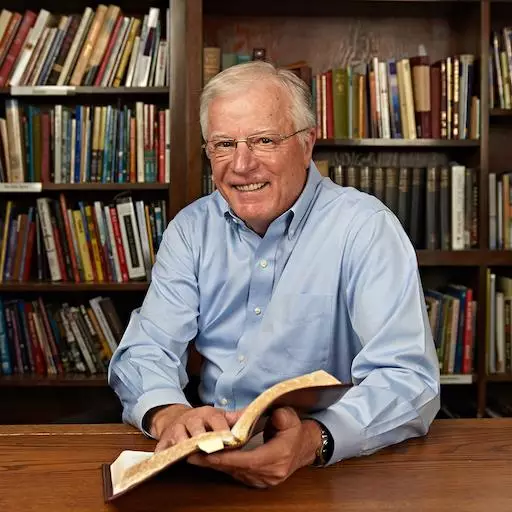
A Living Church – Part 1 of 2


New life comes to a church when revival begins. God showed up in Thessalonica and the people were transformed by the Gospel. In this message from 1 Thessalonians 1, Pastor Lutzer gives the first of five characteristics of a new, living church. When God shows up, both discomfort and joy are experienced.
Guest (Male): Let us run with endurance the race that is set before us, looking to Jesus, the founder and perfecter of our faith. New life comes to a church when revival begins. There is no doubt we could use a great awakening now. What are the indications that God is making his presence known in a special way? Today we begin a series that tells us what they are. From the Moody Church in Chicago, this is Running to Win with Dr. Erwin Lutzer, whose clear teaching helps us make it across the finish line.
Dave: Pastor Lutzer, as we embark on what happens when God comes to church, may I ask if you have experienced times of special visitations of the spirit?
Dr. Erwin W. Lutzer: You know, Dave, the answer to your question is yes. Let me tell you that in the 1970s, God was very pleased to bring a revival to Western Canada. One of the most important characteristics of this revival was repentance. You had people who had stolen money giving it back. You had bitterness that divided families, and that bitterness dissolved in the midst of forgiveness.
There was a sense of humility. Other people noticed what took place, and even the world—that is to say, people who don't believe—recognized that there were changes happening in some of the cities. That's what happens really when God comes to church.
Now this series of messages based on 1 Thessalonians is going to help us to see some of the characteristics of the early church and what Paul expected and what he prayed for so that we will understand the path toward what you talked about, Dave, the path toward revival. Let's listen.
Sometimes God comes to church. You say, "Well, God always comes to church. He's always there. In fact, he's everywhere." Yes, of course, he's everywhere. So in that sense, he's always with us. But sometimes the manifest presence of God, as the ancients used to call it, is much stronger than it is at other times.
There are times when God comes to church in such a way that there is greater blessing, greater conviction, and greater joy than you and I have ever seen in a congregation when God shows up. Because remember, the reality of God is much greater than our experience of God. And when God shows up, people know that God has shown up and he's come to church.
In fact, in this series of messages, I'm going to be telling you in a future message how God showed up in Chicago in 1858 in ways that you perhaps have never heard about. It began in New York City, came here to the city of Chicago and other cities of America, and secular historians said that the revival of 1858 was the event of the century. God showed up.
Today I'm going to simply tell you very briefly about the 1740s. In Northampton, Massachusetts, there was an evangelist by the name of Jonathan Edwards. And Jonathan Edwards began to preach and people were converted almost spontaneously, and he began concerts of prayer throughout the area.
Then he teamed up with an evangelist by the name of George Whitefield, who was converted in England, actually born in a tavern in England, so you can understand his heritage and his background. But he was converted and became a great evangelist and a great friend here in America as well, particularly a friend of Benjamin Franklin. Though Franklin did not accept Whitefield's message, they did become friends.
And the revival was so great that Benjamin Franklin says that one could not walk down the street without hearing psalms sung in different families on every street. God showed up in New England. The crowds were so large, they'd go preach to miners, and the description is that the miners stood there and they wept, and the tears would go down their sooty faces, making furrows on their cheeks.
As a result of that, there was deep conviction of sin, but there was also a passion for God. That always is part of revival. If all that you had was conviction of sin, there are people who are saying, "What would I do if God were to take all my sins away? I'd have nothing to do. I'd have such a vacuum in my life that I wouldn't know where in the world to turn." Well, the passion of God filled that, and so people began to pursue God and to seek him out.
And there was so much righteousness that, according to one biographer, one could leave a bag of gold in the street and it would still be there in the morning even if it was there all night. In other words, converted people don't steal. So you could leave a bag of gold and no one would take it because the revival was so intense. It's estimated that 50,000 people were converted as a result of what we call in America the First Great Awakening. There's no doubt that God showed up.
Now it was in response to prayer, but it was also this sovereign work where God sometimes comes and simply decides that he's going to do the extraordinary. Usually his work is imperceptible, but sometimes it is powerful, and sometimes it is visible. And when it is, everybody knows God has come to church.
In fact, throughout history this has often happened. Let's go back 2,000 years. 2,000 years ago, there was a city north of Athens called Thessalonica. Today it is known as Salonica. Think of a map of Greece and there's Athens, and then you go up the coast along the Aegean Sea and there's Thessalonica.
The Apostle Paul decided to go there with a man by the name of Silas, and they held meetings in the synagogue. And the Bible says that when they were there, they stayed with a man by the name of Jason. Don't know too much about Jason, but he allowed them to stay in their home. And Paul was there for three weeks reasoning in the synagogue.
And what Paul did is he argued this: first of all, that Jesus had to suffer, which was a very new concept to the Jews because they thought that the Messiah wouldn't suffer, he'd just come to rule. And then secondly, he proved that Jesus fulfilled the suffering predicted in the Old Testament and Jesus was the Messiah. And the Bible says that many God-fearing Greeks believed—it's an interesting expression, God-fearing Greeks—and some prominent women believed and were converted.
Now, this created a riot. In fact, the Jews didn't like what was happening. So this is the story: they go into Jason's house. It says in Acts 17, "And when they could not find them," that is Paul and Silas, "they dragged Jason and some of the brothers before the city authorities shouting, 'These men who have turned the world upside down have come here also, and Jason has received them, and they are all acting against the decrees of Caesar saying that there is another king named Jesus.'"
So they drag Jason out of the house, and he has to post bond before he can get free. Paul and Silas decide to leave town and they go to Berea. Now as Paul is thinking about this experience, he's saying, "I wonder, I mean, I taught them all of this about the church. There were some new converts, but what about the leadership of the church? Did the church survive?"
The Bible says that he prayed for them night and day, but you never know. Church planting, what a challenge. You know, we here at the Moody Church want to plant churches. Pastor Hertzberg, our executive pastor, part of his job description is to be the director of church planting. What we'd like to do is to raise up young men who are able and trained and begin churches.
We haven't been able to do that. One problem is time and scheduling, and another, quite frankly, if I may be very upfront today, one problem is money. If you look at our bulletin, you'll notice that we are falling behind in our general fund, and we don't say much about this, but there are many ministries we cannot do because we're constantly behind in our general giving. And so that impacts us.
But Pastor Hertzberg has had experience in church planting, and that's what we'd like to do. We'd like to become a church planting church. But you can imagine the Apostle Paul here, he is struggling with how in the world did they do. So he goes to Berea, then he goes to Athens, and he ends up at Corinth, and he sends Timothy, who wasn't associated with the riot. He sends Timothy and he says, "Go check on the church and bring me word."
Timothy comes and says, "Paul, you won't believe it. This church is thriving." And so the book of 1 Thessalonians was written by Paul to this thriving church that was only a few months old. Unbelievable to think of the characteristics of this church because God showed up. God showed up.
Now in ancient times, you could switch religions. And when you switched religions, what happened is you began to serve this other god and you got the rules and the regulations connected with it, but it didn't change your heart. What happened in this pagan city was as the gospel came, it actually changed people's affections. It actually changed what they loved and what they hated. That's what the gospel does, changes us from the inside out.
And as a result, you have here now the characteristics of a church that is alive, brand new, with all the problems of a new church, and of course eventually they would have all the problems of an old church because every church has its challenges. But what a church it was.
Would you turn, please, to 1 Thessalonians, chapter one, the letter that Paul wrote to this thriving church. And very briefly, I'm going to list for you five characteristics of this church that had come alive as a result of the gospel being preached in it. This is a church in which no doubt God attended and his presence was incredible.
Paul gives a greeting and then in verse two, "We thank God always for all of you, constantly mentioning you in our prayers, remembering before God and our Father your work of faith, labor of love, steadfastness of hope in the Lord Jesus Christ." First of all, it was a transformed church. Where do you get this faith, this faith that inspires work? Where do you get the kind of love that can be a labor of love?
Where do you get the hope in the midst of a pagan world that believed that there was no hope? The only answer is through the gospel. And here these qualities were birthed in their hearts by God, and wherever you have a church that has the right to be called a church, it should always have the characteristics of faith, love, and hope. And if we do not have that, we are not converted.
So Paul is saying here that what you are experiencing is a miracle of God. In fact, these three virtues are really given in the right order, aren't they? Faith looks to the past to what Jesus Christ has done. Love serves in the present, and hope endures, knowing that there's a future. The endurance of hope.
It's not "hope so." It's the sure confidence that God is on your side, and no matter how tough it is in your vocation, no matter how much you hate Monday mornings, no matter how difficult it is in your relationships within the family, you always know that God is there and that his help is present and a better day is coming. It's a transformed church because God showed up.
Secondly, you'll notice that it is also a confident church. Where does it get its confidence from? Notice what Paul says: "For we know, brothers," verse four, "loved by God, that he has chosen you because our gospel came to you not only in word, but also in power and in the Holy Spirit and with full conviction." It is a confident church.
Who began the church? Whose idea was it? When I was going to a one-room schoolhouse—and by the way, I think it was in high school I finally discovered that there were some schools in the city where you had grade one in one room and grade two in another. We had never heard of that. We had grade one over here, the teacher began with this row, then she left the grade ones and went to the grade twos all the way to grade eight.
And in those country schoolhouses, sometimes there were squabbles and sometimes there were arguments and even fights. And of course, as you know, I steadfastly stayed away from those kinds of things. But what the teacher always asked is, "Who started it?" That's what she wanted to know.
Let me ask you, who started the church? Whose idea was it? It was God who chose you, Paul says. It's God who started this. This has nothing to do with human origin. It is the Lord God who begins the church through choosing people to eternal life. And what does he choose them for? To leave their sins, yes, he chooses them out of the world, but they are for himself.
God wants you. It's your heart. It's everything that you own, all of your loves. And so God chooses us for himself. And once you know that, you know that the God who chose you is not going to give up on you, and he's going to be with you until the end. And that gives confidence.
And Paul says our word came unto you not in word only. If all that you hear from me today are words, so that you conceptually understand the message and so that you can know what I'm saying—if all that happens, if that's all that happens to you, then we have failed in our prayer life and in our yieldedness because the word should never go out just in word only.
It should always go out with the demonstration of power, the power to convict, the power to change, the power to transform. That's the way the word of God should go out, and with much conviction. That's settled conviction that you belong to God, that God is number one in your life, and that really nothing else matters about God and his promises. It is that overwhelming conviction that you should experience when the word of God is read and when it is preached.
If it goes out in word only, it's not transforming. It may challenge the mind, you may learn new ideas, new insights, but unless it is transforming to the heart—not just the emotions, but the actual heart—then of course there's a disconnect. And you and I know people, don't we, who hear the word?
Called my family last night in Canada and there's a man who died suddenly, unexpectedly, of a heart attack, age 75, a very, very wealthy farmer who wanted to buy up most of the land in his area and almost did. And the only thing that was said at his funeral about his spiritual life was that he attended church and he'd always say to the pastor, "Good sermon."
Well, all right, we'll take that. Good sermon, better than I guess bad sermon. Like the woman said at the door to the pastor, "You know, your sermon is like a cup of cold water to a drowning man." Think about that a little bit, folks. Think about it.
But his wife says he had no spiritual interest at all, none. Came and sat, came and listened, always left unchanged. That's the word in word only. But when it comes with the power of God and conviction, there's that settled idea of walking with God and knowing that you do, even apart from arguments, even apart from the apologetics for the Christian faith.
Anyway, Paul says it was a confident church. It was a joyful church. You'll notice in verse six he says that, "And you became imitators of us and of the Lord, for you received the word in much affliction with joy." Can you put those two words together, those two phrases? You received the word in much affliction. I mean the blood was running down their backs because of persecution, and yet you received the word with much joy. How do you have joy? You can't unless God shows up.
My friend, this is Pastor Lutzer. I want to have a personal word with you. Do you experience joy even in the midst of trials? Can you say that the Holy Spirit of God has worked in your heart so that you can accept what happens to you and see it from God's standpoint? That's so difficult, isn't it? But the early church accomplished that by the power of the Holy Spirit.
Do you understand, and I hope that all of us do, about the tremendous need for the Holy Spirit of God to speak to us as individuals and as churches? We oftentimes are in a rut, we do the same thing over and over again and we make very little progress in the Christian life. God wants to do so much more. That's why I've preached this series of messages entitled When God Comes to Church. When God comes to church, barriers are broken and even long-standing habits and sins lose their power.
You know, I've written a book entitled *Managing Your Emotions*. One of the chapters has to do with regret, another has to do with rejection. Maybe you feel rejected. Did you know that Jesus was rejected? He was despised and rejected of men. Jesus stands where you stand today, but he stood there for you. His wounds, of course, were wounds that were inflicted by enemies, and yet at the same time it is those wounds that have brought us healing.
Now for a gift of any amount, we're making a book available for you entitled *Managing Your Emotions*. Here's what you do: go to rtwoffer.com. That's rtwoffer.com or pick up the phone and call us at 1-888-218-9337. Our desire here at Running to Win is that you walk in the spirit, that you join us in the great adventure of sharing the gospel of Jesus Christ around the world. Go to rtwoffer.com or pick up the phone and call us at 1-888-218-9337.
Guest (Male): It's time now for another chance for you to ask Pastor Lutzer a question about the Bible or the Christian life. The return of Christ has been expected for almost 2,000 years. It's appropriate that Robert should ask this question: "When will the second coming of Christ happen, and what events will happen?"
Featured Offer

This guide to the last days will stoke your trust in God’s glorious plans for the future. You will be empowered to live with boldness and readiness like never before. Click below to receive this book for a gift of any amount or call us at 1.888.218.9337.
Past Episodes
- Changed By The Word
- Children of an Awesome God
- Chiseled By The Master's Hand
- Christ Among Other Gods
- Christ Before Bethlehem
- Christ, God's Gift at Christmas
- Christians In Conflict
- Come and See Jesus
- Cries from the Cross
- Crowning Christ Lord
- Seven Convincing Miracles
- Seven Reasons You Can Trust The Bible
- Seven Secret Snares
- Sharing Secrets With God
- Slandering Jesus
- Suffering Wrong
- Ten Lies About God
- Thanksgiving
- The Battle for America’s Youth
- The Church in Babylon
- The Darwin Delusion
- The Flurry Of Wings
- The High Cost Of Lost Opportunities
- The Invisible War
- The Invisible World
- The King Is Coming
- The Legacy of a Converted Man
- The Man Who Cradled God In His Arms
- The Manger And The Sword
- The Power of a Clear Conscience
- The Triumph of the Gospel
- The Triumph Of Unanswered Prayer
- Till Death Do Us Part
- What Do These Stones Mean?
- What is God Up To
- What Jesus Thinks Of His Church
- What We Believe
- What Would Jesus Do?
- When a Nation Forgets God Interview
- When God Is First
- When God Shows Himself
- When the Spirit Has His Way
- When You've Been Wronged
- Who Are You To Judge?
- Why Good People Do Bad Things
- Why The Cross Can Do What Politics Can't

Video from Dr. Erwin W. Lutzer
Featured Offer
This guide to the last days will stoke your trust in God’s glorious plans for the future. You will be empowered to live with boldness and readiness like never before. Click below to receive this book for a gift of any amount or call us at 1.888.218.9337.
About Running To Win
Running the race of life is hard. But with the Bible front and center and a heart to encourage, Pastor Erwin Lutzer presents clear Bible teaching, helping you make it across the finish line. Since 2011, this 25-minute program has provided a Godward focus and features listeners’ questions.
About Dr. Erwin W. Lutzer
Dr. Erwin W. Lutzer is Pastor Emeritus of The Moody Church where he served as the Senior Pastor for 36 years (1980-2016). He earned a B.Th. from Winnipeg Bible College, a Th.M. from Dallas Theological Seminary, a M.A. in Philosophy from Loyola University, and an honorary LL.D. from the Simon Greenleaf School of Law (Now Trinity Law School).
A clear expositor of the Bible, he is the featured speaker on two radio programs: Running to Win—a daily Bible-teaching broadcast and Songs in the Night—an evening program that’s been airing since 1943. Running To Win broadcasts on a thousand outlets in the U.S. and across more than fifty countries in seven languages. His speaking engagements include Bible conferences and seminars, both domestically and internationally, including Russia, the Republic of Belarus, Germany, Scotland, Guatemala, and Japan. He has led tours to Israel and to the cities of the Protestant Reformation in Europe.
Pastor Lutzer is also a prolific author of over seventy books, including the bestselling We Will Not Be Silenced, One Minute After You Die, and the Gold Medallion Award winner, Hitler’s Cross. Pastor Lutzer and Rebecca live in the Chicago area and have three grown children and eight grandchildren. Connect with Pastor Lutzer on X (@ErwinLutzer) or moodymedia.org.
Contact Running To Win with Dr. Erwin W. Lutzer
media@moodychurch.org
http://moodymedia.org/
Moody Church Media
1635 North LaSalle
Chicago, IL 60614
1.800.215.5001
Monday – Friday
8:00am – 5:00pm CST
Fax Number
1.312.642.4904