


Seven Words That Will Change Your Life


First John 1:9 says, “If we confess our sins, God is faithful and righteous to forgive us our sins and to cleanse us from all unrighteousness.” And while we take comfort in that promise, there is one sin that God will never forgive. Dr. Robert Jeffress explains how we can avoid that sin and be welcomed into the presence of God.
To support Pathway to Victory, go to ptv.org/donate.
David J. Mullens: Thanks for streaming today's podcast from Pathway to Victory. Pathway to Victory is a nonprofit ministry featuring the Bible teaching of Dr. Robert Jeffress. Our mission is to pierce the darkness with the light of God's Word through the most effective media available, like this podcast. To support Pathway to Victory, go to ptv.org/donate or follow the link in our show notes. Now, here's today's podcast from Pathway to Victory.
Dr. Robert Jeffress: Hi, this is Robert Jeffress, and I'm glad to study God's Word with you every day on this Bible teaching program. On today's edition of Pathway to Victory, did you know there is only one sin that will keep you out of heaven? Do you know what the sin is? It's not adultery. It's not murder. The one sin that will keep you out of heaven is pride, refusing to humble yourself and receive God's free gift of salvation.
David J. Mullens: Welcome to Pathway to Victory with author and pastor Dr. Robert Jeffress. 1 John 1:9 says, "If we confess our sins, God is faithful and righteous to forgive our sins and to cleanse us from all unrighteousness." And while we take comfort in that promise, there is one sin that God will never forgive. Today on Pathway to Victory, Dr. Robert Jeffress explains how we can avoid that sin and be welcomed into the presence of God. But first, let's take a moment to hear some important ministry updates.
Dr. Robert Jeffress: David, for many of our listeners, Pathway to Victory has become a trusted place for reliable Bible study tools. And that truly delights me because we are completely focused on helping you take your next step in your walk with God. This time, I'm pleased to offer you a book that's really quite different from the rest. It's called Seven Lessons from My 70 Years, and it's like picking up my personal journal and reading my quiet reflections.
It contains seven honest lessons the Lord has pressed into my heart across a lifetime of following Him. There are cherished photographs tucked inside as well. This is the real wisdom of 70 years handed to you like a letter from a friend. And every page is anchored in the Word of God. I want you to have my book in this particular season because 2026 marks 30 years of ministry for Pathway to Victory.
Think of it. We've broadcast through generation after generation of cultural chaos. And through it all, our message has never shifted, not once. As we celebrate three decades on the air, I'm calling on you to give generously to keep this ministry strong. And when you do, I'll send you this journal as my heartfelt thank you. Okay, it's time to turn our attention to the study of Luke chapter 18. I titled today's message "Seven Words That Will Change Your Life."
Author Mark Batterson notes that when Benjamin Franklin was a young man, he wrote a number of scathing editorials. And one of the frequent targets of his editorials was a Puritan preacher named Cotton Mather. I can't imagine what it would be like to be a preacher and the subject of scathing editorials, but anyway, Cotton Mather was. And Franklin reacted a lot better than I do sometimes.
Cotton Mather actually decided to try to make peace with Benjamin Franklin, and he invited him to dinner in his home one evening. Knowing that Franklin was a lover of books, Cotton Mather thought that Franklin would enjoy seeing Cotton Mather's massive library of more than 4,000 volumes. So after dinner, he invited him to come to his library. And the entryway from the dining room to the library was very, very narrow, and there was a low-hanging beam.
And so Cotton Mather, not wanting his guest to hit his head on the low-hanging beam, turned around to Franklin and yelled out, "Stoop! Stoop!" Well, Franklin didn't understand what he was saying. He didn't stoop, and he hit his head on that low-hanging beam. Well, like any good preacher, Cotton Mather decided to turn that into a sermon illustration. And later on, he said in a message, "Let this be a caution to you not to always hold your head so high. Stoop, young man, stoop as you go through this world, and you will miss many hard bumps."
Stooping, humbling yourself, is certainly important for experiencing success in this life. But humbling yourself is essential for inheriting eternal life. Did you know there's only one sin that will keep you out of heaven? Do you know what the sin is? It's not adultery. It's not murder. It's not homosexuality. The one sin that will keep you out of heaven is pride, refusing to humble yourself and receive God's free gift of salvation.
And that is the point of a parable Jesus told in Luke 18. It was the last parable He taught on the subject of salvation and perhaps the clearest parable at all. Today, if you have your Bibles, as we continue our study of Luke's gospel, I want you to turn to Luke chapter 18 as we discover seven words that will change your life and your eternity. Luke chapter 18. Now the purpose of this parable is already given to us on the front end by Luke.
Look at verse nine: "And He," that is Jesus, "also told this parable to certain ones who trusted in themselves that they were righteous, and they viewed others with contempt." This parable was directed to a certain group of people, most probably the Pharisees. And notice what he says about the Pharisees. They were ones who trusted in themselves that they were righteous. They based their righteousness on themselves, and they looked down at others with contempt. That's always, by the way, a corollary of pride, looking down at other people.
Jesus is going to tell us there are two ways to try to approach God. There are two ways to try to be in a right relationship with God. One way is based on your own inherent goodness. The other is based on God's grace. Now let's look at the story itself. Notice the two players in the parable. Verse 10: "Two men went up into the temple to pray, one a Pharisee and the other a tax gatherer."
In the Jewish mindset, on the Jewish holiness spectrum, you couldn't find two more opposite people. At the top of that ladder was the Pharisee. On the bottom rung was the tax collector. If Jesus were telling the story today, He would probably tell it this way: Two people went into the church to pray, a preacher and a prostitute. That's how these people would think of these two people, a Pharisee and a tax collector.
This Pharisee was praying, but he was praying out loud so that everybody could hear him. And I love this next phrase: He was praying thus to himself. His prayer was really to himself. He thought it was to God, but it was to himself. Notice what he said: "God, I thank thee that I'm not like other people—swindlers, unjust, adulterers, or even like this tax gatherer over here."
And then he goes into this recitation of all the reasons God should be honored to have such a holy man in His presence. He said, "Lord, notice what I've done. I have fasted twice a week." Now the Old Testament law said you only had to fast once a year. This guy did it twice a week. Not only that, he said, "I pay tithes of all that I get." What this man is saying about himself is true, at least about his outward appearance.
But what he failed to realize was that God is as interested or more interested in what is in our heart than simply our external appearance. He couldn't comprehend that by God's standard, he was just as much of a vile sinner as this guy standing some distance away, the tax collector. So let's look at him for a moment, the second character in this story, the tax collector.
Now I said, according to the Jewish holiness ladder, the Pharisee was at top, but on the bottom rung was the tax collector. He was right down there along with the televangelist and the used chariot salesman. I mean, that's how people thought about tax collectors. They hated the tax collectors. You know, we read the story and we think, well, maybe, just maybe, this tax collector was different. And that's why he's going to end up being the hero of the story.
We think maybe there is something inherently good in this tax collector that makes him different and even more righteous than the Pharisee. No! That would betray the whole point of the parable. What Jesus is saying is this tax collector was just as guilty, just as vile of a sinner as the Pharisee was. What's the difference? Well, notice the difference in their prayers.
Verse 13: "But the tax gatherer, standing some distance away, even was unwilling to lift up his eyes to heaven, but was beating his breast, saying, 'God, be merciful to me the sinner.'" This is one of the shortest prayers in the Bible. Six words in the Greek text, seven words in the English text. That's why I called them "seven words that can change your life and your eternity." God, be merciful to me the sinner.
I want you to notice in this short prayer that this man expresses two crucial elements to inherit eternal life. First of all, he expresses sorrow for his sin. "God," he cries out, "be merciful to me the sinner." In the original text, that word "sinner" is not anarthrous; that is, it's not without an article. It's not, "God, be merciful to me a sinner. God, I'm just like every sinner who needs your forgiveness." No, it's articular. There's an article.
"God, be merciful to me the sinner." Like Paul, he was saying, "I am the chief among sinners, and I need your forgiveness." We don't know what brought him to this point. We don't know what motivated him to come to the temple to pray. But he realized he was in a desperate position before God. By the way, speaking of position, notice where he stood in Jesus' story.
The Bible says Jesus said he stood some distance away. He didn't want to stand close to God. He felt unworthy to be in God's presence. But here's the ironic point. By standing further away from God, he was actually showing that he was closer to God than the Pharisee. You see, the closer you get to God's presence, the more aware you are of your own unworthiness.
That's what happens when we realize the holiness of God and our own sinfulness. He cried out for repentance. He expressed sorrow for his sin. But listen to me today. You can be sorry for your sin without ever being saved from your sin. Repentance is crucial, but it's only the first element of a prayer that leads to eternal life. Because in addition of expressing sorrow for his sin, notice secondly, he requested God's mercy to cover his sin.
He said, "God, be merciful to me the sinner." Now, folks, stay with me on this. This is so important. When he cried out, when he requested God's mercy, the word he used for mercy was not just some general term. It was a very specific term. In fact, this word is only used twice in the New Testament, here and in Hebrews 2. Literally, what he said was, "Lord, be mercy-seated to me the sinner."
Do you remember from the Old Testament what the mercy seat was? In the temple—remember, they were in the temple praying—the holiest place of the temple was the Holy of Holies. There was a veil that separated the Holy of Holies from the rest of the holy place and the entire temple. The only person who could go in there was the high priest once a year to make atonement, a covering for sin.
Inside the Holy of Holies, behind the veil, was the Ark of the Covenant. Remember the Ark of the Covenant? Raiders of the Lost Ark, you know, Steven Spielberg, you remember that? Well, this was real, the Ark of the Covenant. It was a box, and inside this ark, there were a number of items, including a copy of the Ten Commandments. Now, on top of that box containing the Ten Commandments was a lid.
It was made of pure gold. It was called the mercy seat. Why the mercy seat? On each end of that golden lid was a cherub, an angel, the replica of an angel with its wings outstretched. So you had an angel here and an angel here, and it was thought that the presence of God dwelt between the wings of those angels. And the picture that God was painting was very clear.
God in heaven was looking down on His law that was broken by man. It was a picture of judgment. God had to judge the sins of people, for they had broken His law. But once a year, the high priest, after making a sacrifice for his own sins, would come with the blood of an innocent animal and he would put that blood—he would sprinkle it on the golden lid, the mercy seat. He would cover the lid with the blood of that innocent animal.
And so when God looked down from heaven, He no longer saw the sins of His people that had been broken, the laws that had been broken. Instead, when God looked down, He saw the blood of that innocent animal. That blood covered. The word is "atone." Atone means covered. The blood covered God's broken law and the resulting judgment. Now, do you see the picture God was painting there?
One day, Jesus Christ, the Lamb of God, would give His life, give His blood to cover our sins. And the Bible says when Jesus offered His life once for all for the forgiveness of sins, in Hebrews chapter 9, when He made that offering, notice what He did afterwards. Hebrews 9:11-12 tells us: "But when Christ appeared as a high priest of the good things to come, Jesus entered through the greater and the more perfect tabernacle, not made with hands, that is to say, not of this creation; and not through the blood of goats and calves, but through His own blood He entered the holy place once for all, having obtained eternal salvation."
The earthly temple was just a picture of the presence of God in heaven. The earthly high priest was imperfect. He had to make sacrifices for his own sins, and then he had to come year after year after year to atone for the sins of the people. And he did so with the blood of bulls and goats. Jesus Christ is the perfect high priest, and He entered the true tabernacle, the presence of God. And He did so not with the blood of animals but with His own blood, and He made one sacrifice that forever has given us eternal life.
That is what Jesus has done for us. And that is what this man was praying for. When he said, "Lord, be merciful to me the sinner," he's saying, "Lord, cover my sin. Just as the mercy seat was covered, cover my sin. I can't cover it. Only You can cover it." James Montgomery Boice notes that in this simple prayer, notice the pattern. It starts with God, it ends with man, and in the middle is the mercy of God.
God be merciful to me the sinner. The only thing that can bridge a holy God with sinful man is the mercy, the covering that Jesus Christ offers for our sin. Now had Jesus stopped right here and said, "Okay, pop quiz. Which of these two men left the temple forgiven by God?" Oh, the crowd would have answered unanimously: why, the Pharisee, of course.
Did you just hear him talk about what a righteous person he was? And that vile tax collector, does he think saying a little simple prayer is going to make him right with God? No! No, it was the Pharisee who was righteous in a right standing with God. In fact, if you'd ask each of these men, "Who do you think was in a right relationship with God?" I think both the tax collector and the Pharisee probably felt like it's the Pharisee.
But you see, it doesn't matter how they felt. Look at verse 14: "I tell you, this man," the tax collector, "went down to his house justified rather than the other, rather than the Pharisee." You see, ladies and gentlemen, it doesn't matter how you feel about your relationship with God. Did you know your feelings don't matter? People always talk about, "Well, I feel I have a good relationship with God," and "I feel this and that." Look, it doesn't matter how you feel about your relationship with God. What matters is how does God feel about His relationship with you.
And what Jesus is saying is there's one man who left that temple mount justified, declared not guilty, and it was the tax collector because he called on the mercy of God. Ladies and gentlemen, the most important question is: have you been justified? That's a legal term: to declare not guilty. Have you been declared not guilty? There's only one way to be declared not guilty, and that's by appealing to the mercy, the covering, the atonement of Jesus Christ.
Romans 5:1 says, "Therefore, having been justified by works?" No. "Therefore, having been justified by faith, we have peace with God through our Lord Jesus Christ." Notice how Jesus closes this parable. It's this idiom we've heard and quoted often: "For everyone who exalts himself shall be humbled, but he who humbles himself shall be exalted."
The proud person who refuses to bow his knee before Jesus Christ and beg for the covering, His covering for his own sin, one day that person will be humbled. The Bible says one day every knee will bow and every tongue will confess that Jesus Christ is Lord to the glory of God. If you wait till that day, you've waited too long. But secondly, the person who's willing to humble himself in this life, to not only express sorrow for his sin but to trust completely in God's covering of his sin through Christ, that person will be exalted one day, will sit at the right hand of God the Father.
Two approaches to God: one based on works, one based on grace. You know, I worked all week on this sermon. All week, I had been thinking about how different these two men were. But did you know they were also very much alike? That's what I missed all week, how alike they were. They were both Jews. They both had gone to the temple. They were regular worshippers in the temple.
They both believed in the authority of God's Word, the Old Testament. They both were believers in the one true God, the God of Israel. They both wanted to please God. There was only one tiny difference between these two men, and that's how they went about trying to please God. One tried to please God on the basis of his own works. One tried to please God on the basis of Christ's sacrifice.
You see, in today's world, people think that's a tiny theological difference. As long as you believe in the right God, as long as you want to try to please God, as long as you're doing the best you can, you know, what you believe about this minor point of salvation and how you approach God, whether it's faith or works, that's a minor theological difference. Not according to Jesus. Two men who were very much alike left that mountain. As they left the temple mount, one left on the road to eternal life. The other left on the road to eternal death.
Job asked the question, "How can a person be made right with God?" Is it by faith or is it by works? How you answer that question spells the difference between heaven and hell.
David J. Mullens: When listening to His parables, you couldn't possibly be passive. When Jesus spoke, His words drove people into a moment of decision. And rightfully so, because Jesus understood that life and death was hanging in the balance. This is our mission at Pathway to Victory. We understand the eternal implications of hearing and following the Word of God. And that's what we've proclaimed since 1996.
As we celebrate our 30th anniversary as a ministry, I want to invite you to become a Pathway Partner. In this vital role, your monthly support provides the needed capacity to expand our influence all across America and the world. The only thing holding us back from reaching more people is the financial capacity to do so. You can become a Pathway Partner right now by following the simple instructions at ptv.org.
Dr. Robert Jeffress: When you give today, I'll send you my new book, Seven Lessons from My 70 Years. One of the major lessons that runs right through its pages is this one: the secret to a truly fulfilling life is aligning your priorities with God's. When His purposes become our purposes, everything else finds its proper place. I'd love to send you Seven Lessons from My 70 Years when you give a special 30th anniversary gift to support the ministry of Pathway to Victory. Here's David to tell you more.
David J. Mullens: Today, when you give a generous gift to support the ministry of Pathway to Victory, you're invited to request Dr. Jeffress's brand new book, Seven Lessons from My 70 Years. Call 866-999-2965, visit ptv.org, or text PTV to 78800. And in celebration of 30 years of ministry, we've gathered Dr. Jeffress's most requested messages from the past three decades into a complete teaching series.
It's called Truth You Can Trust, and we'll send it your way on DVD video and MP3 format audio disc as a thank you for your especially generous gift of $75 or more. One more time, call 866-999-2965 or make your request online at ptv.org. You could write to us if you'd like: P.O. Box 223609, Dallas, Texas, 75222. That's P.O. Box 223609, Dallas, Texas, 75222. I'm David J. Mullens, wishing you a great weekend. Then join us again next week when our 30-year anniversary celebration continues with more bold biblical teaching from Dr. Robert Jeffress, right here on Pathway to Victory.
Pathway to Victory with Dr. Robert Jeffress comes from the pulpit of the First Baptist Church of Dallas, Texas. The Apostle Paul sailed these waters, walked these streets, and the church was never the same. I'm inviting you to follow in Paul's footsteps on the Pathway to Victory Journeys of Paul cruise through the stunning Greek islands into ancient Ephesus and many other destinations as well. This is purposeful travel at its finest. Set sail May 14th, 2027. Call 888-280-6747 or visit ptv.org.
You made it to the end of today's podcast from Pathway to Victory, and we're so glad you're here. Pathway to Victory relies on the generosity of loyal listeners like you to make this podcast possible. One of the most impactful ways you can give is by becoming a Pathway Partner. Your monthly gift will empower Pathway to Victory to share the gospel of Jesus Christ and help others become rooted more firmly in His Word. To become a Pathway Partner, go to ptv.org/donate or you can follow the link in our show notes.
We hope you've been blessed by today's podcast from Pathway to Victory. Oh, and one last thing before we go: don't forget to reserve your spot on the 2027 Journeys of Paul Mediterranean cruise. Now you've heard me and Dr. Jeffress talk about this Bible conference at sea, and cabins, well, they're going quickly. Just picture yourself aboard the beautiful Celebrity Infinity, sailing round-trip from Athens.
Now each day, you'll gather for biblical teaching, worship, and fellowship, and then you'll step ashore to stand where Paul stood in Ephesus and walk the streets of Thessalonica, where his letters still speak to the church today. Nine unforgettable nights with more biblical destinations along the way. Every meal prepared, every detail taken care of, plus the joy of traveling with like-minded believers. There's also an optional pre-cruise extension in Athens. To book your spot, go to ptv.org.
Featured Offer
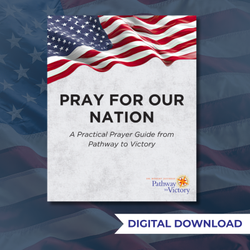
10 Days of Prayer for Our Nation is a devotional resource created to inspire believers to pray for America, its leaders, and future generations. Each day includes Scripture, guided prayer prompts, and encouraging biblical truths that point readers toward God’s faithfulness and promises.
Through this 10-day journey, readers will be reminded that true hope for our nation is found in God. It’s an opportunity to pray with confidence, strengthen personal faith, and seek God’s blessing, wisdom, and direction for the days ahead.
Past Episodes
- Choose Your Attitudes, Change Your Life
- Choosing The Extraordinary Life
- Christmas
- Christmas 2016 Message
- Christmas 2017 Message
- Christmas 2018 Message
- Christmas 2019 Message
- Christmas 2020 Message
- Colossians: Growing Stronger in Christ
- Coming Home to the Father Who Loves You
- Countdown to the Apocalypse
- Courageous : 10 Strategies For Thriving in a Hostile World
- Courageous Living in a Pagan World
- Daniel: Courageous Living In A Pagan World
- Discovering and Using Your Spiritual Gift
- Discovering God's Will
- Divine Defense
- Easter 2013 Sermon
- Easter 2015 Sermon
- Easter 2017 Sermon
- Easter 2018 Message
- Easter 2019 Message
- Easter 2020 message
- Easter 2021 Message
- Experiencing Your New Beginning
- God's Top Ten
- Grace Gone Wild
- Grace Gone Wild: Getting A Grip On God's Amazing Gift
- Grace-Powered Living
- Grace-Powered Living: A Study of Romans 1-4 | Our need — God’s Provision
- Growing Stronger in Christ
- Heaven Can't Wait!
- How Can I Know? Answers to Life's 7 Most Important Questions
- How to Make Wise Decisions
- Leading Your Family from Good to Great
- Living Above Your Circumstances
- Living By Faith: A Study of the Life of Abraham
- Living Without Regrets
- Living Your Dreams: A Study of Nehemiah
- Luke: Developing Your Passion for Christ
- Luke: Reigniting Your Passion for Christ
- Palm Sunday 2017 Message
- Pathway Partners
- Perfect Ending
- Politically Incorrect
- Prayers That Really Work
- Pressing On to Maturity: A Study of Hebrews
- PTV Listener Favorites
- Searching For the Good Life
- Second Chance, Second Act
- Single Messages
- Special Post 2020 Election Message
- Special Programming
- Spiritual Fitness: Strengthening Your Faith in Troubled Times
- Standalone
- Straight Answers to Tough Questions
- Thanksgiving Messages
- The Divine Defense
- The Incomparable Christ
- The Parables: Jesus' Favorite Stories
- The Perfect Ending
- The Solomon Secrets
- Twilight's Last Gleaming

Video from Dr. Robert Jeffress
Featured Offer
10 Days of Prayer for Our Nation is a devotional resource created to inspire believers to pray for America, its leaders, and future generations. Each day includes Scripture, guided prayer prompts, and encouraging biblical truths that point readers toward God’s faithfulness and promises.
Through this 10-day journey, readers will be reminded that true hope for our nation is found in God. It’s an opportunity to pray with confidence, strengthen personal faith, and seek God’s blessing, wisdom, and direction for the days ahead.
About Pathway to Victory
On each daily broadcast, Dr. Robert Jeffress provides practical application of God's Word to everyday life through clear, uncompromised Biblical teaching. Join him today on the Pathway to Victory!
About Dr. Robert Jeffress
Dr. Robert Jeffress is Senior Pastor of the 16,000-member First Baptist Church of Dallas, Texas. Dr. Jeffress is a FOX News contributor and appears regularly on FOX News Channel’s FOX & Friends , FOX News @ Night , Hannity , and The Faulkner Focus and on the FOX Business Network. Dr. Jeffress has made more than 4,000 guest appearances on television programs that include HBO’s Real Time with Bill Maher and Trinity Broadcasting Network’s Praise .
Established in 1996, Pathway to Victory serves as the broadcast ministry of Dr. Jeffress and exists to pierce the darkness with the light of God’s Word through the most effective media available. The daily radio programs air on over 1,100 stations, and the daily television program can be seen on over 11,000 cable and satellite systems, including Trinity Broadcasting Network (TBN), where it has been the #1 most-watched program since 2020. Pathway to Victory broadcasts are translated into seven languages and reach 193 countries throughout the world in addition to all major markets in the USA.
Contact Pathway to Victory with Dr. Robert Jeffress
info@ptv.org
https://ptv.org/
Mailing Address
Pathway to Victory
PO Box: 223609
Dallas, TX 75222-3609
Telephone Numbers
Customer Service: 214.969.2400
Toll-Free Radio Offer: 866-999-2965