


What’s So Good about Good Friday?


Have you ever wondered why Christians call the day of Jesus’ crucifixion “Good Friday”? After all, what could possibly be good about the brutal torture and execution of an innocent man? Dr. Robert Jeffress explains why Christ’s death was actually the greatest gift humanity has ever received.
To support Pathway to Victory, go to ptv.org/donate.
David: Hey podcast listeners, thanks for streaming today’s podcast from Pathway to Victory. Pathway to Victory is a nonprofit ministry featuring the Bible teaching of Dr. Robert Jeffress. Our mission is to pierce the darkness with the light of God’s word through the most effective media available, like this podcast. To support Pathway to Victory, go to ptv.org/donate or follow the link in our show notes. Now, here’s today’s podcast from Pathway to Victory.
Dr. Robert Jeffress: Hi, this is Robert Jeffress, and I’m glad to study God’s word with you every day on this Bible teaching program. On today’s edition of Pathway to Victory, crucifixion was designed to keep the person conscious and suffering. That’s what Jesus experienced on the cross for us, which begs the question: why would we ever use the term good to describe what happened to Jesus Christ?
David: Welcome to Pathway to Victory with author and pastor Dr. Robert Jeffress. Have you ever wondered why Christians call the day of Jesus’s crucifixion Good Friday? After all, what could possibly be good about the brutal torture and execution of an innocent man? Today on Pathway to Victory, Dr. Robert Jeffress explains why Christ’s death was actually the greatest gift humanity has ever received. But first, let’s take a moment to hear some important ministry updates.
Dr. Robert Jeffress: Thanks, David, and welcome again to Pathway to Victory. Last week, we completed our brand-new teaching series on spiritual warfare called The Divine Defense. I use the words brand-new because I delivered the messages a short while ago at my home church, First Baptist in downtown Dallas. Well, many in our listening family have inquired about the book I wrote on this topic. We’re extending the offer to receive a copy if you’ll respond right away.
It’s called The Divine Defense: Six Simple Strategies for Winning Your Biggest Battles. And it’s yours today when you give a generous gift to support the ministry of Pathway to Victory. And then, let me add this important invitation to join me on the upcoming Pathway to Victory cruise to Alaska. Over the years, I’ve become passionate about purposeful travel. My vacation time is valuable, just like yours, and if I’m going to be away, I want the days to really count.
For that reason, I’m inviting you to join us on a refreshing tour of the Great American Frontier. Imagine waking up every morning to the spectacular scenery of snow-capped mountains. Picture yourself exploring the wonder of God’s creations as you spot magnificent glaciers and awe-inspiring wildlife. I invite you to share these life-changing moments with me on this exquisite escape from your busy life. So, check out all the details at ptv.org.
Okay, we’re ready to get started with today’s message. Please turn in your Bibles with me to Romans chapter three, which is one of the seminal passages that describes the importance of the crucifixion. I titled today’s message with a question: What’s so good about Good Friday?
When you hear the word excruciating, what picture comes to mind? It’s probably some pain you have felt that you thought would never end, maybe the pain of childbirth or a kidney stone. But you thought it would never end. It might interest you to know that that word excruciate literally means out of, ex, the cross, out of the cross. It is a word that was coined originally by the Romans to describe the intolerable, unending pain of crucifixion.
Frederick Farrar, in his book The Life of Christ, explains it this way: "A death by crucifixion seemed to include all that pain and death can give in terms of the horrible and the ghastly." That’s what Jesus experienced on the cross for us, which begs the question: why would we ever use the term good to describe what happened to Jesus Christ? What is so good about torture and death on a cross?
The answer is that death that Christ experienced is the answer to our greatest dilemma, mankind’s greatest dilemma. It’s a dilemma that was expressed best by the patriarch Job in Job 9:2 when he said, "What must a person do to be right with God?" Now, admittedly, that’s not a question that many people are asking today. There are some who don’t believe there’s a God we need to be right with.
The majority of people believe in God, but they believe, although they’re not perfect, they’re good enough to have a right relationship with God. Most people don’t ever think about the question at all. Paul faced a similar audience when he wrote his letter to the Romans. He faced a culture like ours that was more interested in sex and sports than it was in salvation. But that didn’t keep Paul from being faithful to deliver the answer to our greatest dilemma.
What is his message? I’m going to give it to you ahead of time so you can write it down because it’s the theme of what we’re going to talk about for the next few moments. Salvation, Paul says, is not a reward, but it is a gift for those who trust in the death of Christ for the forgiveness of their sins. Notice how Paul develops that thought beginning in verse 21. First of all, he talks about the reality of God’s gift of salvation. And he makes three simple statements.
He says, first of all, God’s salvation is offered as a gift. Look at verse 21: "Now apart from the law, the righteousness of God has been manifested, being witnessed by the law and the prophets." That word righteousness literally means a right standing. A synonym would be salvation. Paul is saying a right standing with God is not something we earn; it is achieved apart from law, apart from keeping the law. It’s offered as a gift, not a reward.
And ladies and gentlemen, the greatest choice we have to make in life is: are we going to try to enter heaven in our own righteousness, wearing our own goodness, or are we going to believe what God says, and that is we have to have the righteousness of Jesus Christ? That’s why the Apostle Paul said in Philippians 2: "My prayer is that I might be found in Christ, not having a righteousness of my own derived from the law, but that righteousness, that perfect righteousness that comes on the basis of faith."
Salvation is offered as a gift, not a reward. Secondly, notice Paul says in verses 24 to 26, God’s salvation is based on the work of Christ. It’s offered as a gift; it is based on the work of Christ. Notice in these three verses Paul uses three words to describe what it is, the work that Christ accomplished on that Good Friday. First of all, redemption. Look at verse 24: "Being justified as a gift by His grace through the redemption which is in Christ Jesus."
Christ, through His blood, has redeemed us from spiritual slavery. We were in the clutches of Satan and sin, destined for an eternity of hell. But for no other reason than His great love that He had for us, God sent His Son Jesus to pay the price to redeem us from the slave market of sin. He has redeemed us. The second word that is used is propitiation. People stumble over that word in verse 25: "Whom," talking about Jesus, "God displayed publicly as a propitiation in His blood through faith."
What does that word mean? The word means satisfaction. Jesus Christ, by His death, satisfied the requirements of a holy God. Now, some people are offended by that. Is God some bloodthirsty deity that demands human blood to be satisfied? That sounds like a pagan religion. Well, there were pagan religions that taught that man has to do various things to appease an angry God, offer unending incantations, go through religious rituals, make sacrifice like throwing your children to the crocodiles to be eaten alive.
They were trying to appease their angry God. But here is what makes Christianity different from every other religion. Every other religion says man has to satisfy God’s requirements. But Christianity says we’re incapable of satisfying God; He had to be the one to satisfy His requirements. And that’s what He did when He sent His own Son to be the sacrifice for our sin. That’s what Christ did. He offers us the propitiation for our sins. He offers us redemption from our sins.
And the third word is justification. In verse 26, He says He is both the just and the justifier. This word justification is found over 200 times in the Greek New Testament. Justification is a legal term. It’s that legal act of God by which He declares a sinful person to be righteous. Paul says salvation is offered as a gift. He says, secondly, it’s based on the work of Christ. And thirdly, and most importantly, it is received through faith.
How do I receive that forgiveness in my life? It’s through faith. Look at verse 26: "For the demonstration I say of His righteousness at the present time, so that He would be the just and the justifier of the one who has faith in Jesus." Throughout this chapter, you see that word faith over and over again. Verse 22: "Through faith in Jesus Christ for all those who believe." Verse 25: "Whom God displayed as a propitiation in His blood through faith." Verse 26: "He who has faith in Jesus." Verse 28: "Man is justified by faith."
Faith is integral to our salvation. But listen to me, if you don’t understand what I’m about to say in the next five minutes, you’re going to miss heaven and you’re going to experience eternity in hell if you don’t understand what faith is and what it isn’t. Listen to me: faith is not the means of our salvation; it is the channel through which we receive salvation. We are not saved by faith. Nowhere in the Bible does it say we are saved by faith. Ephesians 2:8 and 9 says, "For by grace you have been saved through faith." Not by faith. We’re saved by grace, which we receive through faith.
You say, well, what in the world is the difference between the two things? Let me see if I can illustrate that for you. Some of you recognize this. It’s a cable for those of you who still have cable television. You remember what the cable is. For a generation of you who have never seen this before because you have a smart TV, we still have a cable. And you know how the cable works. One end of it you hook up to your cable box and the television program flows from the cable box into the other end that you attach to your television set.
This is the means by which you see a program; the cable allows you to see it. But this cable in and of itself can produce no television program. Imagine I take this cable tomorrow night at 8 o’clock, place it on my ottoman with my bowl of popcorn, and I just stare at this, waiting for my nightly rerun of The Beverly Hillbillies. And I’m sitting there waiting for it and wonder: where’s Jethro? Where’s Elly May? Where’s Jed? And I keep staring. It doesn’t matter how long I stare at this; there’s not going to be any television.
Because the television signal is not produced by this cable; it comes through this cable. It is the same way with saving faith. We are saved by God’s grace by the death of Christ that we receive through faith. Now, let me tell you something, two things actually, about saving faith, the kind of faith that saves. First of all, saving faith demands truth. It demands truth. We’re not saved by just some kind of faith that everything’s going to turn out somewhere, some kind of undefined feeling of faith.
Faith, true faith, saving faith always demands an object. It’s faith in something. Faith in something, not just faith, but faith in something. And it has to be the right something. It has to be faith based on truth, faith in the blood of Jesus Christ who died for our sins. Saving faith demands truth. And secondly, saving faith demands trust. That is, it’s not just an intellectual assent to a certain set of facts about Jesus. No, saving faith, that word believe means to trust in, to put your faith in, to put your whole weight upon.
That’s what it means to have saving faith. Think about it this way: imagine a parachutist who’s up in a plane about to make his jump. He’s strapped on the parachute. He believes that parachute can save him. But is it saving him while he’s in the comfort of that airplane cabin? No. The parachutist can stand at the door and dangle one foot out, but is that parachute saving him? No. It’s not until he takes that leap out of the airplane without any other support and pulls that rip cord that the parachute actually saves him.
Ladies and gentlemen, it is the same way with saving faith. It’s not believing certain facts about Jesus; it’s coming to that point in your life when you kneel before a holy God and you say, "God, I know I’m a sinner. I know I deserve your punishment. But I believe with all of my heart that Jesus died on the cross for me. He took the punishment I deserve. And I have nothing else I’m trusting in, not my goodness, not my church rituals. I’m trusting in what Jesus did alone to save me from my sins, give me eternal life."
It’s only when we say that out of sincere desperation that God declares us justified, free, redeemed forever and ever and ever. That is the message of the gospel. God’s gift of salvation is offered as a gift. It’s based on the work of Christ and it is received through faith. We’ve talked about the reality of God’s gift; let’s look at the results of God’s gift. What happens? What does it mean that we have received God’s gift? Well, the result of God’s gift is this: first of all, it demands humility.
Look at verses 27 to 28: "Where then is boasting? It’s excluded. By what kind of law? Of works? No, by a law of faith." The fact that we are saved by God’s grace we receive through faith means there’s no reason to boast. You know, just imagine: what if you and I played even a small role in our salvation? Can you imagine how miserable that would make heaven one day? Because all we would do is go up and down the streets, the golden streets, and brag to other people about what we did to get there.
Well, what did you do to get here? Well, this is what I did to get here. What did you do to get here? There’s going to be none of that in heaven because it’s all of God’s grace. There is no boasting. It demands humility. Secondly, it demonstrates and democratizes salvation. The fact that salvation is by grace alone democratizes salvation. Look at verse 29: "Or is God the God of the Jews only? Is He not the God of the Gentiles also? Yes, of the Gentiles also."
Paul is saying the fact that it’s grace means anybody can be a part of the family of God. Doesn’t matter your skin color, doesn’t matter your past religion, doesn’t matter your net worth or your education; everyone is free to partake of God’s grace. When I was living in Wichita Falls, I became friends with a great pastor, Dr. Frank Pollard, pastor of the great First Baptist Church of Jackson, Mississippi. And I remember a story he told me about his first Sunday preaching at that great church.
At the end of his sermon, he issued the invitation. He said it doesn’t matter who you are, it doesn’t matter the color of your skin, everybody is welcome to come to Christ and become a member of this church. Well, the next Monday morning, his phone rang. A group of the deacons wanted to meet with him. And they went on to explain to him why he was wrong and that everyone in fact was not welcome to come into the church, especially people of a certain skin color.
And when they had finished their diatribe, he said, "Gentlemen, I grew up in a three-room shack. I was the eighth child to be born to my family. The next younger brother was 12 years older than I was. I’m sure my older brothers didn’t want me. They could have gone to my father and they could have said, 'We don’t like him. He’s smelly. He’s noisy. He’s not like the rest of us. We want him out of the house.' And had they done that, my father would have said, 'Forget it. This is my house, and he stays.'"
And Dr. Pollard paused for a moment and looked at those deacons and he said, "Gentlemen, I don’t think we have a right to decide who is and who isn’t welcome in our Father’s house." That’s what Paul said. It doesn’t matter who you are, doesn’t matter your skin color, whether you’re black, white, or brown. It doesn’t matter your education level. It doesn’t matter what you’ve done or where you’ve been. If you want to trust in Christ for the forgiveness of sins, you are welcome into the family of God. That’s what grace does. It democratizes salvation.
And finally, grace demonstrates God’s justice. Look at verse 31: "Do we then nullify the law through faith? May it never be! On the contrary, we establish the law." I mean, somebody could say, well, grace means God’s law isn’t that important. Maybe God is not quite as holy as we think He is. I mean, for example, if God allowed us to earn our salvation by our obedience, what if He said, well, as long as you make 70 percent of the law, keep 70 percent of the law, you can come into heaven?
Well, that would mean 30 percent of the law’s not important. No, the fact that God’s requirements demanded the death of His Son, that that was the only way to settle the sin debt we all have, that doesn’t nullify the law. It shows how seriously God takes His law. All of God’s law is important. This week, I was rereading the story of the 18th-century poet William Cowper. You may know his story. When he was six years of age, his mother died. The father was unavailable.
So, they bundled young William up and, at six years of age, sent him off to a boarding school where he was bullied and badgered and even beaten by the older boys. He fell into severe depression and he tried to kill himself on two different occasions. Finally, when he was 25 years of age, in 1756, William Cowper was sent to an asylum for the insane. At that time in history, it’s the worst fate that could befall a human being to be sent in an asylum for the insane.
While he was in that asylum, he could be heard during nights crying out from his room, "My sin, my sin! If only there were a fountain that could cleanse me of my sin." But he knew of no such fountain. Until he met a new doctor who was assigned to his case, a godly Christian named Dr. Cotton. Dr. Cotton listened to his plea and showed him that fountain where he could find the cleansing of his sin. William Cowper writes his own testimony of that experience.
He said, "I flung myself into a chair near the window, and seeing a Bible there, I ventured once more to apply to it for comfort and instruction. The first verses I saw were in the third chapter of Romans," that passage we just looked at, "that says, 'being justified freely by His grace through the redemption that is in Christ Jesus.' Immediately," William said, "I received the strength to believe and the full beams of the sun of righteousness shone on me. I saw the sufficiency of Christ’s atonement He had made, my pardon in His blood, and the fullness and completeness of His justification."
"In a moment, I believed and I received the gospel." Years later, William Cowper would use that experience to write that hymn we still sing today. "There is a fountain filled with blood, drawn from Immanuel’s veins, and sinners plunged beneath that flood lose all their guilty stain. The dying thief rejoiced to see that fountain in his day, and there may I, though vile as he, wash all my sins away." Salvation is not a reward; it is a gift to those who trust in the death of Christ for the forgiveness of their sins. That’s what makes Good Friday so good.
Wash all my sins away. Those words have been sung by millions of voices across hundreds of years. All of them discovering the same thing William Cowper discovered in his darkest hour: that the grace of God runs deeper than the worst thing you have ever done. That’s the miracle of Good Friday. Not that a good man died, but that the sinless Son of God chose to die for you, for me, and for every other person who fears that they are simply too far gone to be forgiven.
The cross says no one is too far gone for the grace of God. And yet, Good Friday alone is not the complete story. The gift of salvation that was purchased on that cross was validated three days later when Jesus Christ walked out of that tomb alive. The resurrection is God’s confirmation that our sin debt was paid in full. Without Easter Sunday, Good Friday is only tragedy. With it, Good Friday becomes the most important day in human history.
This message remains at the heart of Pathway to Victory. We exist to tell the truth about Jesus Christ, His death on that cross for sinners, just like you and me. His burial and His bodily resurrection from the dead, which shattered the power of sin and the grave and changed everything forever. That truth deserves to be heard in every home, in every city, in every corner of this world. And with your generous support today, that is exactly what we are going to do. Now, here’s David to tell you about the resources you’ll receive as our way of saying thank you when you support the ministry of Pathway to Victory.
David: When you give a generous gift to support the ministry of Pathway to Victory, we’ll say thanks by sending you The Divine Defense. That’s Dr. Jeffress’s best-selling book on demons and spiritual warfare. You’ll get that along with the Equipped for Battle brochure. Just call 866-999-2965 or go online to ptv.org. To give by text, simply send PTV to 78800. And when your gift is $100 or more, we’ll also send you this month’s teaching series on audio and video disc, a companion study guide, plus a book especially for children called Suit Up for Kids.
This engaging book equips children with biblical truth and practical lessons on spiritual victory. One more time, call 866-999-2965 or go online to ptv.org. You could write to us if you’d like: PO Box 223609, Dallas, Texas, 75222. That’s PO Box 223609, Dallas, Texas, 75222. I’m David J. Mullens. The night before Jesus was crucified, he observed the Passover meal with his disciples. And in doing so, he would impart this tradition with entirely new significance and meaning. Join Dr. Jeffress in reflecting on the last supper before the first Easter. That’s Wednesday on Pathway to Victory.
Dr. Robert Jeffress: Pathway to Victory with Dr. Robert Jeffress comes from the pulpit of the First Baptist Church of Dallas, Texas.
David: You made it to the end of today’s podcast from Pathway to Victory, and we’re so glad you’re here. Pathway to Victory relies on the generosity of loyal listeners like you to make this podcast possible. One of the most impactful ways you can give is by becoming a pathway partner. Your monthly gift will empower Pathway to Victory to share the gospel of Jesus Christ and help others become rooted more firmly in His word. To become a pathway partner, go to ptv.org/donate or you can follow the link in our show notes. We hope you’ve been blessed by today’s podcast from Pathway to Victory. Oh, and one last thing before we go: have you reserved your spot yet for the 2026 Pathway to Victory cruise to Alaska? You’ve been hearing me and Dr. Jeffress mention it, so what are you waiting for? Just picture yourself on the deck of Holland America’s elegant Koningsdam and stepping out on deck to witness nature’s grandeur. It’s beautiful. These moments in God’s creation will deepen your faith in powerful ways; it really will. Experience five-star dining, luxurious staterooms, and visiting iconic ports like Juneau, Ketchikan, and Skagway. We’re also bringing along our own Christian entertainment; you’ll love it. Seats are filling up, so book your spot today at ptv.org.
Featured Offer
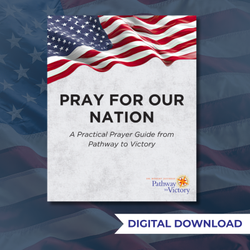
10 Days of Prayer for Our Nation is a devotional resource created to inspire believers to pray for America, its leaders, and future generations. Each day includes Scripture, guided prayer prompts, and encouraging biblical truths that point readers toward God’s faithfulness and promises.
Through this 10-day journey, readers will be reminded that true hope for our nation is found in God. It’s an opportunity to pray with confidence, strengthen personal faith, and seek God’s blessing, wisdom, and direction for the days ahead.
Past Episodes
- Choose Your Attitudes, Change Your Life
- Choosing The Extraordinary Life
- Christmas
- Christmas 2016 Message
- Christmas 2017 Message
- Christmas 2018 Message
- Christmas 2019 Message
- Christmas 2020 Message
- Colossians: Growing Stronger in Christ
- Coming Home to the Father Who Loves You
- Countdown to the Apocalypse
- Courageous : 10 Strategies For Thriving in a Hostile World
- Courageous Living in a Pagan World
- Daniel: Courageous Living In A Pagan World
- Discovering and Using Your Spiritual Gift
- Discovering God's Will
- Divine Defense
- Easter 2013 Sermon
- Easter 2015 Sermon
- Easter 2017 Sermon
- Easter 2018 Message
- Easter 2019 Message
- Easter 2020 message
- Easter 2021 Message
- Experiencing Your New Beginning
- God's Top Ten
- Grace Gone Wild
- Grace Gone Wild: Getting A Grip On God's Amazing Gift
- Grace-Powered Living
- Grace-Powered Living: A Study of Romans 1-4 | Our need — God’s Provision
- Growing Stronger in Christ
- Heaven Can't Wait!
- How Can I Know? Answers to Life's 7 Most Important Questions
- How to Make Wise Decisions
- Leading Your Family from Good to Great
- Living Above Your Circumstances
- Living By Faith: A Study of the Life of Abraham
- Living Without Regrets
- Living Your Dreams: A Study of Nehemiah
- Luke: Developing Your Passion for Christ
- Luke: Reigniting Your Passion for Christ
- Palm Sunday 2017 Message
- Pathway Partners
- Perfect Ending
- Politically Incorrect
- Prayers That Really Work
- Pressing On to Maturity: A Study of Hebrews
- PTV Listener Favorites
- Searching For the Good Life
- Second Chance, Second Act
- Single Messages
- Special Post 2020 Election Message
- Special Programming
- Spiritual Fitness: Strengthening Your Faith in Troubled Times
- Standalone
- Straight Answers to Tough Questions
- Thanksgiving Messages
- The Divine Defense
- The Incomparable Christ
- The Parables: Jesus' Favorite Stories
- The Perfect Ending
- The Solomon Secrets
- Twilight's Last Gleaming

Video from Dr. Robert Jeffress
Featured Offer
10 Days of Prayer for Our Nation is a devotional resource created to inspire believers to pray for America, its leaders, and future generations. Each day includes Scripture, guided prayer prompts, and encouraging biblical truths that point readers toward God’s faithfulness and promises.
Through this 10-day journey, readers will be reminded that true hope for our nation is found in God. It’s an opportunity to pray with confidence, strengthen personal faith, and seek God’s blessing, wisdom, and direction for the days ahead.
About Pathway to Victory
On each daily broadcast, Dr. Robert Jeffress provides practical application of God's Word to everyday life through clear, uncompromised Biblical teaching. Join him today on the Pathway to Victory!
About Dr. Robert Jeffress
Dr. Robert Jeffress is Senior Pastor of the 16,000-member First Baptist Church of Dallas, Texas. Dr. Jeffress is a FOX News contributor and appears regularly on FOX News Channel’s FOX & Friends , FOX News @ Night , Hannity , and The Faulkner Focus and on the FOX Business Network. Dr. Jeffress has made more than 4,000 guest appearances on television programs that include HBO’s Real Time with Bill Maher and Trinity Broadcasting Network’s Praise .
Established in 1996, Pathway to Victory serves as the broadcast ministry of Dr. Jeffress and exists to pierce the darkness with the light of God’s Word through the most effective media available. The daily radio programs air on over 1,100 stations, and the daily television program can be seen on over 11,000 cable and satellite systems, including Trinity Broadcasting Network (TBN), where it has been the #1 most-watched program since 2020. Pathway to Victory broadcasts are translated into seven languages and reach 193 countries throughout the world in addition to all major markets in the USA.
Contact Pathway to Victory with Dr. Robert Jeffress
info@ptv.org
https://ptv.org/
Mailing Address
Pathway to Victory
PO Box: 223609
Dallas, TX 75222-3609
Telephone Numbers
Customer Service: 214.969.2400
Toll-Free Radio Offer: 866-999-2965