


The Most Misunderstood Word in America – Part 2


America is a place where people of all races, religions, and backgrounds can live in harmony. But today’s society has taken its definition of tolerance to a whole new level! Dr. Robert Jeffress shares how our modern understanding of tolerance has changed from its historical meaning.
To support Pathway to Victory, go to ptv.org/donate.
David: Hey podcast listeners. Thanks for streaming today's podcast from Pathway to Victory. You know, Pathway to Victory is a nonprofit ministry featuring the Bible teaching of Dr. Robert Jeffress.
And right now, your generous gift will have twice the impact thanks to the In God We Trust $1.5 million matching challenge, active now through July 5th. To give a special matching challenge gift, go to PTV.org/donate or follow the link in our show notes. Now, here's today's podcast from Pathway to Victory.
Dr. Robert Jeffress: Hi, this is Robert Jeffress, and I'm glad to study God's word with you every day on this Bible teaching program. On today's edition of Pathway to Victory. True tolerance is based on a genuine concern for other people.
A genuine concern that says, I respect your right to believe what you want to believe, to behave as you want to behave. But I also love you too much to remain silent about it. True tolerance not only allows for a strong point of view, it actually demands it.
David: Welcome to Pathway to Victory with author and pastor Dr. Robert Jeffress. You know, America is a place where people of all races, religions and backgrounds can live in harmony. And while this type of community couldn't work without tolerance, our contemporary understanding of that word has taken on an alarming redefinition. Today on Pathway to Victory, Dr. Robert Jeffress shares how today's understanding of tolerance has changed from its historical meaning. But first, let's take a moment to hear some important ministry updates.
Dr. Robert Jeffress: Thanks, David, and welcome again to Pathway to Victory. I'm delighted that you're with me today. As we continue our special teaching series called America and the Bible. I'm sure you agree with me about a tragic trend in the news media today. Political pundits weaving a false narrative about America's rich Christian heritage.
Well, on today's program, you'll hear me describe a word in the English vocabulary that critics have completely misconstrued in order to undermine the Christian foundation of our country. It's the word tolerance. Critics are leveraging this word against Christians, and I want to show you the biblical way to respond. But that's not all that's happening in our culture. Today's woke historians are attempting to twist the truth about our country's founding as well.
And I'm pleased to offer an uplifting book that will help your loved ones stand firm on the principles of faith, family, and freedom that have guided our great nation from her earliest days. This special book is called Our 250th Commemorative Edition of America Is a Christian Nation. And a copy is yours when you give a generous gift toward the In God We Trust matching challenge that's active right now.
As perhaps you've heard, Pathway to Victory is the recipient of a large matching challenge in the amount of $1.5 million. This means that every dollar you give toward blessing America with the hope of God's word will be automatically doubled in impact. I'm going to share more details later in the program.
But right now, let's consider today's very important topic. I'm speaking about the most misunderstood word in America. In today's world, when people say I am tolerant of something, they're saying I believe that that belief, behavior, or choice is just as valid as mine.
However, what I'm going to call true tolerance not only allows for but it requires a belief in absolute truth. Author Gregory Koukl says, probably no concept has more currency in our politically correct culture than the notion of tolerance. Unfortunately, one of America's noblest virtues has been so distorted, it's become a vice.
But tolerance, when correctly understood, really is a virtue that ought to be embraced. But what society understands tolerance to be and what true tolerance is, are vastly different things. Gregory Koukl again identifies the three critical components of true tolerance. Number one, there's a permitting or allowing something you dislike or don't agree with. Secondly, a conduct or point of view with which one disagrees within the process, while number three, respecting the person in the process.
Now, this pseudo tolerance, this new tolerance resembles historical tolerance in some ways, but it's also radically different from the historic understanding of tolerance in four distinct ways. I want you to write this down. First of all, pseudo tolerance rejects the idea of absolute truth.
And of course, by rejecting absolute and spiritual truth, pseudo tolerance has to become what they say they despise. And that leads to a second characteristic of pseudo tolerance. Pseudo tolerance is intolerant of other points of views. That's the most ironic thing about the whole thing. Those who say they're tolerant usually end up being the most intolerant people of all. Let me give you some illustrations of that.
A few years ago, I was invited to be on a panel discussion at one of the largest Jewish temples here in Dallas. And the panel discussion had to do with the separation of church and state. During the discussion, one of the panelists asked me this question. They said, Dr. Jeffress, why are you so opposed to teaching evolution in the public classroom?
I said, I'm not opposed to teaching evolution at all. I think evolution ought to be taught. My question to you, I said, was, why are you so opposed to allowing creationism also to be taught as an alternate theory?
See, that is the hypocrisy of tolerance. The intolerance of these pseudo tolerant people reaches into spiritual issues as well. I want you to read carefully this statement from Reverend William Murray, a prominent Unitarian Universalist minister. Listen to what he says about what he calls intolerant religions. Listen to what he says, quote, I get a little impatient with the concept that we should tolerate all religions because people are entitled to their own beliefs.
If a religion is based on ignorance and irrationality and totalitarianism, think evangelical Christianity, if a religion is based on these things, there is no need to stand aside and pretend that's okay. What I would say about tolerance is, we cannot tolerate intolerance. Now, that statement reveals the hypocrisy of pseudo tolerance.
Number three, pseudo tolerance refuses to differentiate between people and their beliefs and their behavior. Pseudo tolerance refuses to allow you to differentiate between people and their beliefs and behaviors. In other words, to reject Islam is to reject Muslims. If you oppose same-sex marriages, it means you hate homosexuals. If you lobby for the repeal of Roe v. Wade, it means you must despise every woman who has ever had an abortion.
Do you see how insidious that is? Thank goodness, God separates us from our behavior. He says, I hate what you do, but I love you. Listen to me, for us to be the salt and light Jesus commanded us to be, we have to reject every vestige of pseudo tolerance.
Instead of rejecting the concept of tolerance altogether, what we need to do is return to the historic understanding of true tolerance. And what I mean by true tolerance cannot only enhance our preserving influence as Christians in this world, but if we model true tolerance, we can also boost the brightness of our witness for Christ. How does true tolerance differ from pseudo tolerance in three distinct ways? Number one, true tolerance requires making a judgment.
Remember, you can only tolerate those things with which you disagree with, like same-sex marriage, or those things you dislike. So that means you have to make a judgment. Now, we make judgments all the time, don't we?
Some years ago, I made the choice to marry my wife, Amy, over other choices that were out there. Not that many, but other choices were out there. No, that's not true.
I made that choice because she was a superior choice in my mind. I made a judgment. And yet today, the proponents of pseudo tolerance have convinced us that it is unloving and unkind and even unchristian to make any kind of moral or spiritual judgment. And they always quote the words of Jesus. After all, they said, didn't Jesus say, judge not, lest you be judged?
I want you to turn there for a moment to Matthew chapter 7, and let's see what Jesus actually was saying when he said we're not to judge, lest we be judged. In Matthew 7, Jesus was railing against the Pharisees. The Pharisees came up with these strict regulations for how people ought to behave, regulations that they were unwilling to live by themselves.
They were hypocrites. They're like a lot of these politicians who talk about, oh, we're for family values, and yet they behave privately in immoral ways themselves. That's what Jesus was railing about. He said, don't judge other people like the Pharisees to make yourself look better to God and to others. But it is obvious from what Jesus said here, he was not opposing making any judgment at all. Look at Matthew 7. Do not judge, lest you be judged, for in the way you judge, you will be judged, and by your standard of measure, it will be measured to you. And why do you look at the speck that is in your brother's eye, but do not notice the log that is in your own eye? Or how can you say to your brother, let me take the speck out of your eye, and behold the log is in your own eye? You hypocrite, first take the log out of your own eye, and then you will be able to see clearly to take the speck out of your brother's eye. What he's talking about is this.
If you see a fellow Christian who is involved in sin, what are you supposed to do? You ought to do everything you could to help remove that speck from his eye. And you do it not because you hate him, but because you care about him. But to remove that speck from his eye, you have to make a series of judgment. You make the judgment that first of all, we are all accountable to God. Secondly, there are certain beliefs that are contrary to God's revealed will found in the Bible. Thirdly, this person, my fellow Christian, is engaging in some of that behavior. And finally, this kind of behavior will lead to a bad end for him. All of those judgments you have to make before you try to help him with the sin in his life. And Jesus says, by the way, before you try to help him with sin in his life, take the blindfold off, examine your own life first of all, to be sure you're ready to perform the operation, take that beam, that two by four out of your eye as well.
And that leads to a second characteristic of true tolerance. True tolerance is grounded in a genuine concern for other people. The only reason you'd try to remove a particle from somebody's eye is for the well-being of that individual. The effort to remove the particle may involve some temporary discomfort. But thirdly, the motivation for making the judgment and inflicting temporary pain is the long-term comfort of that other person.
You know, we have been told by the pseudo tolerance movement that if we make a judgment that somebody is engaging in beliefs, behaviors, or choices that are wrong, if we judge them in any way, that is a sign of hate. No, the truth is, remaining silent about people's behaviors, beliefs, or choices that cause them harm, that is the most unloving thing you can possibly do.
The famous evangelist of yesteryear, Charles Finney, once said, if you see your neighbor's sin and pass by and neglect to reprove him, it is just as cruel as if you should see his house on fire and pass by and not warn him of it. True tolerance is many times showing a genuine concern for others. Number three, true tolerance allows for preferences.
Proponents of pseudo tolerance have convinced us that tolerance necessitates neutrality. Pseudo tolerance says, you can't have any judgments about anything and truly be tolerant. But to be truly accepting of others, the fact is, we need to express our preference for certain choices, beliefs, and behavior.
Let me illustrate that for you on a governmental level if I could. True tolerance in our government demands that we allow people to embrace beliefs and engage in behaviors that we find distasteful, that we find to be wrong, just as long as those behaviors don't exceed the boundaries of the law. Our Constitution demands that we allow people to worship any God they choose to worship or no God at all. That is the First Amendment.
However, the fact that our Constitution demands that everyone have the freedom to embrace any religious beliefs or no religious beliefs, does not mean that the government cannot demonstrate a preference for Christianity. You see, many people erroneously believe that the First Amendment of the Constitution demands government neutrality or even hostility toward all things Christians. Remember the First Amendment, Congress shall make no law regarding the establishment of religion or prohibiting the free exercise thereof.
In recent years, the so-called establishment clause has been used to ban everything from nativity scenes in the public square to prohibiting prayers at graduation ceremonies because such outward and overt Christian expressions implied the government's endorsement of a specific religion. Now, the problem with that application of the First Amendment is, it is based on a truly false understanding of the words religion and establishment. The First Amendment was written and ratified to guarantee that no particular denomination within the Christian sect would be made the national church of America that everyone would have to worship in. That is all that was meant by the First Amendment. When it says Congress shall not establish a religion, it means Congress shall not establish the Methodist Church, the Baptist Church, the Congregational Church as the state church of which everyone must be a part of.
Now, I made that claim a few weeks ago. You've heard me say that before. You may say, well, pastor, how do you know that's true? How do you know that is what the framers of the Constitution meant in the First Amendment, that they were referring to denominations within Christianity and not different faiths like Hinduism and Buddhism and Islam and so forth? I'm going to give you that evidence and it is compelling.
Supreme Court Justice Joseph Story was appointed to the Supreme Court by President James Madison in 1811. Do you remember who James Madison was? James Madison was considered the chief author and the founder of the Constitution. In fact, 20 years earlier, before he appointed Justice Story, James Madison is the one who introduced the Bill of Rights, including the First Amendment to Congress. That was James Madison. He was the architect of our Constitution. He is the one who appointed Supreme Court Justice Joseph Story.
Now, Justice Story was made a Justice of the Supreme Court by James Madison in 1811, only 20 years after the ratification of the First Amendment. So here you've got a Supreme Court Justice appointed by the architect of the Constitution, James Madison, who's living at the same time as the framers of the First Amendment. He was alive during the debate. It's interesting that Joseph Story wrote a commentary on the Constitution of the United States, and in that commentary, he clarified the meaning of the First Amendment.
And listen to what Joseph Story said. He said, quote, the real object of the First Amendment was not to countenance, much less to advance Islam or Judaism or any other infidelity by prostrating Christianity. No, the whole object was to exclude all rivalry among Christian sects, denominations, and to prevent any national ecclesiastical establishment which should give a hierarchy the exclusive patronage of the national government.
Justice Story said, the whole purpose of the First Amendment was simply to create one Christian sect from being the national church. He goes on to say, never in our wildest imagination was it meant to prostrate Christianity. To elevate Judaism, Islam, and any other infidelity of a religion above the Christian faith. Now, don't you find that fascinating?
That is what was meant by the First Amendment. Congress shall make no law regarding the establishment of a denomination. That is what he was talking about. And although the Constitution allows that people are free to embrace Hinduism, Islam, Judaism if they want to, never should we believe that that is in any way saying that all religions are equally valid. America was founded as a unique Christian nation.
In the New York State Supreme Court case of the People versus Ruggles, Chief Justice James Kent wrote in that case, quote, we are a Christian people, and the morality of the country is deeply engrafted upon Christianity. And not upon the doctrines or worship of those imposters. Listen, that is a high court saying every other religion besides Christianity is an imposter religion.
What I'm saying is true tolerance allows other religious beliefs, but it also allows the showing of preference to other religious beliefs. The belief of Christianity. Our forefathers did not hesitate to declare that America was a Christian nation. And although again they championed the right of other people to embrace other faiths, they did not demand that government prostrate Christianity.
There is no mandate, ladies and gentlemen, in the Constitution that requires government to prevent public expressions of the Christian faith in the public square. In fact, as I've demonstrated in the last two examples, the First Amendment doesn't even require that government treat all faiths equally. You know, you've got high school principals, bless their hearts. They say, well, you know, if I allow a Christian to pray at graduation, then I have to allow a Jew, and then I have to allow a Hindu, and then I have to allow a Muslim. No, you don't. That's not what the First Amendment says. It says you don't have to prostrate Christianity in the name of other religions. A city mayor isn't obligated to balance a nativity scene with a Jewish menorah. The fact is, true tolerance allows for preferences even in the government.
A few months ago, I was interviewed on the radio by Alan Combs. You know, the token liberal at Fox News, and boy, he's an interesting guy. But he kind of ambushed me in the interview because little did I know he had pulled a string of my comments from different sermons over a period of about 15 years, and he just played them one after another to show what an intolerant person I was. And one of the clips he played was where I showed that we as Christians ought to prefer Christians to be our leaders. And so he said, so Dr. Jeffress, what you're saying is you don't want any Jews, Muslims, or Hindus running for office. You want to keep them out of office. I said, that's not true at all. I think anybody has the right to run for public office without any religious test by the government. That's Article 6 of the Constitution. But I also have the right to prefer Christians over non-Christians as our leaders. You see, that is what true tolerance is. True tolerance allows for preferences.
However, when we demonstrate our preference, I do think we need to follow the example of the Lord Jesus Christ. You know, Jesus was very interesting in the way he presented absolute truth. He was very hard in his convictions. In Matthew 10:34, Jesus said, do not think I came to bring peace on the earth. I did not come to bring peace, but a sword. Or Luke 15:25, if anyone comes to me and does not hate his own father and mother and wife and children, and brothers and sisters, yes, even his own life, he cannot be my disciple. Now, those are tough comments, aren't they?
Jesus was tough in his convictions, but he was very soft when it came to people. He was what I like to call a velvet-covered brick. Hard in his convictions, soft with other people who were genuinely searching for God. And I believe if we're going to be effective in being salt and light in our culture, we have to find that same mix between conviction and compassion. But hear me, compassion for other people doesn't negate conviction.
True tolerance not only allows for a strong point of view, it actually demands it. True tolerance is based on a genuine concern for other people. A genuine concern that says, I respect your right to believe what you want to believe, to behave as you want to behave. But I also love you too much to remain silent about it. That is true tolerance.
In his book, The New Absolutes, William Watkins writes, we must violate the new tolerance and become a people marked by intolerance. Not an intolerance that unleashes hate upon people, but an intolerance that's unwilling to allow error to masquerade as truth. An intolerance that is willing to call evil evil and good good.
There's never been a more urgent moment in history when so much hangs in the balance for our country. My hope and prayer is that God would raise up men and women all across America who would become salt and light for him. You can become part of this movement by joining Pathway to Victory as a financial partner. Last week, we launched the $1.5 million In God We Trust matching challenge. That means every gift we receive from now through July 5th will be matched and therefore doubled in impact until we reach the goal.
This is the perfect time for you to leverage your contribution. To thank you for your gift to the matching challenge, I've prepared something I hope will bless your entire family. It's our 250th Commemorative Edition of America Is a Christian Nation. This is a beautifully crafted volume filled with inspiring stories, stunning images, and powerful reminders of the Christian faith that has always been at the heart of this nation. I believe it will be a treasured addition to your home for years to come.
But before I hand this over to David, I want to state this very clearly, in an age where Christian values are being mocked and scorned, you and I need to stand firm on the principles of faith, family, and freedom that have guided our great nation. And through your partnership with us, we are working toward that goal. So, thank you for your generous support during this critical time for our nation. Here's David to tell you more.
David: When you give a generous gift to support the ministry of Pathway to Victory, you're invited to request the brand new 250th Commemorative Edition of America Is a Christian Nation. In addition to the book, you'll also receive In God We Trust, a brand new two-disc set featuring music performances by the First Baptist Dallas Choir and Orchestra and teaching from Dr. Robert Jeffress. To request these resources, call 866-999-2965 or visit PTV.org. You could also text PTV to 78800.
And when your gift is $100 or more, we'll also send you the America and the Bible message series on DVD video and MP3 format audio disc. And remember, because of the In God We Trust matching challenge, your gift to Pathway to Victory will be matched and therefore doubled in impact. So be sure to get in touch with us today. One more time, call 866-999-2965 or go online to PTV.org.
You could also send your donation by mail, write to PO Box 223609, Dallas, Texas 75222. Again, that's PO Box 223609, Dallas, Texas 75222. I'm David J. Mullins. Every day it seems like our country wanders farther away from the Christian principles upon which it was founded. Is there any way to prevent America from falling? Learn why the preservation of our nation depends on the local church. That's Friday on Pathway to Victory. Pathway to Victory with Dr. Robert Jeffress comes from the pulpit of the First Baptist Church of Dallas, Texas.
You made it to the end of today's podcast from Pathway to Victory, and we're so glad you're here. Pathway to Victory relies on the generosity of loyal listeners like you to make this podcast possible. And right now, your ministry gift will be matched and therefore doubled in impact thanks to the In God We Trust $1.5 million matching challenge. Take advantage of this opportunity to double your impact before the deadline on July 5th. To give toward the matching challenge, go to PTV.org/donate or follow the link in our show notes. We hope you've been blessed by today's podcast from Pathway to Victory.
Featured Offer
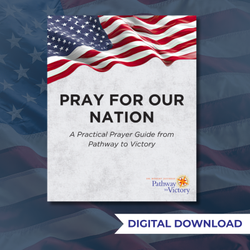
10 Days of Prayer for Our Nation is a devotional resource created to inspire believers to pray for America, its leaders, and future generations. Each day includes Scripture, guided prayer prompts, and encouraging biblical truths that point readers toward God’s faithfulness and promises.
Through this 10-day journey, readers will be reminded that true hope for our nation is found in God. It’s an opportunity to pray with confidence, strengthen personal faith, and seek God’s blessing, wisdom, and direction for the days ahead.
Past Episodes
- Choose Your Attitudes, Change Your Life
- Choosing The Extraordinary Life
- Christmas
- Christmas 2016 Message
- Christmas 2017 Message
- Christmas 2018 Message
- Christmas 2019 Message
- Christmas 2020 Message
- Colossians: Growing Stronger in Christ
- Coming Home to the Father Who Loves You
- Countdown to the Apocalypse
- Courageous : 10 Strategies For Thriving in a Hostile World
- Courageous Living in a Pagan World
- Daniel: Courageous Living In A Pagan World
- Discovering and Using Your Spiritual Gift
- Discovering God's Will
- Divine Defense
- Easter 2013 Sermon
- Easter 2015 Sermon
- Easter 2017 Sermon
- Easter 2018 Message
- Easter 2019 Message
- Easter 2020 message
- Easter 2021 Message
- Experiencing Your New Beginning
- God's Top Ten
- Grace Gone Wild
- Grace Gone Wild: Getting A Grip On God's Amazing Gift
- Grace-Powered Living
- Grace-Powered Living: A Study of Romans 1-4 | Our need — God’s Provision
- Growing Stronger in Christ
- Heaven Can't Wait!
- How Can I Know? Answers to Life's 7 Most Important Questions
- How to Make Wise Decisions
- Leading Your Family from Good to Great
- Living Above Your Circumstances
- Living By Faith: A Study of the Life of Abraham
- Living Without Regrets
- Living Your Dreams: A Study of Nehemiah
- Luke: Developing Your Passion for Christ
- Luke: Reigniting Your Passion for Christ
- Palm Sunday 2017 Message
- Pathway Partners
- Perfect Ending
- Politically Incorrect
- Prayers That Really Work
- Pressing On to Maturity: A Study of Hebrews
- PTV Listener Favorites
- Searching For the Good Life
- Second Chance, Second Act
- Single Messages
- Special Post 2020 Election Message
- Special Programming
- Spiritual Fitness: Strengthening Your Faith in Troubled Times
- Standalone
- Straight Answers to Tough Questions
- Thanksgiving Messages
- The Divine Defense
- The Incomparable Christ
- The Parables: Jesus' Favorite Stories
- The Perfect Ending
- The Solomon Secrets
- Twilight's Last Gleaming

Video from Dr. Robert Jeffress
Featured Offer
10 Days of Prayer for Our Nation is a devotional resource created to inspire believers to pray for America, its leaders, and future generations. Each day includes Scripture, guided prayer prompts, and encouraging biblical truths that point readers toward God’s faithfulness and promises.
Through this 10-day journey, readers will be reminded that true hope for our nation is found in God. It’s an opportunity to pray with confidence, strengthen personal faith, and seek God’s blessing, wisdom, and direction for the days ahead.
About Pathway to Victory
On each daily broadcast, Dr. Robert Jeffress provides practical application of God's Word to everyday life through clear, uncompromised Biblical teaching. Join him today on the Pathway to Victory!
About Dr. Robert Jeffress
Dr. Robert Jeffress is Senior Pastor of the 16,000-member First Baptist Church of Dallas, Texas. Dr. Jeffress is a FOX News contributor and appears regularly on FOX News Channel’s FOX & Friends , FOX News @ Night , Hannity , and The Faulkner Focus and on the FOX Business Network. Dr. Jeffress has made more than 4,000 guest appearances on television programs that include HBO’s Real Time with Bill Maher and Trinity Broadcasting Network’s Praise .
Established in 1996, Pathway to Victory serves as the broadcast ministry of Dr. Jeffress and exists to pierce the darkness with the light of God’s Word through the most effective media available. The daily radio programs air on over 1,100 stations, and the daily television program can be seen on over 11,000 cable and satellite systems, including Trinity Broadcasting Network (TBN), where it has been the #1 most-watched program since 2020. Pathway to Victory broadcasts are translated into seven languages and reach 193 countries throughout the world in addition to all major markets in the USA.
Contact Pathway to Victory with Dr. Robert Jeffress
info@ptv.org
https://ptv.org/
Mailing Address
Pathway to Victory
PO Box: 223609
Dallas, TX 75222-3609
Telephone Numbers
Customer Service: 214.969.2400
Toll-Free Radio Offer: 866-999-2965