


Putting Out The “Not Welcome” Mat – Part 2


In our ongoing battle against Satan, the breastplate of righteousness is one of our most critical defenses. But what exactly is righteousness? And how does it shield us from the enemy’s attacks? Dr. Robert Jeffress explains the difference between self-righteousness and the righteousness that comes as a gift from God.
To support Pathway to Victory, go to ptv.org/donate.
David: Hey podcast listeners. Thanks for streaming today’s podcast from Pathway to Victory. Pathway to Victory is a nonprofit ministry featuring the Bible teaching of Dr. Robert Jeffress. Our mission is to pierce the darkness with the light of God's word through the most effective media available, like this podcast.
To support Pathway to Victory, go to ptv.org/donate or follow the link in our show notes. Now, here's today's podcast from Pathway to Victory.
Dr. Robert Jeffress: Hi, this is Robert Jeffress and I'm glad to study God's Word with you every day on this Bible teaching program. On today's edition of Pathway to Victory, have you discovered we can't always keep Satan and his demons from attacking us?
But we can create an environment in our life that is inhospitable to Satan and his helpers. We can live in such a way that they don't feel welcome in our lives.
David: Welcome to Pathway to Victory with author and pastor Dr. Robert Jeffress. In our ongoing battle against Satan, the breastplate of righteousness is one of our most critical defenses. But what exactly is righteousness, and how does it shield us from the enemy's attacks?
Today on Pathway to Victory, Dr. Robert Jeffress explains the difference between self-righteousness and the righteousness that comes as a gift from God. But first, let's take a moment to hear some important ministry updates.
Dr. Robert Jeffress: Thanks, David. And welcome again to Pathway to Victory. We're just getting started in a brand-new teaching series about spiritual warfare. It's called The Divine Defense. In my book for this series, The Divine Defense, I'll walk you through six powerful strategies that will revolutionize your spiritual life.
This is your daily battle plan for winning the war against Satan. And when you stand with Pathway to Victory through your generous gift today, I'll send you a copy as my personal thank you for your partnership in ministry. This book will spark lively discussion in your Bible study group, and of course, it's perfect for your daily quiet times as well.
In addition to my book, I'll also include a multi-folded brochure I've written for you. It's colorfully illustrated and called Equipped for Battle. This resource offers you six keys to spiritual success. All right, we'll have more details about these resources later in today's program. But right now, let's get started with today's study. Drawing wisdom from Paul's letter to the Ephesians chapter six, I titled today's message: Putting out the Not Welcome Mat.
Our enemy is Satan himself. And if we're going to win in our battle against Satan, we better use the spiritual weapons that God has given us, and they're listed in Ephesians chapter six. We talked about those spiritual weapons beginning last time. Remember, the first thing he said was put on the belt of truth, where he says in Ephesians 6:14, "Stand firm, therefore, having girded your loins with truth."
But the second piece of weaponry is mentioned also in verse 14: "and having put on the breastplate of righteousness." What is the breastplate of righteousness? For a Roman soldier, the breastplate was essential. It was a piece of molded metal that covered the torso and protected vital organs like the heart and the lungs and the bowels.
Well, as Christians, we need to put on a breastplate, but it's not of metal; it's a breastplate of righteousness. What is righteousness? That's what we're going to focus on for the few moments we have today. Now, in the Bible, righteousness is used all of the time, but it's used in three distinct ways, and we need to understand the difference.
First of all, there's what we call self-righteousness. The word righteous means to be in a right standing with God. And self-righteousness is our attempt to earn a right standing with God through our own effort. Our self-righteousness is incapable of earning salvation, but there's a second reason God doesn't allow us to earn His forgiveness.
If we can earn righteousness, salvation no longer is a gift but an obligation of God. Let me say it again. If we can earn our righteousness, a right standing with God, then our salvation is not a gift; it is an obligation of God. Turn in your Bibles over to Romans chapter four, where Paul explains this so simply we can understand it.
He says, "What then shall we say that Abraham, our forefather according to the flesh, has found? For if Abraham," verse two, "was justified by works, he has something to boast about, but not before God. For what does the Scripture say? Abraham believed God, and that belief was credited to him as righteousness."
And then Paul makes this application in verse four: "Now to the one who works, his wage is not credited as a favor, but as what is due." Why is that? A wage is not a favor. It's not a gift; it's an obligation. We work and our employer pays us. So, we don't treat it like a favor or a gift; it's an obligation.
But notice verse five: "But to the one who does not work, but believes in Him who justifies the ungodly, his faith is credited as righteousness." If salvation is something I earn by works, then God is obligated to save us. But ladies and gentlemen, God refuses to owe any man or woman salvation. It is a gift.
Paul said, "For by grace you have been saved through faith, and that not of yourselves. It is a gift of God, not of works, lest any man should boast." That's why self-righteousness doesn't work. It's incapable of earning salvation, and it turns God's salvation into an obligation. So that leads to a second kind of righteousness.
We call it imputed righteousness. That word "impute" is an accounting term. It simply means to put to somebody's account. This is righteousness that is received as a gift. When you become a Christian, there are two accounting transactions, so to speak, that take place the moment you trust in Christ as your Savior.
First of all, God takes all of your sin and He imputes it to Jesus Christ. Our sin got charged to Jesus' account. But that's not the only thing that happened. The righteousness, the perfection of Jesus got transferred to our account to those of us who believe in Christ. Jesus took our sin; we took His righteousness. It's the great exchange.
Maybe this illustration will help you understand what that means. When our girls were teenagers, they each had checking accounts, and any money they would earn, they would put in the checking account, and I left them alone pretty much to do what they wanted to do. But when they got to a certain age and moved away or moved out of the house, I wanted to give them a little bit of a safety net.
So, if they were accidentally overdrawn, the bank wouldn't refuse payment. And so, I linked my checking account to their checking account. And a strange thing started happening. Every now and then, they were responsible, it didn't happen often, but every now and then, I'd look on my statement and I would see a seven-dollar-and-fifty-cent charge from Papa John's Pizza place in Waco, Texas.
I've never had a pizza from Papa John's. I'm sure they're good, but I was being charged for an experience that I didn't have. But that's not all that happened. Somehow magically, a bank computer somewhere lifted money out of my account and placed it into the account of my daughters. They didn't earn it, but it got dropped into their account.
All because of a decision they made and I made to link our accounts together. Now here's what's interesting. When they were 18, no longer was I capable of making that decision for them. They had to sign a paper that agreed to link their account to my account. Otherwise, they were on their own.
When they were 18, they became accountable, and they made their decision. It's the same way in becoming a Christian. God doesn't automatically take our sin debt. God doesn't automatically put His righteousness in our spiritual bank account. It is something that happens only when we agree to that arrangement.
Who in their right mind wouldn't agree to that arrangement? Having all of our unrighteousness charged to the account of Jesus Christ and having all of His righteousness put in our account. That's what imputed righteousness is. You know, the best illustration of the difference between self-righteousness and imputed righteousness is found in Luke 18 in a story that Jesus told.
Turn in your Bibles quickly to Luke 18. This is a parable. But notice the setting of the parable. Jesus told this parable to some people who trusted in themselves that they were righteous, and they viewed others with contempt. Whenever you find self-righteous people, people who think they're righteous on their own, they can't help but look at other people with contempt.
That was the case here. Two very different men, verse 10. Jesus said two very different men went up to the temple to pray; one a Pharisee and the other a tax collector. Now, when we hear the word Pharisee, we imagine Jesus' audience did that. "Oh, he's the villain, the Pharisee." We see him twisting his mustache, the Pharisee.
But that wasn't the way Jesus' audience understood. The Pharisee was the hero in this story. They were good people, religious people; they tried to please God. The Pharisee. Why did he even need to go to pray? He was so righteous. Here's the real villain the audience thought: the tax collector. Now, we don't care for tax collectors, but the Jews hated them.
Because tax collectors were fellow Jews who had purchased the right from Rome to collect taxes on their behalf, and the tax collector could charge whatever he wanted to as long as he paid the minimum to Rome; he could keep the profit for himself. So, the Jews hated tax collectors because, first of all, they were cheating them, and secondly, they were keeping the Roman government going which was oppressing Israel.
So, they hated tax collectors. Two very different people go up to the temple to pray. The Pharisee stood and was praying thus to himself. I love that. He thought he was reaching the heavenlies with his prayers, and they weren't even getting off the ground. He was preaching to himself. And this is what he prayed: "God, I thank You that I'm not like other people—swindlers, unjust, adulterers, or even like this tax collector over here. Why, look at me, Lord. I fast twice a week. I pay tithes of all that I get. When I think about it, Lord, You're pretty lucky to have fellowship with a person so righteous as I am."
That was the Pharisee. Notice he had an "I" problem. Seven times he says, "I, I, I, I." But notice the difference, the tax collector. Verse 13 says, "The tax collector standing some distance away." Not even just from the Pharisee; he stood away from the Holy of Holies. He stood away from the altar of sacrifice. He was unwilling to even lift up his eyes to heaven, but he was beating his breast, saying, "God, be merciful to me, the sinner."
That's all he could utter. Seven words in English, six words in Greek: "God, be merciful to me, the sinner." That word merciful is rich in theology. The Greek word "merciful" is the same word that's used in Leviticus 16 in the Septuagint, the Old Testament translation in Greek. It referred to the mercy seat in the Holy of Holies.
Remember, in the Holy of Holies, the High Priest could only go in there once a year. And in that Holy of Holies was a box, the Ark of the Covenant. There was a lid on that box called the mercy seat. And on each end of that lid, there was an angel on each end with its wings spread out. And it was thought that God was dwelling between the outstretched wings of the angels.
Inside the box was a copy of the Ten Commandments. And every day of the year except one, God would look down on that ark that contained the law of God and see that that law had been broken by His people demanding their judgment. But once a year, the High Priest, after he had made an atonement for his own sin, took the blood of an innocent animal and he had sprinkled it on the mercy seat.
And the picture was now, as God looked down, He no longer saw the law that had been broken by His people, but He saw that broken law covered by the blood of an innocent animal. And of course, that is a picture of what Jesus, the Lamb of God, would do. When He died on the cross for our sins, He achieved what no other human sacrifice or animal sacrifices could: the remission of our sins.
And the Bible says when we trust in Jesus to be our Savior and God looks at us, He no longer sees our sin; He no longer sees His law that has been broken, but He sees the blood of His Son that covers all, not some, but all of our transgressions. That is imputed righteousness. That's what the tax collector was praying: "Lord, literally, be mercy-seated to me, the sinner. Let the blood cover my sin."
Now, if Jesus had stopped here and said, "Let's have a pop quiz, audience. You heard the story about two men, two different prayers. Which man was righteous? Which man left that day justified in a right relationship with God?" If Jesus had asked the audience, they would have said, "Oh, hands down, the Pharisee."
I'm sure the Pharisee left that morning feeling good about his time with the Lord. Man, nothing like some quality quiet time with God. He felt justified. As far as the tax collector, I think he probably felt as miserable as he did when he went up to pray. He didn't feel like anything had changed.
We don't know what led him in desperation to pray that prayer. Maybe it was a slow unraveling of his life, or maybe it was some sin so heinous he didn't even think he was capable of doing it. But something desperation led him to pray, led him to repent of his sin and receive the forgiveness God gave.
He may have left feeling unjustified. The Pharisee may have left feeling justified. But ladies and gentlemen, your relationship with God doesn't depend upon how you feel about it. It's not about how you feel about your relationship with God; it's all about how God feels about His relationship with you. That's what counts.
And Jesus adds the kicker when he says, "I tell you, this man, the tax collector, went to his house justified rather than the other." He may not have felt justified, but he was justified because he had expressed sorrow for his sin; he had placed his trust in the only remedy for his sin, the blood sacrifice made on his behalf. Two very different men with two different kinds of righteousness.
Well, what is Paul talking about, the breastplate of righteousness? He's obviously not talking about self-righteousness. The filthy garment, that's not going to be capable of saving you from Satan's attack. Is he talking about imputed righteousness that we receive when we become a Christian? I don't think so.
Because if that were the case, then everybody who's a Christian would be free from the attacks of Satan. No, there's a third kind of righteousness that we have to understand if we're going to put on the breastplate of righteousness, and that is what I call practiced righteousness. That's another phrase for obedience.
Now, before we're saved, our good works, our obedience to God is worthless. But after we're saved, our obedience is invaluable and it's key in protecting us from Satan's attacks. You know, the Bible talks about practiced righteousness. The Bible calls that fruit. Matthew chapter seven, verses 17 to 19.
Listen to Jesus' words: "So every good tree bears good fruit, but the bad tree bears bad fruit. A good tree cannot produce bad fruit, nor can a bad tree produce good fruit. Every tree that does not bear good fruit is cut down and thrown into the fire." Now listen to this: even those of us who have been saved by grace, have received the indwelling of the Holy Spirit, we have to work at producing fruit.
Why do we have to work at it? Because we have headwinds in our own life called the old nature that still wars against that new nature that wants to please God. So, we have to exert effort to obey God. I mean, it takes effort; let's be honest here. It takes effort to love your mate unconditionally, doesn't it?
Don't say amen too loudly; get the mate upset. But it takes effort to love your mate unconditionally, to hold your tongue when you have a juicy piece of gossip to share, to keep from being angry when somebody has wronged you. It takes effort to summon the courage to share your faith with a family member or a friend.
It takes effort to carve out time to read the Bible. Why does it take effort? Because we have an old nature that wars against our desires to obey God. Now keep thinking about this for a moment. You know, you don't have to tell birds to practice flying. You don't have to tell fish to practice swimming.
You don't have to tell babies to practice crying. And you don't have to tell apple trees to work at it, exert yourself to produce apples. It comes naturally. But for us, it takes a supernatural working for that fruit to appear. And that is why the Bible over and over again tells us to practice righteousness.
Listen to 1 John 3:10: "By this the children of God and the children of the devil are obvious: anyone who does not what? Practice righteousness is not of God, nor the one who does not love his brother." Revelation 22:11: "Let the one who does wrong still do wrong; let him who is filthy still be filthy; let the one who is righteous still practice righteousness."
The breastplate of righteousness that Paul is talking about is the breastplate protection that comes from choosing to obey God over and over again instead of choosing to disobey God. And next time, we're going to discover four practical ways obedience to God, the breastplate of righteousness, protects you from the consequences of Satan's attacks.
I can't emphasize enough the importance for some of you here and some of you watching or listening to this broadcast to listen carefully for the next three minutes. What are you depending on to be accepted into God's presence one day in heaven? If it's your self-righteousness, the good things you've done, your comparative righteousness compared to other people, you're going to be in for a shock of a lifetime when God says, "Depart from me, I never knew you."
There's only one kind of righteousness that will guarantee you entry into heaven, and that's that imputed righteousness, the righteousness that comes as a gift, not an obligation of God. A righteousness that comes when we say to God what that tax collector said: "I'm a sinner, I'm wrong, I need help, I need God to forgive me. And I believe that through the blood of Jesus Christ, He can forgive me of my sins."
The moment you say that to God in all sincerity is the moment God no longer sees you as a sinner. He sees you, looks at you just the same way He looks at His own Son, Jesus. He is pleased with you. He welcomes you to spend eternity with Him. And today, if you would like to receive that gift of salvation, I want to invite you wherever you are to pray this simple prayer in your heart.
Dear God, thank You for loving me. I know I have failed You in many ways and I'm truly sorry for the sins in my life. But I believe that You sent Jesus to die on the cross for me, to take the punishment I deserve to take for my sins. And right now, I'm trusting in what Jesus did for me, not my good works, but in what Jesus did for me to save me from my sins. Thank You for forgiving me and help me to live the rest of my life for You. In Jesus' name, Amen.
David: Maybe today is the day you will say yes to God and become a member of His family. Nothing would please us more than to know that you've accepted His invitation to begin a relationship with Him. Not long ago, one of your fellow listeners from Ohio contacted Pathway to Victory and said, "Dr. Jeffress, I got saved listening one morning to your program. And when it happened, tears started falling from my eyes. I continue to listen to Pathway to Victory on the radio every morning on my way to work. I have five of your books, and I have read them all twice. I pray your program will be around for a long time."
Well, thank you so much for those encouraging words. And if you're among those who give financially to support Pathway to Victory, you can have every confidence that God is using your generosity to bring hope to the man or woman stepping forward to receive Him today as Savior.
To say thank you for your generous gift today, I'll be sending you a copy of the best-selling book that parallels our current study. It's called The Divine Defense: Six Simple Strategies for Winning Your Biggest Battles. Look, when I speak privately with fellow Christians, they often confess their failures to me.
Many times, they feel caught in a vicious cycle of repeated sin and forgiveness. Whether it's anger or irrational fear or loneliness, God doesn't want you to feel defeated by the enemy. My book, The Divine Defense, gives you the spiritual equipment to win your relentless battles. Let me send you a copy. It's yours when you give a generous gift to support the ministry of Pathway to Victory. Here's David with all the details.
To request your very own copy of the best-selling book by Dr. Jeffress called The Divine Defense, contact Pathway to Victory with a generous gift. Now, by the way, it also comes with a copy of the Equipped for Battle brochure. To request these resources, call 866-999-2965 or visit online at ptv.org.
Another convenient way to give is to text PTV to 78800. And when your gift is $100 or more, you're also invited to request the audio and video discs for this month's teaching series, the companion study guide, and also a book written especially for children titled Suit Up for Kids.
This book is designed to help you share these powerful strategies with the kids and grandkids in your life. These resources can be yours today when you call 866-999-2965 or visit ptv.org. You could write to P.O. Box 223609, Dallas, Texas, 75222. Again, that’s P.O. Box 223609, Dallas, Texas, 75222.
I'm David J. Mullins. Next time we'll continue our series called The Divine Defense with the message titled Stopping the Barbarian at the Gate, right here on Pathway to Victory. Pathway to Victory with Dr. Robert Jeffress comes from the pulpit of the First Baptist Church of Dallas, Texas.
Dr. Robert Jeffress: Alaska's pristine wilderness showcases God's glory like nowhere else on earth. And you're invited to experience it firsthand on the Pathway to Victory cruise to Alaska. Set sail with Amy and me June 13th, 2026, for seven unforgettable days. Enjoy daily Bible teaching, worship led by Michael O'Brien, and laughter with Dennis Swanberg, all aboard Holland America's five-star Koningsdam. This journey will refresh your soul, so reserve your cabin today. Call 888-280-6747 or visit ptv.org.
David: You made it to the end of today's podcast from Pathway to Victory, and we're so grateful you're here. Pathway to Victory relies on the generosity of loyal listeners like you to make this podcast possible. One of the most impactful ways you can give is by becoming a Pathway Partner.
Your monthly gift will empower Pathway to Victory to share the gospel of Jesus Christ and help others become rooted more firmly in His word. To become a Pathway Partner, go to ptv.org/donate or you can follow the link in our show notes. We hope you've been blessed by today's podcast from Pathway to Victory.
Oh, and one last thing before we go. Have you reserved your spot yet for the 2026 Pathway to Victory cruise to Alaska? You've been hearing me and Dr. Jeffress mention it, so what are you waiting for? Just picture yourself on the deck of Holland America's elegant Koningsdam and stepping out on deck to witness nature's grandeur.
It's beautiful. These moments in God's creation will deepen your faith in powerful ways; it really will. Experience five-star dining, luxurious staterooms, and visiting iconic ports like Juneau, Ketchikan, and Skagway. We're also bringing along our own Christian entertainment; you'll love it. Seats are filling up, so book your spot today at ptv.org.
Featured Offer
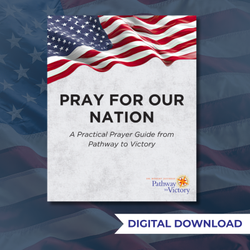
10 Days of Prayer for Our Nation is a devotional resource created to inspire believers to pray for America, its leaders, and future generations. Each day includes Scripture, guided prayer prompts, and encouraging biblical truths that point readers toward God’s faithfulness and promises.
Through this 10-day journey, readers will be reminded that true hope for our nation is found in God. It’s an opportunity to pray with confidence, strengthen personal faith, and seek God’s blessing, wisdom, and direction for the days ahead.
Past Episodes
- Choose Your Attitudes, Change Your Life
- Choosing The Extraordinary Life
- Christmas
- Christmas 2016 Message
- Christmas 2017 Message
- Christmas 2018 Message
- Christmas 2019 Message
- Christmas 2020 Message
- Colossians: Growing Stronger in Christ
- Coming Home to the Father Who Loves You
- Countdown to the Apocalypse
- Courageous : 10 Strategies For Thriving in a Hostile World
- Courageous Living in a Pagan World
- Daniel: Courageous Living In A Pagan World
- Discovering and Using Your Spiritual Gift
- Discovering God's Will
- Divine Defense
- Easter 2013 Sermon
- Easter 2015 Sermon
- Easter 2017 Sermon
- Easter 2018 Message
- Easter 2019 Message
- Easter 2020 message
- Easter 2021 Message
- Experiencing Your New Beginning
- God's Top Ten
- Grace Gone Wild
- Grace Gone Wild: Getting A Grip On God's Amazing Gift
- Grace-Powered Living
- Grace-Powered Living: A Study of Romans 1-4 | Our need — God’s Provision
- Growing Stronger in Christ
- Heaven Can't Wait!
- How Can I Know? Answers to Life's 7 Most Important Questions
- How to Make Wise Decisions
- Leading Your Family from Good to Great
- Living Above Your Circumstances
- Living By Faith: A Study of the Life of Abraham
- Living Without Regrets
- Living Your Dreams: A Study of Nehemiah
- Luke: Developing Your Passion for Christ
- Luke: Reigniting Your Passion for Christ
- Palm Sunday 2017 Message
- Pathway Partners
- Perfect Ending
- Politically Incorrect
- Prayers That Really Work
- Pressing On to Maturity: A Study of Hebrews
- PTV Listener Favorites
- Searching For the Good Life
- Second Chance, Second Act
- Single Messages
- Special Post 2020 Election Message
- Special Programming
- Spiritual Fitness: Strengthening Your Faith in Troubled Times
- Standalone
- Straight Answers to Tough Questions
- Thanksgiving Messages
- The Divine Defense
- The Incomparable Christ
- The Parables: Jesus' Favorite Stories
- The Perfect Ending
- The Solomon Secrets
- Twilight's Last Gleaming

Video from Dr. Robert Jeffress
Featured Offer
10 Days of Prayer for Our Nation is a devotional resource created to inspire believers to pray for America, its leaders, and future generations. Each day includes Scripture, guided prayer prompts, and encouraging biblical truths that point readers toward God’s faithfulness and promises.
Through this 10-day journey, readers will be reminded that true hope for our nation is found in God. It’s an opportunity to pray with confidence, strengthen personal faith, and seek God’s blessing, wisdom, and direction for the days ahead.
About Pathway to Victory
On each daily broadcast, Dr. Robert Jeffress provides practical application of God's Word to everyday life through clear, uncompromised Biblical teaching. Join him today on the Pathway to Victory!
About Dr. Robert Jeffress
Dr. Robert Jeffress is Senior Pastor of the 16,000-member First Baptist Church of Dallas, Texas. Dr. Jeffress is a FOX News contributor and appears regularly on FOX News Channel’s FOX & Friends , FOX News @ Night , Hannity , and The Faulkner Focus and on the FOX Business Network. Dr. Jeffress has made more than 4,000 guest appearances on television programs that include HBO’s Real Time with Bill Maher and Trinity Broadcasting Network’s Praise .
Established in 1996, Pathway to Victory serves as the broadcast ministry of Dr. Jeffress and exists to pierce the darkness with the light of God’s Word through the most effective media available. The daily radio programs air on over 1,100 stations, and the daily television program can be seen on over 11,000 cable and satellite systems, including Trinity Broadcasting Network (TBN), where it has been the #1 most-watched program since 2020. Pathway to Victory broadcasts are translated into seven languages and reach 193 countries throughout the world in addition to all major markets in the USA.
Contact Pathway to Victory with Dr. Robert Jeffress
info@ptv.org
https://ptv.org/
Mailing Address
Pathway to Victory
PO Box: 223609
Dallas, TX 75222-3609
Telephone Numbers
Customer Service: 214.969.2400
Toll-Free Radio Offer: 866-999-2965