


Booting Up For Service


The privilege of sharing the Gospel belongs to each one of us. But how do we go about making God’s business our business? And what does it take to share our faith in a way that truly connects with people? Dr. Robert Jeffress outlines four essential components for building a Gospel-centered life.
To support Pathway to Victory, go to ptv.org/donate.
Guest (Male): Hey podcast listeners! Thanks for streaming today's podcast from Pathway to Victory. Pathway to Victory is a nonprofit ministry featuring the Bible teaching of Dr. Robert Jeffress. Our mission is to pierce the darkness with the light of God's word through the most effective media available, like this podcast. To support Pathway to Victory, go to ptv.org/donate or follow the link in our show notes. Now, here's today's podcast from Pathway to Victory.
Dr. Robert Jeffress: Hi, this is Robert Jeffress, and I'm glad to study God's word with you every day on this Bible teaching program. On today's edition of Pathway to Victory.
Guest (Male): Well, Pastor, how do you exactly go about that? How can you make God's purpose, God's business, your business? And that's what we're going to talk about for the few moments we have today. If you're going to reorder your life, if you're truly going to make God's purpose your purpose in life, there are four important components to doing just that.
Guest (Male): Welcome to Pathway to Victory with author and pastor Dr. Robert Jeffress. The privilege of sharing the gospel belongs to each one of us. But how do we go about making God's business our business? And what does it take to share our faith in a way that truly connects with people?
Today on Pathway to Victory, Dr. Robert Jeffress outlines four essential components for building a gospel-centered life. But first, let's take a moment to hear some important ministry updates.
Dr. Robert Jeffress: Thanks, David. And welcome again to Pathway to Victory. We call this program Pathway to Victory because we want to guide you in experiencing the fullness and satisfaction that comes from following God. But in the midst of our day-to-day battles, I think many of us feel a little more like a victim than a victor. And that's exactly how Satan wants us to feel.
But if you put on the full armor of God, Satan doesn't stand a chance. That's the topic of my best-selling book called The Divine Defense. In Ephesians 6, the Apostle Paul outlines six essential pieces of spiritual armor that every Christian must wear for protection. My book will teach you how to use each of these tools effectively. And it's yours when you give a generous gift to support Pathway to Victory.
And then, I want to tell you about something I'm really looking forward to: our Pathway to Victory cruise to Alaska. For seven luxurious days, I'll be sharing one of God's most magnificent creations with people I genuinely enjoy being around, believers like you. We'll depart from beautiful Vancouver and sail through the legendary Inside Passage. It's absolutely breathtaking.
Every morning, you'll wake up refreshed, knowing that all your meals are prepared for you with sumptuous offerings at breakfast, lunch, and dinner. The world-class service means you can truly relax and focus on what matters: connecting with God and building friendships with like-minded Christians. So why not join us? Check out the details and make your reservation at ptv.org.
Guest (Male): Okay, let's get started with today's study. Open your Bibles to Ephesians chapter six for a message I've titled "Booting Up for Service."
Dr. Robert Jeffress: One day, the famed evangelist D.L. Moody was on the streets of Chicago and approached a stranger and said, "Sir, are you a Christian?" The man growled and said, "Mind your own business." Moody replied, "This is my business." D.L. Moody was a shoe salesman by vocation, but he understood his real assignment was sharing the gospel of Jesus Christ with as many people as possible.
You see, the duty, the privilege of sharing the gospel isn't reserved for pastors or evangelists. It's the purpose of every believer in Jesus Christ. And that's what we've seen over the last few weeks. When you make God's business your business, or as Paul said, when you put on the boots of the preparation of the gospel of peace, when you do that, it gives you stability. It gives you direction. It gives you fulfillment in life.
But we've also seen that making God's business your business can be a strong solution to the problem of Satan's attacks in your life. And that's why in Ephesians chapter 6, when Paul gives us the weapons we can use to thwart Satan's plan to destroy our life, he talks about the purpose of our life, the shoes of the gospel.
How does making God's business your business help you defeat Satan's attack to destroy you? Well, it gives us an incentive to choose purity over immorality. It helps us choose generosity over greed. It helps us choose discipline over aimlessness. Well, Pastor, how do you exactly go about that? How can you make God's purpose, God's business, your business?
And that's what we're going to talk about for the few moments we have today. If you're going to reorder your life, if you're truly going to make God's purpose your purpose in life, there are four important components to doing just that. First of all, write this down: you need to have a conviction of other people's need for Christ.
You need to have a conviction of other people's need for Christ. Before you build your whole life around spreading the gospel, before you take the risk and talking to a non-Christian about their need for Jesus, you have to be persuaded, convicted, that apart from Jesus Christ, everyone is destined for an eternity in hell, separated from God.
You know why most people don't share the gospel? Because they're not really convinced of that truth. Deep down, they don't believe there's only one way to escape the flames of hell. A Pew Research poll revealed that 57% of Christians reject the idea that there is only one way to heaven. How do they reconcile that with Jesus' words, John 14:6: "I am the way, the truth, and the life. No man comes to the father but by me"?
Now, think about it. If Jesus was incorrect about that, if he wasn't telling the truth, it's because either he was lying, he knew it wasn't the truth but he said it anyway, or he was confused about eternal life. Either way, if Jesus was lying or if he was simply confused, he can't be the savior of the world. He's disqualified. No, Jesus was telling the truth.
And we will never share the gospel until we are absolutely convinced that for that child sitting across the breakfast table from you in the morning, that mate that you go to bed with and wake up with, that person you work with every day, that apart from faith in Jesus Christ, they are destined for an eternity of suffering and of hell. Unless you're really convinced of that, you will never share the gospel.
You have to have a conviction of people's need for the gospel. Secondly, a gospel-centered life is one that has confidence in God's power to save. There has to be a confidence in God's power to save. When you really are convinced that there's no other way for salvation and that you are sharing a person's only hope, you'll be imbued with a whole kind of new courage and enthusiasm for sharing the gospel.
You'll have the courage of a firefighter who breaks down a front door and goes into a burning building in order to rescue those who are perishing. The fact is, we need to be convinced of God's ability to save somebody if we're going to make the gospel the center of our life. Thirdly, there needs to be a consideration of a person's level of interest.
If we're going to put on these boots of spreading the gospel and we want to be effective in doing it, we need to take consideration of the person's level of interest that we're talking to. You know, a number of evangelical organizations like Evangelism Explosion that do such a great job in training people in evangelism, they are moving from what we used to call confrontational evangelism to relational evangelism.
Now, let me carefully explain the difference because I don't want anybody to misinterpret what I'm saying. Confrontational evangelism is something many of us were trained in. I call it dump truck evangelism. When you find an unsuspecting victim, you dump out all of the information that you have for 20 or 30 minutes. And whatever you do, you're told, don't stop talking. Don't answer questions. Don't get off track. Just give the presentation. Dump truck evangelism.
Paul Little wrote a book entitled How to Give Away Your Faith, and he wrote about the futility of dump truck evangelism. I bet some of you can identify with this. He said, "I wish I'd learned this lesson about communicating with people sooner. About once every six months, the pressure to witness used to reach explosive heights inside me. Not knowing any better, I would suddenly lunge at somebody and spout all my verses with a sort of glazed look in my eye."
"I honestly didn't expect any response. As soon as my victim indicated a lack of interest, I'd begin to edge away from him with a sigh of relief and the consoling thought that all who live godly in Christ Jesus will suffer persecution. Duty done, I'd draw back into my martyr shell for another six months' hibernation until the internal pressure became intolerable and drove me out."
"It really shocked me when I finally realized that I, not the cross of Jesus, was what was offending people. My inept, unwittingly rude, even stupid approach to them was responsible for their rejection of me and the gospel message." That's what I mean. Instead of confrontational evangelism, we need to be involved in relational evangelism.
What is relational evangelism? It's evangelism that seeks not just to engage in presentation, but communication. You know, there's a difference between presentation and communication. You can be talking, but nobody can be listening at the same time. Instead, Michael Simpson says in his book Permission Evangelism, we ought to adopt the best tactics of a good salesman.
A good salesman carefully crafts every communication to ensure that there's another communication later. I was talking with several people about this this week, and they rightly pointed out there are sometimes you need confrontational evangelism. There are sometimes there's not going to be a second conversation.
I've had experiences like that on an airport, talking to somebody, realize I'd never see this person again. I tried not to dump it on them, but I gave them my best, everything I had to say about the gospel. I've been sitting at the deathbed of somebody who was about to go into eternity. It was my last chance to talk to them. I shared everything I could about the gospel.
But most of the people we interact with, our friends, our family members, our co-workers, we're going to see them over and over again. And if we really want to communicate the gospel, we'll take into consideration their level of interest. By the way, when we talk about relationship evangelism, we're not talking about just sitting down and having coffee with people an endless number of times without ever sharing the gospel.
We're not talking about having somebody become a Christian because of the life you lived and being such a good example. You know what? You and I can't be good enough to lead somebody to Christ. They need to hear the gospel. You know, there's this quote that goes around that's attributed to Saint Francis of Assisi. I don't think Saint Francis ever really said it, but it's these words you've heard before: "Preach the gospel. If necessary, use words."
Have you ever heard that before? Ladies and gentlemen, it's always necessary to use words. Nobody becomes a Christian without the word of God. Romans 10:17 says faith comes by hearing and hearing the word of God. It's the word of God, the Bible says, implanted that is able to save your soul. Make sure that when you share the gospel, though, you're communicating. You have a chance to answer questions. You're not trying to dump on them a presentation.
And then fourthly, if you're going to be gospel-centered, there has to be a comprehension of the message. This is the most important thing I could say today. If we're going to be effective communicators of the gospel, we've got to know what the message is. You know, Paul compares us to soldiers, Christian soldiers, but he uses another metaphor to describe our assignment.
It's found in 2nd Corinthians 5, verse 20: "Therefore, we are ambassadors for Christ, as though God were making an appeal through us. We beg you on behalf of Christ, be reconciled to God." Now, in Paul's day, an ambassador had the job of representing the king or the emperor's message to whomever the ambassador was talking. Today, we still have ambassadors, don't we?
The ambassador's job is not to formulate policy, but to represent the policy of the government, or in our case, the president. Mike Huckabee is a great friend of mine and of this church, and he is our ambassador to Israel. And before Mike left for Israel, we had a great talk together. But you know, during our talk, never once did he say, "Oh, Robert, pray for me that I can solve this mess in Gaza."
He never said, "Pray for me that we'll know how to deal with Hamas. Pray for me that I'll have wisdom in what I tell the Israelis they can do and they can't do." He never asked me to do that. Why? He knows his job is not to formulate Middle Eastern policy. If he tried to formulate policy, he knows he'd be on the next plane back to the United States, discharged from his service.
His job is to represent the president's policy to the nation of Israel. And that is our job as well. We are God's ambassadors. Our job is not to formulate the gospel message. We're not to talk about what we wish Jesus had said instead of what he actually said. It's not our job to come up with a plan of salvation. Our job as an ambassador is to represent clearly and faithfully the message of the King of Kings.
We have to understand what the message is. Now, in these last remaining moments, I'm going to help you understand the message. I'm going to give you the outline of a gospel presentation you can use to share with your children, your grandchildren, family members, friends, or anybody you come in contact with who is interested in knowing Christ as savior.
And you'll notice there are four essentials to God's message of salvation. And with each of those points, I'm giving you a scripture verse because in the end, it's God's word, not my word, that saves somebody. We need to use God's word as our authority. But each outline point also has an illustration. We need to use illustrations. Jesus used them. The Bible used them to help bring light to truth that seems abstract sometimes.
What do we need to know to articulate the gospel? First of all, everyone has sinned. Romans 3:23 says, "For all have sinned and fallen short of the glory of God." What is sin? It's disobedience to God's rules, God's laws. And the Bible says we have all sinned. We've all fallen short. Now, some people have fallen more short than others. Some people are bigger sinners than others. But in the end, it really doesn't matter, does it?
We've all sinned. And I use this illustration with somebody. I would say, imagine three people are standing on the beach in Malibu. And in a moment of insanity, they decide to swim to Hawaii. So they jump into the waters and they begin swimming. One person makes it 50 yards, and he sinks. He drowns. The second person is able to go further. He's able to go 500 yards, and then he sinks.
The third person keeps going and going and going, 2,554 miles. He's within one mile when he sees the shores of Waikiki, and then he sinks and dies. Now, the question is, who made it to Hawaii? The second person swam further than the first one. The third one did better than the second one. But none of them made it, so does it really matter? In the same way, we all have fallen short. Some have fallen more short than others, but that's not the issue.
We've all come short of the glory of God. Everyone has sinned. Secondly, we deserve to be punished for our sins. Romans 6:23 says the wages, the payment of our sin is death. A wage is something you earn, you deserve. And the Bible says because of our sin, we have earned eternal death. Not just physical death, but the death the Bible talks about as an eternal separation from God.
We all deserve to be punished by God. When you steal something, you may suffer incarceration. When you kill somebody, you may suffer the electric chair. But the punishment we deserve is much worse than any of that. We deserve to be eternally separated from God. The third point is this: Christ has died for our sin. That's the heart of the gospel.
Romans 5:8: "But God demonstrated his love toward us in that while we were yet sinners, he sent Christ to die for us." Jesus willingly took the punishment for our sin. When he died on the cross, he wasn't paying for his sins, but for our sin. And sometimes I'll use this illustration. A teenage girl was arrested for speeding. She was brought before the court. The judge fined her $200. She didn't have the $200 and was about to be hauled off to jail for 30 days.
The judge did something very unusual. He stood up, he took off his judicial robe, he came down, reached into his wallet, took the $200 out, and paid the bailiff himself. Now, why would he do that? Because the man not only was the judge, he happened to be the girl's father. Now, that's exactly what God has done for us. The Bible says God is both the just and the justifier.
God is just means he cannot overlook sin. Exodus 34:7 says, "I cannot leave the guilty unpunished." Habakkuk the prophet said God's eyes are too pure to look at evil. God's holy nature demands that somebody has to pay for our sin. But the good news of the gospel is God in heaven, even though he was God, he took off his heavenly robe and he came to earth in the form of Jesus Christ. And he made the payment for our sin.
Christ died for our sins. Fourth, and this is so important: we must receive God's gift of forgiveness. When somebody says to you, "Well, if Christ died on the cross for my sins, that's all I need to do, right? He did it. He's taken care of it. Why isn't everybody saved if Jesus died for everybody?" Here's the simple reason: a gift is not a gift unless it's personally received.
John 1:12 says as many as received Jesus, to those he gave the power to become the children of God, even to those who believe on his name. Sometimes I use this illustration. A few years ago, Oprah Winfrey had a television program in which at the end of the program, she had 250 members in the studio audience. She gave each one of them a brand-new automobile.
I mean, imagine their surprise. They came to watch a TV show, they ended up with a new car. They were ecstatic until they discovered they had to pay income tax on it. The average tax bill was $7,500 for each audience member. But you know, the IRS understands this truth: that unless you receive a gift, it's not a gift. A gift has to be received to be a gift.
There're some audience members that refused the gift. It's only those who accepted the gift who received the gift. And the same is true with salvation. There has to be a time that we acknowledge to God our desire to receive salvation in order to be saved. You know, there are a lot of things I love about being the pastor of First Baptist Church Dallas. I love preaching. I love meeting with our staff. I love strategizing about the future.
But none of those things compares to the joy that comes from being an instrument God uses to lead people from spiritual death to spiritual life. There is no joy like seeing somebody come to faith in Jesus Christ. And folks, that's not a joy that's reserved for pastors. That is a joy God wants every one of us to experience. To make God's business, God's purpose, your business.
J. Campbell White has said it beautifully: "Most people are not satisfied with the permanent output of their lives. Nothing can wholly satisfy the life of Christ within his followers except the adoption of God's purpose toward the world he came to redeem. Fame, pleasure, and riches are but husks and ashes in contrast with the boundless and abiding joy of working with God for the fulfillment of his eternal plans."
"The people who are putting everything into Christ's undertakings are getting out of it life's sweetest and most priceless reward." Today, God is not only commanding you, he is inviting you to experience that joy, that satisfaction that comes from making God's business your business.
I can promise you, on the authority of the Bible, when we make God's purpose our purpose, we will taste the sweetest reward in all of life. Well, we're approaching the end of our teaching series called The Divine Defense. And you still have time to request the materials I prepared for you. The first is my best-selling book titled The Divine Defense.
In my book, I'll describe how you can arm yourself against Satan's attacks and experience real spiritual victory. And a copy is yours when you give a generous gift to support the ministry of Pathway to Victory. In addition, we'll also include a quick reference tool that reminds you of the power God has given you to win any battle you face. It's called Equipped for Battle.
This exclusive brochure folds out into six colorful panels that clearly describe each item in the armor of God, using illustrations and strategies for winning the battle. And may I add, thanks so much for investing in this global ministry with your generosity. Your gifts are truly making a difference as we prepare men and women all around the world for spiritual battle. Look, I don't need to convince you that the world seems to be spinning out of control.
But cultural wars are not won in the political realm. We're fighting spiritual battles. So now's the time to declare that Jesus Christ is our only hope. Your gift will make all the difference. So thanks for responding today. Here's David with all the details.
Guest (Male): Today, when you support the ministry of Pathway to Victory by giving a generous gift, we'll say thanks by sending you The Divine Defense. That's Dr. Jeffress's best-selling book on spiritual warfare. You'll get that along with the Equipped for Battle brochure. 866-999-2965 is the number to call, or visit online at ptv.org. You can also support this ministry by texting PTV to 78800.
And when your gift is $100 or more, you're also going to get the new Divine Defense teaching series on audio and video disc, the companion study guide, and the children's book called Suit Up for Kids. This book is a fun, interactive way to teach kids how to put on the armor of God and stand strong against the enemy. To request the complete package of resources, call 866-999-2965 or visit ptv.org.
You could write to P.O. Box 223609, Dallas, Texas, 75222. Again, that's P.O. Box 223609, Dallas, Texas, 75222. I'm David J. Mullins. As Christians, are we called to just survive or to go on the offensive? Find out when you join us Tuesday for Pathway to Victory. Pathway to Victory with Dr. Robert Jeffress comes from the pulpit of the First Baptist Church of Dallas, Texas.
Dr. Robert Jeffress: You made it to the end of today's podcast from Pathway to Victory, and we're so glad you're here. Pathway to Victory relies on the generosity of loyal listeners like you to make this podcast possible. One of the most impactful ways you can give is by becoming a Pathway Partner. Your monthly gift will empower Pathway to Victory to share the gospel of Jesus Christ and help others become rooted more firmly in his word.
To become a Pathway Partner, go to ptv.org/donate, or you can follow the link in our show notes. We hope you've been blessed by today's podcast from Pathway to Victory. Oh, and one last thing before we go. Have you reserved your spot yet for the 2026 Pathway to Victory cruise to Alaska? You've been hearing me and Dr. Jeffress mention it, so what are you waiting for?
Just picture yourself on the deck of Holland America's elegant Koningsdam and stepping out on deck to witness nature's grandeur. It's beautiful. These moments in God's creation will deepen your faith in powerful ways. It really will. Experience five-star dining, luxurious staterooms, and visiting iconic ports like Juneau, Ketchikan, and Skagway.
We're also bringing along our own Christian entertainment. You'll love it. Seats are filling up, so book your spot today at ptv.org.
Featured Offer
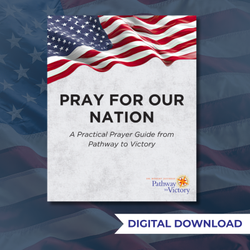
10 Days of Prayer for Our Nation is a devotional resource created to inspire believers to pray for America, its leaders, and future generations. Each day includes Scripture, guided prayer prompts, and encouraging biblical truths that point readers toward God’s faithfulness and promises.
Through this 10-day journey, readers will be reminded that true hope for our nation is found in God. It’s an opportunity to pray with confidence, strengthen personal faith, and seek God’s blessing, wisdom, and direction for the days ahead.
Past Episodes
- Choose Your Attitudes, Change Your Life
- Choosing The Extraordinary Life
- Christmas
- Christmas 2016 Message
- Christmas 2017 Message
- Christmas 2018 Message
- Christmas 2019 Message
- Christmas 2020 Message
- Colossians: Growing Stronger in Christ
- Coming Home to the Father Who Loves You
- Countdown to the Apocalypse
- Courageous : 10 Strategies For Thriving in a Hostile World
- Courageous Living in a Pagan World
- Daniel: Courageous Living In A Pagan World
- Discovering and Using Your Spiritual Gift
- Discovering God's Will
- Divine Defense
- Easter 2013 Sermon
- Easter 2015 Sermon
- Easter 2017 Sermon
- Easter 2018 Message
- Easter 2019 Message
- Easter 2020 message
- Easter 2021 Message
- Experiencing Your New Beginning
- God's Top Ten
- Grace Gone Wild
- Grace Gone Wild: Getting A Grip On God's Amazing Gift
- Grace-Powered Living
- Grace-Powered Living: A Study of Romans 1-4 | Our need — God’s Provision
- Growing Stronger in Christ
- Heaven Can't Wait!
- How Can I Know? Answers to Life's 7 Most Important Questions
- How to Make Wise Decisions
- Leading Your Family from Good to Great
- Living Above Your Circumstances
- Living By Faith: A Study of the Life of Abraham
- Living Without Regrets
- Living Your Dreams: A Study of Nehemiah
- Luke: Developing Your Passion for Christ
- Luke: Reigniting Your Passion for Christ
- Palm Sunday 2017 Message
- Pathway Partners
- Perfect Ending
- Politically Incorrect
- Prayers That Really Work
- Pressing On to Maturity: A Study of Hebrews
- PTV Listener Favorites
- Searching For the Good Life
- Second Chance, Second Act
- Single Messages
- Special Post 2020 Election Message
- Special Programming
- Spiritual Fitness: Strengthening Your Faith in Troubled Times
- Standalone
- Straight Answers to Tough Questions
- Thanksgiving Messages
- The Divine Defense
- The Incomparable Christ
- The Parables: Jesus' Favorite Stories
- The Perfect Ending
- The Solomon Secrets
- Twilight's Last Gleaming

Video from Dr. Robert Jeffress
Featured Offer
10 Days of Prayer for Our Nation is a devotional resource created to inspire believers to pray for America, its leaders, and future generations. Each day includes Scripture, guided prayer prompts, and encouraging biblical truths that point readers toward God’s faithfulness and promises.
Through this 10-day journey, readers will be reminded that true hope for our nation is found in God. It’s an opportunity to pray with confidence, strengthen personal faith, and seek God’s blessing, wisdom, and direction for the days ahead.
About Pathway to Victory
On each daily broadcast, Dr. Robert Jeffress provides practical application of God's Word to everyday life through clear, uncompromised Biblical teaching. Join him today on the Pathway to Victory!
About Dr. Robert Jeffress
Dr. Robert Jeffress is Senior Pastor of the 16,000-member First Baptist Church of Dallas, Texas. Dr. Jeffress is a FOX News contributor and appears regularly on FOX News Channel’s FOX & Friends , FOX News @ Night , Hannity , and The Faulkner Focus and on the FOX Business Network. Dr. Jeffress has made more than 4,000 guest appearances on television programs that include HBO’s Real Time with Bill Maher and Trinity Broadcasting Network’s Praise .
Established in 1996, Pathway to Victory serves as the broadcast ministry of Dr. Jeffress and exists to pierce the darkness with the light of God’s Word through the most effective media available. The daily radio programs air on over 1,100 stations, and the daily television program can be seen on over 11,000 cable and satellite systems, including Trinity Broadcasting Network (TBN), where it has been the #1 most-watched program since 2020. Pathway to Victory broadcasts are translated into seven languages and reach 193 countries throughout the world in addition to all major markets in the USA.
Contact Pathway to Victory with Dr. Robert Jeffress
info@ptv.org
https://ptv.org/
Mailing Address
Pathway to Victory
PO Box: 223609
Dallas, TX 75222-3609
Telephone Numbers
Customer Service: 214.969.2400
Toll-Free Radio Offer: 866-999-2965