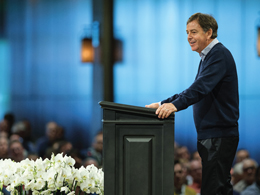
Of all the responsibilities of ministry none is more important than the continuing labor in God's Word. That's why our yearly pastors' conference always places such strong emphasis on the Scriptures. We really believe that the Word is the way. Considering how many ministry models are now put forward, it is important to bear in mind what Jesus said, "Heaven and earth will pass away, but my words will never pass away." Basic 2007 focuses on the weighty responsibility, spiritual energy, exacting demands and increasing joy of ministry shaped by ironclad commitment to careful study and clear communication of the Bible. "I charge you in the presence of God and of Christ Jesus who is to judge the living and the dead, and by his appearing and his kingdom: preach the word, be urgent in season and out of season, convince, rebuke, and exhort, be unfailing in patience and teaching." Taking seriously this charge from the Apostle Paul, Basics 2007 is intended to stir our hearts and renew our minds, that we may proclaim Christ with greater conviction and clarity.
Theological questions surround our lives, whether we are conscious of it or not. For some, the questions are as simple as, “Is there a God?” and “How can I be assured He exists?” For others, the considerations may probe deeper, and center upon conversations such as, “What is God’s true nature?” and “How sovereign is God over my life?” Any dialogue or introspective contemplation about God is, by definition, theology, whether the person is a child or a PHD in philosophy. According to author and college professor Kelly Kapic, “Theology is not reserved for those in the academy, it is an aspect of thought and conversation for all who live and breathe, who wrestle and fear, who hope and pray.” In his book, A Little Book for New Theologians, Kelly Kapic provides a clear, straightforward way to distinguish between the academic study of God’s Word and the assimilation of God’s Word into daily life.